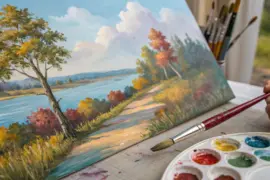
Working with acrylic paint can be incredibly rewarding, but even experienced painters fall into common traps that compromise their finished work. Understanding these pitfalls and how to navigate them will transform your painting experience from frustrating to fulfilling.
Mistake #1: Drowning Your Paint in Water

Acrylic paint is water-based, which makes it tempting to reach for water whenever the consistency feels off. The problem lies in the chemistry of the paint itself. Acrylics consist of three essential components: pigment for color, acrylic polymer for binding, and water as the carrier medium. When you add excessive water, you’re diluting the polymer binder that holds everything together and adheres it to your surface.
Beyond a 50% water-to-paint ratio, you’re entering risky territory. Push that to 70% or higher, and the paint loses its adhesive properties entirely. The result? Weak, chalky colors that may flake off months or years later, particularly in high-humidity environments or areas with temperature fluctuations.
The Professional Approach
Instead of water, invest in purpose-designed acrylic mediums. Glazing medium creates transparent layers without sacrificing structural integrity. Slow-drying medium extends working time while maintaining the paint’s binding strength. These mediums are essentially colorless paint, containing the same polymer binder that gives acrylics their durability.
For situations where you genuinely need high dilution (perhaps for watercolor-like washes), mix one part acrylic medium with ten parts water first, then add this mixture to your paint. This ensures adequate binder remains in even the thinnest applications.
When working on your initial blocking-in stage, a slightly thinner consistency helps the paint glide across dry canvas. In this case, dampen your brush rather than thinning the paint directly. Dip the brush in water, wipe the excess on the rim of your water container, then load your paint. This gives you better control than pre-mixing water into the paint on your palette.
| Application Type | Paint-to-Water Ratio | Best For |
|---|---|---|
| Thick impasto layers | 100% paint, no water | Textured effects, palette knife work |
| Standard application | 80% paint, 20% water | Most painting techniques |
| Thin glazes | 50% paint, 50% medium | Transparent layers, color adjustments |
| Wash effects | Paint + (1:10 medium-to-water blend) | Watercolor-like effects, staining |
Mistake #2: Fighting the Clock Instead of Managing It

Acrylic paint dries through evaporation, which means your working environment directly affects your working time. On a dry winter day with the heat running, paint can become unworkable within minutes. Conversely, humid summer conditions might grant you twenty minutes or more. I learned this the hard way during a particularly ambitious cloudscape, where my carefully mixed sky colors dried on the palette before I could blend them properly.
The rapid drying time is both acrylic’s greatest strength and its most challenging characteristic. It allows for quick layering and fast completion times, but it demands strategy rather than hoping for the best.
Creating a Controlled Environment
The stay-wet palette revolutionizes acrylic painting. These palettes use a layer of absorbent material (typically a sponge or stacked paper towels) saturated with water, covered by a semi-permeable membrane (parchment paper works excellently). Your paint sits on this membrane, drawing moisture from below while remaining separate from direct water contact.
You can construct a functional stay-wet palette in five minutes. Take a shallow plastic container with a lid, layer several paper towels on the bottom, saturate them thoroughly with water, and lay a sheet of parchment paper over the top. Squeeze your paints onto the parchment. When you finish painting, close the lid. Your paints will remain workable for days, sometimes even a week.
For the paint already on your canvas, keep a fine-mist spray bottle filled with clean water nearby. A light spritz over your working area every few minutes keeps the surface damp enough for continued blending without over-saturating the paint film.
Retarding medium offers another solution, though it requires careful handling. This additive contains glycol compounds that slow water evaporation dramatically. However, use no more than 25% retarder in your paint mixture. Exceeding this ratio can prevent proper curing, leaving your paint surface gummy indefinitely.
The strategic approach involves putting out larger amounts of paint than you think you’ll need. Beginners tend to squeeze out timid amounts that dry immediately. A generous blob—think the size of a quarter for each color—gives you adequate working volume and actually dries more slowly than a tiny dab.
Mistake #3: Ignoring the Transformation from Wet to Dry

Acrylic paint lies to you while it’s wet. The colors you see on your palette and freshly applied to canvas will shift as they cure. Most acrylics dry darker, sometimes significantly so. This happens because the acrylic binder appears milky white when wet but becomes completely transparent as it dries. That milky appearance makes colors look lighter and slightly hazier. Once the water evaporates and the polymer clears, the true pigment color emerges—often noticeably deeper.
Interestingly, some colors behave differently. Certain blacks and very dark pigments can actually dry lighter, creating the opposite problem. Professional-grade paints typically show less dramatic shifts than student-grade formulations, but the shift never disappears entirely.
Compensating for Color Shift
Mix your colors slightly lighter than your target value. This feels counterintuitive at first, particularly when working on portraits or precise color-matching situations. With practice, you’ll develop an instinctive sense of how much adjustment each color needs.
Always test your mixed colors. Keep a scrap piece of canvas or heavyweight paper near your painting surface. Brush a small amount of your mixed color onto this test surface and use a hairdryer on the cool setting to accelerate drying. This 30-second investment prevents the frustration of discovering your carefully mixed sky color dried three shades darker than intended.
Layer-building techniques work to your advantage here. Rather than attempting to achieve final colors in one application, build up to your desired value through multiple thin layers. Each layer dries quickly, allowing you to assess the true color and adjust subsequent layers accordingly. This approach not only manages color shift better but also creates more luminous, professional-looking results.
Professional-grade paints from reputable manufacturers contain higher pigment concentrations and more consistent binder ratios, resulting in more predictable color shifts. When color accuracy matters critically—product illustration work, restoration projects, or commission pieces with specific color requirements—the investment in quality paint pays immediate dividends.
Mistake #4: Skipping the Foundation

Raw canvas, wood panels, or paper might look ready to paint, but unprepared surfaces create a host of problems. Acrylic paint applied directly to raw canvas soaks in unevenly, creating dull, patchy areas where the binder gets absorbed into the fibers. You’ll use three times as much paint trying to achieve even coverage, and the finished piece will lack vibrancy.
Canvas fibers are naturally acidic. Over time, this acidity degrades the acrylic polymer, potentially causing cracking or delamination. Wood panels present similar issues, with tannins and oils from the wood bleeding through your paint layers and causing permanent discoloration.
Proper Surface Preparation
Gesso creates the barrier between your paint and the substrate. Despite its name, acrylic gesso contains no actual gesso (calcium carbonate and animal glue). Modern acrylic gesso is essentially white acrylic paint with added calcium carbonate to increase absorbency and opacity.
Apply your first coat thinned with about 10% water. This helps it penetrate the canvas fibers and create a mechanical bond. Use a wide, inexpensive brush (3-4 inch chip brushes work beautifully) and apply the gesso in parallel strokes across your entire surface. Don’t worry about perfection on this coat; you’re creating a foundation.
Let this dry completely—typically 30 minutes to an hour depending on humidity. Apply a second coat, this time perpendicular to the first. This cross-hatching technique ensures even coverage and prevents visible directional texture. For a third coat (recommended for professional results), return to your original direction.
Some painters prefer a perfectly smooth surface and will lightly sand between coats using 220-grit sandpaper. This removes any brush marks or irregularities. Others appreciate a subtle texture that helps with paint adhesion and creates visual interest. Choose based on your painting style and the effect you’re seeking.
Texture Considerations
| Surface Preparation | Best For | Effect |
|---|---|---|
| 2 coats gesso, unsanded | Expressive, textured work | Visible brush marks, tooth for paint adhesion |
| 3 coats gesso, sanded smooth | Detailed, refined work | Glass-smooth surface, minimal texture |
| 2 coats gesso + texture gel | Abstract, impasto work | Pronounced texture, dimensional effects |
| Toned ground (gesso + color) | Classical painting techniques | Mid-tone starting point, faster coverage |
Mistake #5: Creating Muddy, Lifeless Colors

Color mixing seems straightforward until you end up with a palette full of brownish-gray disappointments. Muddy colors don’t come from poor technique; they result from mixing colors that inadvertently combine all three primary colors. When red, blue, and yellow come together in a mix, they neutralize toward brown, gray, or black.
The culprit is color bias. Every red, blue, and yellow leans toward one of its neighboring colors on the color wheel. Cadmium red leans toward orange (containing a hint of yellow). Alizarin crimson leans toward violet (containing a hint of blue). When you try to mix a vibrant violet using cadmium red and cerulean blue (which leans toward green, containing yellow), you’ve introduced all three primaries into the mix. The result is a dull, muddy purple instead of the rich, jewel-tone violet you envisioned.
Strategic Color Selection
Build your palette with warm and cool versions of each primary color. This gives you six colors total (excluding white and black), yet allows you to mix virtually any hue with either vibrant intensity or subtle, muted tones.
For brilliant, saturated secondary colors, choose primaries that both lean toward your target color. Mixing a vibrant orange requires a red with yellow bias and a yellow with red bias. Conversely, for sophisticated, muted tones, deliberately choose colors that introduce the complementary color.
Understanding this principle transforms color mixing from guesswork into intentional control. You can create exactly the color you need, whether that’s an eye-catching pure hue or a subtle, grayed tone that recedes into the background.
Practical Color Palette Structure
- Warm red (cadmium red, naphthol red) – leans toward orange
- Cool red (quinacridone crimson, alizarin) – leans toward violet
- Warm yellow (cadmium yellow medium, yellow ochre) – leans toward orange
- Cool yellow (lemon yellow, hansa yellow) – leans toward green
- Warm blue (ultramarine blue) – leans toward violet
- Cool blue (cerulean blue, phthalo blue) – leans toward green
- Titanium white – for tints and opacity
- Neutral gray or black (optional) – for value adjustments
Mix colors on your palette by starting with the dominant hue and gradually adding small amounts of the secondary color. It’s far easier to darken or adjust a mix than to lighten or correct an already-muddy combination. Keep your mixing area clean, wiping your palette knife between different color families to avoid cross-contamination.
Building Your Practice
These five mistakes appear in work at every skill level because acrylic paint behaves differently than our intuition expects. Water seems like the obvious solution for thinning, but it undermines paint structure. Fast drying seems like a nuisance, but strategic setup turns it into an advantage. Color shift feels deceptive, but understanding it enables accurate color control. Skipping surface prep saves ten minutes while costing you permanence and vibrancy. Muddy colors feel accidental, but they result from predictable color theory.
Addressing these issues doesn’t require expensive equipment or advanced techniques. A homemade stay-wet palette costs less than five dollars. A jar of acrylic medium lasts for months. Gesso is remarkably inexpensive per canvas. Understanding warm versus cool color bias costs nothing but transforms your results immediately.
The difference between frustrating painting sessions and satisfying ones often comes down to these fundamental practices. Set up your workspace with intention. Prepare your surfaces properly. Choose your materials strategically. These aren’t restrictions on your creativity—they’re the foundation that allows your creative vision to manifest exactly as you imagine it.
https://eu.winsornewton.com/blogs/guides/how-to-clean-acrylic-paint-brushes
Wie viel Wasser kann man problemlos zu einer Acrylfarbe hinzufügen?