
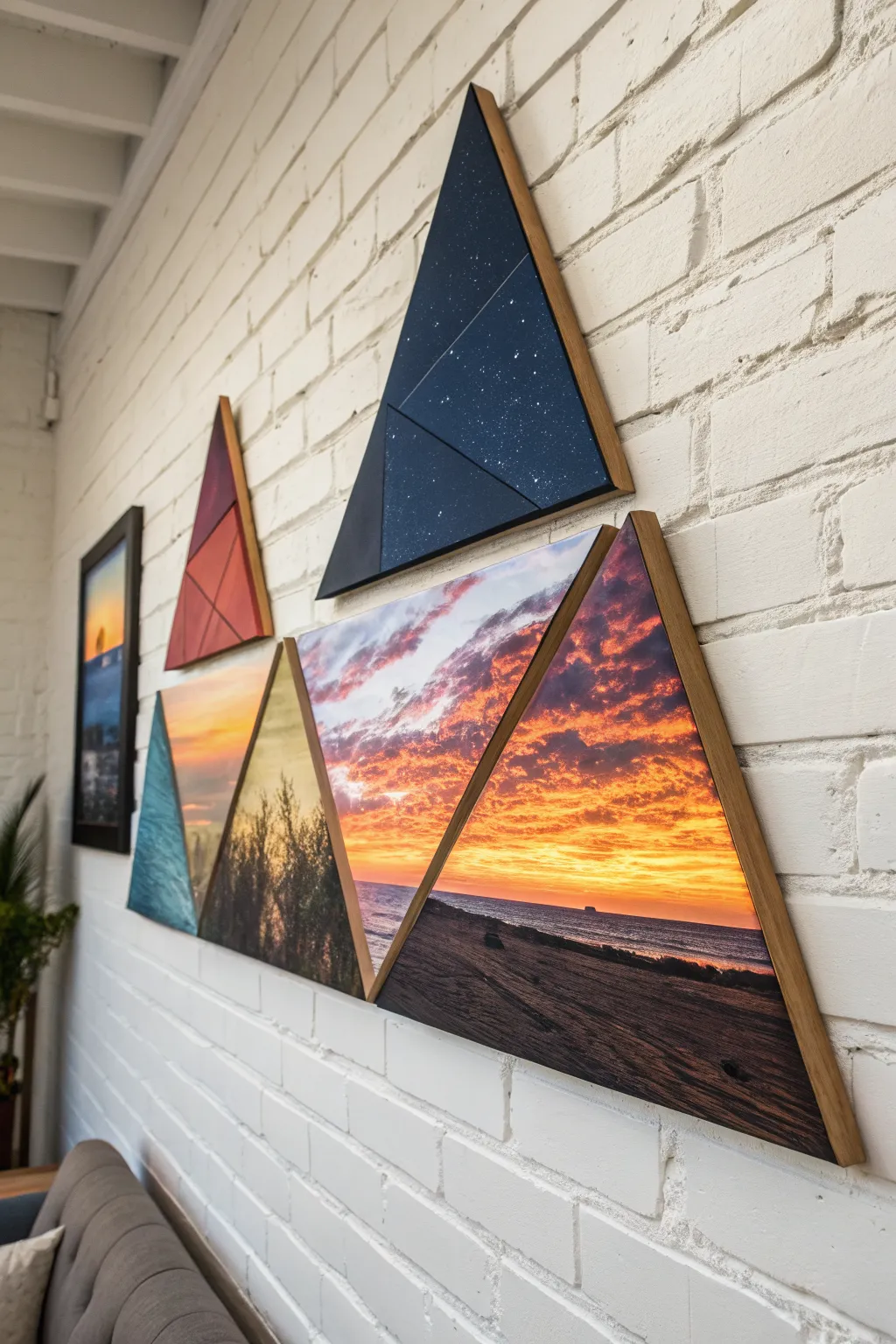
Triangle canvases are such a fun little puzzle—one bold shape that instantly pushes your composition in a fresh direction. Here are my favorite triangle canvas painting ideas that really lean into that pointy peak and wide base, from classic landscapes to artsy, unexpected designs.
Sunset Gradient With a Bold Horizon
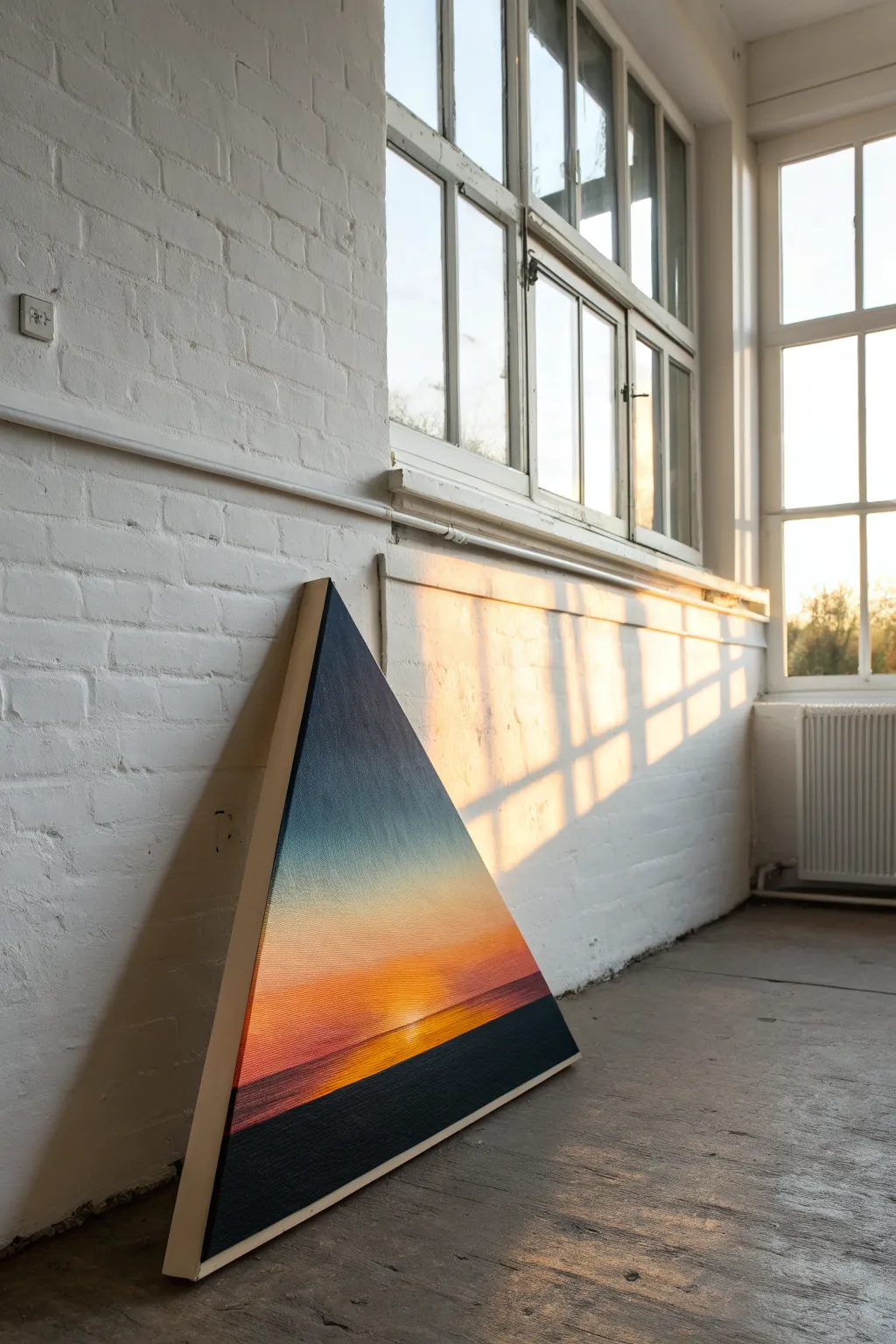
Capture the serenity of a setting sun on a unique triangular canvas that leans casually against your wall. This project blends a smooth, meditative color gradient with sharp geometric lines, creating a modern statement piece that glows with warmth.
Step-by-Step
Materials
- Large triangular stretched canvas
- Acrylic paints (Titanium White, Cadmium Yellow, Cadmium Orange, Burnt Umber, Phthalo Blue, Mars Black)
- Wide flat brush (2-3 inch)
- Medium flat brush (1 inch)
- Small round brush for details
- Palette or mixing plate
- Jar of water
- Paper towels
- Easel or flat work surface
Step 1: Setting the Sky Gradient
-
Establish the horizon line:
Decide where your horizon line will sit. In this painting, it’s quite low, about a quarter of the way up from the bottom edge. Mark this faintly with a pencil or a piece of masking tape if you want a crisp line. -
Mix the darkest sky color:
Create a deep, midnight blue by mixing Phthalo Blue with a touch of Mars Black and a tiny bit of Burnt Umber to warm it. This will be the very top section of your triangle. -
Apply the top layer:
Using your wide flat brush, paint the top third of the canvas with this dark blue mixture. Use horizontal strokes to mimic the sky’s natural banding. -
Transition to teal:
While the dark blue is still wet, mix some white into your blue to create a teal mid-tone. Blend this into the lower edge of the dark section, working your way down the canvas. -
Create the light horizon glow:
Clean your brush thoroughly. Mix Titanium White with a very small amount of Cadmium Yellow and a speck of Orange. Paint this right above your horizon line, blending upward into the teal. -
Blend the sky together:
With a clean, slightly damp brush, gently stroke back and forth across the transition zones between the dark blue, teal, and the light horizon color. I like to keep a soft touch here to ensure the gradient looks seamless and atmospheric.
Step 2: Painting the Sun and Water
-
Paint the sun’s core:
Locate the center point just above the horizon line. Paint a small semi-circle or intense glow using pure Titanium White mixed with a generous amount of Cadmium Yellow. -
Add the sunset flare:
Surround the yellow sun with a band of Cadmium Orange, blending it outwards into the pale horizon sky. This creates that radiating heat effect. -
Block in the water:
Below the horizon line, paint the base of the water using a dark mixture similar to the top of the sky—Mars Black with Phthalo Blue. Cover the bottom area completely. -
Create the reflection path:
While the dark water base is wet, take your medium brush with Cadmium Orange and Yellow. Paint horizontal streaks directly under the sun, getting wider as they move toward the very bottom edge. -
Refine the reflection:
Add a few streaks of pure Orange and even a touch of Red near the horizon line in the water to intensify the reflection. Keep your strokes strictly side-to-side.
Muddy colors?
If your orange and blue mix into a dull grey where they meet, let the blue layer dry completely first. Then, glaze the orange over it gently to keep the colors vibrant.
Step 3: Final Details & Edges
-
Deepen the foreground:
Once the first water layer is tacky, go back over the bottom corners with almost pure Mars Black. This vignetting draws the eye toward the colorful center. -
Sharpen the horizon:
Use your small round brush or the edge of a flat brush to clean up the horizon line. It should be straight and sharp to contrast with the soft sky blending. -
Paint the canvas sides:
Don’t forget the deep edges of the canvas. Continue the colors around the sides—dark blue at the top, orange at the horizon, and black at the bottom—for a professional gallery-wrapped look. -
Final blending check:
Stand back and look for any harsh lines in the sky gradient. If found, use a dry, soft brush to lightly feather them out before the paint cures completely.
Keep it straight
Use a strip of painter’s tape across the horizon line while painting the sky. Remove it to paint the water, ensuring a razor-sharp division between sea and sky.
Now step back and admire how this striking shape transforms a classic sunset into a modern masterpiece.
Moonlit Forest Silhouette at the Base
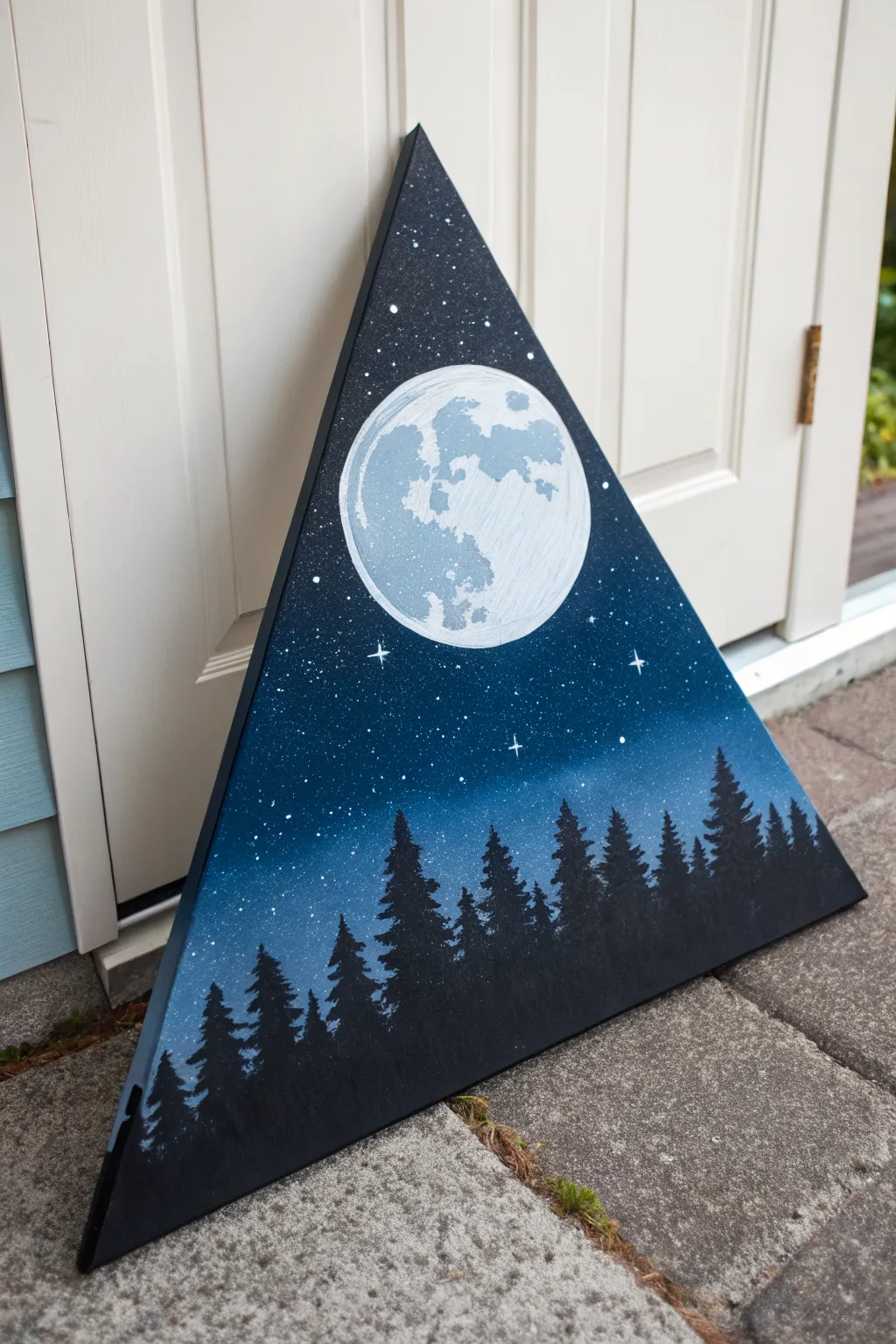
This striking triangle canvas captures the serene mystery of a night forest under a full moon. The project combines a smooth, starry gradient background with crisp black silhouettes, making it a perfect piece for learning blending and detailing techniques.
Detailed Instructions
Materials
- Triangle canvas (approx. 12-16 inches per side)
- Acrylic paints: Black, Phthalo Blue (or Navy), White, Grey
- Large flat brush or sponge brush
- Medium round brush
- Small fine liner brush
- Old toothbrush (for stars)
- Circular object or compass for tracing
- Pencil
- Palette or paper plate
- Water cup and paper towels
Step 1: Setting the Sky
-
Prime the canvas:
If your canvas isn’t pre-primed, apply a coat of gesso. Since we are working with dark colors, you can even tint your gesso grey to help with coverage, though white works perfectly fine. -
Map out the moon:
Before painting the background, decide where your moon will sit. Using a circular object like a masking tape roll or a compass, lightly trace a circle in the upper center of the triangle. This reserves the space so it stays bright white later. -
Mix the night blue:
Create a deep midnight blue by mixing your Phthalo Blue with a touch of black. You want a color that is dark but clearly blue, distinguishable from pure black. -
Paint the upper gradient:
Starting from the very top point of the triangle, apply the deep midnight blue mixture. Paint around the outside of your pencil circle carefully. -
Transition to lighter blue:
As you move down the canvas toward the bottom third, gradually mix a tiny bit of white into your blue on the palette. Blend this lighter blue into the dark section while the paint is still wet to create a soft Ombré effect. -
Create the horizon glow:
Near the bottom edge, where the trees will eventually stand, blend in a slightly lighter, hazier blue-grey. This atmospheric perspective will make the black trees pop. -
Darken the edges (Optional):
To add depth, I like to gently brush pure black along the very top tip and the side edges of the canvas, blending it inward just a half-inch to frame the sky.
Pro Tip: Glowing Moon
Before painting the white moon, lightly dry-brush a faint halo of light blue around the traced circle. This creates a glowing atmosphere.
Step 2: The Moon and Stars
-
Fill the moon base:
Once the blue background is dry to the touch, fill in your traced circle with solid titanium white. You may need two coats to fully cover the texture of the canvas. -
Add moon texture:
Mix a very light grey. Using a fairly dry brush or a small sponge, dab irregular patches onto the white moon to represent craters and maria. Keep the texture concentrated on one side or the center, leaving the edges bright. -
Refine the rim:
Use a liner brush and pure white to sharpen the outer edge of the moon, ensuring it looks essentially perfectly round against the dark sky. -
Splatter the stars:
Dilute a small amount of white paint with water until it’s ink-like. Dip an old toothbrush into it, face the bristles toward the canvas, and run your thumb across them to spray fine mist over the blue sky area. Avoid the moon if possible, or wipe it off quickly. -
Paint hero stars:
Using your finest liner brush, hand-paint a few larger stars by making tiny dots. Create a few ‘twinkle’ stars by painting a small cross with a longer vertical line.
Troubleshooting: Blobs
If your star splatter creates large accident blobs, turn them into distant planets or larger stars by dotting the center with white once dry.
Step 3: The Forest Silhouette
-
Paint the base ground:
Load a flat brush with pure black acrylic. Paint a solid strip along the very bottom edge of the triangle to establish the ground. -
Establish tree center lines:
Using a small round brush, paint vertical lines of varying heights rising from the ground. These will be the trunks of your pine trees. Make sure they vary in height to look natural. -
Stipple the foliage:
Switch to a small, slightly worn brush or a fan brush turned vertically. Starting at the top of a trunk line, dab paint in a zigzag motion, widening the strokes as you move down the tree. -
Layer the forest:
For a dense forest look, paint the tallest trees first. Then fill the gaps between them with shorter, smaller tree tops. This creates a sense of a thick treeline. -
Detail the tips:
Use your finest liner brush to pull out tiny, sharp points at the very top of each tree and on the ends of the branches. Pine trees are spiky, not fluffy. -
Connect the bottom:
Ensure the bottom of the trees blends seamlessly into the black ground strip you painted earlier. The bottom area should be solid black with no sky showing through. -
Paint the canvas sides:
Don’t forget the deep edges of the canvas. Continue the black ground and the dark blue sky around the sides of the triangle frame for a professional finish.
Let the canvas dry completely before hanging it to bring a touch of wilderness to your wall
Galaxy Sky That Pulls Your Eye Up
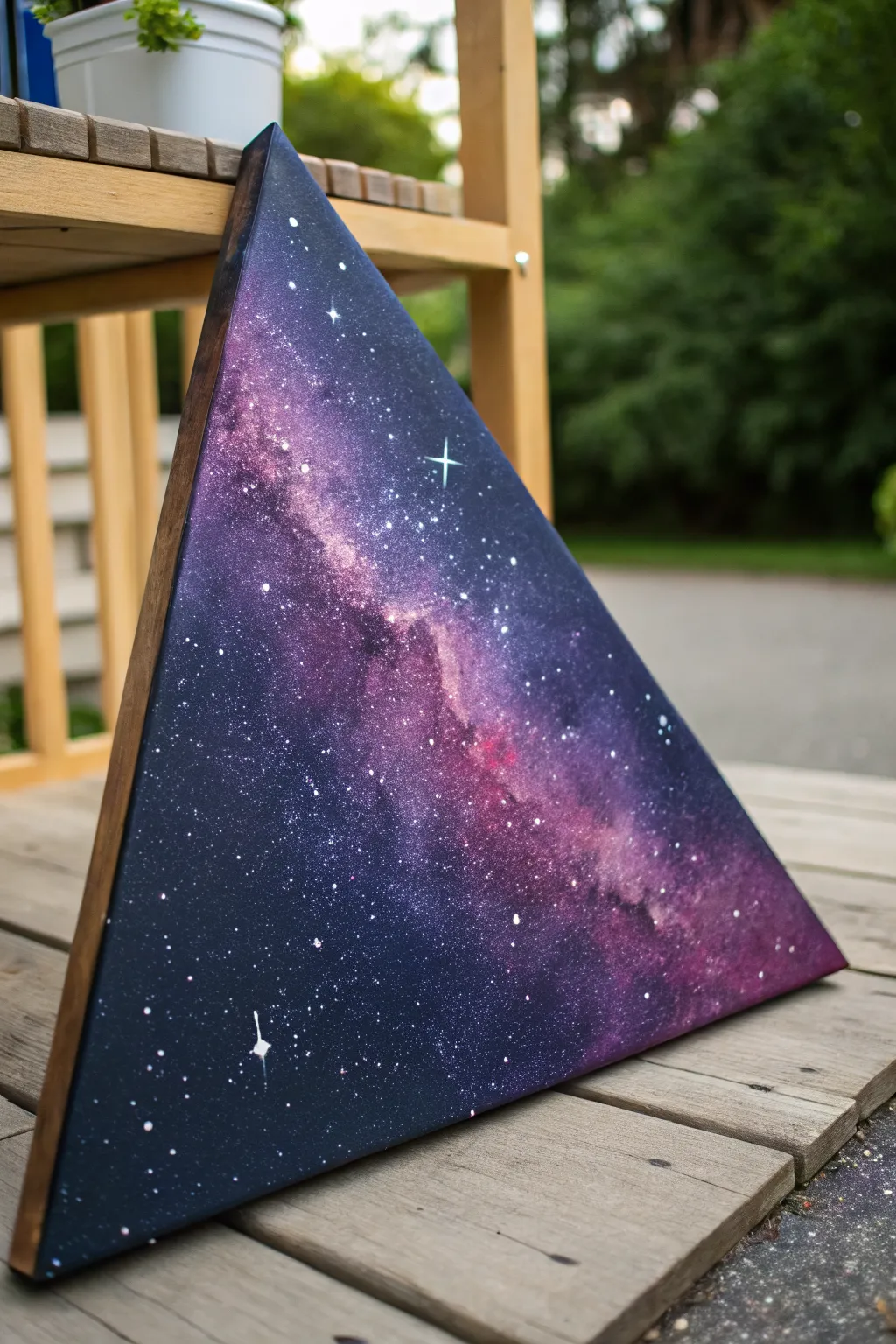
This stunning triangular canvas captures the vast beauty of the cosmos with deep violets, nebulous pinks, and sparking stars. It’s a perfect project for breaking out of the standard rectangular frame and adding a geometric twist to your space décor.
Step-by-Step
Materials
- Triangle-shaped stretched canvas
- Acrylic paints (black, phthalocyanine blue, dioxazine purple, magenta, white)
- Medium flat brush
- Small round brush
- Old toothbrush or stiffness bristle brush
- Sponge or sea sponge (optional but helpful)
- Palette or paper plate
- Cup of water and paper towels
Step 1: Setting the Background
-
Prepare your colors:
Squeeze out generous amounts of black, deep blue, and purple onto your palette. You’ll want these accessible for wet-on-wet blending. -
Establish the dark edges:
Using your flat brush, paint the three corners and the very edges of the triangle with pure black. This creates a vignette effect that draws the eye toward the center. -
Blend in the deep blues:
While the black is still wet, mix a bit of deep blue into it and paint inwards from the black edges. Use crisscross strokes to blur the line where the colors meet so there are no harsh transitions. -
Add the purple mid-tones:
Continue moving toward the center, blending purple into the blue. Leave a diagonal channel roughly through the middle of the triangle unpainted or very lightly painted for now; this is where your nebula will go.
Star Spatter Control
If you accidentally spatter a giant blob of white paint, don’t panic. Let it dry completely, then paint over it with black or purple to turn it back into empty space.
Step 2: Creating the Nebula
-
Lay down the magenta base:
In that central diagonal channel you left open, sponge or brush on your magenta paint. Allow it to overlap slightly with the surrounding dark purple to create a seamless glow. -
Highlight the core:
Mix a little white with your magenta to create a bright pink. Apply this sparingly to the very center of your nebula streak to make it look like light is bursting forth. -
Softening the clouds:
I like to use a clean, dry sponge or a dry brush to softy dab the edges of the pink nebula. This ‘mists’ the paint into the dark purple background, making it look like gas clouds rather than a painted stripe. -
Adding depth with darks:
If your nebula looks too flat, take a tiny bit of black on a small brush and dab random, organic shapes into the pink areas. These represent dust clouds blocking the light.
Nebula Intensity
For a brighter nebula, verify your paint opacity. If your magenta is too transparent, paint a layer of white first, let it dry, and then glaze the magenta over it for a vibrant pop.
Step 3: The Starry Field
-
Mix your star spatter:
Thicken some white paint with a few drops of water until it has the consistency of heavy cream or ink. It needs to flow easily from bristles. -
Test the spatter:
Dip an old toothbrush or stiff brush into the thinned white paint. Test it on a scrap piece of paper by flicking the bristles with your thumb to ensure you get fine mist rather than giant globs. -
Create distant stars:
Hold the brush about 6-8 inches from the canvas and flick the bristles to create a spray of tiny white dots across the entire surface. Focus slightly heavier concentrations near the bright nebula. -
Add larger stars:
Use a small round brush or the handle end of a paintbrush to manually dot a few larger stars here and there. Vary the sizes to create a sense of distance. -
Paint the hero stars:
Choose two or three spots for major distinct stars. Paint a small white dot, then carefully drag four thin lines outward from the center (up, down, left, right) to create a twinkling cross shape. -
Add a glow effect:
For the hero stars, you can dry-brush a very faint, tiny circle of white or pale blue around the center point to make them look like they are glowing intensely. -
Final assessment:
Step back and look at the composition. If the nebula needs to be brighter, carefully glaze a thin layer of white over the pinkest parts once dry. -
Paint the canvas edges:
Don’t forget the sides of the canvas canvas! Paint the thick edges black or dark purple so the artwork looks finished from every angle when hung on the wall.
Now you have a piece of cut-out universe ready to display on your shelf or wall
Aurora Streaks Pointing to the Apex
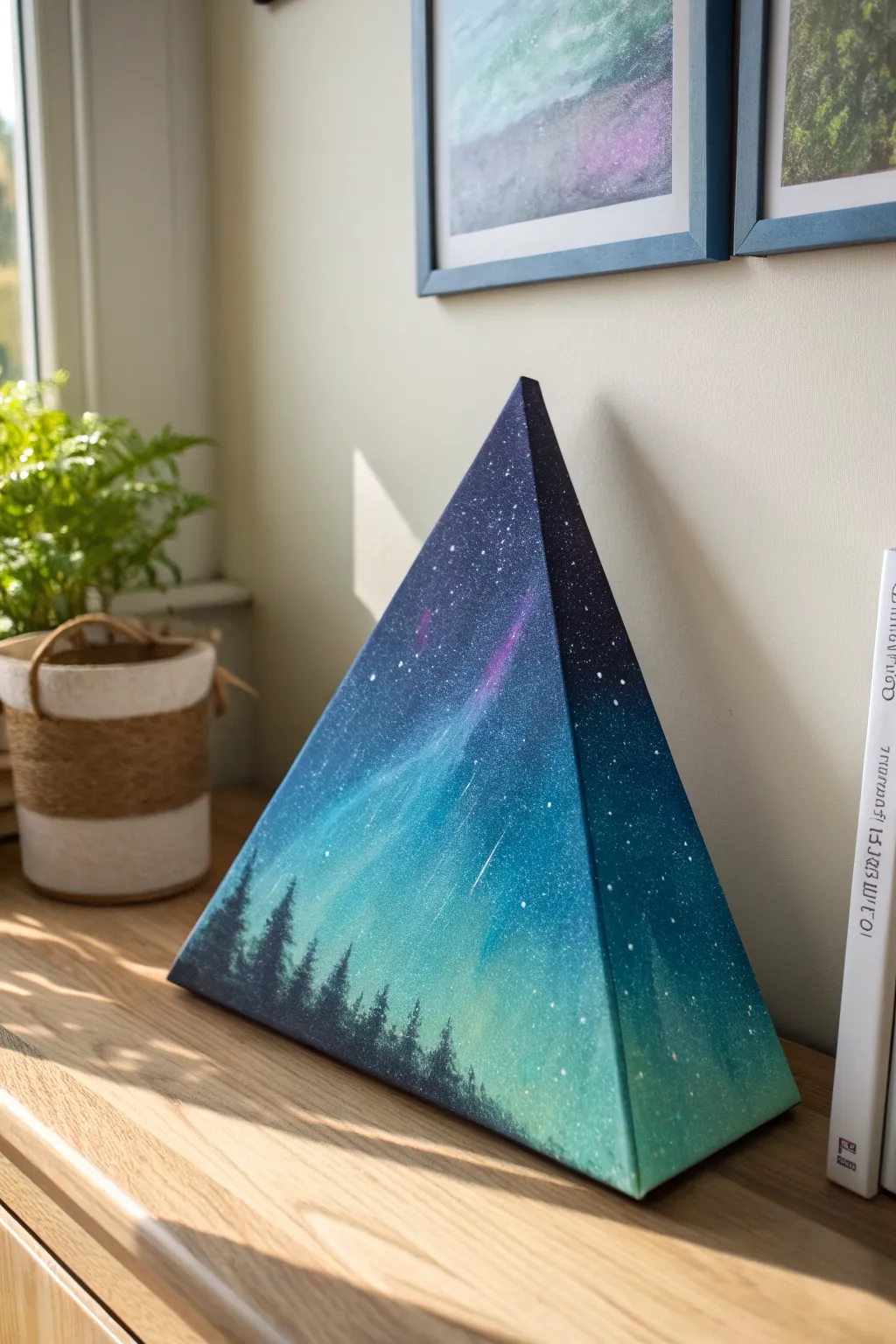
This stunning project transforms a unique triangular canvas into a window overlooking a magical boreal forest. The upward-sweeping aurora lights perfectly complement the canvas shape, drawing the eye toward the starry apex.
How-To Guide
Materials
- Triangular stretched canvas (pyramid shape)
- Acrylic paints (Phthalo Blue, Navy Blue, Teal/Turquoise, Purple, Black, Titanium White)
- Sponge applicator or kitchen sponge
- Flat shader brush (medium)
- Small round detail brush (size 0 or 1)
- Old toothbrush (for splattering stars)
- Cup of water and paper towels
- Palette or paper plate
Step 1: Setting the Atmosphere
-
Base Coat Application:
Begin by covering the entire triangular canvas with a dark navy blue. Paint the sides of the canvas as well so the artwork wraps around the edges for a finished 3D look. -
Creating the Gradient:
While the navy is still slightly wet, sponge on black paint at the very bottom edge and the top peak to create depth. Blend this gently into the navy mid-section. -
Introducing the Aurora Base:
Mix a small amount of teal with a touch of white to make a glowing light blue. Using a clean sponge, dab a vague, diagonal band across the center of the triangle, moving from the bottom left toward the upper middle. -
Refining the Blend:
With a barely damp clean sponge, soften the edges of your light blue band into the dark background. The goal is a soft, misty glow rather than a hard line.
Step 2: Painting the Light Show
-
Streaking the Sky:
Switch to a flat brush. Load it with bright teal paint and wipe off most of the excess. Use rapid, upward flicking motions to create vertical streaks within your glowing band. -
Adding Purple Accents:
Repeat the previous dry-brushing technique with a vibrant purple color. Place these streaks primarily near the top of the teal section to simulate the shifting colors of the Northern Lights. -
Highlighting the Core:
Mix white with a tiny bit of teal. Add a few very concentrated, intense streaks right in the center of the aurora band. This creates the ‘brightest’ part of the light display. -
The Falling Star:
using your smallest detail brush and pure white paint, drag a single, thin line diagonally through the blue section to create a shooting star.
Star Control
Test your toothbrush splatter on a piece of scrap paper first. If the drops are too big, the paint is too thick; if they run, it’s too watery.
Step 3: Starry Details
-
Mixing Star Paint:
Dilute a small dollop of white paint with water until it reaches an ink-like consistency. It needs to be fluid enough to splatter easily. -
Splattering the Galaxy:
Dip an old toothbrush into the thinned white paint. Point the bristles toward the canvas and run your thumb across them to spray a fine mist of stars over the upper two-thirds of the painting. -
Adding Major Stars:
Use the tip of your small round brush or a toothpick to manually dot a few larger, brighter stars scattered randomly across the darkest parts of the sky. -
Drying Time:
Let the sky layer dry completely before moving on to the foreground. This prevents the black trees from smearing into the wet sky.
Glow Up
Mix glow-in-the-dark medium into your white star paint and the lightest teal highlights. The painting will reveal a hidden magic when the lights go out.
Step 4: The Forest Silva
-
Mapping the Horizon:
Load your small round brush or a fine liner brush with black paint. Lightly sketch a slightly uneven horizon line very close to the bottom edge of the canvas. -
Painting Tree Trunks:
Draw vertical lines of varying heights rising from your horizon line. Make the trees taller on the left side and shorter toward the middle to create variety. -
Stippling Branches:
Starting at the top of a trunk line, use a stippling or tapping motion to create pine branches. Tap very narrow at the top and gradually widen the shape as you move down the trunk. -
Filling the Forest:
Continue adding trees across the bottom. Overlap them slightly; put some trees in front and some behind to build density. -
Grounding the Image:
Fill in the very bottom strip below the trees with solid black to anchor the composition. -
Final Inspection:
Check the edges of the canvas one last time to ensure the painting wraps cleanly around the shape. Touch up any white spots.
Place your finished prism on a shelf where it can catch the light and remind you of the silent beauty of the North
BRUSH GUIDE
The Right Brush for Every Stroke
From clean lines to bold texture — master brush choice, stroke control, and essential techniques.
Explore the Full Guide
Ocean Wave With a Triangular Break
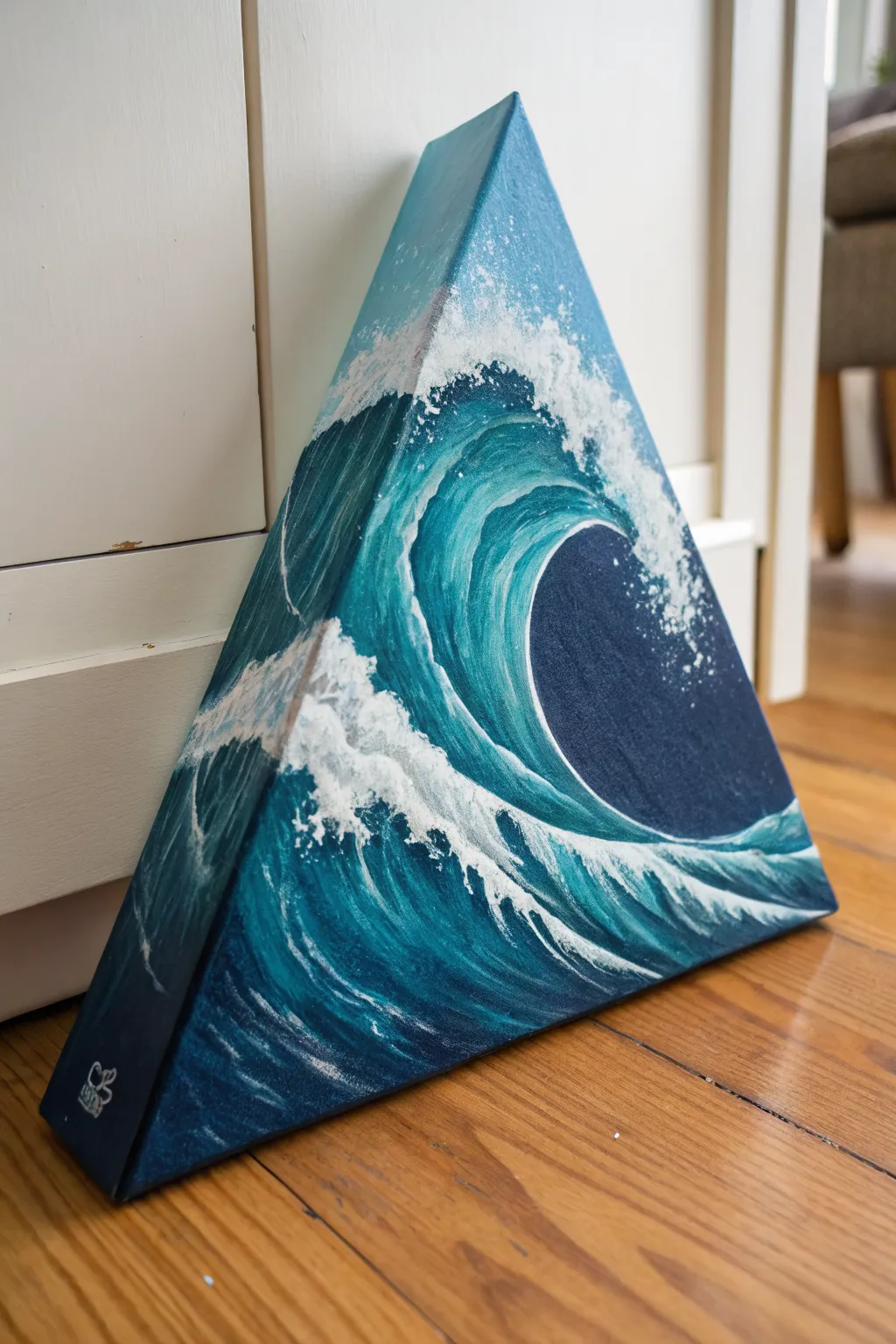
Ride the artistic wave with this dynamic triangular canvas project, where the unique shape enhances the natural curve of a crashing breaker. Capturing the deep blues and frothy whites of the ocean, this piece uses a gallery-wrap technique to bring the movement right off the wall.
Step-by-Step
Materials
- Triangular stretched canvas (approx. 12-16 inches per side)
- Acrylic paints: Phthalo Blue, Ultramarine Blue, Turquoise, Titanium White, Black
- Large flat brush (1 inch)
- Medium filbert brush
- Small round detail brush (size 0 or 1)
- Fan brush (optional, for spray)
- Palette or paper plate
- Cup of water and paper towels
- Easel or propping stand helpful for the unusual shape
Step 1: Planning and Base Layers
-
Map the composition:
Begin by lightly sketching the main curve of the wave with a diluted light blue paint or a watercolor pencil. The curl should start high on the left side and swoop down toward the bottom right corner, creating a large ‘C’ shape. -
Block in the deepest shadows:
Mix Ultramarine Blue with a touch of Black to create a very dark navy. Paint the ‘inside’ of the wave tunnel (the barrel) on the right side. Ensure this dark area is smooth and opaque. -
Extend to the edges:
Don’t stop at the front face! Carry that deep navy color around the right-hand edge of the canvas. Painting the sides creates a professional, finished object. -
Establish the mid-tones:
Mix Phthalo Blue and Turquoise. Apply this vibrant teal color to the main body of the rising water on the left, blending it slightly where it meets the darker shadow of the barrel. -
Paint the background sky:
For the small triangular tip at the very top, mix a soft, lighter blue using Turquoise and White. Paint this area smoothly, blending it downward until it meets where the wave’s crest will range.
Muddy Waters?
If your white foam is turning light blue instead of staying crisp, the blue layer underneath is still too wet. Let the blue base dry completely before applying any white highlights.
Step 2: Creating Movement and Form
-
Add striated water texture:
Using your medium filbert brush and the teal mix, paint curved strokes that follow the shape of the wave. These lines simulate the water being pulled upward before it crashes. -
Deepen the left side:
Introduce pure Phthalo Blue to the lower left corner. Paint long, sweeping strokes upward into the teal area to show the depth and thickness of the water. -
Wrap the left edge:
Just like before, continue these blue and teal streaks around the left side of the canvas so the movement looks continuous from all angles. -
Define the lip:
Use a lighter mix of Turquoise and White to highlight the very top edge of the curling water, just before it turns into foam. This distinct line separates the water from the dark barrel.
Step 3: Foam and Crash Details
-
Start the main crash:
Load a medium brush with thick Titanium White. Stipple (dab repeatedly) paint along the top crest where the wave is breaking. Keep the edges irregular and fluffy. -
Create the spray mist:
Using a dry brush or an old scruffy brush with very little white paint, lightly scrub above the crest to create the misty spray that flies off the top of the wave. -
Paint the foam trails:
Switch to a small round brush. Paint thin, web-like white lines trailing down the face of the wave. These should follow the curve of the water, not straight down. -
Add heavy churn at the bottom:
At the base of the wave where it hits the imagined surface, apply simpler, broader strokes of white to represent the churning sea foam. -
Build the texture layers:
I find that layering is key here. Once the first white layer is dry, go back with fresh, thick white paint on the brightest highlights of the foam to make them pop against the blue. -
Refine the barrel spray:
Inside the dark curve of the wave, add tiny dots and splatters of white to show droplets caught in the shadow. A toothbrush or stiff fan brush works well for flicking these tiny specks. -
Final edge check:
Rotate the canvas and ensure your white foam lines and spray details wrap cleanly around the edges, connecting the front image to the sides seamlessly.
Level Up: Gloss Finish
Once fully dry, apply a high-gloss varnish to the water areas only (the blue and teal parts), leaving the foam matte. This mimics the reflective wetness of real water.
Hang your stunning seascape with the point facing up to add a modern, aquatic splash to any room.
Palm Tree Silhouette for Tall Composition
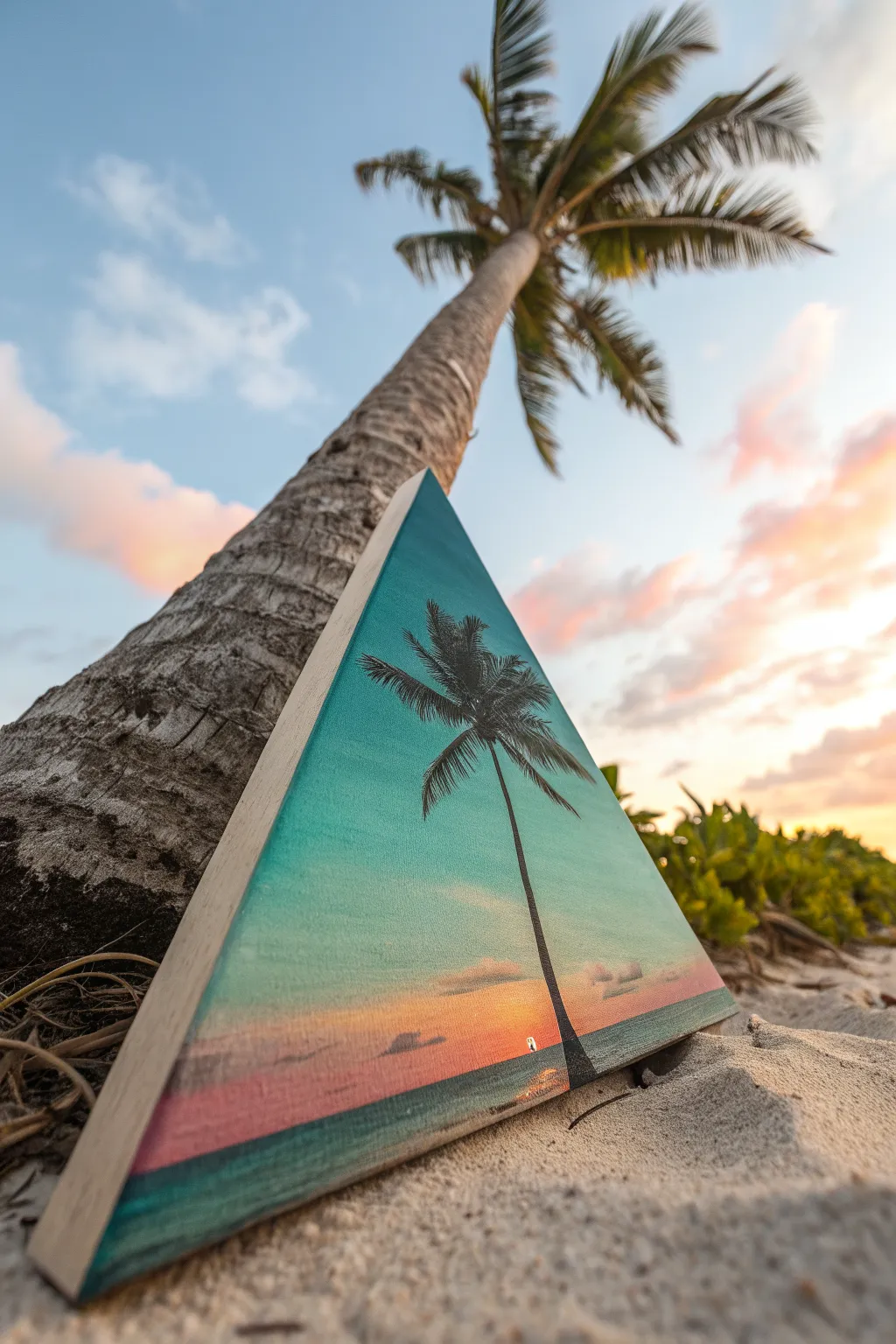
Capture the magic of an endless summer with this striking triangular canvas project. The unique shape perfectly frames a solitary palm tree, emphasizing its height against a dreamy, gradient sunset sky that shifts from deep teal to warm coral.
Step-by-Step Tutorial
Materials
- Triangular stretched canvas (medium to large size)
- Acrylic paints: Teal/Turquoise, Sky Blue, White, Coral/Pink, Orange, Black, Dark Brown
- Large flat brush (for blending)
- Medium round brush
- Small detail brush (liner or rigger brush)
- Palette
- Water cup and paper towels
- Pencil
Step 1: Creating the Sunset Gradient
-
Prime the Surface:
Begin by ensuring your triangular canvas is clean and ready. If not pre-primed, apply a coat of gesso. Once dry, decide on your horizon line; for this composition, place it very low, about one-fifth of the way up from the bottom edge to emphasize the sky’s height. -
Mix the Sky Colors:
Prepare your gradient palette. You’ll need a cool teal or turquoise for the top point, transitioning into a lighter sky blue, then fading into white, and finally warming up into coral pink and orange near the horizon. -
Paint the Top Section:
Using a large flat brush, apply the deep teal paint at the very top point of the triangle. Paint downward about a third of the way, keeping the strokes horizontal despite the canvas shape. -
Transition to Blue:
While the teal is still wet, introduce the sky blue. Blend the two colors directly on the canvas where they meet, working your brush back and forth horizontally to create a smooth, seamless fade. -
Add Soft Clouds:
Mix a little white into your blue to lighten it as you move toward the middle. I like to keep this area slightly irregular to suggest soft, distant vapor, rather than a perfect gradient. -
Warm the Horizon:
Near the bottom pencil line, apply your coral pink and orange tones. Blend these upward into the pale blue/white section to create that magical ‘golden hour’ glow. -
Determine the Waterline:
Paint the thin strip of ocean below the horizon line. Use a darker version of your teal mixed with a tiny touch of black or deep blue to distinguish it from the sky. -
Sand Texture:
At the very bottom edge, create a small strip of beach using a mix of white, tiny bit of orange, and brown for a beige sand tone. Let the entire background dry completely before proceeding.
Troubleshooting: Muddy Skies
If blending blue and orange turns grey/brown, let the blue layer dry first. Glaze the orange over top lightly, or use a strong band of white in between as a buffer zone.
Step 2: The Palm Tree Silhouette
-
Sketch the Trunk:
Using a pencil very lightly, draw a guideline for your palm tree trunk. Position it slightly off-center to the right, leaning gently inward to follow the flow of the triangle’s right edge. -
Paint the Trunk Base:
Mix a heavy black with a small amount of dark brown. Using a medium round brush, paint the base of the trunk at the sand line, making it slightly wider at the root. -
Extend the Trunk:
Switch to a smaller brush as you move up. Paint the trunk extending upward, tapering it gradually until it becomes very thin near the center-top of the canvas. -
Add Trunk Texture:
Instead of a smooth line, subtle bumps or ridges along the sides of the trunk give it that realistic, segmented palm texture. -
Map the Fronds:
At the top of the trunk, paint 5-7 curved lines radiating outward to act as the spines of the palm fronds. Vary their lengths and angles for a natural look. -
Detail the Leaves:
Use your smallest liner brush or rigger brush here. With the black paint, flick tiny, quick strokes downward from each spine line to create the feathery leaves. -
Layer the Foliage:
Make the fronds dense near the center crown and more sparse toward the tips. Overlap some fronds to build volume. -
Final Touches:
Add a tiny highlight of white or sun-yellow on the water right beneath where the sun would be setting, and perhaps a small white glint on the horizon line itself. -
Seal the Edges:
Don’t forget the deep sides of the canvas. Paint them a solid color (like black or the teal from the top) or continue the image wrapping around the sides for a gallery finish.
Level Up: Metallic Glow
Mix a tiny drop of gold metallic paint into your orange horizon line or brush it lightly onto the water’s reflection for a sunset that shimmers in the light.
Now you have a slice of paradise ready to bring warmth to any corner of your home

PENCIL GUIDE
Understanding Pencil Grades from H to B
From first sketch to finished drawing — learn pencil grades, line control, and shading techniques.
Explore the Full Guide
Watercolor Washes Inside Crisp Triangle Edges
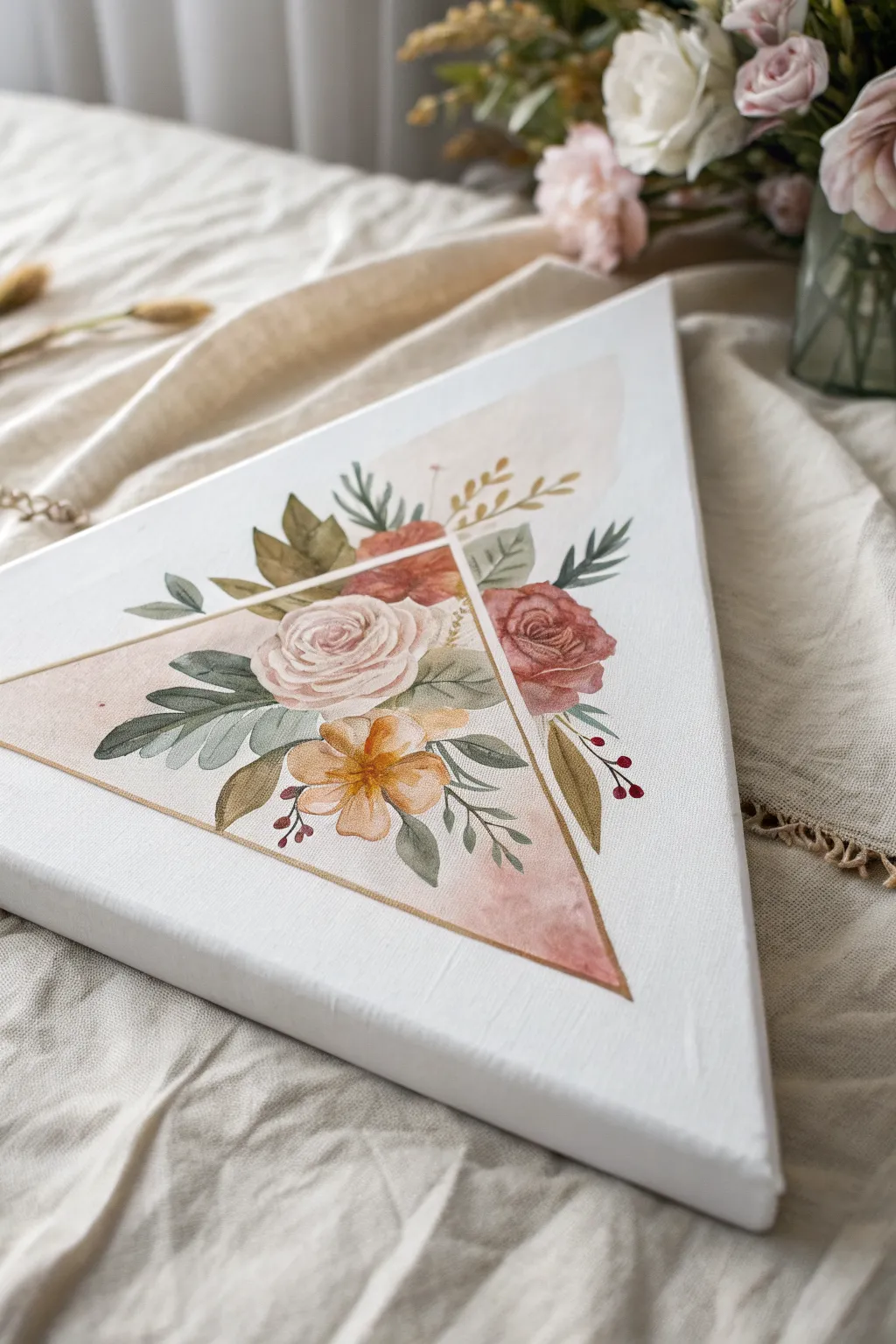
This elegant project combines the stark, modern shape of a triangle with the soft, organic beauty of a vintage-style floral bouquet. By creating crisp geometric boundaries and filling them with delicate blooms, you achieve a stunning contrast that looks beautiful on any wall.
How-To Guide
Materials
- Triangular stretched canvas (approx. 12-16 inches per side)
- Watercolor ground (or absorbent ground)
- Acrylic paints (Soft Pink, Rose Madder, Burnt Sienna, Sap Green, Oxide Green, Yellow Ochre, Gold)
- Acrylic fluid medium or glazing liquid
- Painter’s tape (low tack)
- Pencil (HB or lighter)
- Wide flat synthetic brush
- Round synthetic brushes (sizes 2, 4, and 6)
- Small liner brush (size 0 or 00)
- Palette or mixing tray
- Water container and paper towels
Step 1: Preparation & Layout
-
Prime the surface:
Since standard canvases repel water, apply two smooth coats of watercolor ground (or absorbent ground) to the canvas surface. Use a wide flat brush and let it dry completely between coats—usually about 24 hours for full curing—to create an absorbent, paper-like surface. -
Define the central triangle:
Using a ruler, lightly sketch a smaller, inverted triangle in the center of your canvas. The points shouldn’t touch the canvas edge; leave about 2-3 inches of breathing room on all sides. -
Tape the boundaries:
Apply low-tack painter’s tape along the *outside* edges of your penciled triangle. Press the edges of the tape down firmly with your fingernail or a burnishing tool to seal them tight against the canvas texture. -
Sketch the florals:
Lightly sketch your floral composition. Place a large rose in the center-left, a secondary rose on the right, and a smaller yellow bloom below. Crucially, allow leaves and petals to extend well beyond the taped triangle lines—we want the flowers to ‘break’ the geometry.
Clean Lines Pro Tip
Before painting your background wash, paint a thin layer of clear matte medium along the tape edge. This seals the tape and prevents any color from bleeding underneath.
Step 2: Creating the Background Wash
-
Mix a watery wash:
Dilute a tiny amount of Soft Pink and Burnt Sienna with plenty of water (and a drop of glazing liquid if the paint feels too sticky). You want a very pale, tea-stained color. -
Apply the inner tint:
Gently brush this wash inside the taped triangle area. Don’t worry about painting over your floral sketches for now; if the paint is translucent enough, you’ll still see the pencil lines. Let this background layer dry completely.
Step 3: Painting the Florals
-
Base coat the main roses:
Using diluted acrylics to mimic watercolor, paint the base shape of the large cream/white rose using a very pale wash of Yellow Ochre and a touch of pink. For the darker red rose on the right, use a wash of Rose Madder. -
Paint the leaves:
Mix Sap Green with a little Burnt Sienna for a muted, vintage olive tone. Paint the leaves, letting the color vary in density. Remember to paint the parts of the leaves that extend *outside* the triangle tape area as well—this creates the floating effect. -
Add depth to the petals:
Once the base layers are dry, come back with slightly less diluted paint. Add shadows between the rose petals using darker mixes of your base colors. Keep your brush strokes loose and organic. -
Detail the yellow flower:
Paint the small bottom flower with Yellow Ochre mixed with a touch of Gold. Use the size 2 brush to define the individual petals, keeping the center slightly darker for dimension. -
Enhance the foliage:
Switch to a darker green (Oxide Green) and add center veins and stems to your leaves. Use the liner brush for delicate sprigs and berries extending outward from the main bouquet.
Level Up: 3D Elements
For a mixed-media twist, enhance the flower centers with embroidery. Poke holes through the canvas and stitch French knots using gold thread.
Step 4: Finishing Touches
-
Remove the tape:
Ensure the paint inside the triangle is fully dry. Very slowly peel back the painter’s tape at a 45-degree angle to reveal the crisp background edge. The leaves you painted earlier should naturally cross over where the tape used to be. -
Bridge the gaps:
You will likely have ‘blank’ spots on your leaves and flowers where the tape covered the canvas. Carefully use your small brushes to paint in the missing sections of the petals and leaves, connecting the inside image to the outside elements seamlessly. -
Add the gold frame:
Using a liner brush and metallic Gold acrylic paint, paint a thin, steady line over the geometric triangle border. This defines the shape and hides any slight unevenness where the background wash meets the white canvas. -
Final leaf details:
Add tiny decorative elements like small red berries or fern-like fronds in the background wash area to fill any empty space and balance the composition. -
Seal the work:
Once completely cured (give it at least 24 hours), apply a spray varnish. A matte or satin finish works best to preserve the soft, watercolor aesthetic without adding harsh glare.
Hang your geometric floral piece in a bright spot where the natural light can highlight the delicate washes and gold accents.
Abstract Lines That Converge at the Point
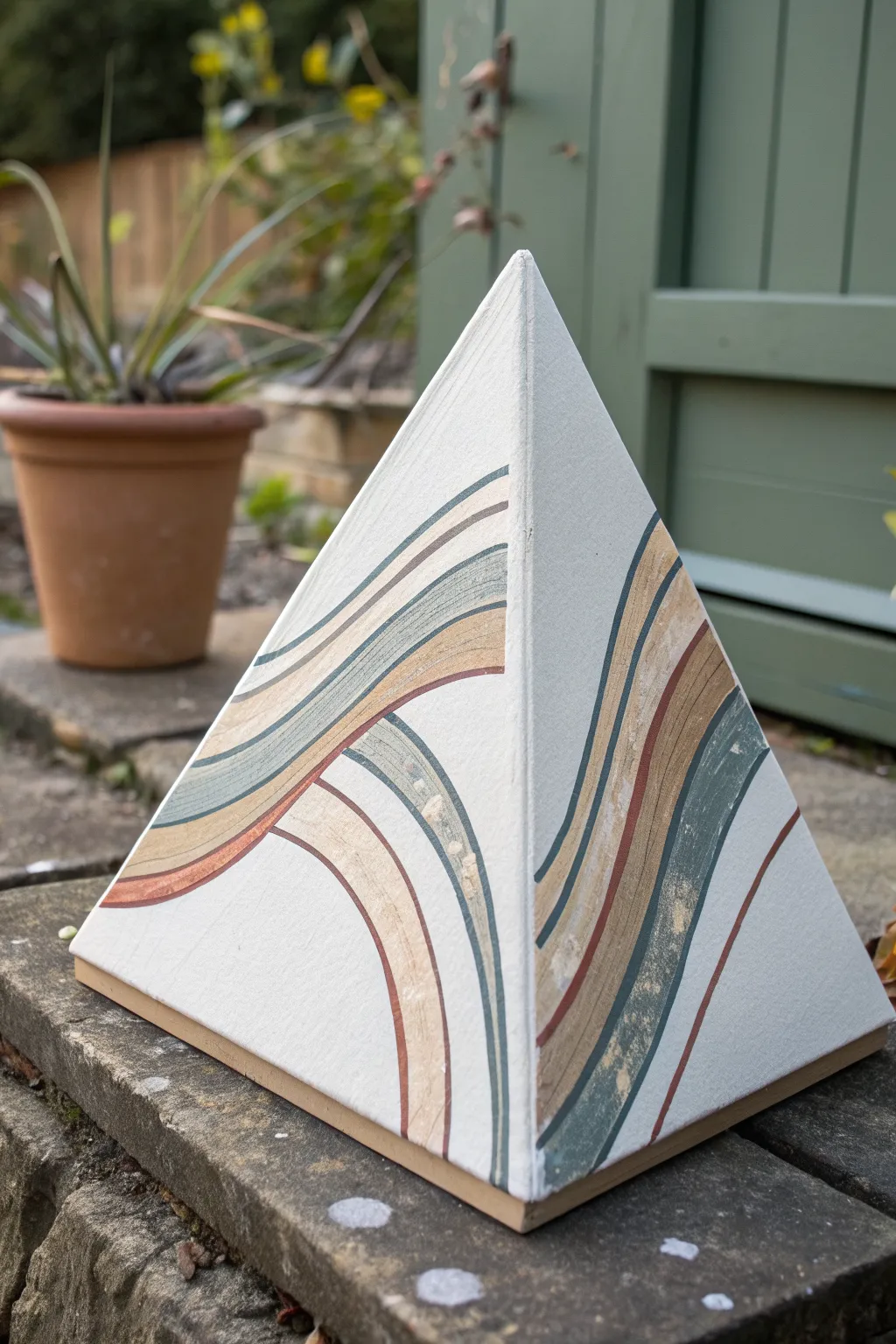
Transform a unique 3D pyramid canvas into a modern sculptural piece with this soothing, abstract design. Featuring flowing, organic bands of teal, ochre, and terracotta, the lines guide the eye upward to create harmony on all four sides.
Step-by-Step Guide
Materials
- Pyramid-shaped canvas (or wooden block primed with gesso)
- Acrylic paints (Cream/Off-White, Teal, Ochre/Gold, Terracotta/Rust)
- Medium flat brush (approx. 1/2 inch)
- Small round detail brush (size 1 or 2)
- Pencil
- Palette or mixing plate
- Water cup and paper towels
- Fine-grit sandpaper (optional)
Step 1: Preparation and Base Coat
-
Prime the surface:
If your pyramid form is raw wood or unprimed canvas, apply a coat of gesso to all four sides and let it dry completely. This ensures your paint adheres smoothly. -
Mix the background color:
Create a warm, stony off-white base color. Mix a generous amount of white acrylic with a tiny drop of ochre or raw sienna to warm it up. -
Apply the base layers:
Paint the entire surface of the pyramid with your off-white mixture. Use long, even strokes from bottom to top. -
Ensure opacity:
Allow the first coat to dry; if the material underneath shows through, apply a second coat for a solid, opaque finish.
Continuous Flow
When painting the corners, place the pyramid on a lazy susan. Following the line around the corner while rotating helps keep the curve smooth and unbroken.
Step 2: Sketching the Design
-
Mark the flow:
Lightly sketch your design with a pencil. Start at the bottom left corner of one face and draw flowing, wavy lines that curve upward toward the right edge. -
Wrap the pattern:
Continue the lines onto the adjacent face. The lines that exit the right side of the first face should enter the left side of the next face, creating a continuous loop around the pyramid. -
Vary the widths:
Draw parallel curves to create bands of varying thickness. Some bands should be wide enough for bold color, while others should be thin ‘spacer’ lines. -
Create converging sections:
Add a second set of waves on the lower section that perhaps curve in a slightly different direction or intensity to create dynamic movement, as seen in the reference where waves nest into each other.
Metallic Accent
Use metallic gold leaf or gold paint for the thin ochre bands. It catches the light beautifully as you walk around the 3D shape.
Step 3: Applying Color
-
Prepare the palette:
Squeeze out your teal, ochre, and terracotta paints. I like to slightly water these down just a touch or mix with a flow medium so the long strokes stay smooth. -
Paint the teal bands:
Using your flat brush, fill in the widest curvy bands with the teal paint. Focus on keeping the edges crisp. -
Add the ochre accents:
Select the bands adjacent to the teal and fill them with the ochre or gold tone. This warm color contrasts beautifully with the cool blue-green. -
Introduce terracotta:
Use the terracotta/rust color for the thinner accent bands. This adds a deep, earthy anchor to the palette. -
Layering for texture:
Once the filled bands are dry, you can dry-brush a lighter version of the same color over them to give that slightly weathered, stone-like texture visible in the image.
Step 4: Defining Details
-
Outline the bands:
Switch to your small round detail brush. Mix a darker version of your teal or a dark grey to use for outlining. -
Create distinct separation:
Carefully paint thin lines between the colored bands and the white background. This “pinstriping” effect makes the design pop. -
Refine the edges:
Go back with your off-white base color to clean up any areas where the colored paint might have wobbled outside the intended lines. -
Seal the seam:
Pay distinct attention to the corner edges of the pyramid. Ensure the paint wraps perfectly over the sharp corner so the design looks continuous from all angles.
Step 5: Finishing Touches
-
check for consistency:
Rotate the pyramid and check the flow of the lines. Connect any gaps where the faces meet. -
Seal the artwork:
Apply a matte varnish over the entire piece. This protects the paint and unifies the sheen, giving it a professional, ceramic-like appearance.
Place your finished pyramid on a bookshelf or side table to add a touch of modern geometric calm to your space


Starburst Burst Radiating From the Apex
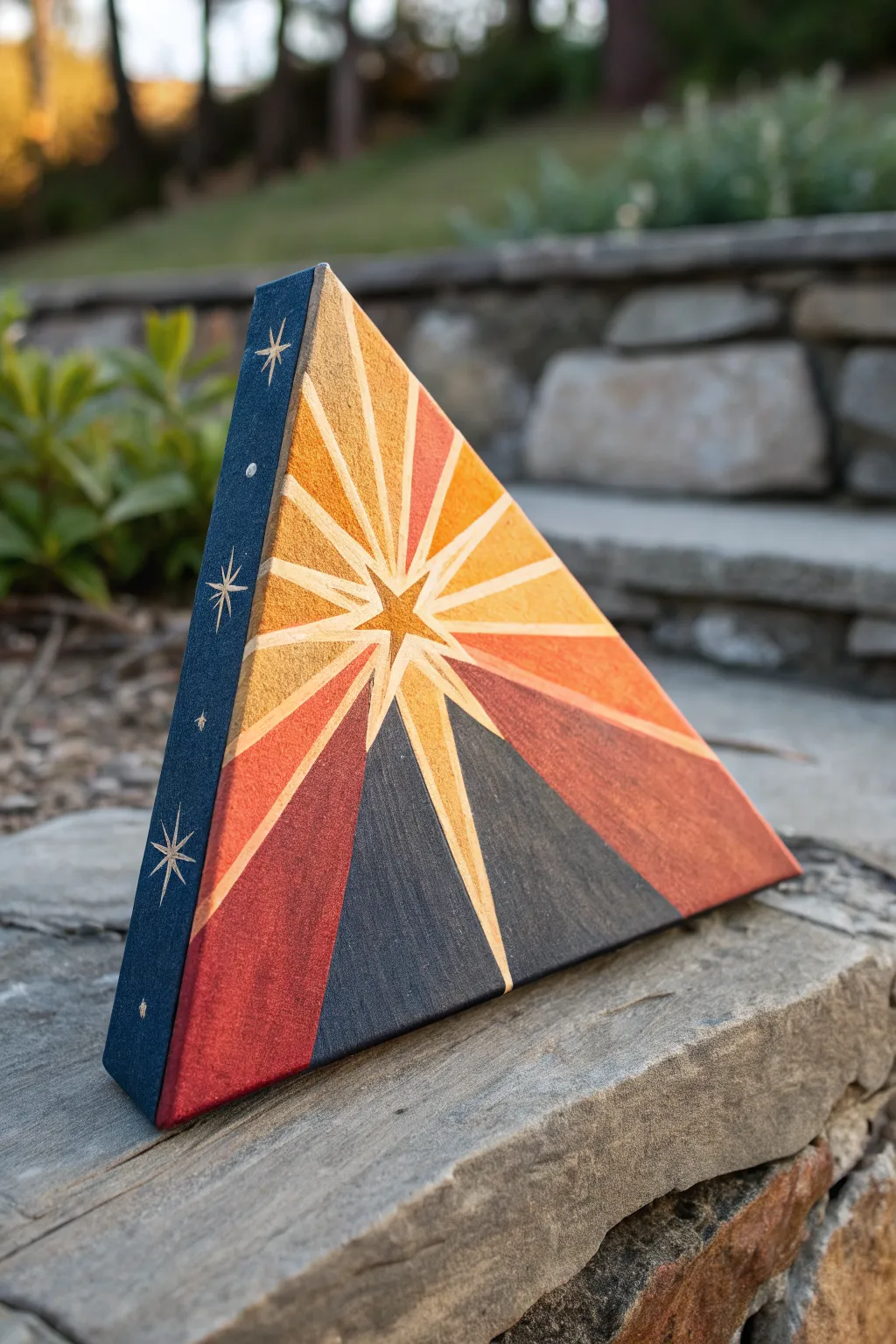
Capture the warmth of a setting sun against a twilight sky with this striking geometric design on a unique triangular canvas. Sharp lines and contrasting warm and cool tones create a dynamic starburst effect that feels both modern and celestial.
Detailed Instructions
Materials
- Triangular stretched canvas (approx. 10-12 inches per side)
- Acrylic paints (Navy Blue, Charcoal/Black, Deep Red, Burnt Orange, Bright Yellow, Metallic Gold, White)
- Painter’s tape (1/4 inch width is ideal)
- Flat shader brushes (medium and small)
- Detailed liner brush
- Ruler or straight edge
- Pencil
- Gesso (optional)
Step 1: Preparation and Mapping
-
Prime the surface:
If your canvas isn’t pre-primed, apply a smooth coat of gesso to all three sides and the face. Let it dry completely to ensure your painter’s tape adheres well later without peeling up surface fibers. -
Establish the focal point:
Decide where your starburst will originate. In the reference, the center star sits in the upper-middle third, slightly left of the vertical center. Mark this spot lightly with a pencil. -
Draft the rays:
Use your ruler to draw faint lines radiating outward from your focal point to the edges of the triangle. Vary the width of these sections slightly to create a more dynamic, less uniform look. -
Draft the central star:
Around your focal point, sketch a small 5- or 6-pointed star shape. The points of this star should align with some of the radiating lines you just drew, acting as the ‘source’ of the burst.
Tape Trick
If you struggle with the tape bunching up at the central star point, stop the tape about 1/4 inch away from the center and freehand that tiny inner area later with a liner brush.
Step 2: Painting the Base Rays
-
Tape the first set of sections:
Apply painter’s tape along the pencil lines for your first color group (the dark navy sections). Ensure the tape is pressed down firmly, especially near the center point where lines converge. -
Seal the tape edges:
To get those razor-sharp lines, I like to brush a tiny amount of clear medium or the base canvas color over the tape edge first. This prevents the colored paint from bleeding underneath. -
Apply the dark tones:
Paint the large bottom section and the side edge with a mix of Navy Blue and a touch of Charcoal. Carry this color all the way around the side edge of the canvas for a finished look. -
Paint the warm rays:
Once the dark sections are dry and tape is removed, re-tape to isolate the warm sections. Paint these alternating rays with Deep Red, Burnt Orange, and Bright Yellow. You may need two coats for the yellow to be opaque. -
Blend the gradients (optional):
For a softer look within the rays, you can gently blend orange into yellow while the paint is wet, though the reference image uses solid blocks of color for a graphic style.
Level Up: Texture
Mix a little sand or modeling paste into the paint for the dark blue/black sections. It creates a gritty, stone-like contrast against the smooth, shiny gold rays.
Step 3: Detailing the Star and Lines
-
Remove all tape:
Carefully peel away all remaining tape. You should now have a pattern of radiating colors separated by thin gaps of raw canvas (or whatever color was under the tape). -
Fill the gaps:
Using a steady hand and a small flat brush, paint the gaps between the color rays. The image suggests a light, creamy yellow or metallic gold for these separating lines to make the colors pop. -
Paint the central star:
Using a small detail brush, fill in the central star shape. A metallic gold or a bright yellow-orange works best here to simulate glowing light. -
Sharpen the edges:
If any paint bled or lines look wobble, use your liner brush and the separation color (cream/gold) to tidy up the boundaries between the rays.
Step 4: Side Details and Finish
-
Detail the side panel:
On the thick side edge of the canvas (the navy blue section), use a fine liner brush to paint small embellishments. Paint simple four-pointed stars and tiny dots in white or silver to mimic a night sky. -
Add highlights:
Mix a tiny amount of white into your gold or yellow. Add very thin highlight lines to the center of the radiating star arms to give them a slight faceted, 3D appearance. -
Final inspection:
Check the corners where the face meets the sides. Ensure the paint wraps clean around the edge. Touch up any bare canvas spots. -
Varnish:
Once the painting is fully cured (give it at least 24 hours), apply a satin or gloss varnish to protect the paint and enhance the vibrancy of the colors.
Place your finished triangular canvas on a shelf or hang it as part of a geometric gallery wall to enjoy your handiwork
Minimal Moon Phase Stack Up the Center
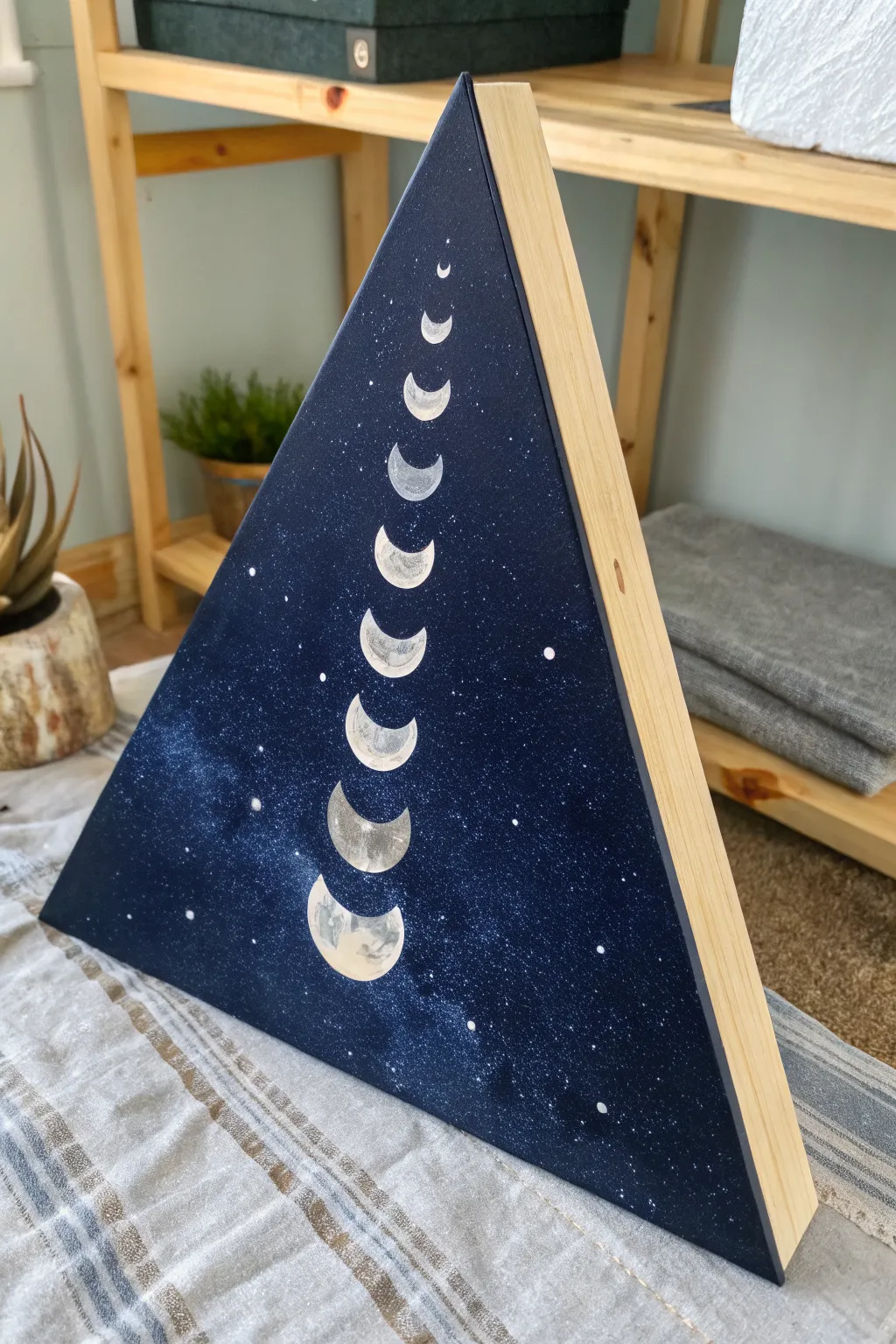
This striking project combines the geometry of a triangular canvas with the organic beauty of a night sky. You will create a deep, starry galaxy background featuring a vertical stack of moon phases that graduate in size for a perfectly balanced composition.
Step-by-Step Tutorial
Materials
- Triangle wood canvas or panel (pine finish sides preferred)
- Acrylic paints: Navy Blue, Black, White, Silver or Grey
- Painter’s tape
- Sponges or dense foam brushes
- Various paintbrushes: 1-inch flat brush, fine detail brushes
- Old toothbrush or stiff bristle brush
- Circle stencils, compass, or varying sized bottle caps/lids
- Pencil
- Palette for mixing
Step 1: Preparation and Background
-
Protect the Edges:
Since the natural wood grain on the sides provides a beautiful contrast to the dark sky, carefully apply painter’s tape along the outer edges of the triangle. Press down firmly to prevent any paint bleed. -
Mix the Night Sky Base:
On your palette, create a deep midnight hue. Start with a generous amount of navy blue and mix in a touch of black. You want a color that is dark and rich, but not completely flat black. -
Apply the Base Coat:
Using a sponge or a wide flat brush, apply your dark mixture to the entire face of the canvas. Use a dabbing or stippling motion rather than long strokes to create a subtle, textured appearance like the vastness of space. -
Add Depth with Lighter Tones:
While the base is still slightly tacky, mix a tiny bit of white into your blue to make a lighter navy. Lightly sponge this irregularly around the center and bottom left areas to suggest nebulae or distant light clouds. -
Create the Stars:
Dilute a small amount of white paint with water until it has an inky consistency. Dip an old toothbrush or stiff brush into it. -
Splatter the Galaxy:
Hold the brush over the canvas and use your thumb to flick the bristles, spraying tiny white specks across the ‘sky’. Vary your distance from the canvas to create different star sizes. -
Dry Completely:
Allow the background to dry fully before moving on. This is crucial so your pencil marks for the moons will show up clearly and won’t smudge the sky.
Star Splatter Control
Test your splatter technique on scrap paper first. If big blobs happen, dab them carefully with a paper towel while wet to turn them into distant nebulas.
Step 2: Painting the Moon Phases
-
Plan the Moon sizes:
The moons need to decrease in size as they go up. Find 6-7 circular objects (like coins, lids, or dowels) ranging from large (about 2 inches) to very small (pencil eraser size). -
Mark the Vertical Center:
Use a ruler to lightly visualize notate the vertical center line of the triangle. This ensures your stack doesn’t lean to one side. -
Trace the Crescents:
Start at the bottom with your largest circle. Place it centrally and lightly trace a crescent shape. Move upwards, switching to progressively smaller circles, leaving about half an inch of space between each moon. -
Paint the Base Moon Shape:
Using a medium detail brush and grey paint (or a mix of black and white), fill in the crescent shapes. This acts as a primer and base tone for the details. -
Add Texture to the Moons:
Mix a light grey and a pure white. Use a very small, dry brush or a tiny piece of sponge to dab these colors onto the grey crescents. Focus the white on the curved outer edge of the crescent to make it look illuminated. -
Detail the Craters:
For the largest moons at the bottom, use a darker grey to add tiny, irregular blotches. This mimics the ‘seas’ and craters found on the actual lunar surface. -
Refine the Edges:
If your sponge edges got fuzzy, use your original dark background color and a fine liner brush to carefully clean up the inner curve of the crescents, making them sharp and crisp. -
Add Specific Highlights:
Add a final tiny streak of pure white to the widest part of each crescent. This makes the moons pop against the dark background. -
Remove the Tape:
Once everything is touch-dry, slowly peel away the painter’s tape from the wood edges at a 45-degree angle to reveal the clean, natural border.
Glow In The Dark
Mix phosphorescent medium with your white paint for the stars and moon highlights. The piece will look normal by day but magically light up at night.
Hang your celestial creation in a well-lit spot to let the subtle textures of the galaxy shine through
Optical Illusion Chevron Stripes
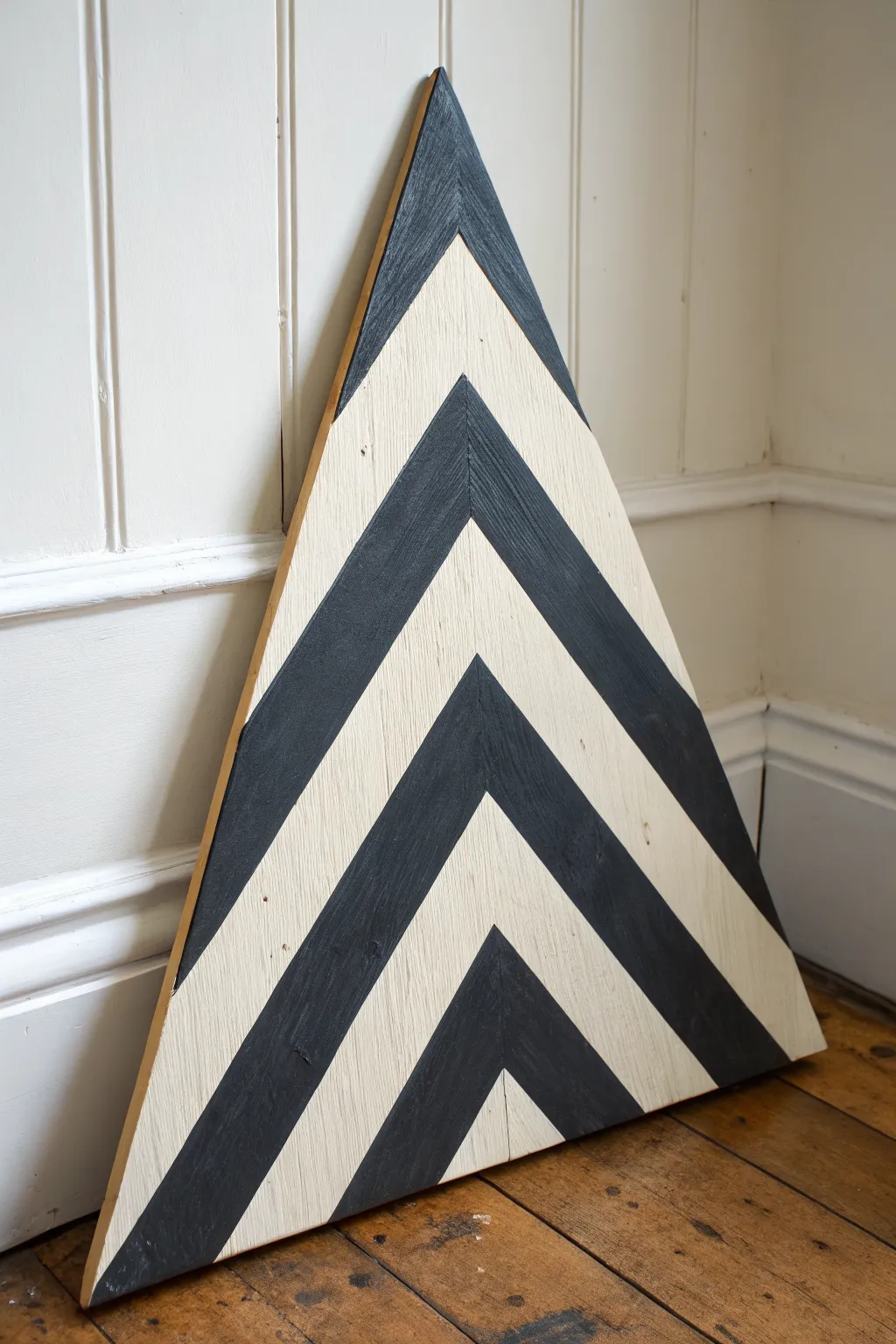
This striking geometric piece uses high-contrast black and natural wood tones to create a bold chevron pattern that adds modern flair to any corner. The simple triangular shape enhances the sharpness of the lines, making it a perfect project for minimalists.
Detailed Instructions
Materials
- Triangular wooden panel or canvas
- Painter’s tape (0.5 to 1 inch width)
- Matte black acrylic paint
- Flat paintbrush (1-inch width)
- Pencil
- Ruler or straight edge
- Sandpaper (fine grit)
- Clear matte varnish or sealant
- Damp cloth
Step 1: Preparation and Base
-
Prepare the surface:
Begin by ensuring your triangular panel is smooth. If you are using raw wood, give it a light sanding with fine-grit sandpaper to remove any rough patches or splinters. -
Clean the dust:
Wipe the entire surface down with a damp cloth to remove sanding dust. Let the wood dry completely before moving on. -
Determine the center line:
Using your ruler, measure the exact center of the bottom edge of the triangle. Lightly draw a vertical line with a pencil from the peak of the triangle down to this center point. This will be your guide for the chevron peak.
Bleeding Lines?
If paint seeps under the tape, wait for it to dry completely. Then, use a small piece of fine-grit sandpaper to gently buff away the bleed on the raw wood sections.
Step 2: Creating the Pattern
-
Mark vertical intervals:
Along that central vertical line you just drew, make small tick marks every 2 inches (or your desired stripe width) starting from the bottom moving upward. -
Mark the edges:
Repeat this measuring process along the left and right diagonal edges of the triangle, ensuring the marks align horizontally with the central ticks. -
Connect the lines:
Use your straight edge to connect the central tick marks to the corresponding edge marks, creating a series of inverted ‘V’ shapes. Keep your pencil pressure light so the lines are easy to cover later. -
Tape the first set of stripes:
Apply painter’s tape to the sections that will remain the natural wood color (or white, if you chose to paint a base coat). Press the edges of the tape down firmly with your fingernail or a credit card. -
Check the intersections:
Pay special attention to the center point where the tape pieces meet at the ‘V’. You want a sharp point, so carefully trim the tape with a craft knife or overlap them neatly to form a crisp angle without gaps.
Metallic Twist
Swap the matte black paint for a gold or copper metallic leaf. Applying size and leaf to the masked areas creates a glamorous industrial-chic look.
Step 3: Painting and Finishing
-
Seal the tape edges:
To prevent bleeding, I like to brush a very thin layer of clear matte medium or the base color over the tape edges first. This seals the tape and ensures crisp lines. -
Apply the black paint:
Once the sealant is dry, use your flat brush to apply the matte black paint into the exposed chevron areas. Brush away from the tape edge initially to avoid forcing paint underneath it. -
Add a second coat:
Let the first coat dry to the touch, then apply a second coat of black paint for a rich, opaque finish. Ensure the coverage is even and solid. -
Remove the tape:
While the second coat is still slightly tacky (not fully cured), carefully peel back the painter’s tape at a 45-degree angle. This helps prevent the paint from chipping or pulling up with the tape. -
Touch up imperfections:
Inspect your lines. If any paint bled through, use a small detail brush with the background color (or gentle sandpaper if using raw wood) to clean up the edges. -
Erase guide lines:
Once the paint is fully dry, gently erase any visible pencil marks from the unpainted sections. -
Seal the artwork:
Finish the piece by applying a coat of clear matte varnish over the entire surface. This protects the wood and evens out the sheen between the painted and unpainted areas.
Now you have a bold, graphic accent piece ready to lean on a shelf or hang on the wall
Triangle Triptych Mosaic With One Shared Sky
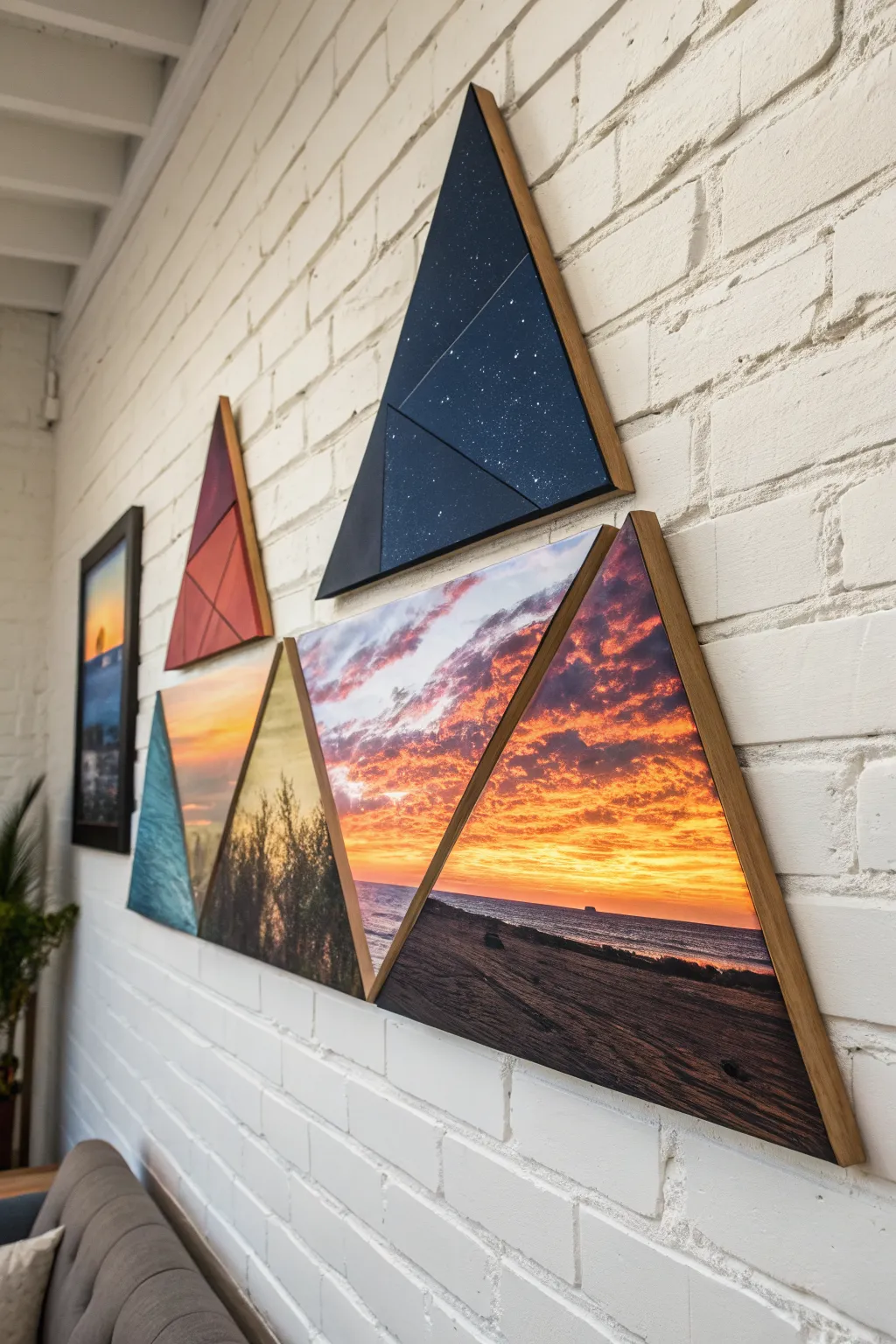
Transform a single stunning sunset image into a modern art installation by splitting it across multiple triangular geometric panels. This project combines woodworking and digital printing (or careful hand-painting) to create a fragmented yet cohesive panoramic view.
Detailed Instructions
Materials
- High-resolution sunset or landscape photograph (digital file)
- Plywood sheet (1/2 inch or 3/4 inch thickness)
- Wooden trim pieces (1×2 inch oak or pine)
- Glossy photo paper or adhesive vinyl
- Mod Podge or heavy-duty spray adhesive
- Wood glue and wood filler
- Sandpaper (120 and 220 grit)
- Miter saw or hand saw with miter box
- Circular saw or table saw
- Wood stain (light oak or walnut)
- X-Acto knife with fresh blades
- Picture hanging hardware (D-rings or sawtooth hangers)
Step 1: Planning and Cutting the Base
-
Determine dimensions:
Measure your wall space to decide the total width of your bottom mosaic. For the look in the photo, you will need three distinct triangles that fit together to form a rough trapezoid shape, plus a separate larger triangle for the night sky above. -
Draft the shapes:
Draw your triangle shapes directly onto the plywood sheet. The bottom row consists of a right-angle triangle on the left, a central equilateral-style triangle, and a larger irregular triangle on the right. -
Cut the plywood panels:
Using a circular saw or table saw, carefully cut out the triangular shapes from the plywood. Wear safety goggles and ensure your cuts are straight, as these edges define the mosaic effect. -
Sand the edges:
Smooth down any rough saw marks on the edges of your plywood triangles using 120-grit sandpaper, followed by 220-grit for a clean finish.
Step 2: Creating the Frame
-
Measure frame lengths:
Measure each side of your cut plywood triangles individually. Since these are custom shapes, don’t assume any two sides are identical. -
Cut the miters:
Set your miter saw to cut the wooden trim. You will likely need to adjust the angle for each corner, as these aren’t all standard 45-degree cuts. A digital angle finder is very helpful here. -
Assemble the frames:
Attach the trim pieces to the edges of the plywood using wood glue and small finish nails. The trim should be flush with the back but extend slightly forward to create a ‘lip’ for the artwork. -
Fill and sand frames:
Fill any gaps in the mitered corners with wood filler. Once dry, sand the frames smooth so the joints look seamless. -
Stain the wood:
Apply your chosen wood stain to the frames. I find that a lighter oak stain contrasts beautifully with the dark sunset colors. Wipe away excess stain and let it dry completely.
Clean Corner Tip
If cutting non-standard angles is tricky, cut the frame pieces slightly long, glue them on, and then sand the overhanging ends flush creates a perfect corner without complex math.
Step 3: Applying the Imagery
-
Digital preparation:
Open your high-resolution sunset image in photo editing software. Overlay your triangle shapes digitally to determine exactly which part of the sunset will appear on which panel. -
Print the sections:
Print the images on high-quality glossy photo paper or adhesive vinyl. Ensure you print them slightly larger than the wooden faces to allow for trimming. -
Apply adhesive:
If using paper, apply a thin, even layer of spray adhesive or Mod Podge to the face of the plywood (inside the frame area). -
Mount the prints:
Carefully lay the print onto the plywood surface. Smoothing from the center outward is crucial to prevent air bubbles. -
Trim the excess:
Use a sharp X-Acto knife to trim exactly along the inner edge of the wooden frame for a crisp, professional fit. -
Create the night sky panel:
For the top triangle, either use a photo of stars or hand-paint the panel deep navy blue and splatter white paint for stars before framing it in the same manner.
Add Dimension
For a ‘Level Up’ effect, make some triangles deeper than others by using different widths of trim (e.g., 1×2 vs 1×3). This 3D variance creates interesting shadows.
Step 4: Installation
-
Attach hardware:
Install D-ring hangers or sawtooth hangers on the back of each panel. Ensure they are level relative to how the triangle should sit. -
Map the wall:
Cut paper templates of your triangles and tape them to the wall to perfect the spacing. The ‘split’ effect works best with about 1-2 inches of gap between frames. -
Hang the panels:
Hang the bottom sunset row first to establish your horizon line, then place the night sky triangle centered above them.
Step back and enjoy how your fragmented horizon comes together to create a stunning window into the sky.
Have a question or want to share your own experience? I'd love to hear from you in the comments below!