
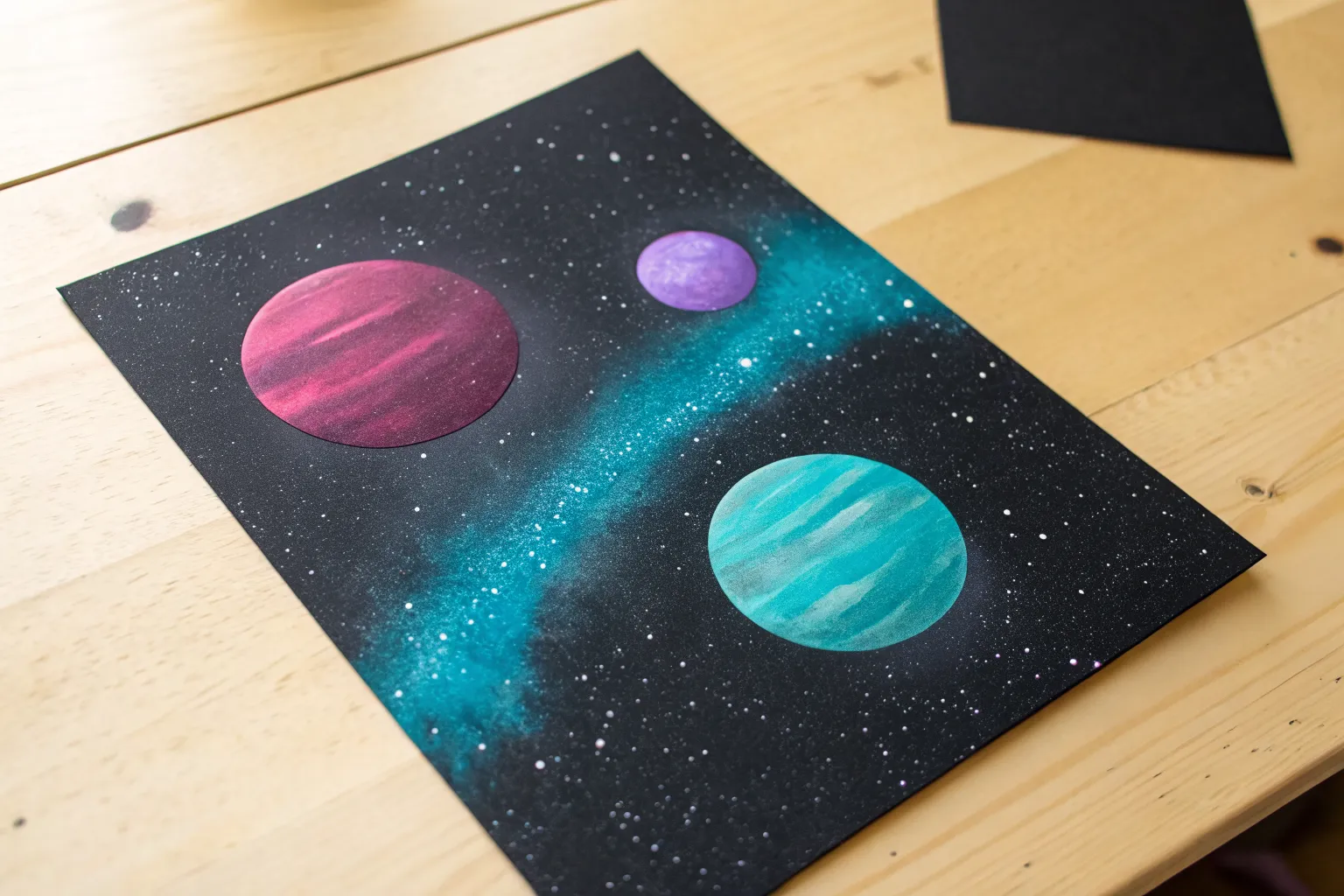
If you’re new to spray paint art, you’re in for that magical moment where a few quick layers suddenly look like something you’d hang on the wall. These beginner ideas are the ones I teach when you want bold results fast—lots of masking, easy silhouettes, and super-forgiving cosmic textures.
Classic Galaxy With One Planet
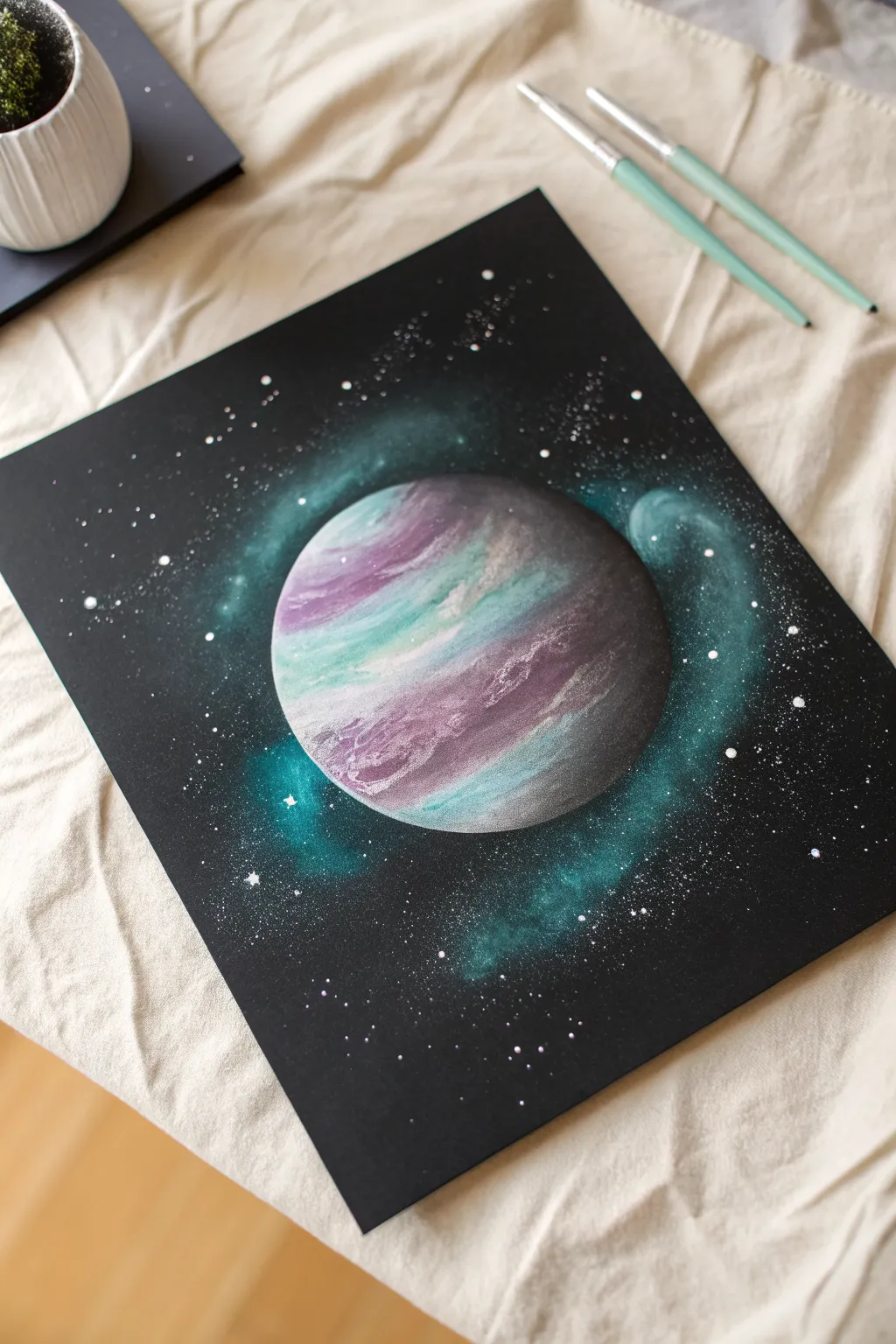
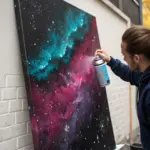
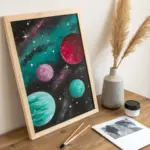
This striking project captures the serene beauty of a lone planet drifting through a misty teal nebula. With its vibrant swirls of purple and turquoise against a deep black void, it’s the perfect introduction to creating dimension and texture with spray paint.
Step-by-Step
Materials
- Glossy poster board or photo paper (black)
- Spray paint (Teal/Turquoise, Purple, White, Black)
- Round object for masking (bowl, lid, or plate)
- Couple of sheets of magazine paper or newspaper texture tool
- Protective gloves and mask
- Drop cloth or cardboard workspace
Step 1: Creating the Planet Texture
-
Prepare your space:
Set up your workspace in a well-ventilated area, laying down your drop cloth. Place your glossy poster board flat in the center. -
Lay the color base:
In the general area where you want your planet, spray a patch of your teal paint. Don’t worry about a perfect circle yet; just get the color down. -
Add secondary colors:
While the teal is still wet, spray a stripe or patch of purple right next to or slightly overlapping the teal. -
Whiten the highlights:
Spray a quick burst of white paint across the colored area. This will help create the bright, atmospheric swirls later. -
Texture with magazine paper:
Immediately crumple a piece of glossy magazine paper into a loose ball, then flatten it out slightly. Lay it gently over the wet paint. -
Create the topography:
Lightly run your hand over the magazine paper to ensure contact, then peel it off. You’ll see organic veins and craters form where the paint lifts. -
Add a shadow side:
To give the planet roundness, lightly mist a small amount of black spray paint on the bottom-right edge of your textured area to create a shadow crescent.
Step 2: Masking and Background
-
Mask the planet:
Once you are happy with your texture, place your round object (bowl or lid) directly over the painted area. This protects your planet while you paint the background. -
Black out the background:
Spray black paint over the entire rest of the poster board, covering any overspray from your initial color layers. Ensure the background is solid black. -
Create the nebula mist:
With the lid still in place, aim your teal spray can partly at the lid and partly at the paper. Spray short bursts around the perimeter of the lid to create a glowing halo effect. -
Extend the galaxy:
Continue using the teal paint to spray a sweeping, curved line extending outward from the planet, mimicking a spiral arm or gas cloud. -
Soften the nebula:
If I feel the teal is too harsh, I sometimes mist a tiny bit of white from a distance into the center of the nebula cloud to brighten it up.
Paint drying too fast?
Work quickly! Spray paint dries fast. Have your magazine paper ready before you spray the first color so you can texture immediately while it is wet.
Step 3: Stars and Final Reveal
-
Prepare for stars:
Spray a small puddle of white paint onto a piece of scrap cardboard or directly onto your gloved finger. -
Flick the stars:
Dip your fingers into the white paint and flick them toward the paper. Varing the speed of your flick will change the size of the star clusters. -
Remove the mask:
Wait about a minute for the mist to settle, then carefully lift the bowl or lid straight up to reveal your sharp, circular planet underneath. -
Check for cleanup:
Inspect the edges of your planet. If any mist crept under the lid, you can touch it up carefully, but usually, it adds to the atmosphere. -
Dry completely:
Allow the entire piece to dry for at least 15-20 minutes before handling or framing it.
Add a comet
Turn a can of white paint upside down and press the nozzle very gently while moving your hand quickly across the sky to create a shooting star streak.
Hang your new celestial masterpiece on the wall and enjoy the view of your personal galaxy
Two-Color Nebula Gradient Background
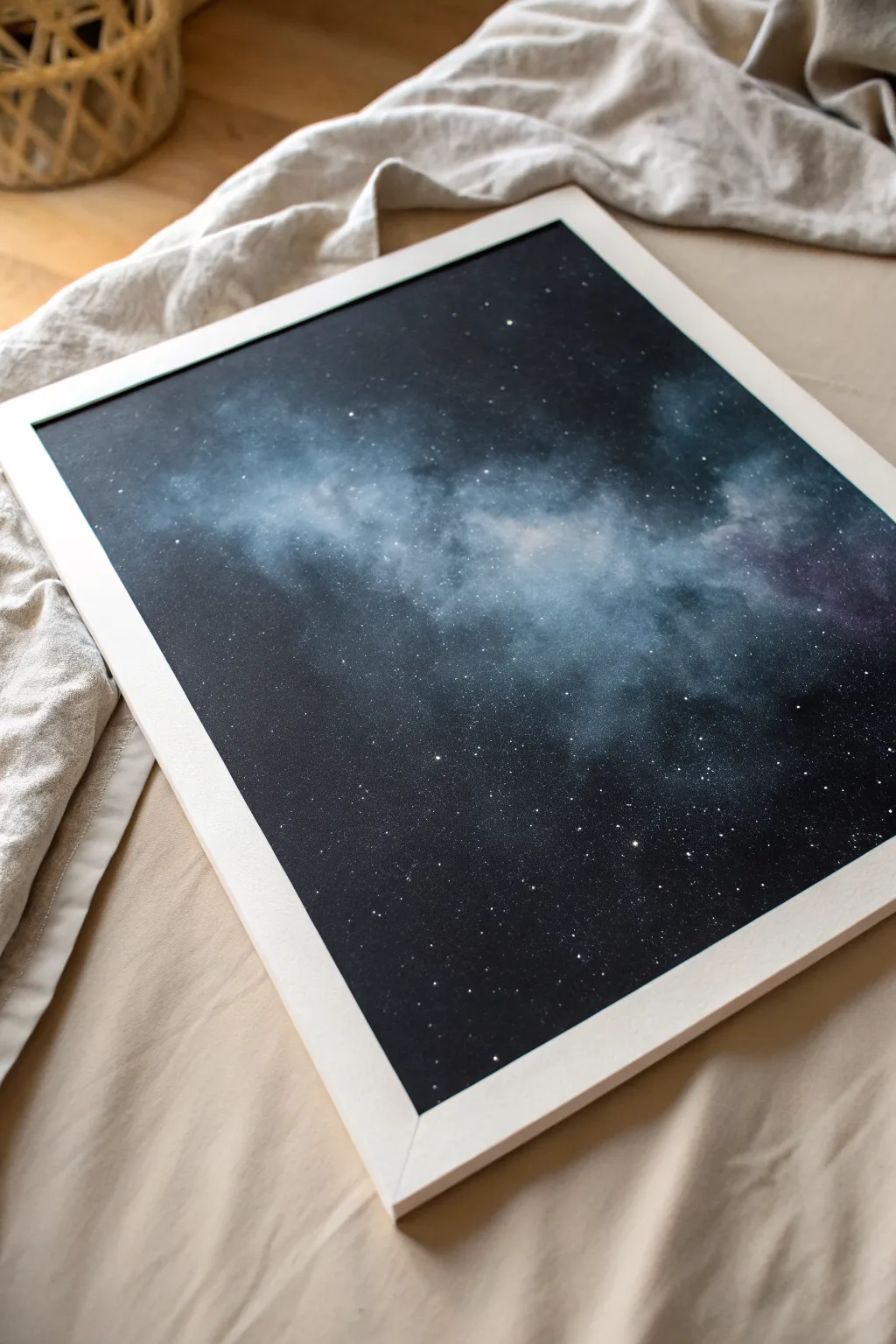
This project captures the quiet intensity of deep space using just two main colors and a simple layering technique. The result is a moody, ethereal galaxy painting that looks incredibly professional framed against a stark white border.
Step-by-Step Tutorial
Materials
- Heavyweight poster board or glossy cardstock (11×14 or similar)
- Black spray paint (gloss or matte)
- Bright blue spray paint
- Purple spray paint (optional, for depth)
- White spray paint
- A scrap piece of heavy paper or cardstock (for texture)
- Latex gloves
- Respirator mask
- Clean, dry painting workspace
- White frame (for finishing)
Step 1: Setting the Stage
-
Direct the flow:
Before spraying, examine your workspace. Ensure you have good ventilation and that your paper is taped down securely if you are working outside to prevent it from blowing away. -
Lay the foundation:
Start by shaking your black spray paint can vigorously for at least one minute to ensure the pigment is mixed well. -
Apply the base coat:
Spray a generous, even layer of black paint across the entire surface of your poster board. You want full coverage so no white paper shows through. -
Add the nebula core:
While the black base is still wet, take your bright blue spray paint. Aim for the center-right section of the paper. -
Create soft edges:
Spray the blue in short, controlled bursts. I like to hold the can slightly further away than normal (about 12 inches) to create a misty, diffused edge rather than a solid spot of color. -
Introduce depth (optional):
If you are using purple, spray a very small, quick burst near the edge of the blue area to add a subtle variation in the cosmic gas cloud.
Step 2: Texturing the Galaxy
-
Crumple the tool:
Take your scrap piece of heavy paper or a magazine page and crumple it up into a loose ball, then unfurl it slightly so it has ridges and peaks. -
Lift the pigment:
While the paint is still tacky (this is crucial), gently press the crumpled paper onto the blue and black painted areas. -
Create the cloud effect:
Lift the paper straight up. This technique removes some of the top layer of paint, revealing the colors underneath and creating that organic, cloudy nebula texture seen in the photo. -
Repeat as needed:
Continue dabbing and lifting around the nebula area. Vary your pressure to create lighter and darker patches within the blue mist. -
Re-darken the void:
If you feel the blue has taken over too much of the canvas, spray a light mist of black around the corners and edges to frame the nebula back into the darkness.
Muddy colors?
If your blue and black are mixing into a grey sludge, you likely over-manipulated the paint with the crumpled paper. Dab once and lift; avoid rubbing or dragging the paper.
Step 3: Creating the Stars
-
Prepare the stars:
Spray a small puddle of white spray paint onto a disposable palette or a piece of cardboard. -
Load the paint:
Dip your gloved fingers into the white paint puddle. You want paint on your fingertips, but not dripping wet. -
Flick the universe:
Position your hand over the artwork. Use your thumb to flick your fingers, snapping the paint off your tips onto the canvas. -
Control the density:
Flick more pigment over the blue nebula areas to suggest a dense star cluster, and flick sparsely over the black void areas for distant, lonely stars. -
Add major stars:
For a few larger, brighter stars, you can hold the white spray can upside down (or use a special nozzle) to spit a few larger droplets, but be careful not to overdo it. -
Final dry:
Let the entire piece dry completely for at least an hour in a well-ventilated area before attempting to move or frame it. -
Framing:
Once bone dry, place the artwork into a clean white frame. The high contrast of the white border makes the deep black space scene pop visually.
Add a planet
Before spraying the background, place a pot lid or round bowl on the paper. Spray around it. Remove it at the end to reveal a perfectly round planet silhouette.
Now you have a piece of cosmic art that invites you to get lost in the stars
Starfield Splatter Over Deep Space
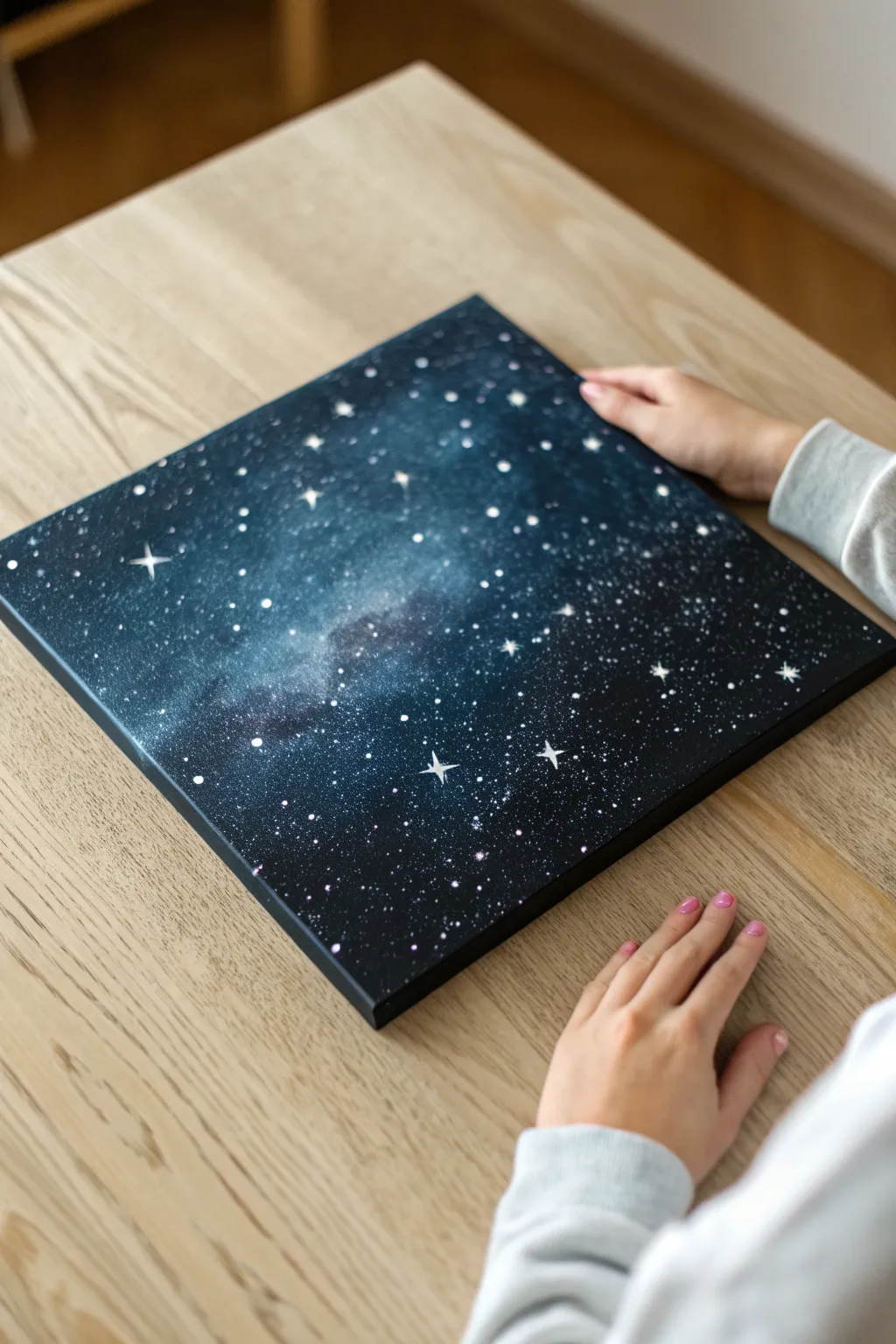
Capture the magic of deep space with this mesmerizing spray paint galaxy, featuring layers of nebula mist and brilliant starbursts. The depth is achieved through simple layering techniques that make the stars feel like they are floating at different distances.
Step-by-Step Guide
Materials
- Square canvas (12×12 or 16×16 inch)
- Black spray paint (matte or satin)
- Deep blue spray paint (navy or midnight blue)
- Teal or cyan spray paint
- Purple spray paint (optional, for subtle depth)
- White acrylic paint
- Old toothbrush
- Small fine-liner paintbrush
- Glossy clear coat spray
- Drop cloth or newspapers
- Respirator mask
- Gloves
Step 1: Setting the Atmosphere
-
Prep your workspace:
Lay down your drop cloth in a well-ventilated area, preferably outdoors. Set your canvas flat on a raised surface, like an old box, so you can easily spray the edges. -
Apply the base coat:
Cover the entire canvas with black spray paint. Use long, sweeping motions to ensure even coverage, and don’t forget to spray the sides of the canvas for a professional finish. -
Create the nebula core:
While the black is still slightly tacky, take your teal or cyan spray paint. Hold the can about 12 inches away and do a few quick, soft bursts in the center-left area to create a cloudy glow. -
Add deep space tones:
Spray your deep blue paint around the edges of the teal cloud, blending it outward into the black. The goal is a soft transition, not a hard line. -
Layer in purple accents:
If you are using purple, add very sparing, quick bursts overlapping the blue and teal sections. This adds a subtle richness that mimics real nebula photography. -
Soften the edges:
Mist a tiny bit of black spray paint back over the edges of your colored areas. This ‘pushes’ the color back and makes the nebula look like it’s fading into the darkness. -
Let it dry:
Allow the spray paint layers to dry completely, which usually takes about 15 to 20 minutes depending on humidity. The surface should not be sticky to the touch.
Step 2: Birthing the Stars
-
Prepare the splatter mix:
Squeeze a coin-sized amount of white acrylic paint onto a palette or paper plate. Add a few drops of water to thin it down until it has an inky, fluid consistency. -
Load the toothbrush:
Dip the bristles of an old toothbrush into your thinned white paint. Test the consistency on a piece of cardboard first to ensure you get dots, not globs. -
Create background stars:
Hold the toothbrush about 10 inches above the canvas. Run your thumb quickly across the bristles to flick a fine mist of tiny white specks across the entire dark background. -
Add larger stars:
Reload the toothbrush with slightly thicker paint. Bring it closer to the canvas and flick slower to create larger, brighter stars in concentrated clusters, primarily over the lighter nebula areas. -
Paint the hero stars:
Using your fine-liner brush and un-thinned white acrylic, carefully dot a few specific points where you want the brightest stars to be. -
Add the flares:
For the largest stars, paint a tiny cross or ‘plus sign’ through the center dot. Extend the vertical line slightly more than the horizontal one to create that classic twinkling star effect. -
Seal the galaxy:
Wait for the acrylic stars to dry fully. Finish the piece with a light coat of glossy clear spray to make the dark colors pop and protect the paint.
Paint Blob Rescue
Did a large drop of white paint fall by mistake? Don’t wipe it! Turn it into a distant planet or a larger star by carefully dabbing it with a paper towel to create texture.
Cosmic Depth
For a 3D effect, do a layer of fine star splatter, let it dry, spray a very thin mist of transparent black over it, and then add a second layer of fresh bright stars on top.
Hang your new piece on the wall and enjoy the view of your personal galaxy
Mountain Silhouette Under a Cosmic Sky
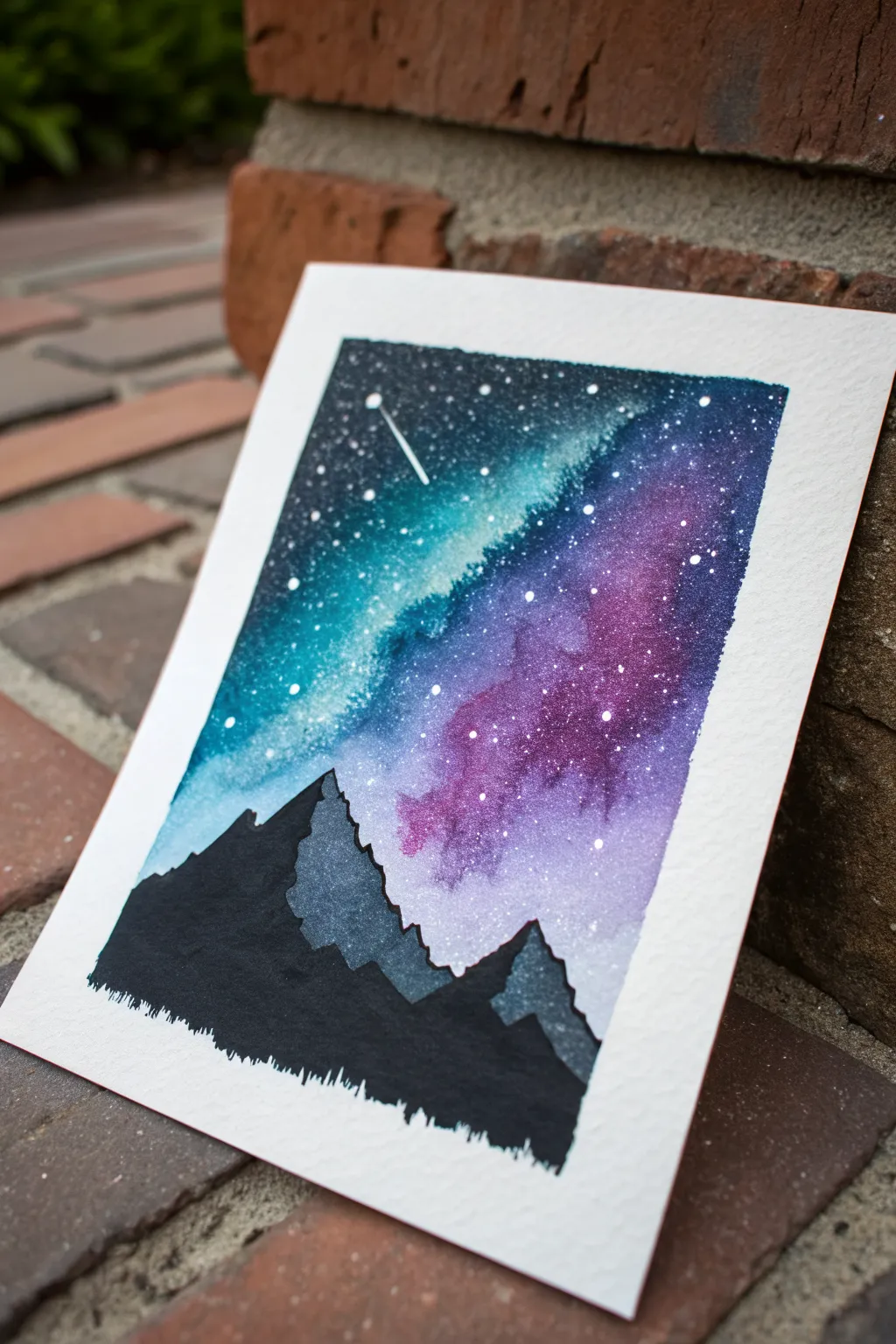
Capture the magic of a starry night over jagged peaks with this striking silhouette project. By blending cool cosmic tones and layering stark mountains, you’ll create a scene that feels infinite yet intimate.
Step-by-Step
Materials
- Heavyweight watercolor paper or mixed media paper
- Painter’s tape or masking tape
- Spray paint cans: Teal, Purple, Dark Blue, Black, White
- Cardstock or stiff paper (for stencils)
- Scissors or craft knife
- Gloves and mask (for safety)
- Old toothbrush or spray paint splatter nozzle
Step 1: Preparation & Sky Layer
-
Secure the Borders:
Begin by taping down all four edges of your paper to a flat, protected surface. This creates that clean, professional white border shown in the final piece and keeps the paper from curling. -
Base Color – Teal:
Shake your teal spray paint well. Spray a diagonal streak starting from the upper left area, moving towards the center. Keep the can about 8-10 inches away for a soft, diffused edge. -
Adding the Purple Nebula:
While the teal is still tacky, spray a burst of purple into the center and right side of the paper. Allow it to slightly overlap with the teal to create interesting blended transition zones. -
Deepening Space:
Use dark blue spray paint to fill in the remaining corners and edges of the sky. Mist it lightly over parts of the purple and teal to darken them, giving the effect of deep, outer space surroundings. -
Creating Stars:
Spray a small puddle of white paint onto a scrap piece of cardboard. Dip an old toothbrush into it and flick the bristles with your thumb to create a spray of fine white stars across the wet sky. -
The Shooting Star:
For the prominent shooting star, use a piece of cardstock as a shield. Hold it close to the paper and spray a quick, tiny burst of white, or simply use a white paint pen later for more control. -
Dry Time:
Let this cosmic background dry completely before moving on. If it’s sticky, your mountain stencils might adhere to the paint and ruin the finish.
Uneven Spray?
If your spray can sputters, try cleaning the nozzle with warm water or thinner. Always test spray on scrap cardboard first.
Step 2: Mountain Layers
-
First Stencil Cut:
Take a piece of cardstock and tear or cut a jagged, uneven edge. This will be the stencil for your distant, lighter mountain range. -
Positioning the Distance:
Place this torn stencil about one-third of the way up from the bottom of your paper, covering the sky you want to protect. -
Spraying the Mid-Ground:
Lightly mist black spray paint (or a dark grey if you have it) below the stencil line. You don’t want this layer pitch black yet; a slightly misty, semi-transparent look adds depth. -
Shift and Repeat:
Once the first mountain layer is dry to the touch, tear a new stencil shape with different peaks. Place this one slightly lower than the first one. -
Foreground Mountains:
Spray a heavy, solid coat of black paint below this new stencil line. This creates the closest mountain range, which should be the darkest and most defined silhouette. -
Grassy Texture:
To get the uneven, grassy texture at the very bottom, hold your can closer and spray short bursts, or use a torn piece of paper with tiny, erratic rips as a final stencil along the bottom edge. -
The Reveal:
Wait until everything is absolutely dry. I prefer to wait at least 20 minutes to be safe. Carefully peel away the border tape at a 45-degree angle to reveal crisp, clean edges.
Add a Planet
Place a coin or circular object on the paper before spraying the sky colors. Remove it at the end to reveal a solid planet silhouette.
You now have a window into a vast galaxy resting in your hands
BRUSH GUIDE
The Right Brush for Every Stroke
From clean lines to bold texture — master brush choice, stroke control, and essential techniques.
Explore the Full Guide
Pine Tree Line Silhouette With Moon
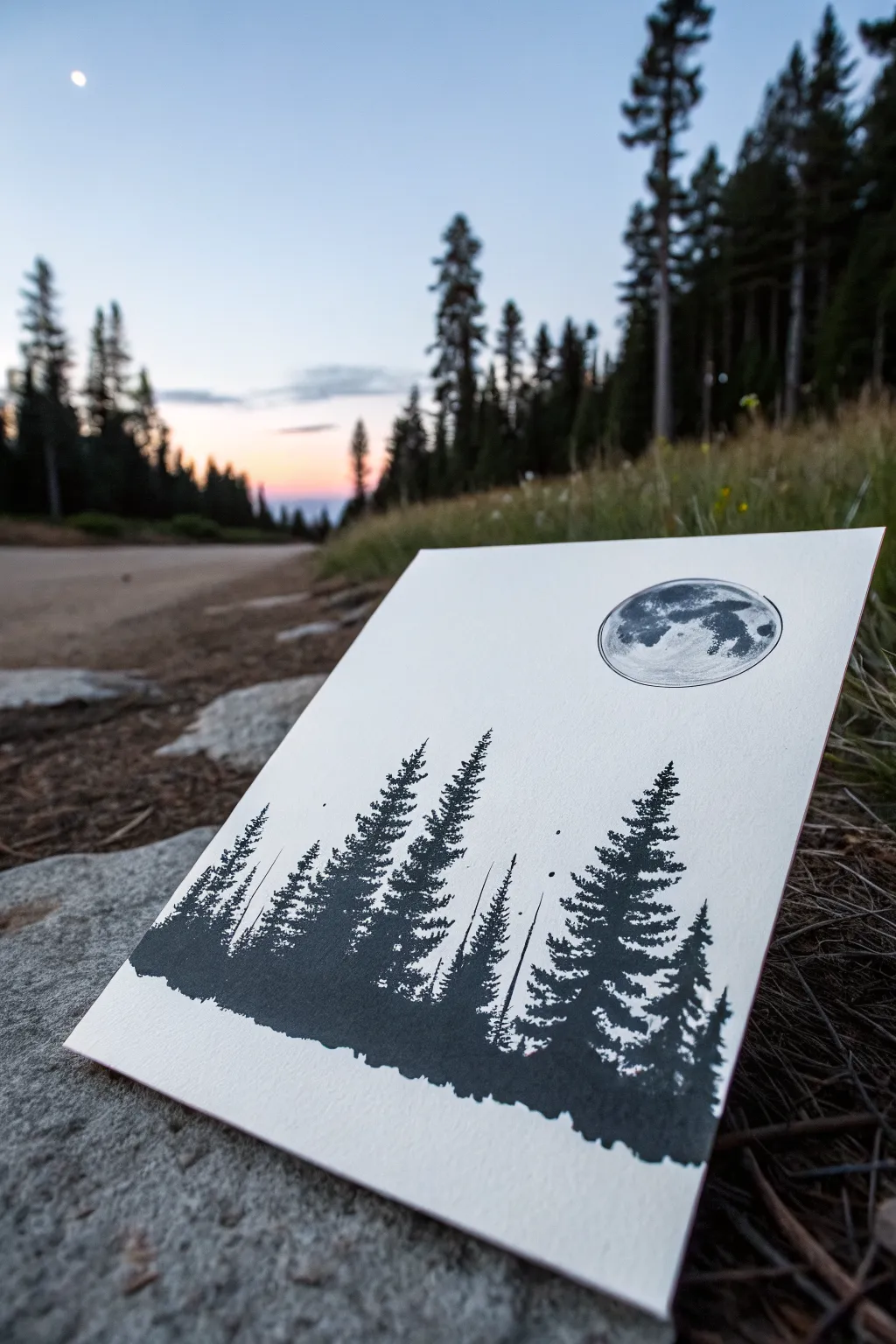
Capture the serene beauty of a twilight forest with this minimalist black and white spray paint project. By combining crisp stenciling for the moon with freehand masking techniques for the trees, you’ll create a striking contrast that looks professionally printed.
Step-by-Step Guide
Materials
- Heavyweight mixed media paper or cardstock (white)
- Black spray paint (matte finish)
- Grey spray paint (optional, for moon shading)
- Cardboard or poster board (for masking)
- Circle stencil or circular object (can lid)
- Newsprint or scrap paper
- Painter’s tape
- Exacto knife or craft scalpel
- Graphite pencil (soft, like 2B-4B)
- Blending stump or cotton swab
Step 1: Planning and The Moon
-
Choose your canvas:
Begin with a rectangular piece of heavyweight white paper. Cardstock works well because it won’t warp easily under the light mist of spray paint. -
Position the moon stencil:
Decide where you want your moon. In this design, it’s placed in the upper right quadrant. Place a circle stencil down, or use the negative space left after cutting a circle out of a piece of scrap paper. -
Mask the surrounding area:
Cover the rest of your white paper completely with newsprint or scrap sheets, taping them down so only the circle opening is exposed. You want to protect that pristine white background. -
Add texture to the moon:
This moon isn’t just a white circle; it has craters. Lightly crumple a small piece of paper or use a natural sponge. Dip it very lightly into a tiny puddle of black or dark grey paint (sprayed onto cardboard first). -
Detail the craters:
Gently dab the crumpled paper or sponge inside your stencil opening. Keep the texture concentrated on one side to mimic shadows. -
Draw finer details:
For the specific crisp look in the reference, remove the stencil once the paint is dry. Use a graphite pencil to hand-draw the craters and ridges. I like to shade heavily in the ‘seas’ (maria) of the moon and blend with a stump for that realistic, moody look shown.
Step 2: Creating the Tree Line
-
Prepare the torn edge mask:
Take a piece of scrap cardboard or stiff paper that is wider than your canvas. Tear the top edge roughly to create an uneven, organic line. This will form the ground and the base of your trees. -
Position the ground mask:
Place this torn mask across the bottom third of your paper. This protects the very bottom edge and gives the tree line a natural place to sit. -
Cut vertical barriers:
To make distinct trees rather than a blob of black, you need vertical masks. Cut several long, thin strips of paper or poster board. -
Arrange the tree spacing:
Lay these vertical strips down on your paper where you want the *gaps* between the trees to be. The empty spaces between the strips will become your pine trees. -
Create foliage texture (The Card Trick):
This is a classic spray paint art technique. Spray black paint onto a piece of glossy magazine paper or a palette. Quickly, while it’s wet, dip the edge of a small piece of torn poster board into the paint. -
Stamp the tree tops:
Press the paint-loaded edge onto your paper where a tree tip should be. Rock the card gently to transfer the paint in a narrow pine shape. -
Build the branches downward:
Work your way down the tree trunk, re-dipping your card into wet paint often. As you go lower, angle your stamping strokes slightly outward to make the tree wider at the base. -
Vary the density:
Make some trees dense and dark, and others slightly sparse by using less paint. This mimics the natural variation in a forest. -
Fill the silhouette base:
Once you reach the bottom where your torn ground mask is, fill in the lower canopy solidly with the black paint using your card or a quick, controlled spray if you have the control. -
Add floating particles:
The reference image shows tiny specks around the trees. Flick a toothbrush with a tiny bit of black paint, or gently tap a paint marker to add a few deliberate dots in the air for atmosphere.
Clean Edges Only
If paint bleeds under your moon stencil, don’t panic. Wait for it to dry, then gently use a white gel pen or opaque white paint marker to cover the mistake and reshape the circle.
Step 3: Finishing Touches
-
Dry completely:
Let the black paint dry fully before moving anything. The ink needs to set so it doesn’t smear into the white sky. -
Remove masks:
Carefully peel away the ground mask and any vertical strips you used. Reveal the crisp bottom edge. -
Touch up the moon outline:
If your moon stencil left a fuzzy edge, use a fine-tip black pen or your pencil to crispen the circular outline, giving it that graphic illustration style. -
Review contrast:
Check your darks. If the black trees look a bit grey or transparent in spots, carefully go back over them with the card-stamping technique or a black marker to ensure a solid silhouette.
Pro Tip: Card Stock Matters
For the tree foliage, use glossy paper (like magazine covers) for your stamping tool. It doesn’t absorb the paint, allowing you to transfer distinct, sharp textures onto the artwork.
Once the paint has fully cured, frame your monochromatic masterpiece or gift it as a stunning handmade card
City Skyline Silhouette With Sunset Fade
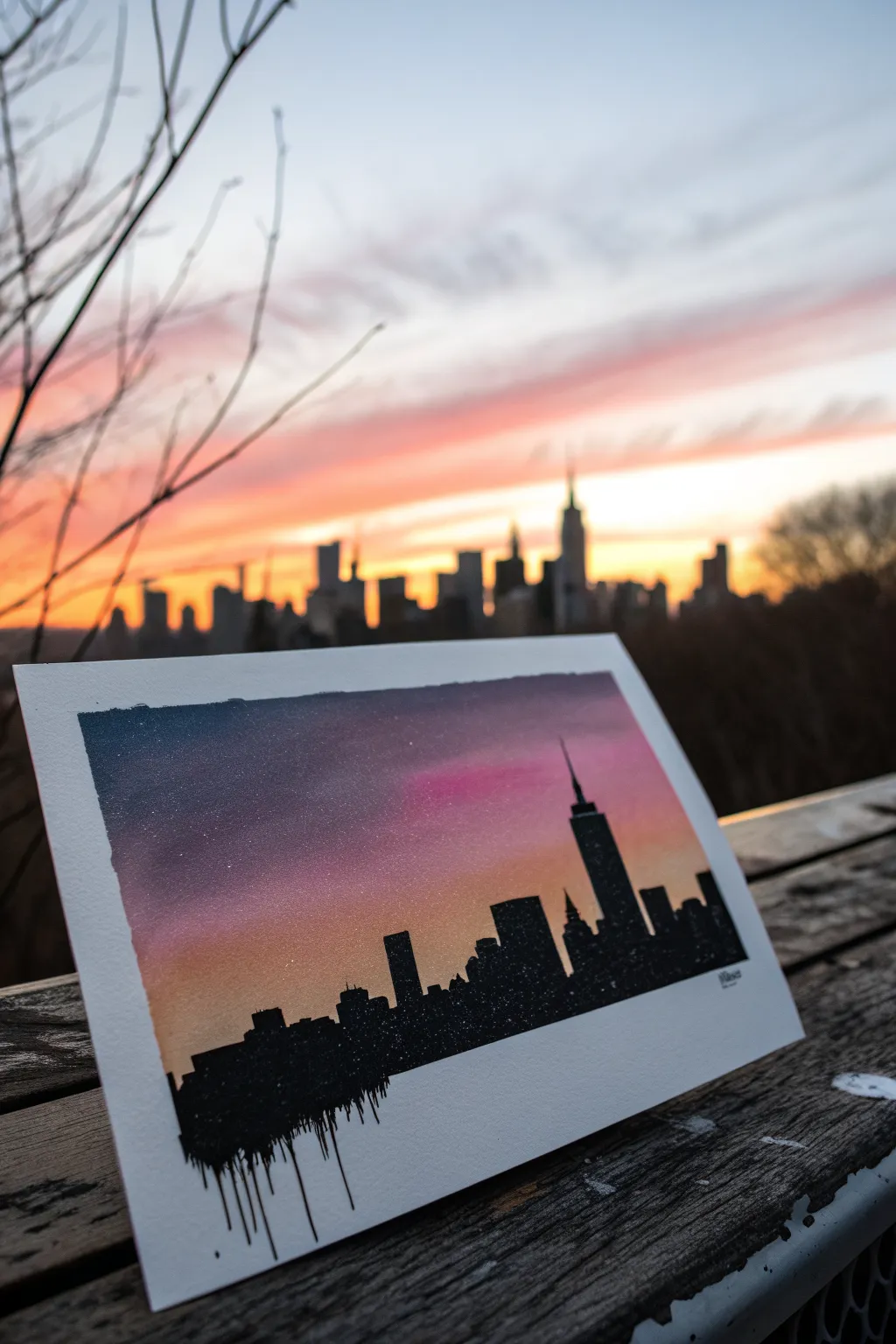
Capture the moody beauty of a city transitioning into night with this striking silhouette project. By combining a soft, blended spray paint gradient with a crisp, dripping black skyline, you’ll create a piece that feels both structured and spontaneous.
Step-by-Step
Materials
- Heavyweight watercolor paper or mixed media cardstock (approx. 5×7 inches)
- Spray paint: Dark Blue/Navy
- Spray paint: Purple/Magenta
- Spray paint: Orange
- Spray paint: Yellow or Light Peach
- Black acrylic paint or black spray paint (decanted into a cup)
- Painter’s tape or masking tape
- Small flat paint brushes and detail brushes
- Scrap cardboard or a drop cloth
- Pencil and eraser (optional)
Step 1: Setting the Sky
-
Prepare your canvas:
Begin by securing your paper to a scrap piece of cardboard using a loop of tape on the back. This keeps it from flying away while spraying. -
Mask the borders:
Apply strips of painter’s tape along all four edges of your paper to create a clean white frame. Press down firmly to prevent paint from sneaking underneath. -
Apply the darkest tone:
Start at the very top of the paper with your dark blue or navy spray paint. holding the can about 8-10 inches away, spray a light, horizontal band across the top third. -
Transition to purple:
Immediately follow with the purple or magenta spray paint slightly below the blue, aiming partially over the bottom edge of the blue to encourage blending. -
Add the warmth:
Spray a band of orange below the purple, again overlapping slightly to create that seamless transition from cool night sky to warm sunset. -
Finish the horizon:
Complete the gradient by spraying yellow or light peach at the very bottom. Don’t worry if it looks too bright; the silhouette will cover much of this area. -
Dry completely:
Set the paper aside in a well-ventilated area. It is crucial that the background is 100% dry before you attempt to paint the sharp black lines over it.
Step 2: Building the City
-
Plan the skyline:
Once dry, lightly sketch a horizon line just below the halfway point of your gradient. You can pencil in rough shapes for skyscrapers, including one tall spire like the Empire State Building. -
Prepare the black paint:
For the silhouette, you can use black acrylic paint for control, or spray some black spray paint into a plastic cup and use a brush to apply it while it’s liquid. -
Block in the main shapes:
Using a flat brush, fill in the solid black blocks of the buildings. Focus on getting nice sharp edges on the roofs and corners. -
Add architectural details:
Switch to a fine detail brush to add the antenna spire on the tallest building and any small water towers or jagged roof details on the smaller structures. -
Create the drip effect:
At the bottom of your black city block, load your brush with watered-down black acrylic (or the liquid spray paint). Press the loaded brush against the bottom edge. -
Encourage the flow:
Tilt the paper upright so gravity pulls the excess paint down. If it’s stubborn, tap the paper gently on your surface or add a tiny drop of water to the paint bead. -
Vary the lengths:
I like to make sure the drips are uneven—some long, some short—to keep the aesthetic organic and gritty rather than uniform. -
Final dry:
Let the black layer dry completely. The drips will take longer than the rest of the painting. -
Reveal the border:
Carefully peel away the masking tape. Pull it away from the center of the painting at a 45-degree angle to ensure a crisp, clean edge.
Paint Bleeding Under Tape?
If edges aren’t crisp, your tape wasn’t sealed tight enough. Next time, run a fingernail or credit card firmly over the tape edges before spraying to lock them down.
Add Subtle Stars
Before painting the black city, flick a toothbrush loaded with white paint over the dark blue section to create a faint starry night effect.
Peel back that tape and enjoy your vibrant, contrasting cityscape

PENCIL GUIDE
Understanding Pencil Grades from H to B
From first sketch to finished drawing — learn pencil grades, line control, and shading techniques.
Explore the Full Guide
Multiple Planets With Bowl Masks
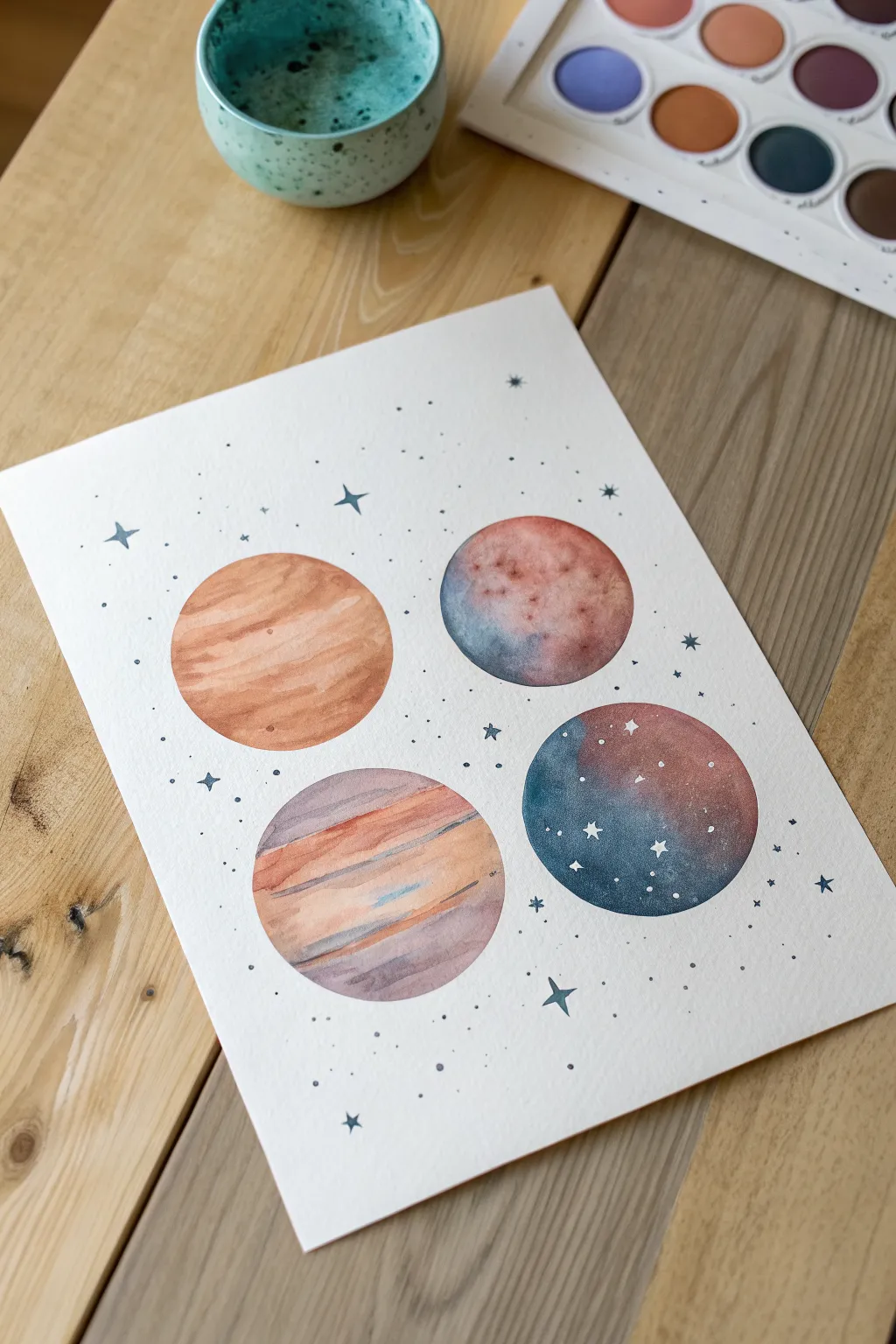
Despite the section title referencing spray paint, this particular example showcases the delicate beauty of watercolor to create celestial bodies. You’ll learn to wet-blend pigments to form four distinct planets, surrounded by a constellation of hand-painted stars.
Step-by-Step Guide
Materials
- Cold-pressed watercolor paper (300gsm recommended)
- Watercolor paints (pan set shown: rust, ochre, indigo, violet, deep blue)
- Round watercolor brushes (sizes 6 or 8 for planets, size 0 or 2 for stars)
- Small bowls, cups, or a compass for tracing circles
- Pencil and eraser
- Two jars of water (one for clean, one for dirty)
- Paper towels
- White gel pen or gouache (optional for stars)
Step 1: Preparation & Tracing
-
Plan your layout:
Place your piece of watercolor paper on a flat surface. Visualize where you want your four planets to sit, aiming for a balanced composition that doesn’t feel too cluttered. -
Trace the circles:
Use small bowls, cups, or a drafting compass to lightly trace four perfect circles onto the paper with a pencil. Keep the lines faint so they disappear under the paint later. -
Prepare your palette:
Activate your watercolor pans with a drop of water each. You’ll need earthy tones like burnt sienna and ochre for the left planets, and cool tones like indigo and violet for the right ones.
Pro Tip: Bloom Control
To stop colors from turning to mud, clean your brush thoroughly between warm and cool planets. I like to change my water halfway through to keep the colors crisp.
Step 2: Painting the Warm Planets
-
Start the top-left planet:
Wet the inside of the first circle with clean water using your larger brush. Drop in diluted burnt sienna or rust color, letting it bloom across the wet surface. -
Create texture:
While the paint is still wet, add horizontal strokes of a slightly darker brown or ochre across the sphere to simulate atmospheric bands. Leave some areas lighter to create a spherical illusion. -
Paint the bottom-left Jupiter-style planet:
Move to the bottom-left circle. Wet the area and paint distinct bands of color: start with rust orange, blending into creamy ochre, and add a touch of muted purple at the bottom. -
Refine the bands:
Use the tip of your brush to drag the wet pigment horizontally, creating the stripes typical of gas giants. Allow the colors to bleed slightly into each other for a soft look.
Level Up: Metallic Magic
Mix a tiny amount of metallic gold or silver watercolor into your star paint, or trace the sheer edge of one planet, to make your galaxy catch the light.
Step 3: Painting the Cool Planets
-
Draft the top-right planet:
For this textured world, wet the circle and drop in a mix of reddish-brown and steel blue. Don’t over-blend; let the two colors sit side-by-side to create a mottled, cratered surface. -
Add salt for texture (optional):
If you want extra texture on this planet, sprinkle a tiny pinch of table salt on the wet paint. It will absorb pigment and create starburst patterns once dry. -
Start the bottom-right deep space planet:
Load your brush with indigo or deep prussian blue. Paint this circle with a gradient, making one side much darker than the other to suggest a shadow side. -
Blend in warmth:
While the blue is wet, drop a small amount of reddish-purple or warm brown into the lighter side of the planet, letting them merge softly.
Step 4: Details & Stars
-
Add highlights:
Once the bottom-right planet is damp but not soaking, use a small brush to lift out a few tiny dots of color, or use white gouache to paint tiny stars directly onto the planet’s surface. -
Paint the background stars:
Switch to your smallest brush (size 0 or 2). Load it with a dark blue-grey mixture. -
Draw star shapes:
Draw four-pointed stars by making a small cross shape, elongating the vertical and horizontal lines. Scatter these randomly around the planets. -
Add stardust:
Fill the empty spaces between planets with tiny dots of the same grey-blue color. Vary the pressure to make some dots larger and some barely visible specks. -
Final check:
Step back and look at the composition. If any planet looks too flat, you can add a second layer of glaze to the shadowed side once the first layer is completely dry.
Once fully dry, frame your cosmic creation to add a serene, artistic touch to your space
Ringed Planet With Simple Ring Mask
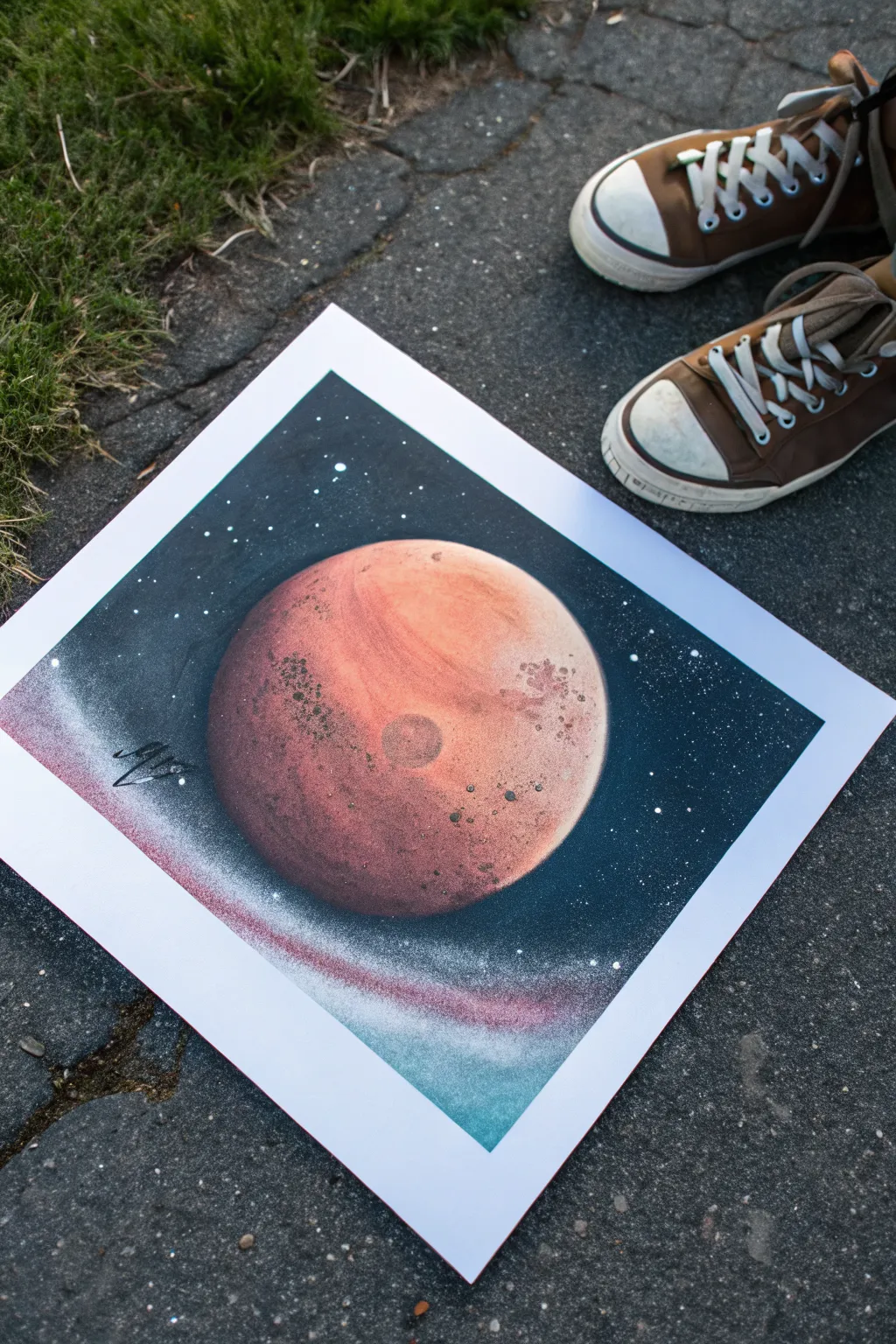
Create a striking celestial scene featuring a textured, Mars-like planet floating against a deep, starry void. This beginner-friendly project uses basic masking techniques to achieve a crisp, spherical look with surprising depth.
Step-by-Step Tutorial
Materials
- Glossy poster board (white)
- Spray paint: Black, White, Red, Orange, Yellow
- Round object for masking (pot lid, bowl, or cake pan)
- Magazine page or glossy paper (for texture)
- Newspaper or scrap paper
Step 1: Creating the Planet Texture
-
Lay the Foundation:
Place your glossy poster board on a flat, protected surface. In the center area where you want your planet, spray a generous patch of yellow and orange paint. Keep the layers wet for mixing. -
Add Vivid Color:
While the base is still wet, spray bursts of red paint over the orange and yellow. Don’t worry about making a perfect circle yet; just focus on getting good color coverage in the center. -
Initial Texture:
Take a crumpled piece of a magazine page or glossy paper. Press it flat onto the wet paint, gently smooth it with your hand, and immediately peel it off to create veins and rocky textures. -
Create the Shadow Side:
To give the planet dimension, spray a light mist of black paint along the bottom-left edge of your colored area. This will become the shadowed side of the sphere. -
Highlight the Bright Side:
Spray a quick burst of white paint on the opposite, upper-right side. This simulates light hitting the atmosphere. -
Add Craters:
For the large impact crater seen in the center, place a small circular object (like a bottle cap or cut paper circle) onto the wet paint. Spray a tiny burst of black on one side of it to create a shadow, then lift the object. -
Final Texture Pass:
Use your magazine page again, lightly touching areas that look too smooth or where the colors need more blending. The goal is an organic, rocky surface.
Wet-on-Wet is Key
For the best marbling texture, ensure your base colors (yellow/red) are still wet when you apply the magazine paper. If it dries, the texture won’t lift.
Step 2: Background and Atmosphere
-
Mask the Planet:
Let the planet paint tack up for a minute. Place your large bowl, pot lid, or cut-out circle directly over the textured area. Ensure it seals well against the paper to keep the edge crisp. -
Darken the Void:
Spray black paint over the entire rest of the poster board, covering all exposed white areas. Go heavy enough to get a deep, rich black. -
Create the Nebula Streak:
While the black is wet, spray a faint, sweeping curve of white and maybe a touch of red near the bottom left corner to create a cosmic gas cloud or nebula effect. -
Soften the Nebula:
Mist a little more black over the edges of your nebula streak to push it into the background, making it look transparent and ghostly rather than like a solid line. -
Prepare the Stars:
Spray a small puddle of white paint onto a piece of scrap cardboard or paper. Dip your fingers into the paint (wear gloves!) or use a stiff brush. -
Flick the Stars:
Flick the white paint off your fingers or brush toward the black background. Vary your distance to create different sized stars. -
Add Major Stars:
If you want a few brighter, specific stars, hold the spray can upside down very close to the paper and give the nozzle a tiny, quick tap (test on scrap paper first). -
Reveal the Art:
Carefully lift your masking bowl or lid straight up. Do this slowly to avoid dragging any wet black paint across your colorful planet. -
Clean the Edge:
If there is any overspray on the planet, you can sometimes gently scrape it away with a craft knife once dry, but usually, the crisp line is ready to go. -
Sign It:
I always like to scratch my signature into the wet black paint using a nail or a stick for a permanent, etched look.
Go for a Galaxy Style
Add a spiral galaxy in the background by twisting a piece of newspaper in the wet black paint before flinging your stars.
Let your masterpiece dry completely before framing or displaying it on your wall


Comet Trails With Quick Swipe Masks
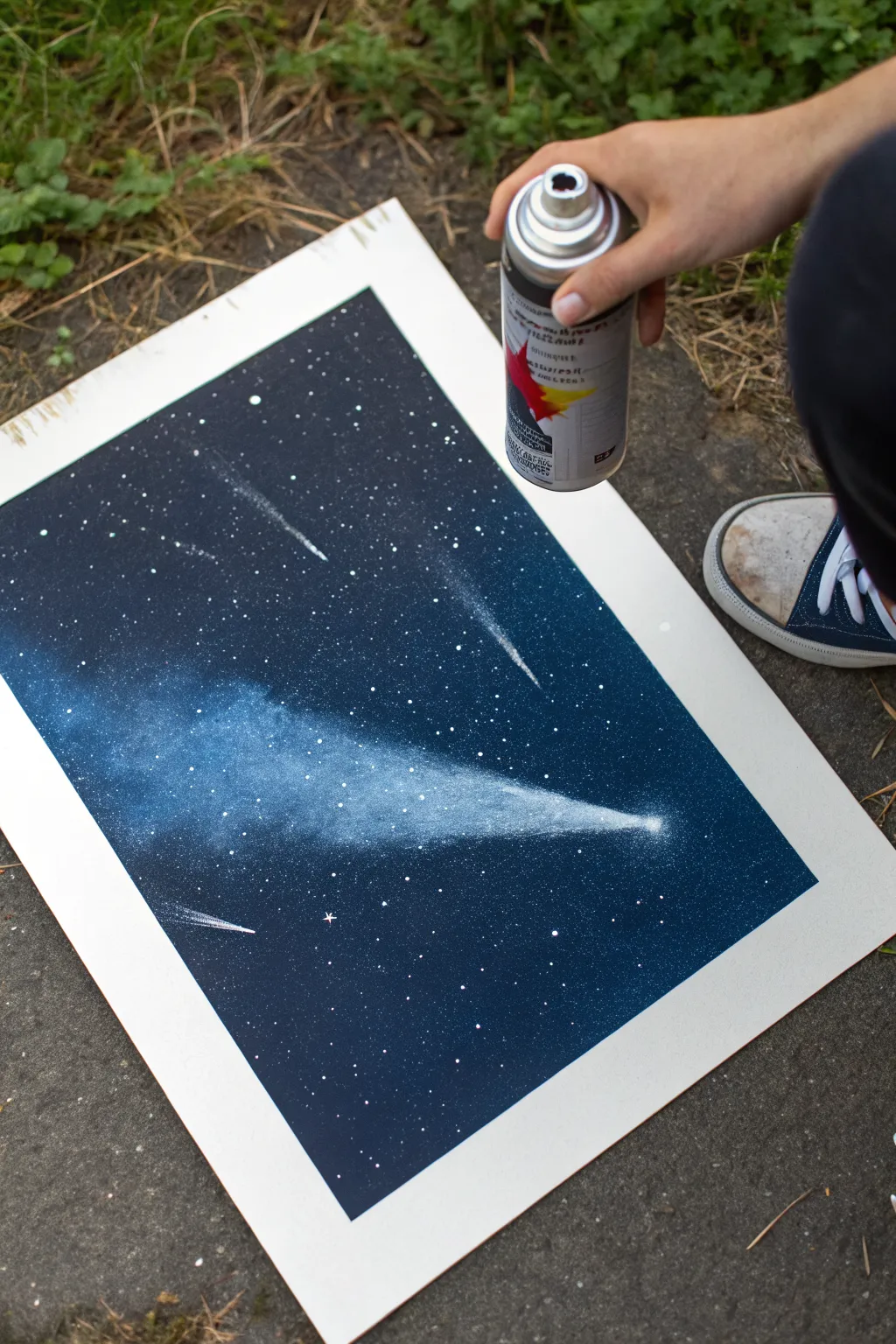
Capture the magic of a deep blue universe right on your patio with just a few simple spray techniques. This project creates a stunning comet tail effect using clever masking tricks to cut through the starry darkness.
Step-by-Step Tutorial
Materials
- White glossy poster board or heavy cardstock
- Navy blue spray paint
- Black spray paint
- White spray paint
- A scraps of stiff paper or torn magazine page (for masking)
- Painter’s tape or masking tape
- Gloves and respirator mask
- Cardboard box or drop cloth (to protect surface)
Step 1: Setting the Stage
-
Prepare your workspace:
Lay down your drop cloth or cardboard on a flat outdoor surface. Secure your white poster board in the center, ensuring the edges are flat. -
Lay the comet foundation:
Since we are working with subtractive layering, start by spraying a diagonal swath of white paint across the lower middle section of the paper. This will become the bright core of your comet later. -
Add secondary streaks:
Spray two smaller, shorter bursts of white elsewhere on the page—perhaps near the top corners—to serve as smaller shooting stars. -
Let it tack up:
Wait about a minute for the white paint to become tacky but not fully dry. This helps the next steps adhere without blending into a gray mess.
Step 2: Creating the Galaxy
-
Mask the main comet:
Tear a piece of magazine paper or stiff card. Hold it slightly above the paper, covering the bottom edge of your main white streak. -
Apply the deep blue:
While shielding that white streak, spray a heavy coat of navy blue over the rest of the paper. Overlap slightly with your mask to create a soft, fading edge on one side of the comet tail. -
Darken the void:
Take your black spray paint and focus on the corners and the edges furthest away from the light source. This vignette effect drives focus toward the center. -
Refine the comet shape:
Quickly, while the blue is wet, hold your torn paper mask along the top edge of the white streak and spray blue over it. The goal is to carve out a sharp, defined edge for the comet’s path. -
Repeat for smaller stars:
Use smaller torn paper scraps to mask the tiny white streaks you made earlier. Spray blue around them to reveal their shooting star shapes.
Blurred Edges?
If your comet edges look fuzzy, you held the mask too high. Keep the paper mask almost touching the surface for crisp lines, or lift it for soft glows.
Step 3: Stars and Details
-
Prepare for stars:
Spray a small puddle of white paint onto a scrap piece of cardboard or directly onto your gloved fingertip. -
Flick the stars:
While the background is still slightly wet, flick the white paint off your finger toward the artwork. Vary your distance to create different star sizes. -
Create the comet head:
To make the bright head of the comet, position the spray can nozzle very close to the widest part of your white streak. Give it a tiny, quick burst of white for an intense glow. -
Highlighting:
Add a few larger, deliberate stars by carefully tapping the nozzle to release larger droplets, or use a straw to blow a drop of paint onto the canvas. -
Dry and seal:
Allow the piece to sit undisturbed for at least 15 minutes. Once fully dry, you can apply a clear coat if desired to protect the glossy finish.
Planet addition
Place a circular lid over a colorful area before spraying the dark blue background. Remove it at the end to reveal a hidden planet among the stars.
Now you have a dynamic slice of the cosmos ready to display or gift
Desert Cactus Silhouette With Night Sky
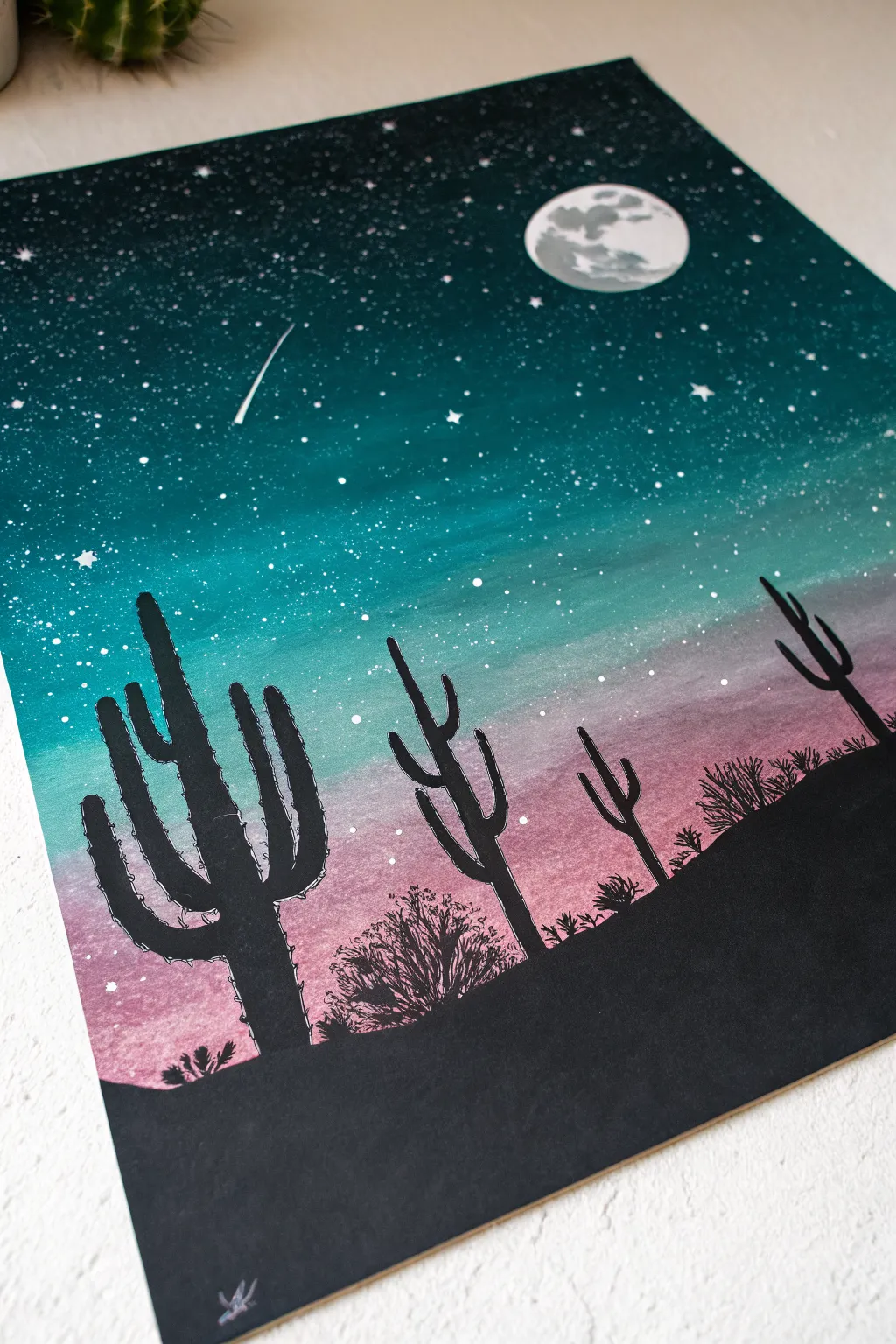
This vibrant piece captures the magic of a desert night using simple masking and blending techniques. You’ll create a stunning gradient sky that transitions from deep teal to a soft dusty pink, all framed by sharp cactus silhouettes and a glowing moon.
Step-by-Step Guide
Materials
- White poster board or glossy spray paint paper
- Spray paint cans (Colors: Black, White, Deep Teal/Turquoise, Pink/Magenta)
- Round object for moon stencil (e.g., a jar lid or bottle cap)
- Heavy weight (to hold the moon stencil down)
- Palette knife or craft stick
- Old toothbrush (for stars)
- Black paint marker or fine liner pen (optional for details)
- Disposable gloves and respirator mask
Step 1: Setting the Celestial Scene
-
Prepare your workspace:
Set up in a well-ventilated area, preferably outdoors. Lay down a drop cloth or old newspaper to protect your surroundings from overspray. -
Position the moon:
Place your round object (like a jar lid) in the upper right quadrant of the paper to act as a mask for the moon. Place a small weight on top so it doesn’t shift when the air pressure from the can hits it. -
Create the horizon glow:
Start at the bottom third of the paper with your pink or magenta spray paint. Apply a horizontal band of color, sweeping side to side to ensure even coverage. -
Transition to the night sky:
Immediately above the pink layer, spray your deep teal or turquoise color. Allow the bottom edge of the teal to slightly overlap the top edge of the pink. -
Blend the gradient:
While the paint is still wet, you can lightly mist the transition area to soften the line where the colors meet, creating that dreamy sunset fade. -
Deepen the cosmos:
Spray the upper portion of the paper with more teal, or even a touch of black at the very top corners, to simulate the darkness of space fading into the atmosphere.
Space Dust Tip
For ultra-fine, distant stars, stand further back and mist a very light burst of white spray paint into the air above the paper, letting the mist settle naturally.
Step 2: Stars and Texture
-
Create the star field:
Spray a small puddle of white paint onto a piece of scrap cardboard. Dip the bristles of an old toothbrush into this white paint. -
Flick the stars:
Hold the toothbrush over your painting and run your thumb across the bristles to flick tiny speckles of white paint onto the sky area. vary the pressure to get different sizes. -
Add a shooting star:
To make the comet, use a palette knife or piece of cardstock. Dip the edge in white paint and make a quick swipe, or carefully flick a slightly larger drop and drag it with a tool while wet. -
Reveal the moon:
Carefully lift the weight and the round object used for the moon mask. You should have a crisp white circle underneath. -
Texture the moon:
Crumple a small piece of paper or magazine page. Lightly dab it into a tiny bit of gray or black spray paint residue, then gently dab the white moon circle to create craters and texture. -
Let the background dry:
Allow the entire background layer to set completely before moving on to the silhouette. This prevents the black paint from bleeding into the sky color.
Step 3: The Silhouettes
-
Paint the landscape base:
Using black spray paint, spray the bottom curve of the paper to create the ground. You can use a torn piece of poster board as a shield to create a distinct, rolling hill shape. -
Draft the cacti:
Since spray paint nozzles are wide, spray a puddle of black paint onto your palette. Use a thin brush or even a palette knife to scoop up this paint. -
Paint the cactus shapes:
Hand-paint the tall Saguaro cactus shapes on top of the dried background. Start with the main trunk and add the curved, upward-reaching arms. -
Add prickly details:
Using the very tip of a fine brush, a palette knife edge, or a black paint marker, add tiny lines or spikes along the edges of the cactus arms to simulate needles. -
Create desert shrubs:
At the base of the cacti, dab your brush or a crumpled piece of paper dipped in black paint to create the textured look of scraggly desert bushes. -
Final touches:
Check for any areas in the black silhouette that look transparent and add a second coat if needed for a solid, opaque look.
Level Up: Highlights
Use a white gel pen or thin brush to add tiny highlight lines on the left side of the cactus arms (opposite the moon) to suggest reflected moonlight.
Once the black paint fully cures, your desert nightscape is ready to frame and display
Simple Animal Silhouette Over Aurora Colors
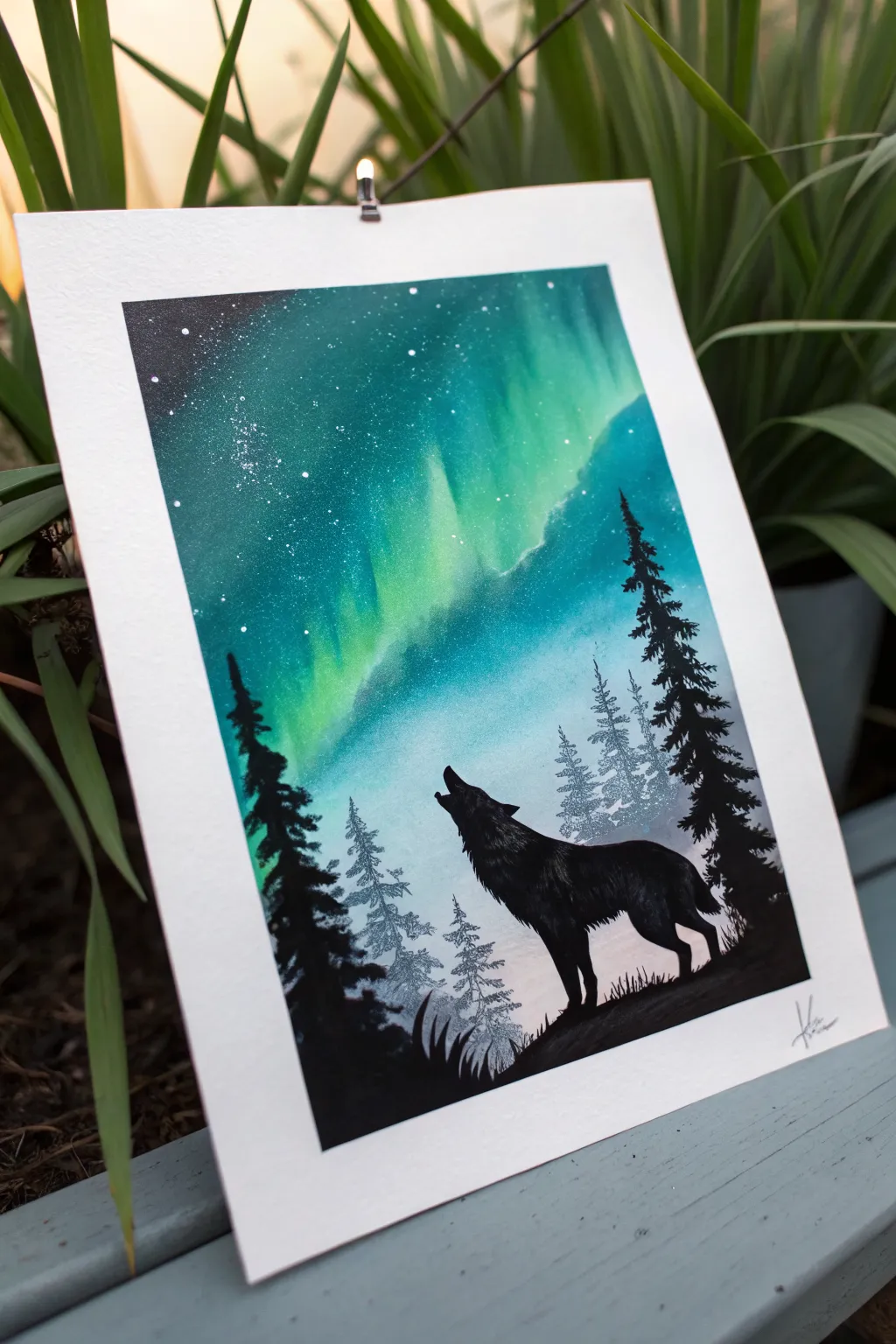
Capture the mystic beauty of the wild with this striking spray paint art piece, featuring a lone wolf silhouette against a vibrant aurora borealis sky. The contrast between the brilliant greens and deep blacks makes for a dramatic, professional-looking result that is surprisingly beginner-friendly.
Step-by-Step Tutorial
Materials
- Glossy poster board or heavy cardstock (white)
- Spray paint: Black, Navy Blue, Teal/Light Blue, Lime Green, White
- Wolf silhouette stencil (pre-cut or made from cardstock)
- Tree stencils (optional, varying sizes)
- Old magazine pages or scrap paper for masking
- Sponge or crumpled plastic bag
- Protection gear: Mask and gloves
Step 1: Creating the Aurora Sky
-
Prepare your workspace:
Set up in a well-ventilated area, laying down drop cloths. Place your white glossy poster board flat on your work surface. Since spray paint dries fast, have all your colors uncapped and within reach. -
Lay the vibrant base:
Start by spraying a diagonal swath of Lime Green across the middle of the paper. This will be the brightest part of your aurora. Don’t worry about perfect lines; soft edges are better. -
Add the mid-tones:
Immediately spray Teal or Light Blue on either side of the green band. Allow the colors to overlap slightly with the green to create a natural blend. -
Deepen the sky:
Spray Navy Blue towards the upper corners and edges, blending it into the teal. Finally, add touches of Black at the very top corners to suggest the deep night sky. -
Create the aurora streaks:
While the paint is still wet, take a piece of glossy magazine paper. Lay it gently over the wet sky area, run your fingers over it in a vertical, wavy motion, and peel it off quickly. This lifts some paint and creates those magical vertical streaks characteristic of the Northern Lights. -
Add stars:
Spray a tiny amount of White spray paint onto a piece of cardstock. Dip your fingers or a stiff brush into the wet puddle and flick it toward the upper dark sections of the painting to create a star field.
Step 2: Adding the Landscape
-
Dry the background:
Wait for the sky layer to be completely dry to the touch. This is crucial—if it’s wet, your stencil work will smudge. I like to leave it for at least 30 minutes in the sun. -
Create distant trees:
Use a light grey spray paint or a very light mist of black. Hold a tree stencil slightly above the paper (don’t press it down hard) and spray lightly. This creates a ‘ghost’ or foggy effect for the background trees. -
Position the wolf stencil:
Place your wolf silhouette stencil on the bottom right-center of the paper. Use small weights (like coins or nuts) to hold the edges flat against the paper so paint doesn’t creep under. -
Spray the foreground silhouette:
Spray Black paint directly over the wolf stencil and the bottom area of the paper to create the ground. Ensure the coverage is solid and opaque. -
Add foreground trees:
While the black is handy, use a detailed tree stencil or a torn piece of cardstock to add sharp, black pine trees on the left and right edges. These should frame the wolf. -
Create texture on the ground:
Before the black ground paint dries, crumple a plastic bag or use a sponge to dab the bottom edge lightly. This adds a texture that looks like rocky terrain or grass. -
Define the grass:
Use a palette knife or the edge of a piece of cut cardstock to scrape upward into the wet black paint at the bottom. This reveals the white paper underneath in thin lines, simulating blades of grass. -
Remove the stencil:
Carefully lift your wolf stencil straight up to avoid smearing the edges. If there are any tiny bridges from the stencil, fill them in carefully with a black permanent marker or a small brush. -
Optional highlighting:
If you want the wolf to have a bit of dimension, you can spray a tiny bit of white onto a sponge and very gently dab the top edge of the wolf’s back to mimic moonlight reflection.
Sticky Situation
If your stencil lifts the base paint when removed, your background layer wasn’t dry enough. Ensure the sky is fully cured before placing any adhesive or heavy stencils on top.
Level Up
Add a planet or large moon behind the aurora. Place a circular lid on the paper before spraying the sky colors, then remove it to reveal a white circle you can texture later.
Once dry, frame your masterpiece to highlight the glowing contrast of the aurora.
Negative Space Stencil Lettering Quote
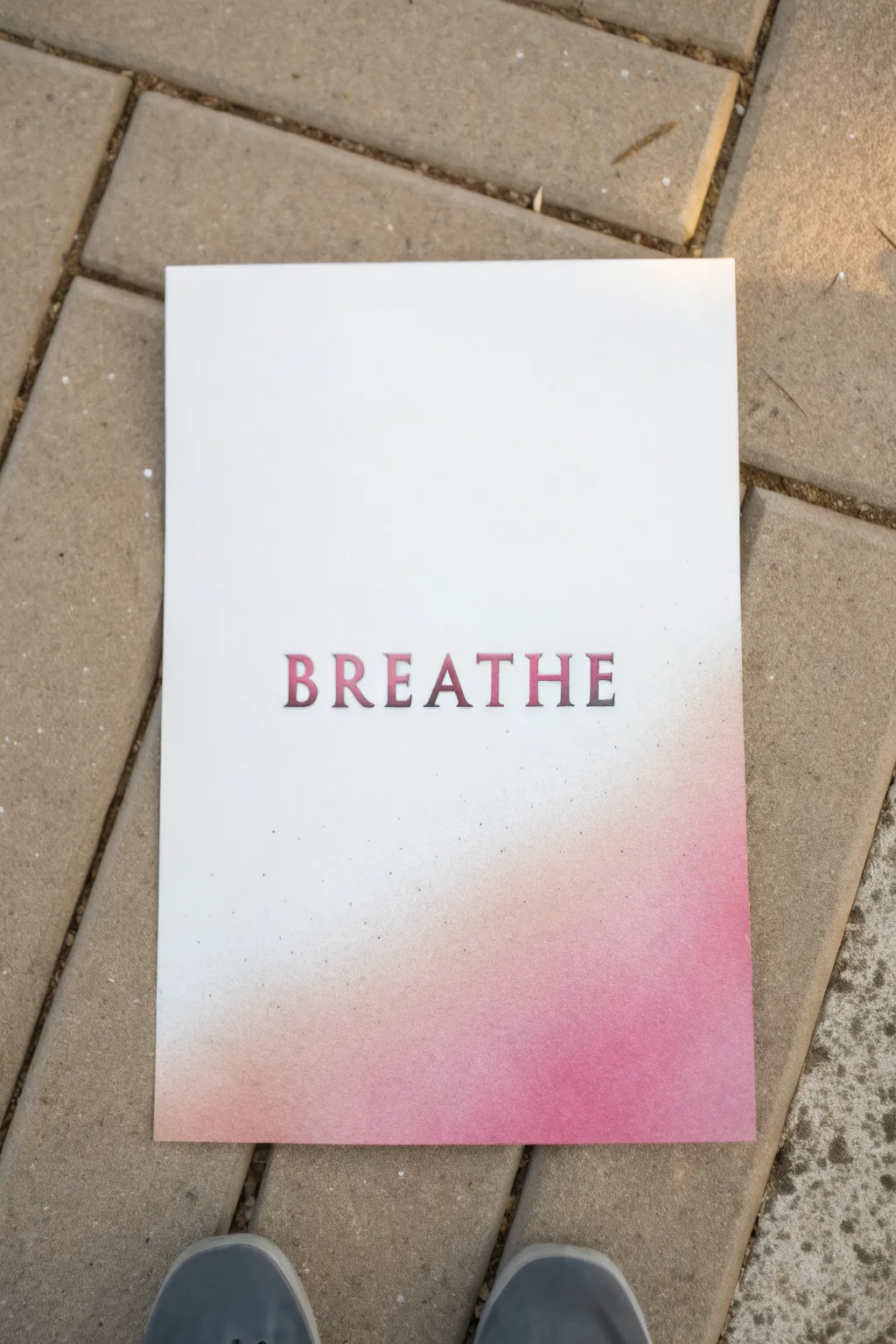
Create a calming, minimalist piece of art that combines sharp typography with a soft, dreamy gradient. This beginner-friendly project uses negative space techniques to make the word “BREATHE” appear crisp against a gentle wash of color.
Step-by-Step Tutorial
Materials
- Rectangular canvas or thick art board (white)
- Adhesive vinyl or painter’s tape
- Cutting machine (Cricut/Silhouette) or X-Acto knife and cutting mat
- Transfer tape (if using vinyl)
- Spray paint (Rose Gold, Soft Pink, or Salmon)
- Dark grey or black spray paint (optional, for drop shadow effect)
- Newspaper or drop cloth
- Respirator mask
- Weights (like small rocks or cans) for holding down edges
Step 1: Preparation & Stencil Creation
-
Prepare your workspace:
Set up in a well-ventilated area, preferably outdoors. Lay down a drop cloth or old newspapers to protect the ground from overspray. -
Design your text:
Choose a clean, serif font for the word “BREATHE”. If you have a cutting machine, design the file to fit the center of your canvas. -
Cut the stencil:
Cut the letters out of adhesive vinyl. Alternatively, if doing this manually, print the word on paper, tape it over painter’s tape strips, and carefully cut out the letters with an X-Acto knife to create individual letter stickers. -
Weed the design:
Remove the excess vinyl around the letters. You want the individual letters themselves to act as stickers.
Step 2: Applying the Resist
-
Transfer the letters:
Use transfer tape to lift the letters closer to their original spacing. Center them carefully on your white canvas. -
Adhere the letters:
Press the letters down firmly onto the canvas. Use a credit card or scraper to burnish the edges so paint can’t sneak underneath. -
Create a drop shadow (Optional):
For the subtle 3D effect seen in the image, lightly mist a tiny amount of dark grey spray paint directly over the letters from a high angle. Let this dry completely before moving on.
Bleeding Edges?
If paint bled under the letters, use a white paint pen or a small brush with white acrylic paint to carefully touch up the edges and sharpen the text.
Step 3: Painting the Gradient
-
Shake the can:
Shake your pink or rose gold spray paint can vigorously for at least one minute to ensure the pigment is mixed. -
Test the spray:
Do a quick test spray on your drop cloth to check the nozzle flow. -
Start off-canvas:
Begin spraying away from the canvas, then sweep across the bottom right corner. -
Build the gradient:
Focus the color density on the bottom right corner. As you spray toward the center and over the letters, pull the can further away to create a lighter mist. -
Check density:
The color should be strongest at the bottom edge and fade significantly as it reaches the top left. The area around ‘BREATHE’ should have a medium speckling of color. -
Let it dry:
Allow the paint to become touch-dry. This usually takes about 15-20 minutes depending on humidity.
Metallic Pop
Use a metallic gold or silver spray paint for the gradient. The shimmering particles catch the light and make the negative space text look luxurious.
Step 4: The Reveal
-
Peel the letters:
Carefully lift the edge of one vinyl letter using a craft knife or fingernail. -
Remove slowly:
Peel the letters off slowly at a 45-degree angle. This helps prevent ripping the paint film. -
Clean up:
If any adhesive residue remains, gently dab it with a sticky piece of tape to lift it. -
Final cure:
I always leave the finished piece to cure for 24 hours before hanging it up to ensure the paint hardens fully.
Hang your new artwork where you need a gentle reminder to pause and reset
Layered Stencils for Foreground Details
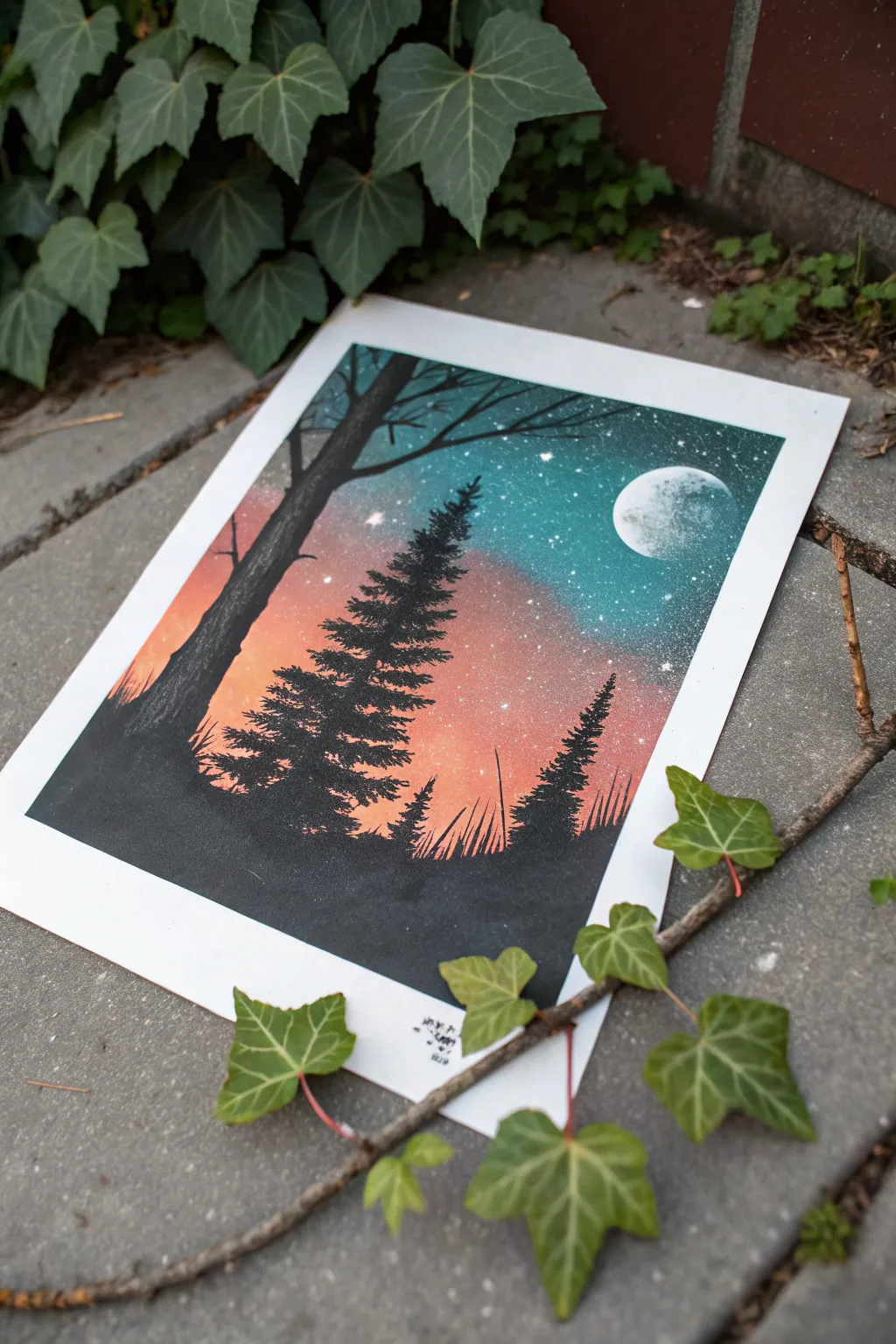
Capture the magic of a twilight transition with this vibrant spray paint landscape. This project teaches you how to blend a seamless galaxy gradient and use sharp stencils for intricate foreground silhouettes.
Step-by-Step Guide
Materials
- Glossy poster board or photo paper
- Spray paint: Teal/Turquoise, Orange, White, and Black
- Magazine pages or paper scraps (for masking)
- Circular object (lid, coin, or stencil) for the moon
- Cardstock or manila folder (for stencils)
- Craft knife or detail scissors
- Newspaper or drop cloth
- Palette knife or folded card (for texture)
Step 1: Setting the Scene
-
Prepare the Moon:
Begin by deciding where you want your moon. Place your circular object (like a jar lid or a coin) onto the white glossy paper where the moon sits. If you want a textured moon, spray a quick burst of white and blot it with crumpled newspaper before covering it. -
Lay the Sky Base:
Start with your teal or turquoise spray paint. Spray the top third of the poster board generously. While it’s still wet, you can add slight bursts of darker blue or black at the very corners for a vignette effect. -
Create the Sunset Fade:
Below the teal, spray a band of orange paint. I like to overlap the teal slightly so the colors mix in the middle to create a soft, dusky transition. -
Diffuse the Colors:
Take a crumpled piece of magazine paper and lightly swipe or dab across the transition line between the teal and orange while the paint is still wet. This helps blend the gradient without muddying the colors too much. -
Add the Stars:
Spray a small puddle of white paint onto a scrap piece of cardboard. Dip your fingers or a stiff brush into it and flick tiny droplets across the sky area to create a starry field. Vary the pressure for different star sizes. -
Reveal the Moon:
Carefully lift your circular object to reveal the white moon underneath. Allow the entire background to dry completely for about 10–15 minutes before moving to the next phase.
Master the Flicker
For realistic stars, spray paint onto your fingertips (wear gloves!) and flick quickly. Closer flicks make dense clusters; distant flicks make scattered stars.
Step 2: Foreground Silhouettes
-
Establish the Horizon:
Using your black spray paint, spray heavily across the bottom inch or two of the paper to create the sold ground. You can use a torn piece of cardstock as a shield to create an uneven, hilly horizon line. -
Draft the Trees:
On a separate piece of cardstock, draw the outline of a tall pine tree and a large deciduous tree trunk. Cut these shapes out carefully with a craft knife to create your stencils. -
Position the Main Tree:
Place the deciduous tree trunk stencil on the left side, ensuring the base connects with the black ground. Hold it flat against the paper to prevent overspray underneath. -
Spray the First Silhouette:
Spray black paint directly over the stencil. Use short, controlled bursts rather than a continuous stream to keep the edges sharp. -
Texture the Trunk:
While the trunk paint is wet, you can lightly drag a palette knife or the edge of a folded card through it to suggest bark texture, though a solid black silhouette works beautifully too. -
Layer the Pine Tree:
Position your pine tree stencil in the center-left area. Spray black over this stencil, ensuring the branches are well-defined against the orange sunset background. -
Add Distant Trees:
For the smaller trees on the right, you can either cut a smaller stencil or use the tip of a palette knife dipped in black paint to scratch in smaller tree shapes. -
Create Grass Details:
Spray a little black paint onto a pallet or scrap paper. Dip the edge of a small piece of cut cardstock into the paint and stamp it upwards from the horizon line to create blades of tall grass. -
Final Touches:
Check for any light spots in the foreground shadows and fill them in with a quick touch of black spray. Let the artwork dry completely before handling.
Fuzzy Edges?
If your tree stencils look blurry, the stencil wasn’t flush with the paper. Use small weights (like coins) on the stencil edges to hold them down flat.
Once the paint fumes clear, you’ll have a stunning cosmic landscape ready to frame
Drip-and-Fade Abstract Color Cloud
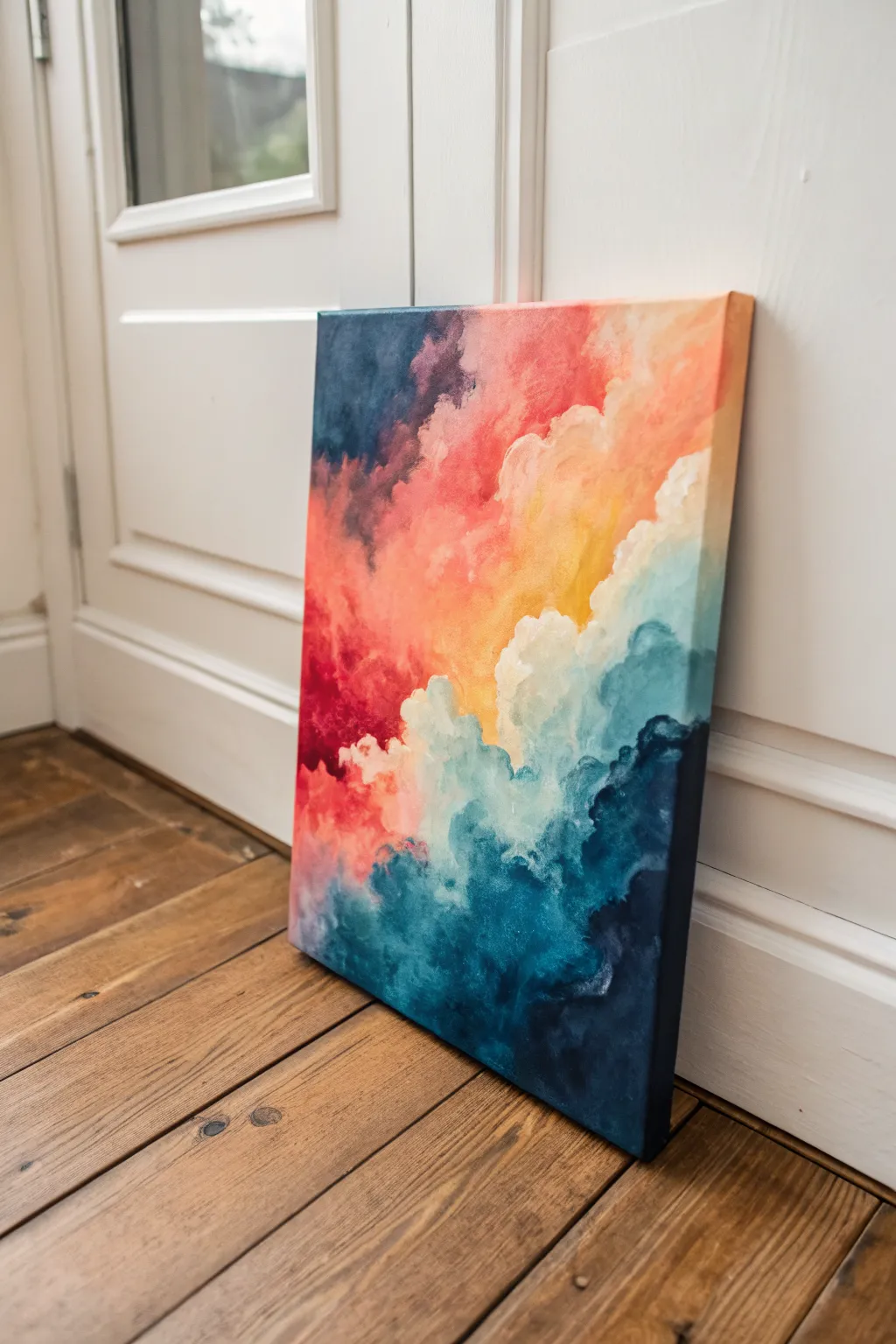
Capture the ephemeral beauty of a storm lit by sunset with this vibrant canvas project. Heavy textures and bold gradients merge to create fluffy, cloud-like formations that seem to drift right off the surface.
Detailed Instructions
Materials
- Stretched canvas (16×20 or similar)
- Spray paint (Dark Blue, Teal, White, Yellow, Orange, Red, Dark Purple/Navy)
- Natural sea sponge or crumpled plastic bag
- Glossy magazine pages or cardstock scraps
- Painter’s tape
- Respirator mask
- Drop cloth
- Gloves
Step 1: Preparation and Base Layer
-
Set the Stage:
Begin by laying down your drop cloth in a well-ventilated area, preferably outdoors. Mask off the wooden frame on the back of your canvas with painter’s tape to keep it clean. -
Prime the Surface:
Apply a light, even coat of white spray paint across the entire canvas. This doesn’t need to be opaque, but it provides a consistent ‘tooth’ for the subsequent colors to grab onto. -
Map the Shadows:
Start with your darkest blue or navy. Spray the bottom right corner heavily, letting the color fade out as it moves toward the center. Repeat this process in the top left corner with dark purple to balance the composition.
Cloud Lifting Trick
If paint gets too thick, press a crumpled newspaper onto the wet surface and lift straight up. It removes excess paint and leaves a vein-like ridge pattern.
Step 2: Building the Gradient
-
Introduce the Mid-Tones:
While the dark corners are still slightly tacky, spray a band of teal next to the dark blue at the bottom. Allow slightly overlapping spray to mix naturally with the navy. -
Warm Up the Palette:
Moving diagonally up the canvas, spray a section of red transitioning into orange above the dark purple section on the left. This creates the intense ‘burning’ look of a sunset. -
The Golden Hour:
Spray bright yellow in the center-right area, bridging the gap between the cool teals and the warm oranges. Keep your hand moving constantly to avoid drips at this stage. -
Blend the Transitions:
Use short bursts of white paint lightly misted over the transition lines between your major color blocks (like where teal meets yellow). This softens the harsh lines before we add texture.
Step 3: Creating Cloud Texture
-
The Magazine Technique:
Tear a glossy magazine page or cardstock into an irregular, organic curve. This will act as your cloud stencil. -
Forming the First Billow:
Place the torn paper near the bottom center. Spray a quick burst of white paint partially on the paper and partially on the canvas above it to create a sharp top edge and a misty bottom. -
Softening Edges:
Immediately after spraying the white, take a crumpled plastic bag or sea sponge and gently dab the wet paint. This breaks up the mechanical spray pattern and makes the cloud look organic and fluffy. -
Layering Upwards:
Move your paper stencil up slightly and rotate it to get a different curve. Spray white again, overlapping the previous layer slightly. I like to vary the pressure here to get different opacities. -
Integrating Color:
As you move into the yellow and orange sections, stop using pure white. Instead, lightly mist yellow or orange over your white cloud tops to make them look illuminated by the background light. -
Reinforcing Shadows:
If your dark corners got too washed out, tear a new piece of paper and hold it upside down (curve facing down). Spray a tiny amount of dark blue or purple under the cloud bellies to add dimension.
Muddy Colors?
Stop immediately if colors turn gray. Let that layer dry for 10 minutes before adding more. Wet-on-wet blends well, but too much mixing creates mud.
Step 4: Final Details
-
Highlighting:
Take a very small piece of torn cardstock to shield specific areas and spray concentrated bursts of white on the very ‘tops’ of the cloud formations for high-contrast highlights. -
Texture Check:
Look for any areas that look too flat. Use your sponge to lightly dab any paint that looks too wet or uniform, blending it into the surrounding colors. -
The Edge Wrap:
Ensure you spray the sides of the canvas with the corresponding colors (blue on the bottom right edge, red on the top left edge) so the artwork looks finished from all angles. -
Drying:
Let the painting sit undisturbed for at least 24 hours. Because of the heavy layering and texture work, the thickest parts of the paint need extra time to cure fully.
Hang your new atmospheric masterpiece on a wall that receives good natural light to really make those colors glow
Mini Series: Trading-Card Size Space Scenes
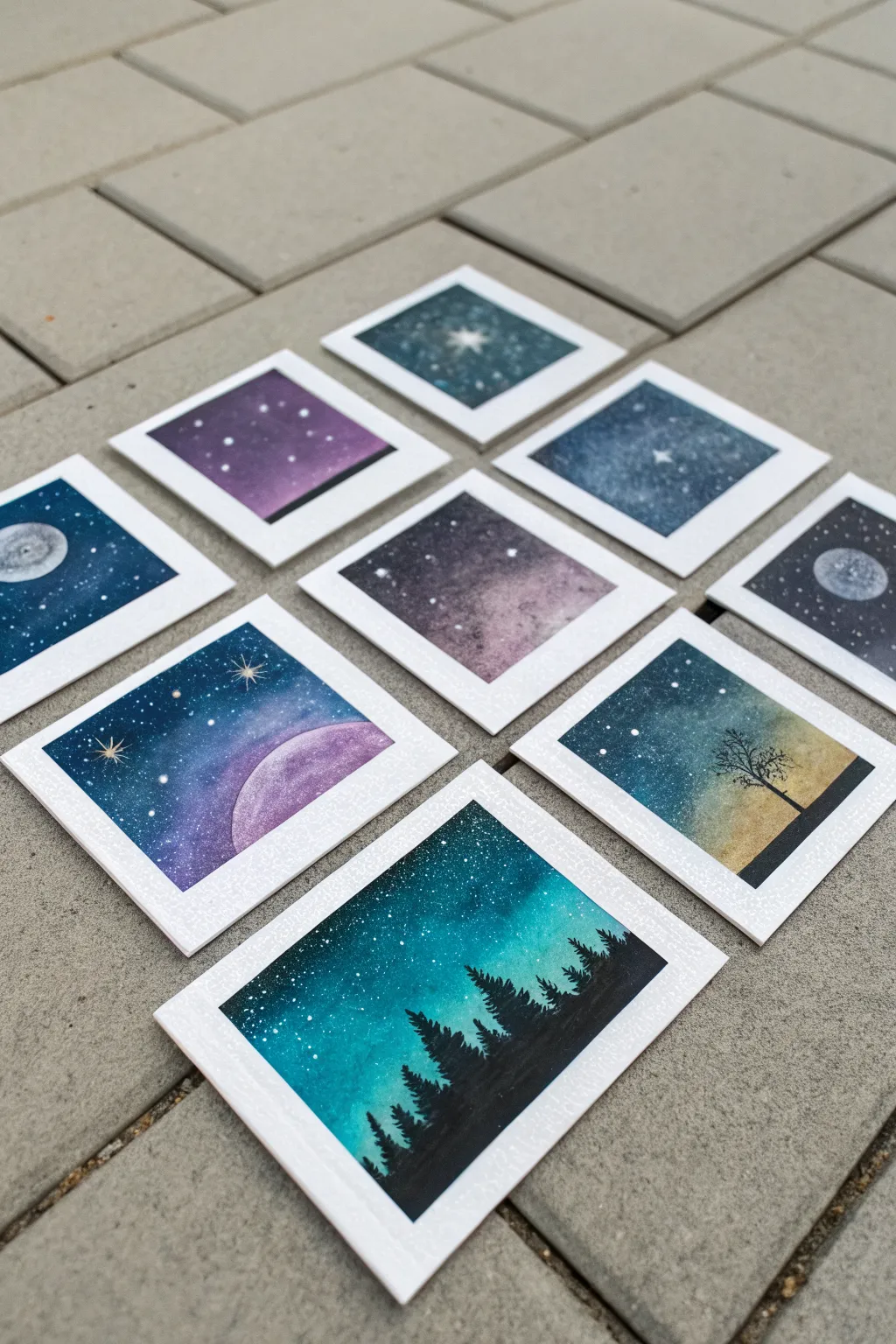
These miniature space scenes capture the grandeur of the universe on a tiny canvas perfect for trading or framing. By working small, you can quickly experiment with different color combinations and silhouette techniques without using large amounts of paint.
Step-by-Step Tutorial
Materials
- Glossy cardstock or photo paper (cut to 4×4 inches)
- Spray paint cans (black, white, purple, blue, teal, yellow)
- Newsprint or magazine pages (for texture)
- Circular templates (washers, bottle caps, or coin) for planets
- Cardboard scraps with straight edges
- Palette knife or small putty knife
- Toothbrush (for stars)
- Gloves and respirator mask
Step 1: Setting the Stage
-
Prepare your canvas:
Cut your glossy cardstock into square trading-card sizes, around 3 to 4 inches. Tape the backs down to a larger board so the force of the spray doesn’t blow them away. -
Lay the base colors:
Choose 2-3 bright colors for your background, such as teal and blue or purple and pink. Spray random patches of these colors across the cards, ensuring no white paper shows. -
Create texture:
While the paint is still wet, crumple up a piece of magazine paper or newsprint. Press it gently onto the wet paint and lift it off immediately to create a vein-like, organic texture.
Starry Precision
Does your star spray look like blobs? Test the toothbrush flick on scraps first. The paint needs to be fluid, not sticky.
Step 2: Planets and Moons
-
Positioning planets:
Decide where you want your planets or moons. Place a bottle cap or coin over the textured color areas you want to preserve as a celestial body. -
Shadowing:
Before covering completely, you can spray a tiny burst of black on one edge of your planet area to create a shadow side. -
Masking:
Place your circular object (washer, lid, or coin) firmly over the planet area. Weight it down with a small rock if the spray pressure is high.
Sticky Situations
If the paper tears when lifting the texture sheet, wait 10 seconds after spraying the base coat. It shouldn’t be swimming wet.
Step 3: The Deep Space Layer
-
Blackout the background:
Spray black paint over the entire card, covering the colored areas and the masking objects. Do this in light layers to avoid drips. -
Variable darkness:
Don’t aim for solid, flat black everywhere. Leave some areas slightly lighter or mist a little blue or purple over the black while wet to suggest a nebula glowing in the dark. -
Adding stars:
Spray a small puddle of white paint onto a scrap piece of cardboard. Dip a toothbrush into it and flick the bristles with your thumb to mist tiny white dots across the black sky. -
Add a galaxy flare:
For a bright star or supernova, hold the white spray can upside down very close to the paper and give a quick, tiny burst, or use a stencil to add a cross-shaped glare. -
Reveal the planets:
Carefully lift off your bottle caps or coins to reveal the colorful, textured planets underneath. Ensure the black paint is tacky but not fully dry so it doesn’t chip.
Step 4: Landscapes and Silhouettes
-
Mountains and ground:
For scenes with ground, verify the sky is dry to the touch. Place a torn piece of poster board across the bottom to act as a stencil and spray black below it for a solid horizon. -
Painting trees:
Spray a puddle of black paint and use your palette knife or the edge of a small piece of cardboard. Dip the edge in black and stamp vertical lines to form tree trunks. -
Adding foliage:
Use the corner of your cardboard tool or a small brush to dab irregular patterns along the trunks, creating the look of pine branches or deciduous leaves. -
Refining the frame:
Since these are small cards, the edges often get messy. I find masking the borders before painting looks cleanest, but you can also trim the edges with scissors afterward for a sharp white border. -
Final drying:
Let the cards sit undisturbed in a well-ventilated area for at least an hour before handling or stacking them.
Once dry, these mini masterpieces make excellent gifts or a striking collection when displayed together on a wall
Have a question or want to share your own experience? I'd love to hear from you in the comments below!