
Sometimes the best way to clear creative block is to set playful limits. Art challenges push you to draw, paint, or craft your way out of hesitation and into flow. Simple, consistent practice can rewire the brain for experimentation while rebuilding confidence through small successes.
Why Challenges Work
Creative routines often slip when perfectionism or uncertainty takes over. Short, structured exercises reduce decision fatigue—the mental strain that comes from too many choices. A five-minute contour sketch or a daily color study harnesses the psychology of repetition: regular, achievable practice produces steady neural reinforcement in the visual cortex and motor memory systems.
As motivation returns, these small acts reopen the connection between thought and gesture. Many artists notice how the sense of “effort” fades when the hands move faster than self-criticism can intervene. That’s the real goal of these challenges—to replace hesitation with curiosity.
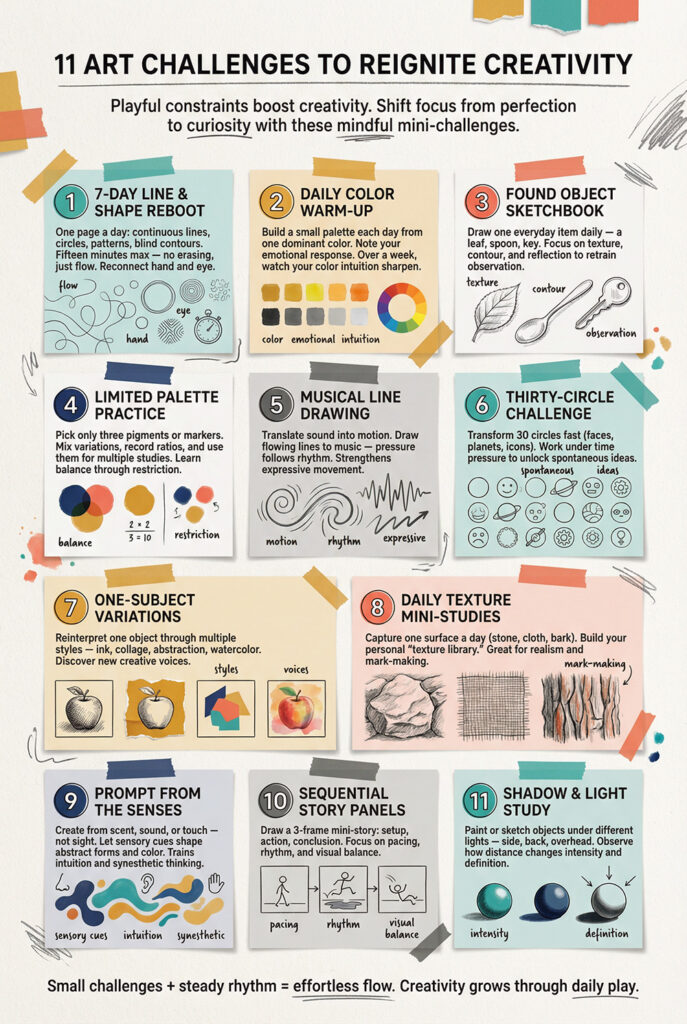
1. The 7-Day Line and Shape Reboot

Minimal materials—paper and pen—make this an ideal restart for hesitant hands. The rule is simple: work with lines and shapes, no shading, no erasers.
Daily Focus Guide
| Day | Task | Purpose |
|---|---|---|
| 1 | Continuous line drawing of any household object | Builds fluidity and control |
| 2 | Fill a page with overlapping circles | Trains rhythm and composition balance |
| 3 | Create a geometric pattern using only triangles | Encourages structural thinking |
| 4 | Blind contour self-portrait | Reduces perfectionism |
| 5 | Combine organic and geometric forms | Explores contrast and unity |
| 6 | Trace shadows cast by light on objects | Connects observation with form |
| 7 | Create an abstract composition from favorite shapes | Synthesizes experimentation |
Keep each exercise under 15 minutes. The goal is flow, not outcome. Over time, these focused sessions sharpen line confidence—one of the foundational skills that underpins all art mediums.
2. Daily Color Exploration

Color fatigue often signals a deeper block: uncertainty about harmony and contrast. This challenge reawakens visual sensitivity through controlled daily experiments.
Basic Setup
- A sketchbook dedicated solely to color swatches and notes.
- Medium of choice: watercolor, gouache, markers, or digital paint.
- A timer (10–20 minutes per session).
Challenge Structure
- Start by picking a dominant hue—say ultramarine blue.
- Each day, build a new palette inspired by it (analogous, complementary, or monochromatic).
- Note visual responses: warmth, coolness, or emotional tone.
Color studies retrain the visual cortex to perceive nuanced variation in hue and value. It’s almost like tuning an instrument—you gradually sharpen sensitivity. After a week, many artists notice improved instinctive color selection in larger works.
3. The Found Object Sketchbook

This challenge helps reconnect art with sensory mindfulness. The rule: collect one small object daily and sketch it using any technique.
Practical Guidelines
- Focus on tactile detail—surface roughness, reflection, or texture.
- Alternate between zoomed-in studies and full-object renderings.
- Experiment with contour emphasis and negative space.
Objects can be as mundane as a leaf, a key, or a thread spool. When drawn carefully, even a chipped button becomes an exploration of value, contour, and form. The scientific benefit lies in slowed observation—repeated close attention triggers perceptual sharpening through neuroplastic adaptation in the dorsolateral prefrontal cortex, improving spatial judgment and memory.
4. The Limited Palette Challenge
Restricting materials generates surprising freedom. This exercise emphasizes the principle of constraint-based creativity: limitation enhances innovation.
Setup
Choose only three pigments (or three markers/pencils) and one paper type. Work with these materials for several days in succession.
Process
- Mix or blend to achieve as many secondary colors as possible.
- Keep a record swatch sheet with labeled ratios.
- Apply the same palette to small studies: still life, botanical forms, or abstract designs.
This practice refines understanding of value contrast and chromatic balance—a skill transferable across all visual media. Limitation also minimizes the visual noise that too many choices create, allowing color relationships to become deliberate and intuitive.
5. Musical Line Drawing
Sound can reactivate dormant visual rhythm. In this challenge, choose instrumental tracks and translate melody into movement with pen or brush.
How To Begin
- Play a two- to five-minute instrumental piece.
- Draw lines that respond to the sound—curves for legato passages, angles for staccato rhythms.
- Vary stroke pressure with volume changes.
As the auditory cortex synchronizes with the motor system, pattern recognition heightens. This exercise bridges music and composition, strengthening intuitive gesture and line dynamic control. Many artists later integrate this sensitivity into expressive compositions or calligraphic works.
6. Thirty Circles Challenge

This quick routine transforms abstract thinking into playful design. Begin with a sheet of thirty empty circles (trace coins or use a printed template).
Steps
- Set a timer for five to ten minutes.
- Transform each circle into a unique design—faces, planets, ornaments, or microscopic forms.
- Work as quickly as possible to avoid overthinking.
The brain’s associative networks activate rapidly under time constraints, fostering creativity through divergent thinking. The results may look simple, but the neurological benefit lies in forcing unfiltered ideation—translating mental symbols into immediate visual form.
7. One-Subject Variations
Focusing on a single theme for multiple days refines comprehension of proportion, tone, and composition. Choose one object—perhaps a potted plant or ceramic mug—and reinterpret it through changing styles and media.
Suggestions for Variation
- Line drawing
- Ink and wash
- Blocky gouache abstraction
- Collage reinterpretation
- Overlapping forms in transparent watercolor
This iterative approach parallels laboratory testing: repeated observation under varied conditions reveals structure. By Day 5 or 6, the subject becomes a vehicle for experimentation rather than representation, often sparking personal stylistic discoveries.
8. Daily Texture Mini-Studies
Texture challenges reconnect hand, eye, and memory. Choose one texture a day—stone, fabric, metal, bark—and reproduce it as faithfully as possible.
Tools
- Graphite pencils for precise hatching.
- Charcoal for rough, high-contrast surfaces.
- Watercolor drybrush for soft, porous effects.
Keep samples small, about postcard-sized. After several sessions, compile a “texture library,” labeling each with material and technique notes. This personalized reference guide becomes a technical resource for future projects, strengthening material realism and mark-making control.
9. Prompt From the Senses

Engaging smell, sound, and touch stimulates associative image-making. Each day, use a sensory cue as the theme.
Examples:
- The scent of coffee at morning light
- The sound of distant traffic rain
- The texture of linen cloth
Translate those cues into color and form rather than literal objects. This trains synesthetic creativity—the ability of one sensory stimulus to evoke another medium’s response—encouraging more emotionally resonant artwork.
10. Sequential Story Panels
Narrative sketches teach flow, proportion, and timing. Create a short sequence of three to four frames depicting a simple everyday event—a cat stretching, tea being poured, or leaves falling.
Format
| Panel | Description | Artistic Focus |
|---|---|---|
| 1 | Establish scene | Perspective, mood |
| 2 | Add movement | Gesture, motion |
| 3 | Conclude action | Composition balance |
| 4 (optional) | Epilogue moment | Rhythm and silence |
Treat each frame as an individual composition yet maintain coherence across the series. This technique improves compositional planning while offering emotional narrative range.
11. Shadow and Light Challenge
Lighting defines form, and deliberate light study deepens perception of depth and value. Each session, experiment with one lighting setup—overhead, side-cast, or backlight.
Method
- Arrange a small still life with strong contrasted lighting.
- Sketch using only tonal values, avoiding outlines.
- Observe how shadow edges vary with distance from the light source.
This challenge draws upon basic optics: the inverse-square law explains why light intensity drops rapidly with distance, affecting reflected highlights and shadow gradients. Practicing such observation teaches precision and realism crucial for any advanced technique.
Integrating Challenges into Routine
Sporadic bursts of inspiration fade quickly unless anchored in sustainable structure. A few strategies keep the process enjoyable and consistent:
- Set a daily or alternate-day time slot.
- Keep materials visible and ready; reduce friction before each session.
- Accept incompleteness—partial drawings still train perception.
- Rotate between fast and slow challenges to maintain balance between freedom and discipline.
Consistency re-establishes the neural and emotional rhythm of creativity. Over time, the accumulation of small studies forms a visual journal—proof that skill and imagination thrive under steady, mindful attention.
Have a question or want to share your own experience? I'd love to hear from you in the comments below!