
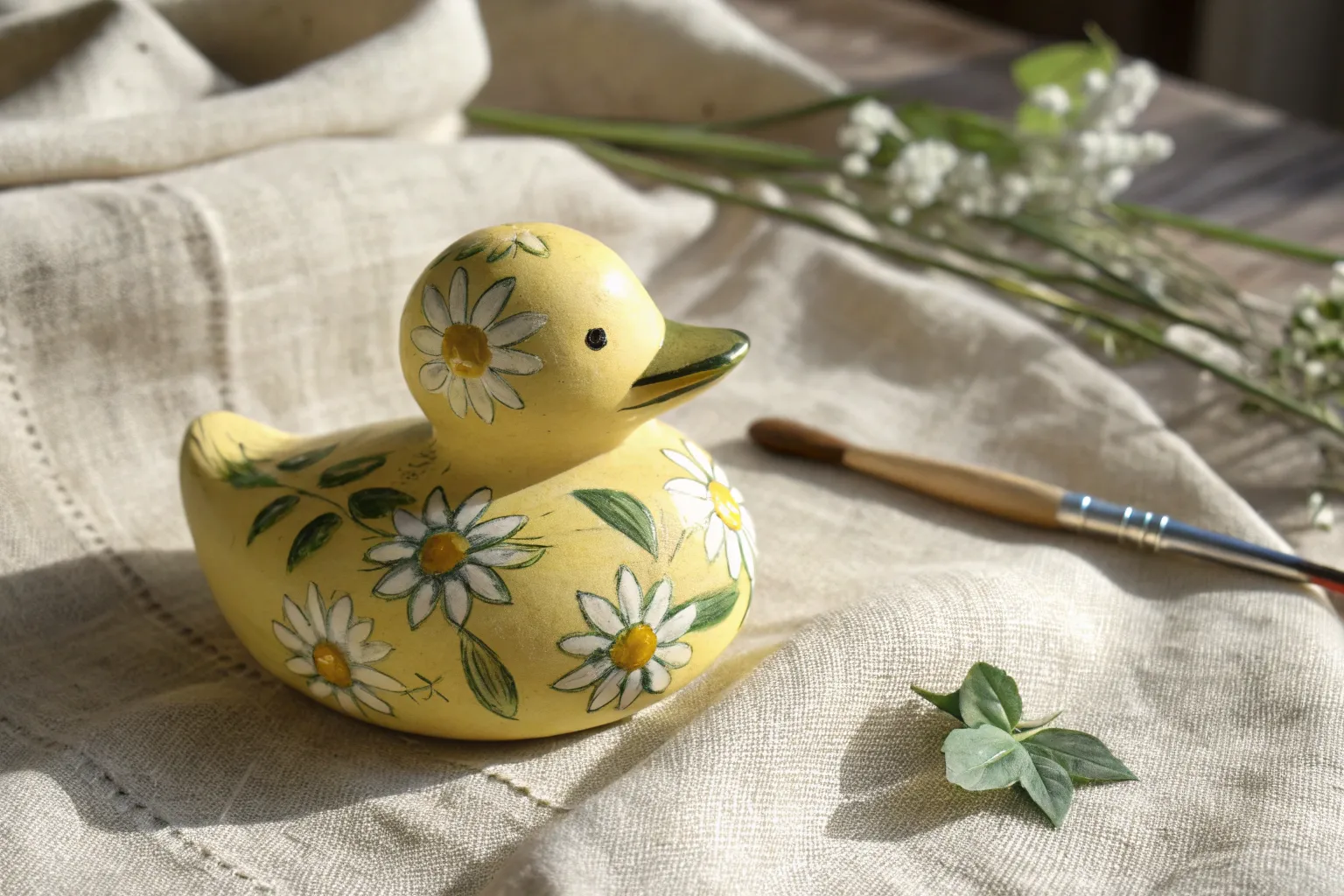
There is something inherently cheerful about capturing the iconic curves of a yellow bath toy, whether you are sketching it on canvas or customizing the physical rubber duck itself. Let’s dive into a variety of playful techniques and creative themes that will joyful splash of color to your art studio.
Capturing the Classic Yellow Form
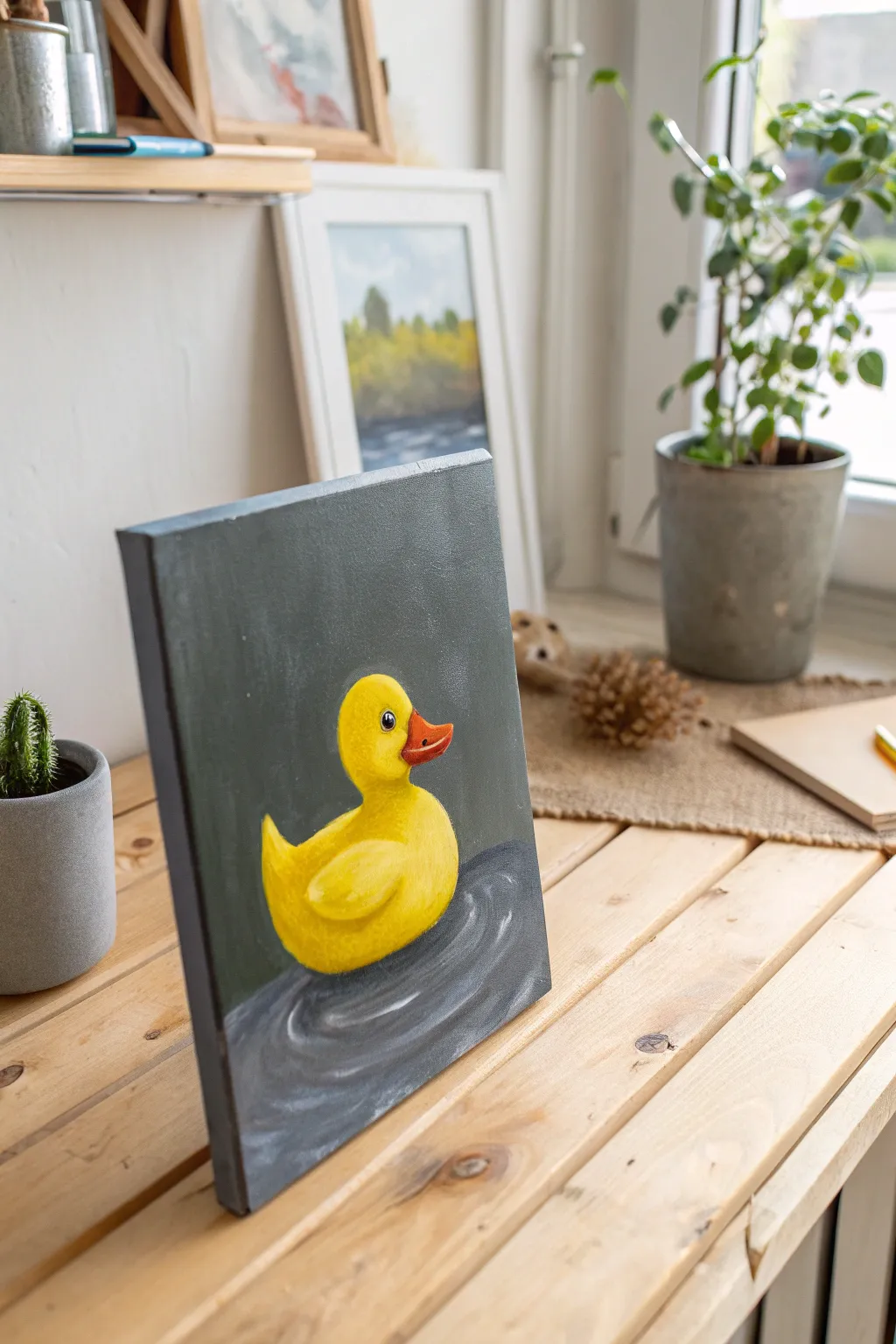
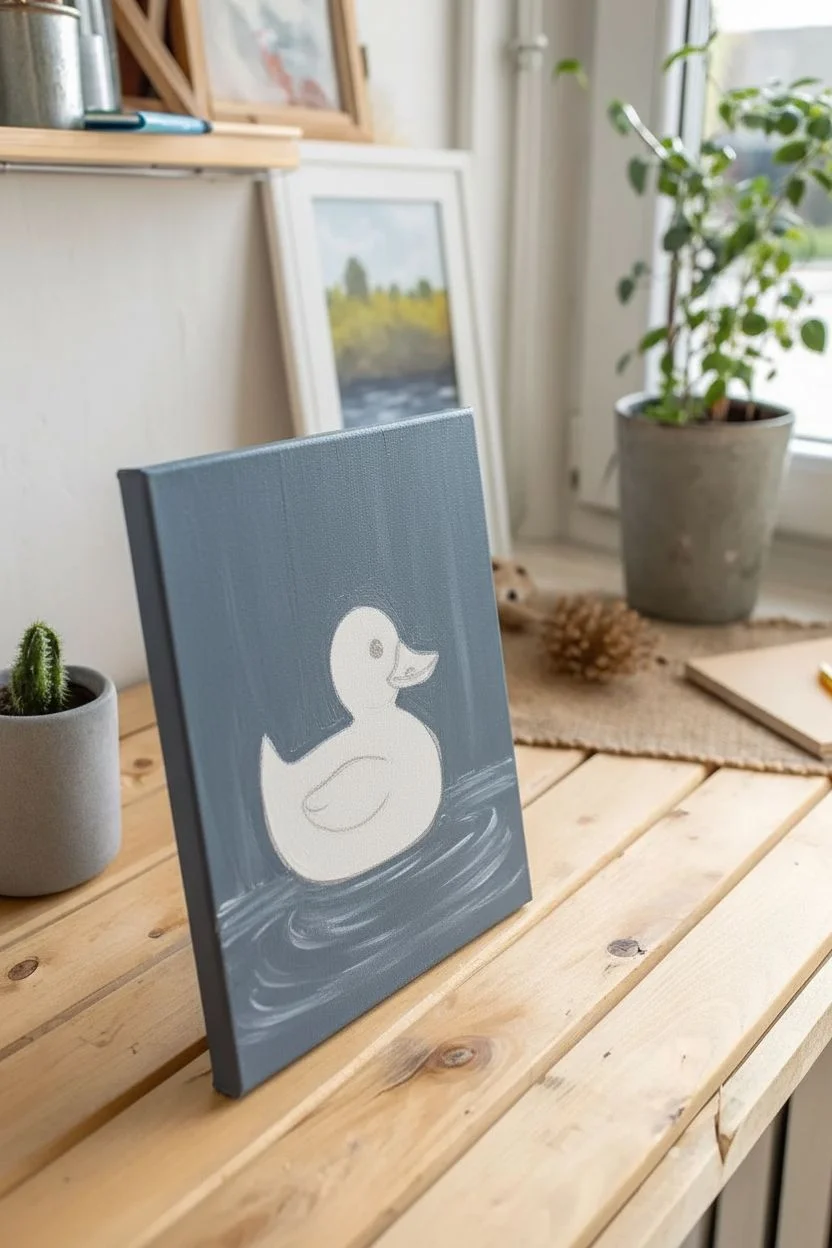
This project contrasts the vibrant, nostalgic yellow of a classic rubber duck against a moody, slate-grey background. Ideally suited for acrylics, this painting exercise focuses on simple forms, bold color blocking, and capturing the illusion of floating objects.
Step-by-Step Tutorial
Materials
- Square canvas (e.g., 8×8 or 10×10 inches)
- Acrylic paints: Cadmium Yellow, Titanium White, Mars Black, Cadmium Orange, Burnt Sienna
- Flat brush (size 6-8) for background
- Round brushes (size 4) for the body
- Fine liner brush (size 0 or 1) for details
- Palette and water cup
- Pencil for sketching
Step 1: Sketching and Background
-
Outline the Subject:
Lightly sketch the rubber duck in the lower center of your canvas. Focus on the ‘figure-8’ shape of the head and body, adding the small triangle for the tail and the bill profile. -
Mix the Background Grey:
Create a slate grey color by mixing Mars Black and Titanium White. Aim for a medium tone—dark enough to make the yellow pop, but light enough to show later water shadows. -
Paint the Upper Background:
Using your flat brush, paint the area above the duck with vertical strokes. I like to keep the brushwork slightly visible here to add texture to the ‘wall’ or air behind the subject. -
Paint the Water Base:
Continue with the same grey mixture for the bottom section around the duck, but switch to horizontal curved strokes to simulate the water’s surface. -
Refine the Edges:
Carefully cut in around your pencil sketch with the grey paint. If you accidentally paint over the lines, just let it dry and sketch the shape again.
Transparency Trouble?
Yellow paint often struggles with opacity. If the grey background shows through your duck, paint the duck shape sitting on white first, let it dry, then apply the yellow on top.
Step 2: Color Blocking and Form
-
Base Coat Yellow:
Fill in the body of the duck with pure Cadmium Yellow. Since yellow pigment is often transparent, you will likely need two or three thin coats to get solid coverage. -
Mixing Shadow Tone:
Mix a small amount of Cadmium Yellow with a tiny touch of Burnt Sienna or Orange. Do not use black, as it will turn the yellow green and muddy. -
Apply Body Shadows:
Paint this warmer, darker yellow along the bottom curve of the duck’s chest, under the neck, and beneath the wing to give the object weight and dimension. -
Highlight the Form:
Mix Cadmium Yellow with Titanium White. Apply this to the top of the head, the upper curve of the wing, and the top of the chest to simulate overhead lighting. -
Paint the Beak:
Fill in the beak shape with Cadmium Orange. Add a thin line of red or dark orange along the mouth opening to create a slight smile.
Level Up: Reflections
To add realism, mix a dilute glaze of yellow paint and apply it faintly to the water ripples directly below the duck’s chest to mimic a reflection on the wet surface.
Step 3: Details and Water Effects
-
Create the Eye:
Using your smallest brush, paint a black circle for the eye. Once dry, add a tiny dot of Titanium White in the upper right corner of the pupil for life. -
Beak Highlights:
Add a small dash of light orange or white mixed with orange to the top of the beak to show its glossy texture. -
Deepen Water Shadows:
Mix a darker grey (more black than white). Paint semi-circular shadows directly underneath the duck where it meets the water. -
Create Ripples:
Mix a light grey (mostly white with a touch of black). Using loose, curved strokes, paint concentric rings radiating out from the duck to create ripples. -
Blend Water Effects:
While the ripples are wet, you can feather the edges slightly into the background grey so they look soft and fluid. -
Final Highlights:
Add pure white accents to the sharpest points of the ripples and a final bright spot on the duck’s wing to maximize the shiny, rubbery look.
Step back and enjoy the cheerful contrast of your bright little swimmer against the calm grey backdrop
The Bubbling Bath Time Scene
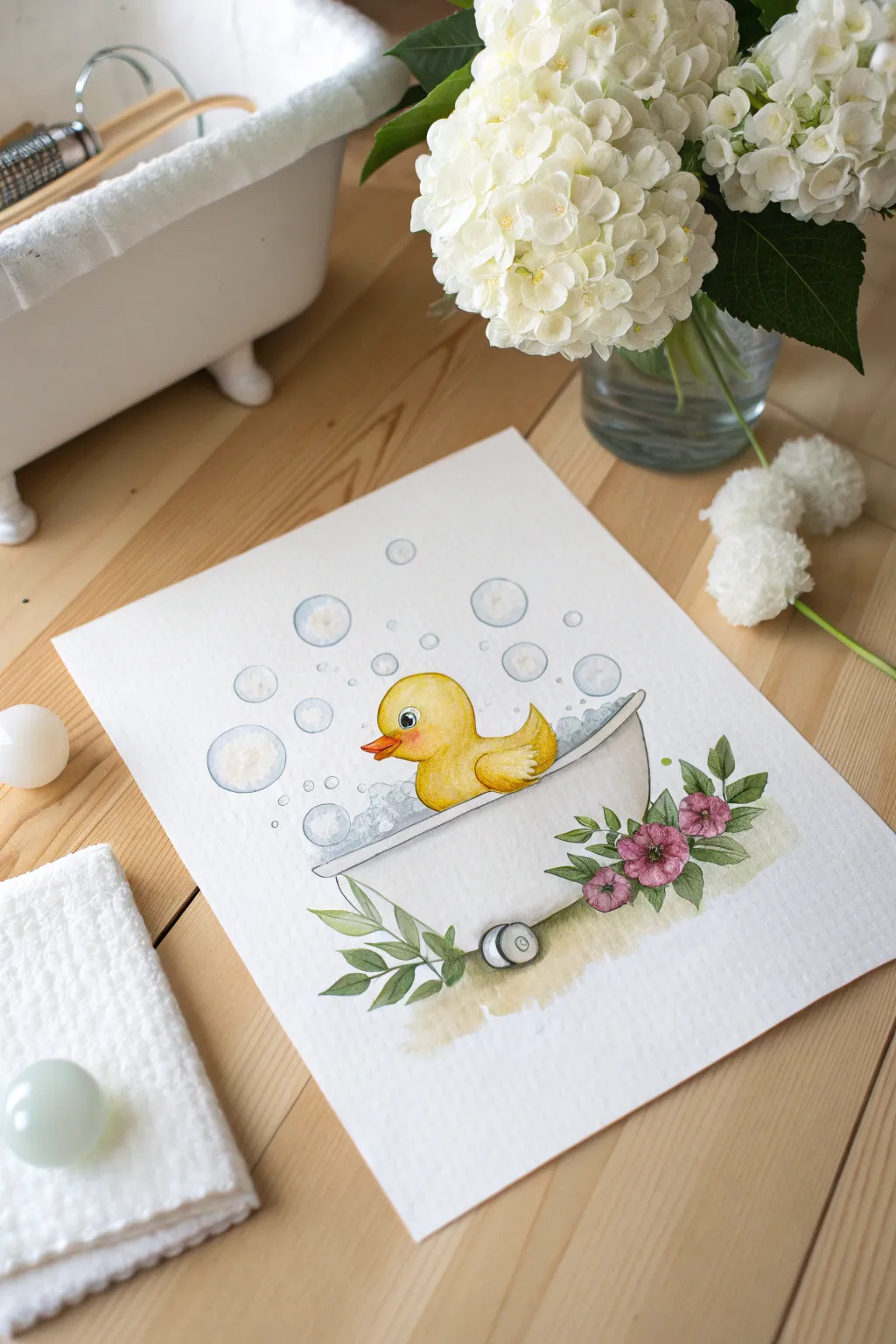
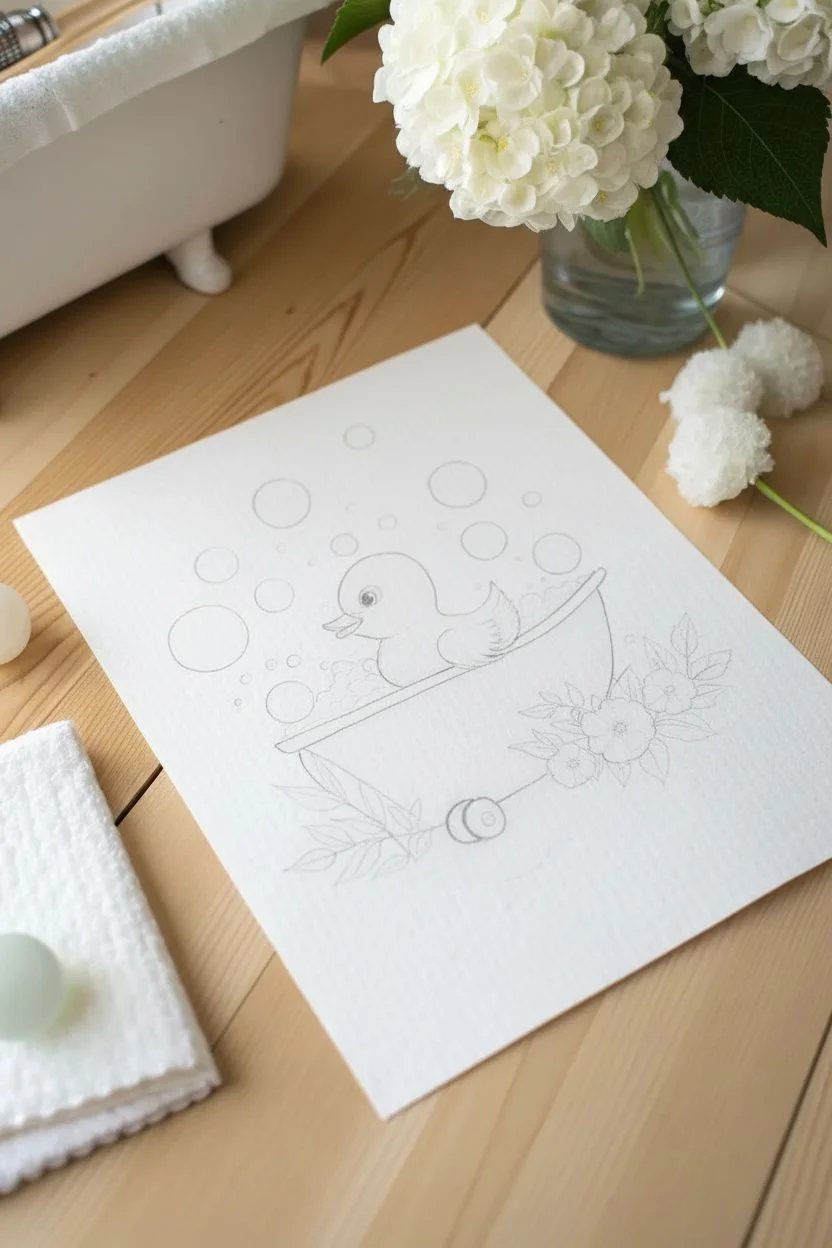
Capture the joy of bath time with this delightful watercolor illustration featuring a rubber duck in a vintage clawfoot tub. This project combines soft washes for bubbles with crisp details for the floral accents, creating a sweet piece perfect for a nursery or bathroom decor.
How-To Guide
Materials
- Cold press watercolor paper (300 gsm)
- Watercolor paints (Lemon Yellow, Cadmium Orange, Sap Green, Alizarin Crimson, Cobalt Blue, Payne’s Grey)
- Round brushes (sizing #2, #4, and #6)
- HB Pencil and kneaded eraser
- White gouache or white gel pen
- Paper towels
- Two jars of water
Step 1: Sketching the Scene
-
Outline the tub:
Begin by lightly sketching a wide, shallow U-shape for the bathtub body. Add a rolled rim at the top and sketch a single visible claw foot at the front bottom center. -
Position the duck:
Draw the rubber duck sitting inside the tub. Use a circle for the head and an oval for the body, ensuring the bottom of the duck is hidden by the tub’s rim. -
Add nature elements:
Sketch a cluster of leaves and three simple flowers tucking around the right side of the tub. Keep the shapes loose and organic. -
Draw the bubbles:
Scatter circles of various sizes floating above the duck. Include some bubbly foam textures overflowing from the tub’s rim. -
Clean up the sketch:
Gently roll a kneaded eraser over your entire drawing. You want the graphite lines to be faint enough to guide you but invisible under the paint.
Circle Perfect
Struggle with freehand circles? lightly trace a small coin or button for the bubbles during the sketch phase to ensure they stay round.
Step 2: Painting the Duck
-
Yellow base coat:
Load a #6 brush with clean water and dampen the duck’s body, then drop in a bright Lemon Yellow wash. Leave the eye area white. -
Add dimension:
While the yellow is still slightly damp, mix a touch of orange into your yellow and paint the shadow areas under the neck and the wing feathers. -
Paint the beak:
Using a bright Cadmium Orange and a smaller #4 brush, paint the beak. Add a tiny line of darker red-orange for the mouth opening. -
Detail the eye:
Switch to your #2 brush and black or dark grey paint. Carefully outline and fill the eye, leaving a tiny speck of white paper for the highlight.
Fixing Blooms
If water blossoms into a drying area creating a ‘cauliflower’ edge, wait for it to fully dry, then gently scrub the edge with a damp stiff brush.
Step 3: Tub and Botanicals
-
Shade the tub:
Since the tub is white, we only paint the shadows. Use a very diluted mix of Cobalt Blue and grey to shade the bottom curve and the area under the rim. -
Darken the rim:
Define the rolled rim of the tub with a thin line of grey-blue. Paint the claw foot with a stronger grey mix, leaving a highlight in the center for a metallic look. -
Leaf base layers:
Paint the leaves with a light wash of Sap Green. I like to vary the water amount here so some leaves look lighter than others. -
Floral colors:
Paint the flower petals with a soft pink wash. Once dry, dab a deeper crimson or purple into the very centers to create depth. -
Refining foliage:
Once the base green is dry, use your small brush to add veins and darker green shadows where the leaves overlap.
Step 4: Atmosphere and Details
-
Bubble outlines:
Mix a very watery pale blue. Carefully paint thin outlines for the floating bubbles, keeping the lines broken rather than perfect continuous circles. -
Softening bubbles:
Before the outline dries completely, use a clean, damp brush to pull the color slightly inward, softening the hard edge. -
Grounding the image:
Paint a loose, organic wash of ochre or warm brown underneath the tub and foliage to represent the ground, fading it out at the edges. -
Tub foam:
Add pale blue-grey shadows to the foam pile in the tub, using small circular motions to suggest a soapy texture. -
Final highlights:
Use white gouache or a gel pen to add crisp ‘shine’ marks to the bubbles, the wettest part of the duck, and the tub rim.
Step back and admire your charming, bubbly creation
Pop Art Color Blocks
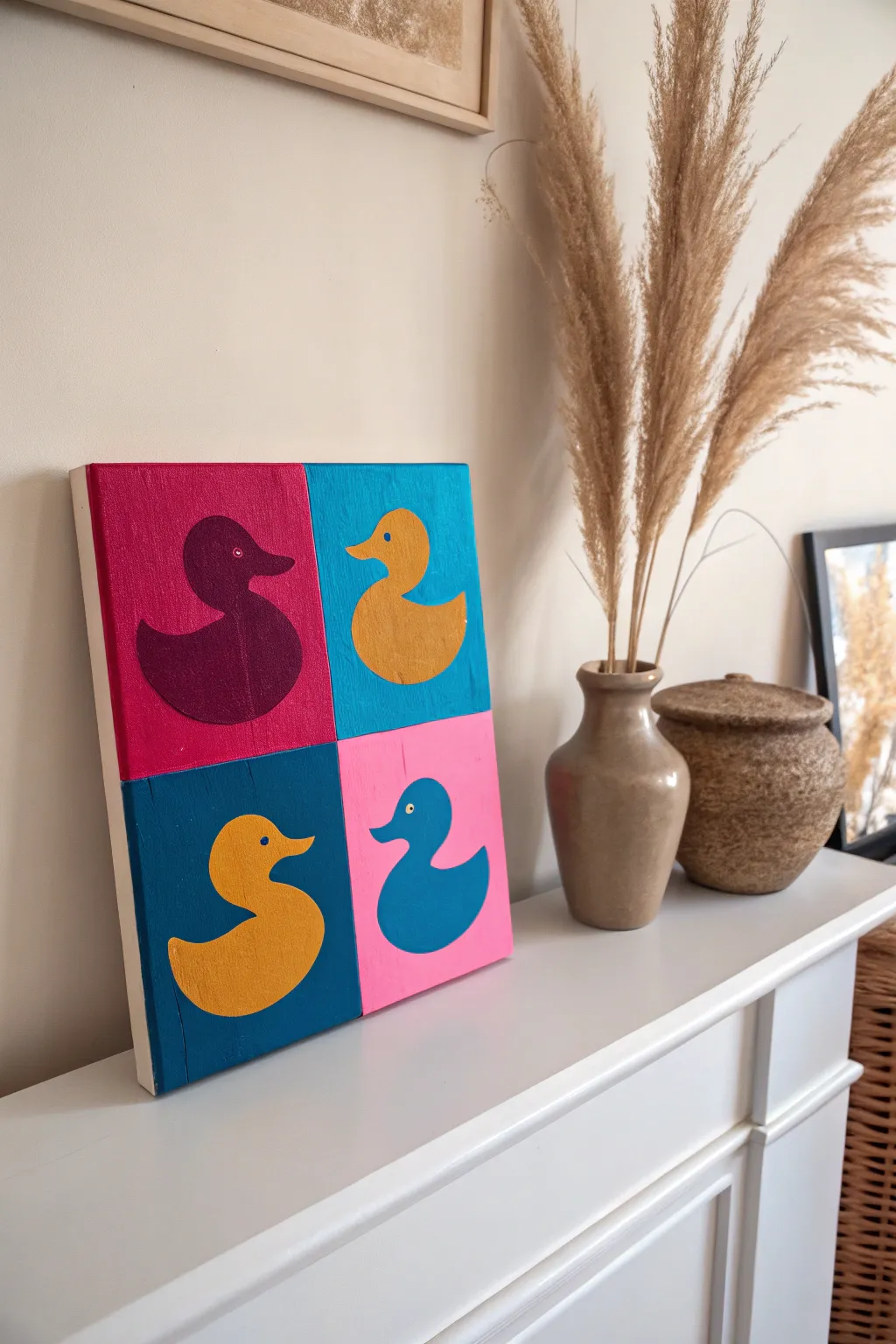
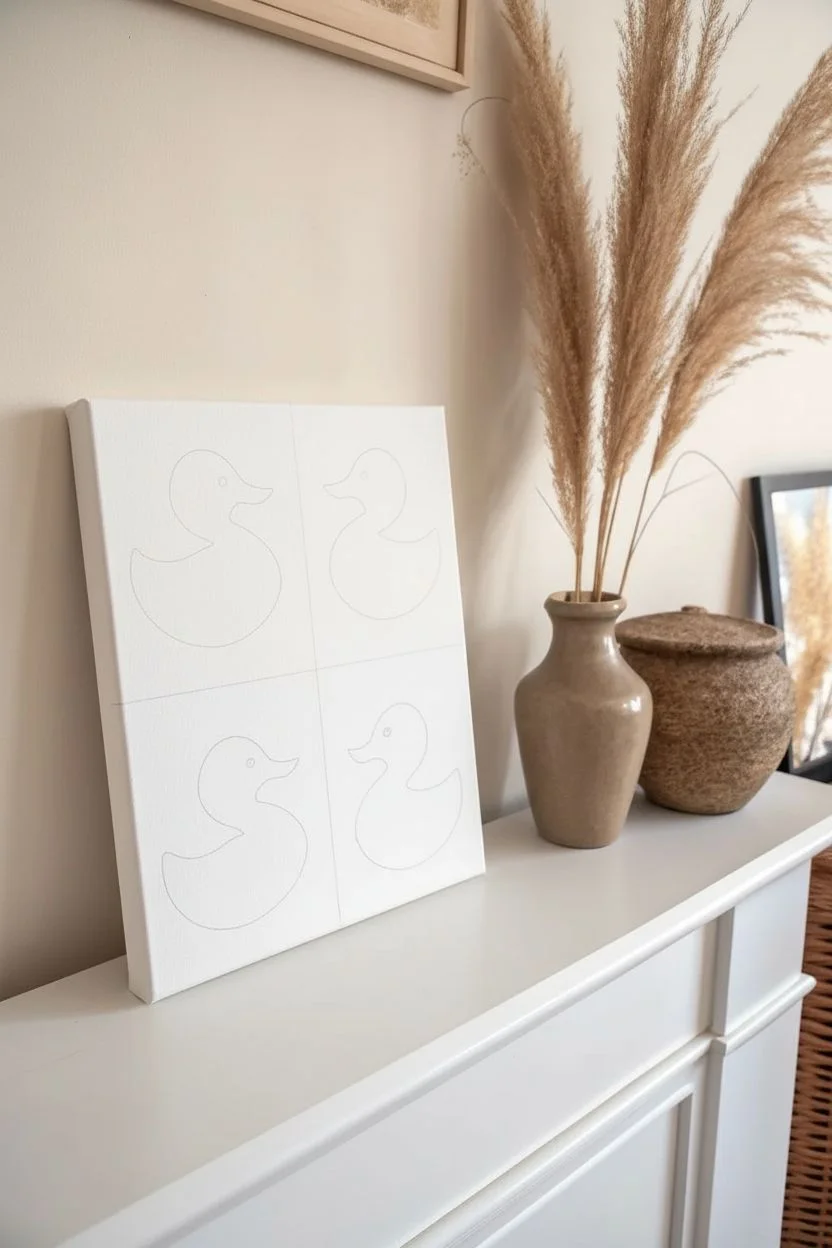
Bring a splash of playful retro style to your walls with this Warhol-inspired acrylic painting. You will create a balanced composition of four rubber ducks using bold, contrasting colors arranged in a classic pop art grid.
Step-by-Step Guide
Materials
- Square canvas (12×12 or 16×16 inches)
- Acrylic paints (Magenta, Cyan, Teal, Yellow, Purple, Bubblegum Pink, White, Black)
- Flat synthetic brushes (various sizes)
- Small round detail brush
- Pencil and eraser
- Ruler
- Cardstock or thick paper
- Scissors
Step 1: Planning the Grid
-
Measure the canvas:
Place your square canvas on a flat work surface. Use a ruler to measure the exact height and width to find the center points. -
Draw the quadrants:
Lightly draw a vertical line and a horizontal line through the center points with a pencil, dividing the canvas into four equal squares. -
Create a template:
Draw a simple rubber duck silhouette on a piece of cardstock. Make sure it is sized appropriately to fit comfortably inside one of your quadrants with some breathing room around the edges. -
Cut out the stencil:
Carefully cut out your duck shape using scissors. This template ensures every duck on the canvas looks identical. -
Trace the design:
Place the template in the center of the top-left quadrant and trace around it lightly. Repeat this process for the remaining three quadrants.
Step 2: Blocking in Backgrounds
-
Paint the magenta quadrant:
Squeeze out your magenta or hot pink acrylic. Using a flat brush, carefully paint the background of the top-left square, cutting in neatly around the pencil outline of the duck. -
Paint the cyan quadrant:
Clean your brush thoroughly. Paint the background of the top-right square using a bright cyan or sky blue paint. -
Paint the teal quadrant:
For the bottom-left square, use a deep teal or dark blue shade to fill in the background space around the duck shape. -
Paint the light pink quadrant:
Fill the background of the final bottom-right square with a soft bubblegum pink. -
Apply a second coat:
Acrylics can sometimes be translucent. Once the first layer is dry, apply a second coat to all four background colors to achieve a solid, opaque look.
Straight Line Struggles?
If you have trouble painting straight lines freehand, place strips of low-tack painter’s tape along your pencil grid lines before painting the backgrounds to get crisp edges.
Step 3: Painting the Ducks
-
Paint the purple duck:
Using a smaller flat brush, fill in the duck shape in the top-left quadrant with a deep purple acrylic. -
Paint the yellow ducks:
For the top-right and bottom-left quadrants, paint both duck silhouettes with a bright, opaque yellow. I usually apply a tiny bit of white to my yellow first to help it cover the canvas better. -
Paint the blue duck:
Fill in the final duck in the bottom-right quadrant with a medium blue tone that contrasts well with the light pink background. -
Check opacity:
Just like the backgrounds, give the ducks a second coat of paint once the first is dry to ensure no canvas texture shows through.
Texture Twist
Make the artwork pop even more by applying a high-gloss varnish only over the duck shapes, leaving the background matte for a cool textural contrast.
Step 4: Refining Details
-
Clean up the edges:
Use a small liner brush to touch up any areas where the background color may have overlapped the ducks, or vice versa, creating crisp, sharp lines. -
Add eye whites:
Dip the handle end of a small brush into white paint and dot it onto the head of each duck to create perfectly round eyes. -
Add pupils:
Once the white dots are dry, use a smaller tool (like a toothpick or fine brush tip) to add a tiny black or colored dot in the center of the white. -
Erase guidelines:
If any pencil lines from your initial grid are still visible at the very edges of the canvas, gently erase them now.
Hang your new masterpiece in a bright spot where the bold colors can really shine
Mastering Water Reflections
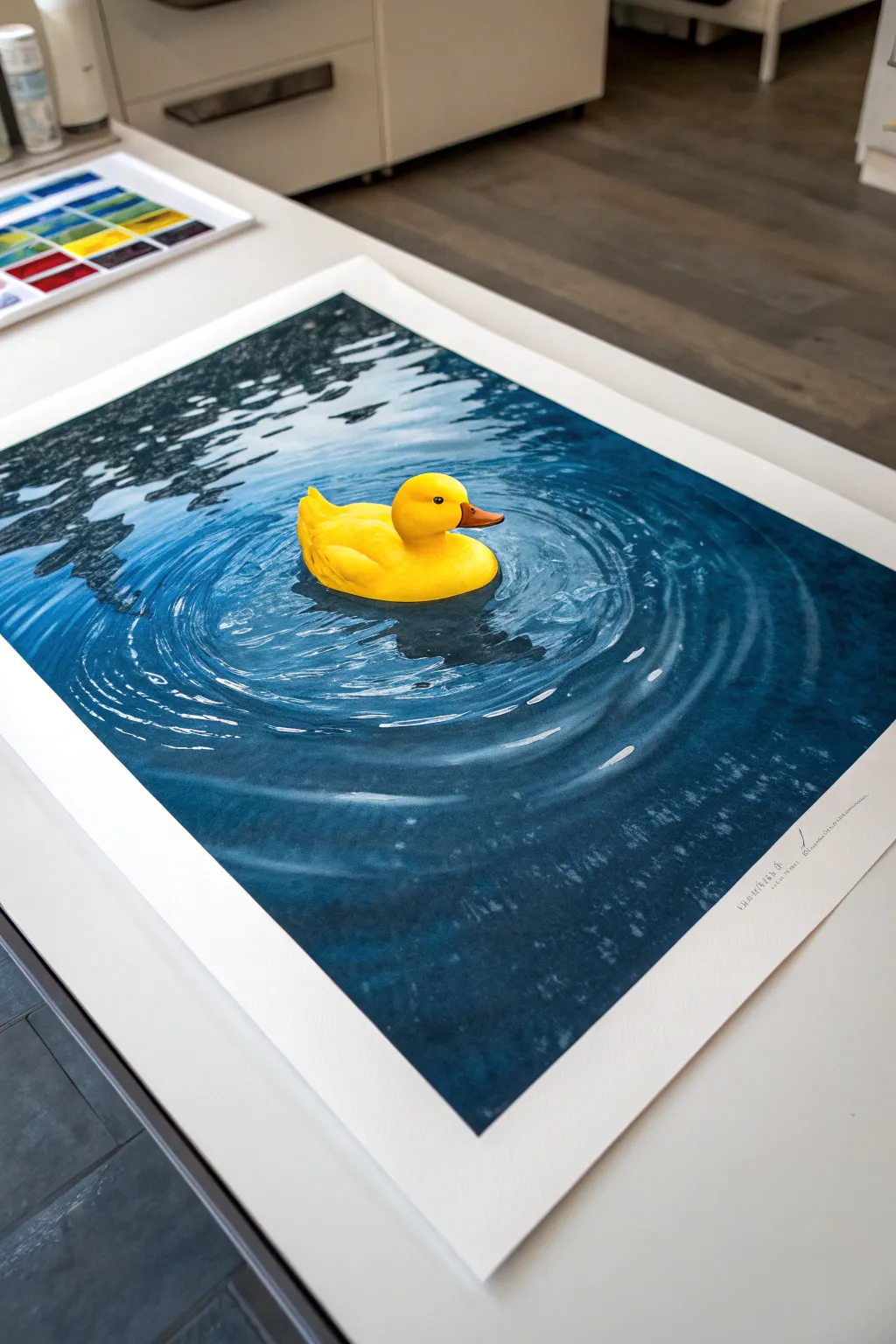
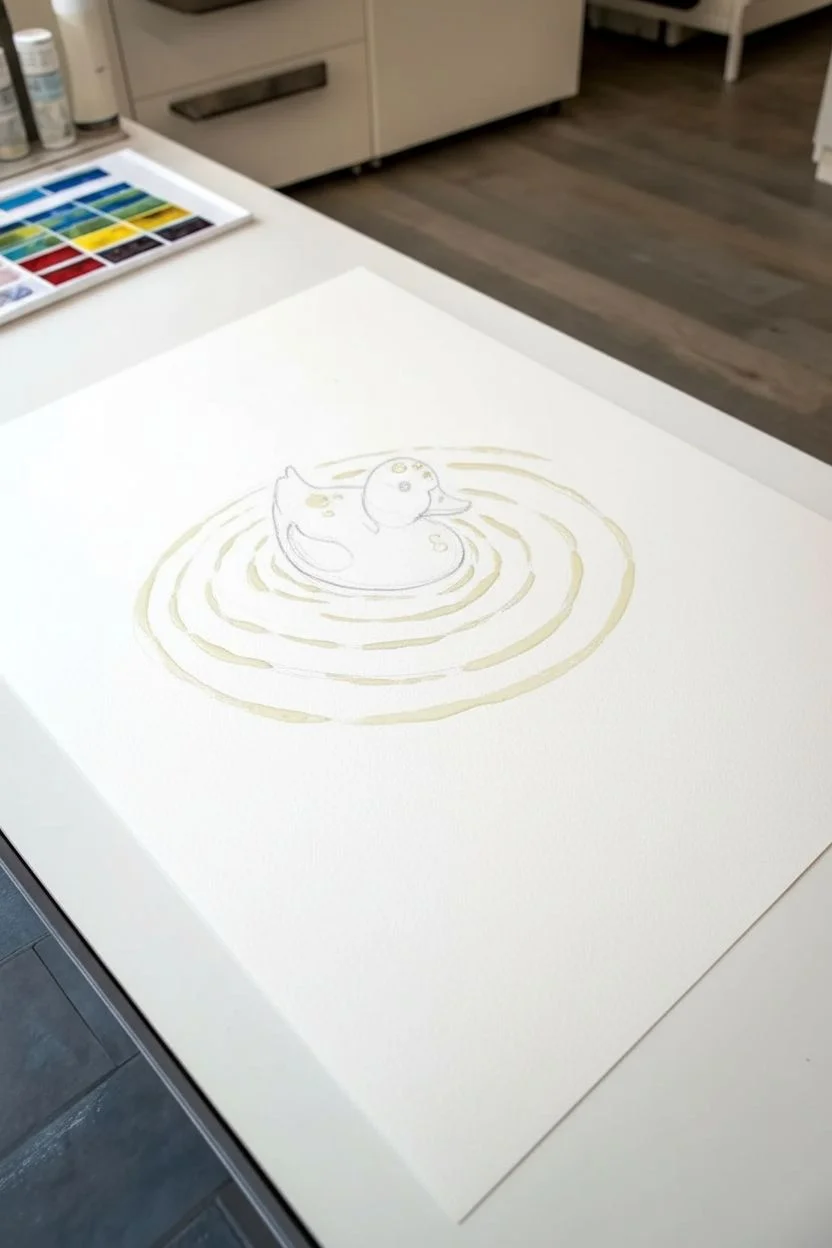
Capture the stillness of a classic rubber duck floating in deep blue water with this realistic painting project. This tutorial focuses on creating convincing plastic textures and mastering the distortion of concentric ripples using watercolor and gouache.
Detailed Instructions
Materials
- Heavyweight watercolor paper (300gsm cold press)
- Watercolor paints (Cadmium Yellow, Orange, Phthalo Blue, Indigo, Payne’s Grey)
- White Gouache
- Round brushes (Sizes 2, 6, and 10)
- Masking fluid
- HB Pencil and eraser
- Palette for mixing
Step 1: Sketching and Masking
-
Outline the subject:
Lightly sketch the rubber duck in the center of your paper. Focus on the smooth curves of the head and the distinct upturned tail. -
Map the ripples:
Draw elliptical rings radiating outward from the duck. These don’t need to perfect circles; organic, slightly wobbling ovals look more realistic. -
Preserve the whites:
Using a detailed brush or a silicone tool, apply masking fluid to the tops of the water ripples where the light hits, and add a few tiny dots on the duck’s head and back for specular highlights. -
Let it cure:
Allow the masking fluid to dry completely before touching it with a wet brush, otherwise, you risk tearing the paper.
Step 2: Painting the Duck
-
Base yellow layer:
Apply a clean wash of Cadmium Yellow over the entire duck body, avoiding the beak area. -
Building form:
While the yellow is still damp, drop in a slightly warmer yellow-orange mix along the bottom of the duck and under the neck to create volume and shadow. -
The beak:
Paint the beak with a bright orange. Add a tiny line of reddish-brown where the beak opens to give it definition. -
Defining the eye:
With a fine tip brush, carefully paint the eye black, leaving a tiny pinprick of white paper (or use white gouache later) for the reflection. -
Deepening shadows:
Once the first layer is dry, add a glaze of raw sienna to the darkest curves of the plastic body to emphasize the rubber texture.
Pro Tip: Meniscus Effect
Paint a tiny, dark blue rim right where the yellow duck meets the water. This mimics the meniscus, showing the surface tension.
Step 3: The Deep Blue Water
-
First water wash:
Mix a large amount of Phthalo Blue. Wet the paper around the duck and apply a medium-toned wash, letting it flow over the ripple lines but stopping carefully at the duck’s edge. -
Duck reflection:
Directly under the duck, paint a blurred reflection using a mix of yellow and green tones, as the yellow duck influences the blue water color here. -
Darkening the troughs:
Mix Indigo and Payne’s Grey to create a deep, near-black blue. Paint the ‘troughs’ (the spaces between the masked ripple highlights) to create depth. -
Softening edges:
I like to use a clean, slightly damp brush to soften the edges of the dark blue ripples so they transition smoothly into the lighter blue mid-tones. -
Outer water:
Make the water significantly darker towards the edges of the paper to draw the viewer’s eye inward toward the bright yellow subject. -
Cast shadow:
Paint a darker shadow directly beneath the duck’s tail and breast where it blocks the light entering the water.
Level Up: Soap Suds
Once dry, paint clusters of tiny bubbles near the tail using white gouache circles with faint rainbow glazes inside for a bath-time feel.
Step 4: Finishing Details
-
Remove masking:
Once the paper is bone dry, gently rub away the masking fluid to reveal the crisp white paper underneath. -
Refining ripples:
The white lines might be too stark. Glaze over them lightly with very dilute blue in areas where the ripples fade out, leaving the brightest whites near the center. -
Gouache highlights:
Use white gouache to add sharp, un-diluted highlights on the wettest part of the duck’s back and beak to make it look like slick plastic.
Now you have a striking study in contrast and reflection that pops right off the page
BRUSH GUIDE
The Right Brush for Every Stroke
From clean lines to bold texture — master brush choice, stroke control, and essential techniques.
Explore the Full Guide
Priming Your Physical 3D Canvas
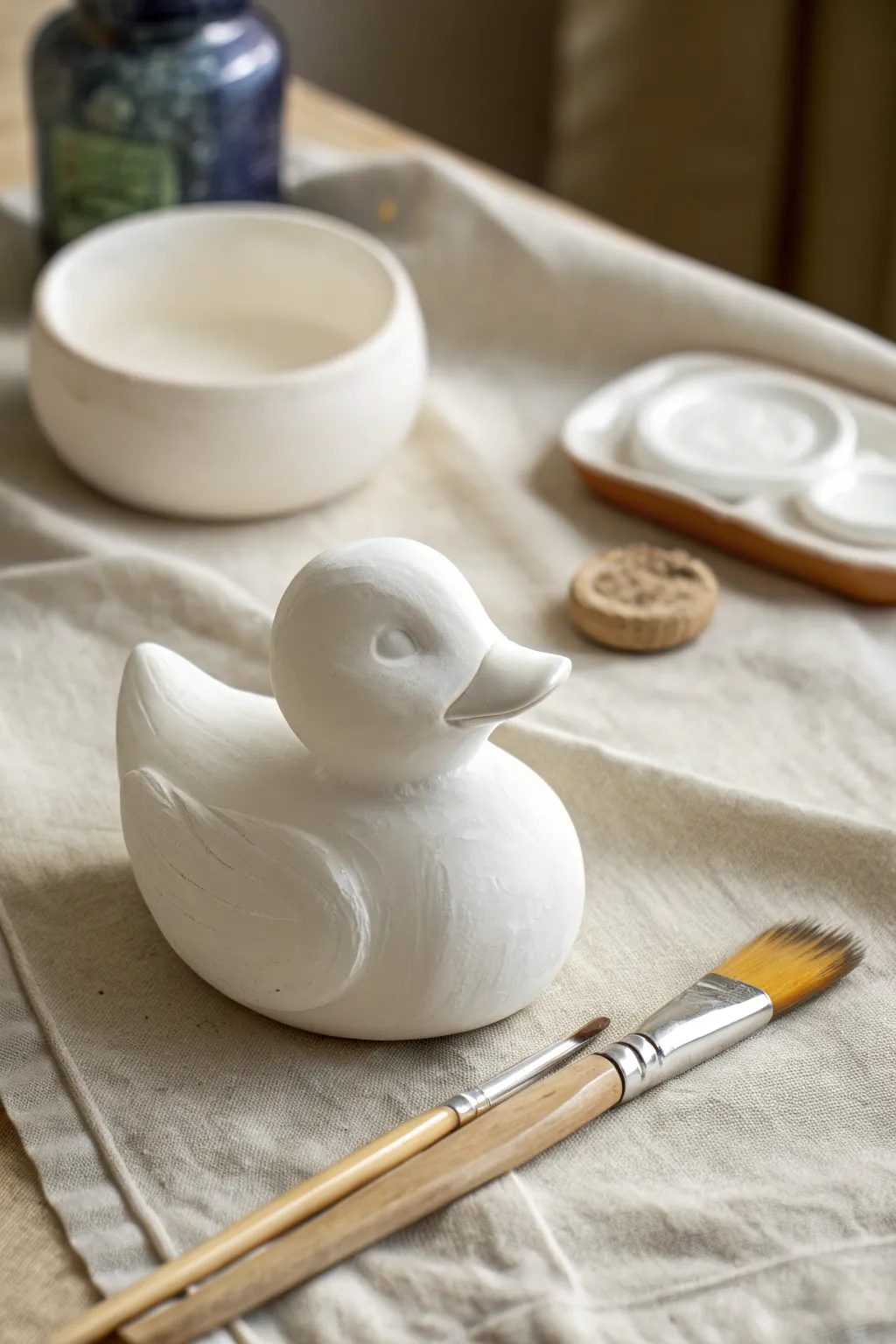
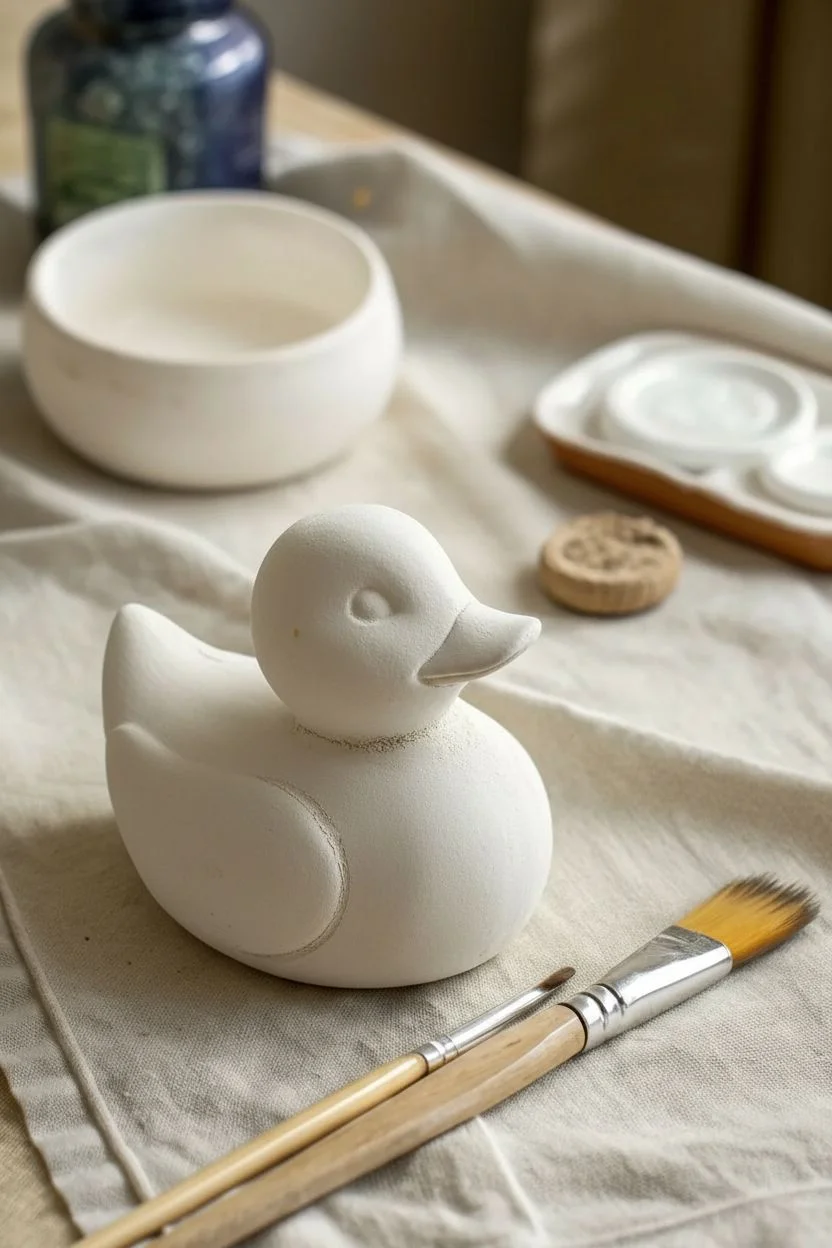
Before diving into colorful designs, establishing a flawless, matte white base is crucial for professional-looking results. This tutorial guides you through priming your duck figurine to create a toothy surface that grabs pigment and ensures your artwork stands the test of time.
Step-by-Step Guide
Materials
- Unpainted duck figurine (ceramic, plaster, or bisque)
- White acrylic gesso or high-quality primer
- Wide flat synthetic brush (size 8 or 10)
- Small round detail brush
- Fine-grit sandpaper (400 grit)
- Clean water jar
- Lint-free shop cloth or cotton rag
- Ceramic or plastic mixing palette
- Protective drop cloth
Step 1: Surface Preparation
-
Prepare the workspace:
Lay down a linen cloth or newspaper to protect your work surface from dust and accidental drips. -
Inspect the figurine:
Examine your duck for any rough seams, manufacturing burrs, or bumps left over from the casting process. -
Initial sand:
Gently rub the fine-grit sandpaper over any raised imperfections to flatten them out, paying attention to the underside edges. -
Clean the surface:
Dampen your lint-free cloth with a little water and wipe the entire figure to remove sanding dust and oils. -
Dry thoroughly:
Use a dry section of the cloth to ensure no moisture remains, as trapped water can affect how the primer adheres.
Sticky Surface?
If the gesso feels tacky after drying, humidity might be too high. Give it extra drying time or use a fan before sanding to avoid gumming up your sandpaper.
Step 2: Applying the Base
-
Load the palette:
Pour a generous amount of white gesso into your palette or bowl; stir it briefly if it has separated. -
Load the brush:
Dip your wide flat brush into the gesso, coating the bristles about halfway up to maintain flexibility. -
Begin at the bottom:
Start applying the primer near the base of the duck using long, horizontal strokes to establish a smooth layer. -
Work upwards:
Continue brushing up the sides and chest, overlapping your strokes slightly to avoid creating raised ridges. -
Handle the curves:
As you reach the wings and tail, curve your brush strokes to follow the natural anatomy of the sculpture. -
Detail the face:
Switch to your smaller round brush to carefully apply primer around the eyes and under the beak without pooling paint.
Pro Tip: Wet Brush
Dip your brush in clean water and dab it on a towel before picking up the primer. A slightly damp brush helps the gesso glide smoothly and reduces streak marks.
Step 3: Smoothing and Refining
-
Check for gaps:
I like to rotate the duck under a bright light at this stage to spot any gray areas that need more coverage. -
Feather the edges:
If you see any drips beginning to form, lightly feather them out with a damp brush before they begin to set. -
Allow to dry:
Let the first coat dry completely, which typically takes about 20 to 30 minutes depending on humidity. -
Light sanding:
Once dry to the touch, very lightly skim the sandpaper over the surface again to knock down any brush textures. -
Second coat:
Apply a second thin layer of gesso, brushing in a perpendicular direction (cross-hatching) to the first coat for solid opacity. -
Final smooth:
Inspect the beak area one last time to ensure the primer remains smooth and hasn’t clogged any sculpted details. -
Final cure:
Leave the pristine white duck to cure for a few hours, or ideally overnight, before starting your color painting.
With your canvas now perfectly primed and silky smooth, you have the ideal foundation to begin your masterpiece
Polka Dots and Striped Patterns
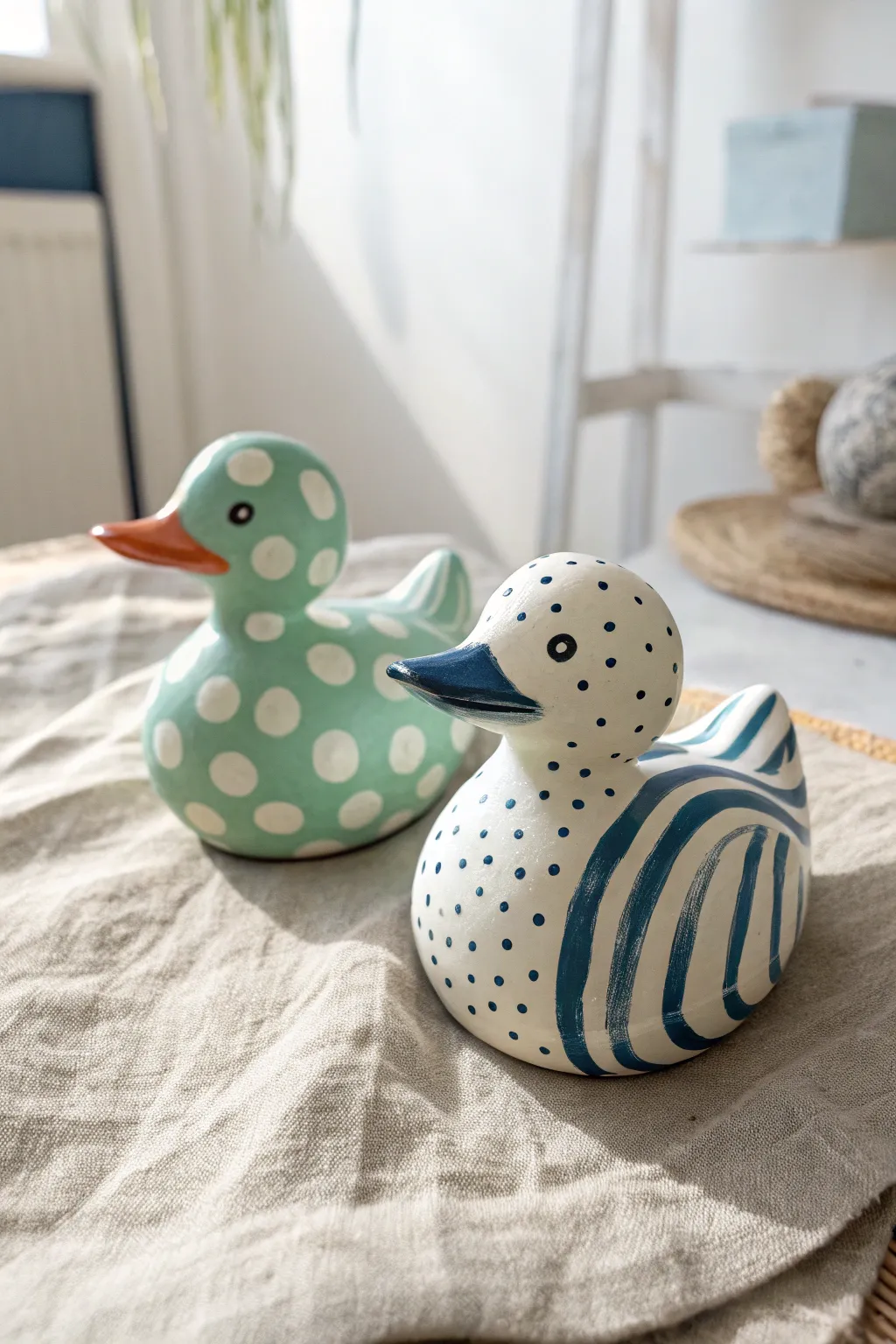
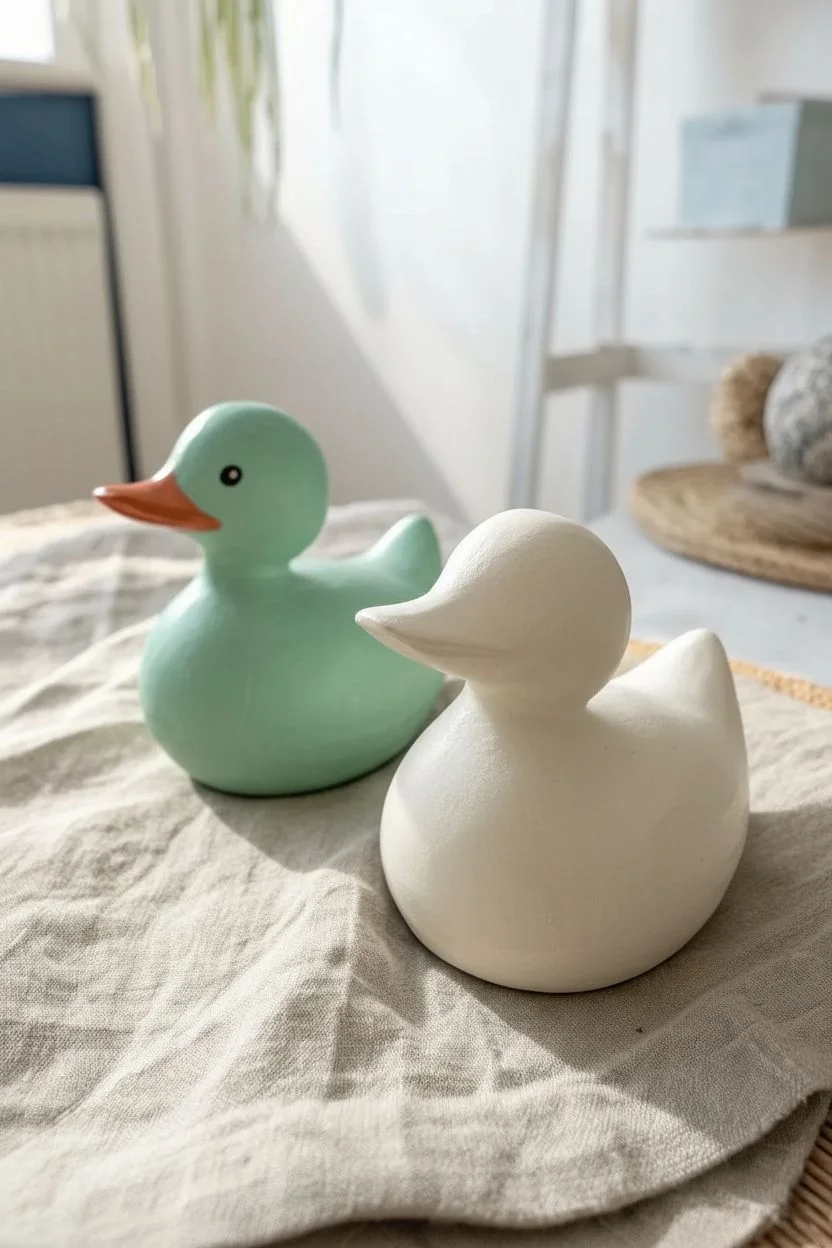
Bring a touch of playful Scandinavian charm to your shelf with these hand-painted wooden ducks. This project combines a soothing mint palette with crisp nautical stripes for a timeless, artisanal look.
Detailed Instructions
Materials
- 2 wooden or ceramic duck shaped blanks
- Acrylic paint (Mint Green, Creamy White, Navy Blue, Burnt Orange, Black)
- Medium flat brush (3/4 inch)
- Small round brush (size 2 or 4)
- Detail liner brush
- Dotting tool or pencil with eraser
- Matte varnish spray
- Palette and water cup
Step 1: Base Preparation
-
Surface smoothing:
If using wooden ducks, gently sand any rough patches with fine-grit sandpaper and wipe clean with a damp cloth to remove dust. -
First base coat:
Paint the first duck entirely with the mint green acrylic, using long strokes to minimize brush marks. -
Second base coat:
Coat the second duck with the creamy white paint; I prefer applying two thin layers rather than one thick one to prevent drips. -
Drying time:
Allow both figures to dry completely for at least 20 minutes before handling them to avoid tacky fingerprints.
Step 2: The Polka Dot Duck
-
Painting the beak:
Use a small round brush to paint the beak of the mint green duck with burnt orange paint, carefully cutting in the edge near the face. -
Creating dots:
Dip a large dotting tool or the clean eraser end of a pencil into plain white paint. -
Pattern application:
Press the tool firmly onto the green surface to effectively stamp the polka dots, spacing them randomly but evenly around the body. -
Refining opacity:
Reload your tool with fresh paint every two or three dots to ensure the white circles stay crisp and opaque.
Pro Tip: Perfect Circles
For uniform polka dots without special tools, use the flat end of a drill bit or the handle of a paintbrush. Dip straight in and press straight down.
Step 3: The Nautical Stripe Duck
-
Dark beak:
Paint the beak of the creamy white duck using the navy blue acrylic paint and a steady hand. -
Head details:
Using the tip of a small round brush dipped in navy blue, gently stipple small dots onto the head, neck, and chest area. -
Wing stripes:
Switch to a liner brush to create the sweeping wing details. -
Painting curves:
Start from the shoulder area and pull curved lines backward toward the tail, mimicking the shape of folded wing feathers. -
Line variation:
Apply varying pressure to the brush to make the stripes thicker in the middle and tapered at the ends for an artistic look.
Troubleshooting: Dragging Paint
If your brush drags while painting the navy stripes, mix a tiny drop of water into your paint on the palette to improve flow and get smoother lines.
Step 4: Finishing Touches
-
The eyes:
Dip the handle end of a paintbrush into black paint and dot a small eye onto each duck face. -
Sparkle:
Once the black is dry, add a tiny pin-prick of white paint to the upper corner of the eye to create a reflection. -
Touch ups:
Check around the necks and bases for any missed spots or smudges and conceal them with original base colors. -
Sealing:
Finish by placing the ducks in a well-ventilated area and applying a coat of matte varnish to protect your design.
Now step back and admire your adorable new decor pieces.

PENCIL GUIDE
Understanding Pencil Grades from H to B
From first sketch to finished drawing — learn pencil grades, line control, and shading techniques.
Explore the Full Guide
Superhero Cosplay Transformations
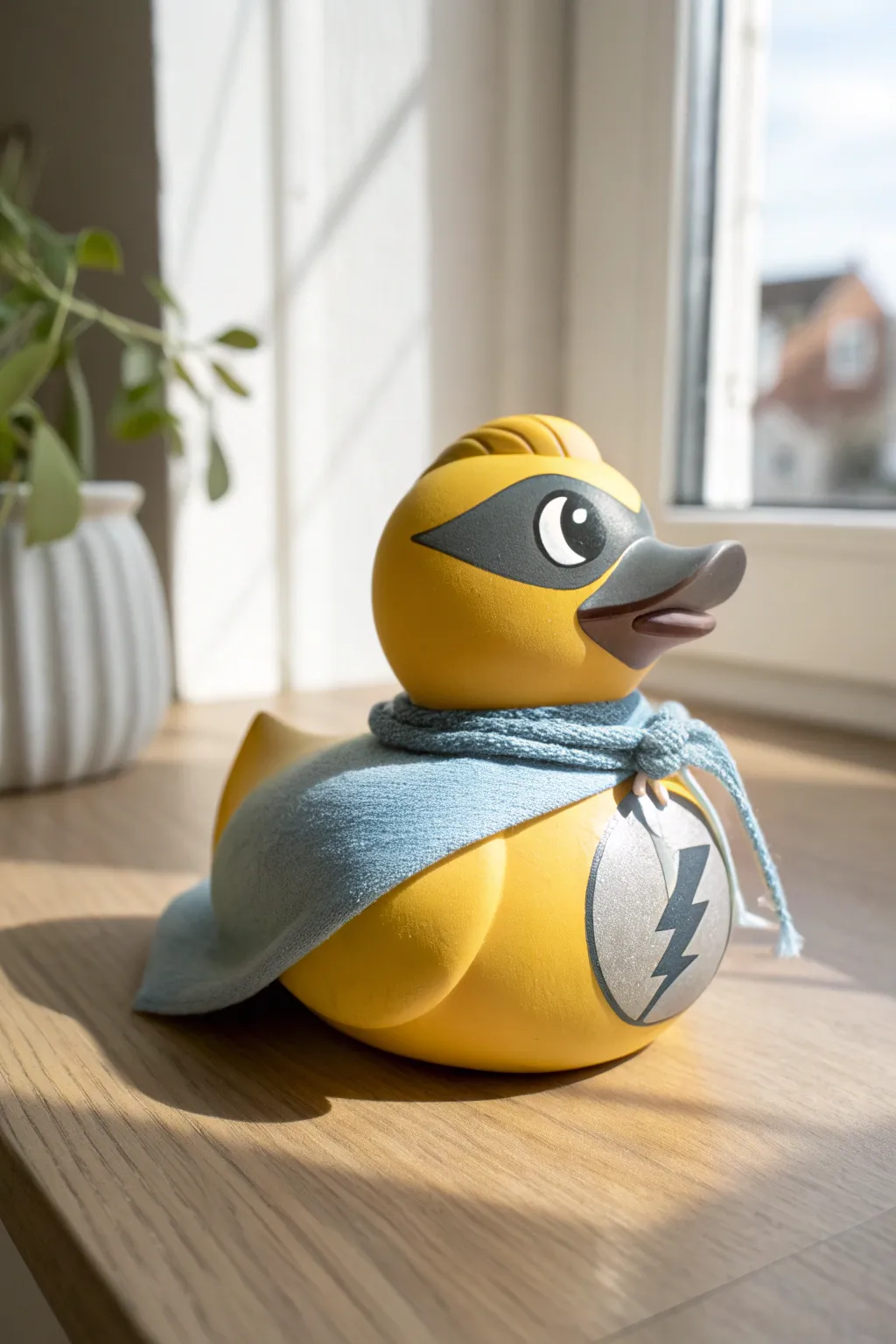
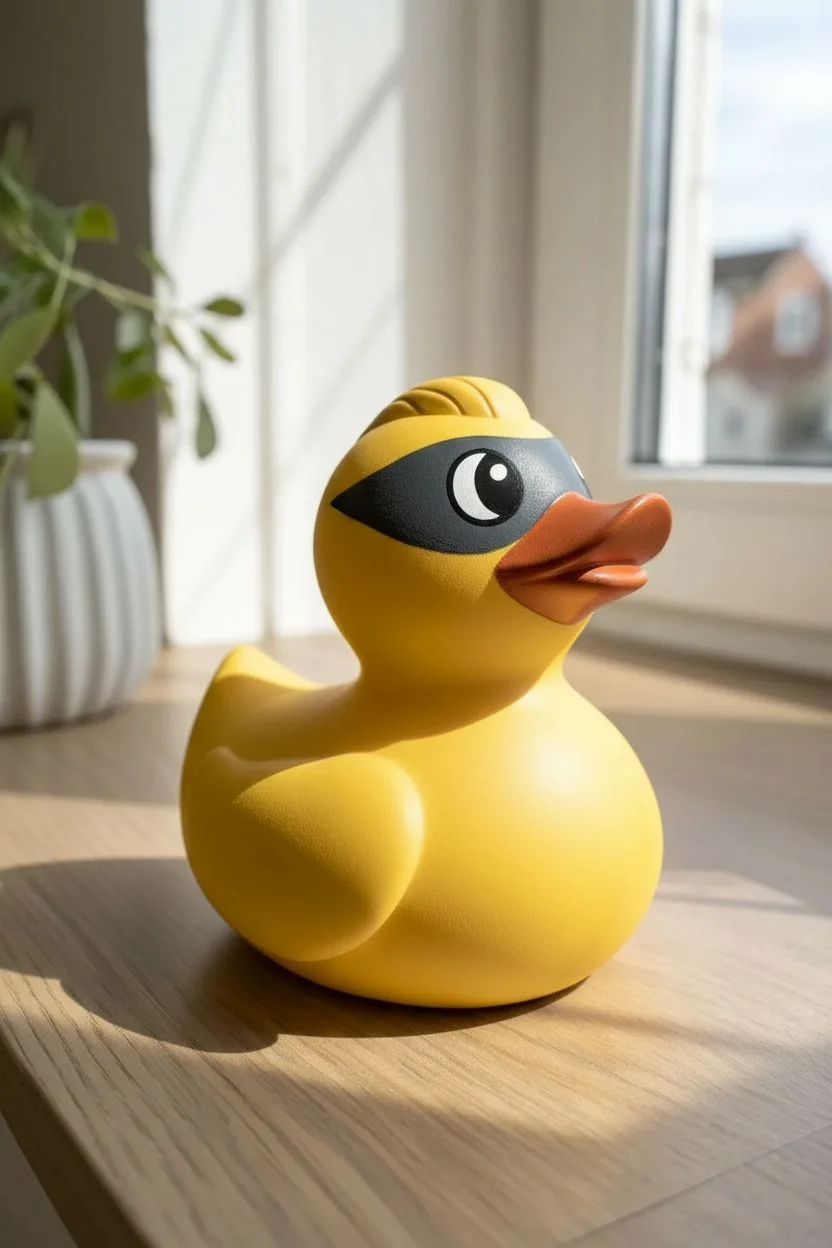
Transform a standard bath toy into a caped crusader with this fun creative project. With a painted mask, a striking chest emblem, and a handmade fabric cape, your rubber duck will look ready to zoom into action.
How-To Guide
Materials
- Standard yellow rubber duck
- Acrylic paints (Dark charcoal, silver, white, black, reddish-brown)
- Fine detail paintbrushes
- Light blue jersey knit fabric
- Fabric scissors
- Fabric glue
- Pencil
- Matte clear sealer spray
Step 1: Face and Mask
-
Clean the surface:
Wash your rubber duck with warm soapy water to remove any manufacturing oils, then dry it thoroughly with a lint-free cloth. -
Sketch the mask:
Using a pencil, lightly draw the outline of the superhero mask around the eyes, angling the edges up towards the back of the head. -
Paint the mask base:
Fill in the mask outline with dark charcoal or dark grey acrylic paint, using a small brush to keep the edges sharp. -
Color the beak:
Mix a reddish-brown tone and paint the beak, covering any original orange color completely. -
Add the eyes:
Once the mask paint is dry, paint large white ovals inside the mask area for the eyes. -
Detail the pupils:
Paint black pupils inside the white ovals, glancing to the side for a bit of personality. -
Add the highlights:
I like to add a tiny white dot in the upper corner of each pupil to give the character a spark of life.
Primer Prep
Rubber surfaces can be slick. Lightly scuff the shiny plastic with fine-grit sandpaper before painting to help the acrylics adhere permanently.
Step 2: Emblem and Finish
-
Outline the logo:
Draw a perfect circle on the center of the duck’s chest using a stencil or by tracing a small bottle cap. -
Paint the silver base:
Fill the circle with metallic silver acrylic paint and let it dry completely. -
Add the bolt:
Using your finest detail brush, carefully paint a lightning bolt shape in the center of the silver circle using the dark charcoal paint. -
Seal the paint:
Once all paint is fully cured, spray the duck with a matte clear sealer to protect your artwork from scratches.
Step 3: The Cape
-
Cut the fabric:
Cut a piece of light blue jersey fabric into a rounded trapezoid shape that drapes nicely over the duck’s back. -
Prepare the tie:
Cut a long, thin strip of the same fabric, about a quarter-inch wide and eight inches long. -
Attach the cape:
Lay the thin strip horizontally and glue the top edge of the cape piece to the center of the strip, slightly rolling the strip to hide the raw edge. -
Dress the hero:
Wrap the strip around the duck’s neck and tie a snug knot or bow at the front, just above the silver emblem. -
Final trim:
Trim the ends of the knot to your desired length to complete the look.
Vinyl Victory
For ultra-crisp lines on the chest logo, try cutting the circle and lightning bolt from adhesive vinyl or a printable sticker sheet instead of painting.
Now your super-duck is ready to patrol your desk or shelf with heroic flair.
Adding Personality with Sunglasses
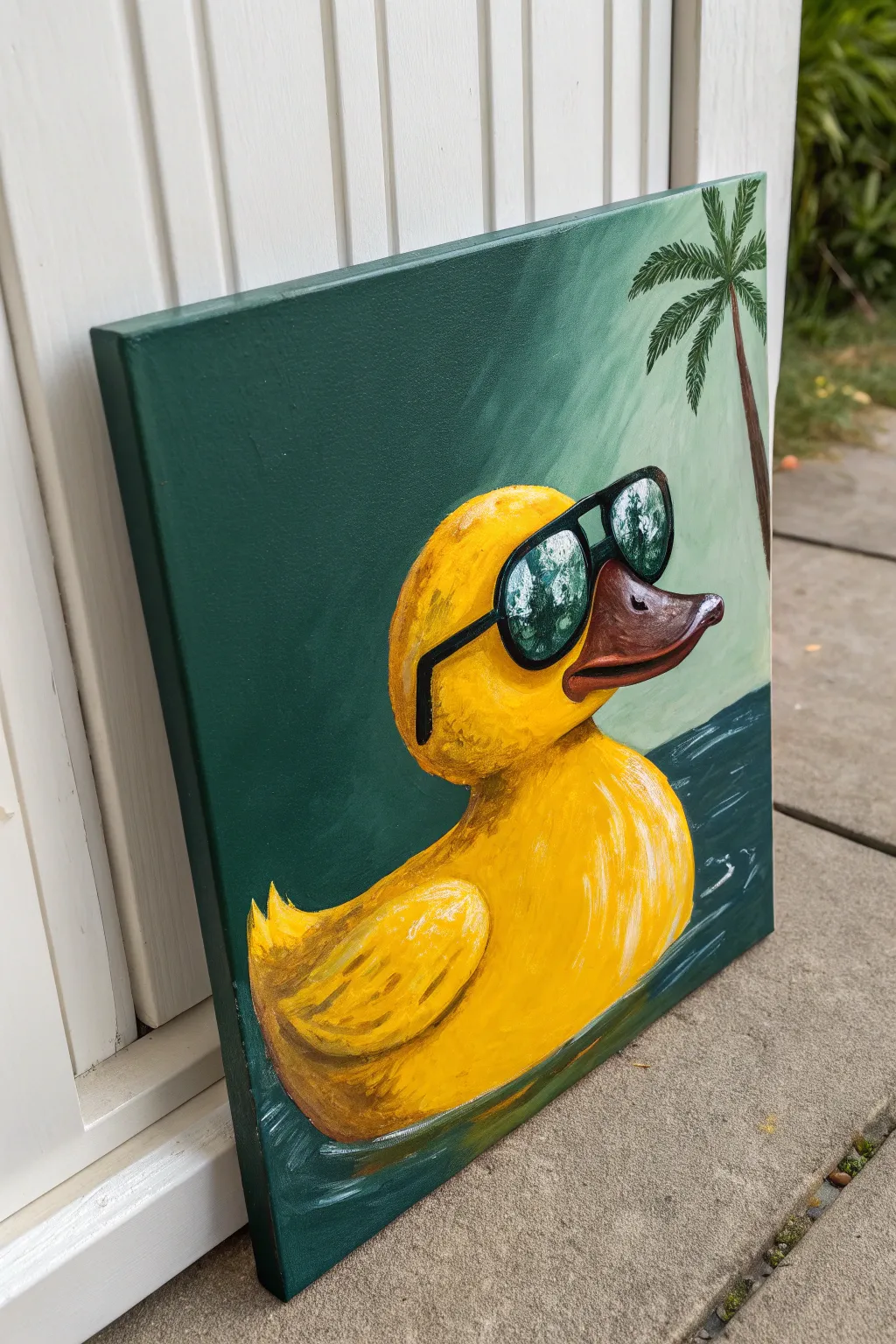
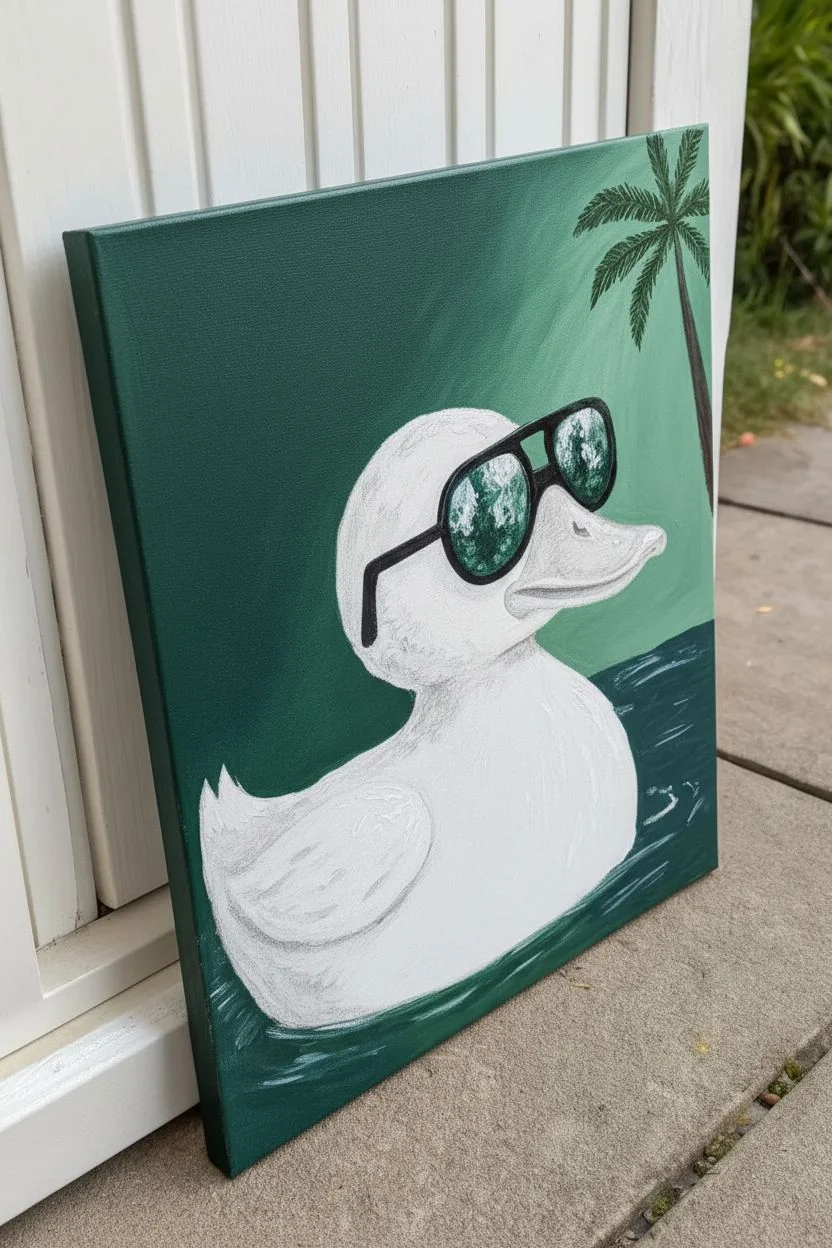
Bring some serious summer attitude to your walls with this vibrant acrylic painting of a rubber duck donning reflective aviators. The deep green background contrasts beautifully with the bright yellow feathers, making this piece pop in any bathroom or sunroom.
Detailed Instructions
Materials
- Square stretched canvas (approx. 12×12 inches)
- Acrylic paints: Phthalo Green, Cadmium Yellow, Yellow Ochre, Burnt Sienna, Carbon Black, Titanium White
- Pencil and eraser
- Flat brush (3/4 inch) for background
- Medium round brush (size 6)
- Fine liner brush (size 0 or 1)
- Palette and water cup
- Paper towels
Step 1: Sketch and Background
-
Outline the subject:
Lightly sketch the large duck shape in the center of your canvas using a pencil. Draw the oversized sunglasses first to get the placement right, then add the rounded head, beak, and body. -
Mix the background color:
Combine Phthalo Green with a touch of Black to create a deep, rich forest green. For the right side, mix a separate puddle of the green with a small amount of White to create a subtle gradient. -
Apply the background:
Using the large flat brush, paint the background area around the duck. Start with the dark mix on the left and blend into the lighter mix on the right side to suggest a light source. -
Paint the edges:
Don’t forget to wrap the dark green paint around the sides of the canvas for a finished, professional look without a frame. -
Add the palm tree:
Using a small round brush and brown paint (mix Burnt Sienna with a tiny dot of Black), paint a curved line for the tree trunk on the right edge. Use the dark background green to flick outward strokes for the palm leaves. -
Indicate water:
At the very bottom of the canvas, use horizontal strokes of your dark background mix with a touch of white to create a few simple ripples suggesting the duck is floating.
Clean Colors
If your yellow looks muddy or green against the background, apply a coat of white gesso or paint over the background area first and let it dry before applying the yellow.
Step 2: Painting the Duck
-
Base coat the body:
Fill in the duck’s body and head with pure Cadmium Yellow. You may need two coats to ensure the green background doesn’t show through. -
Block in the beak:
Paint the beak using Burnt Sienna. Add a little White to the top edge for a highlight later, but keep it flat for now. -
Paint the sunglasses silhouette:
Fill in the entire shape of the sunglasses with solid Carbon Black. Ensure the edges are crisp against the yellow face.
Custom Reflections
Personalize the artwork by changing the reflection in the glasses. Instead of trees, paint a tiny reflection of a beach umbrella or a city skyline.
Step 3: Shading and Texture
-
Shadow the neck:
Mix Yellow Ochre with a tiny bit of Burnt Sienna. Apply this darker shade under the sunglasses and around the neck area to create dimension. -
Define the wing:
Use the same shadow mix to outline the curve of the wing on the side of the body. -
Add feather texture:
I like to use a dry brush for this step; take a little Titanium White mixed with Cadmium Yellow and whisk quick, curved strokes across the chest and wing to simulate wet feathers. -
Detail the beak:
Use dark brown or black to paint the nostril and the line separating the upper and lower beak. Add a sweeping curve of lighter orange on the lower lip for volume.
Step 4: Reflections and Details
-
Create the lens base:
Mix a dark grey-green shade. Paint the inside of the sunglasses lenses, leaving a thin black rim around the outside. -
Paint the lens reflection:
Dab lighter green and white spots inside the lenses to look like reflected trees and sky. Keep these shapes abstract and soft. -
Add lens shine:
Using the liner brush and pure Titanium White, add a sharp diagonal streak or a few bright dots on the lenses to make them look like hard, shiny glass. -
Final highlights:
Add pure white accents to the top of the duck’s head, the tip of the tail, and the wettest part of the chest to make the plastic texture look glossy.
Let your painting dry completely before hanging it up to bring a splash of fun to your space.


Spooky Halloween Characters
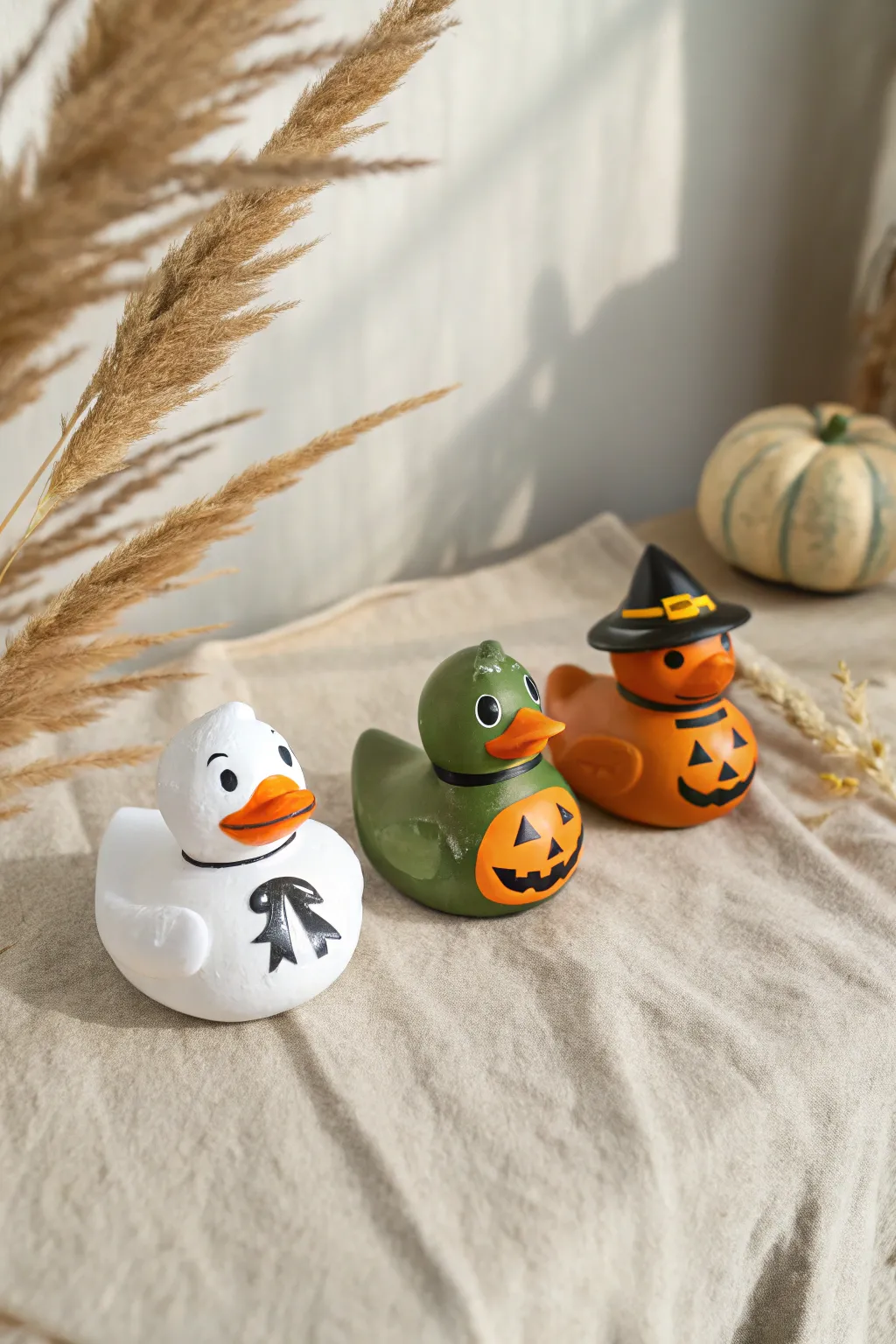
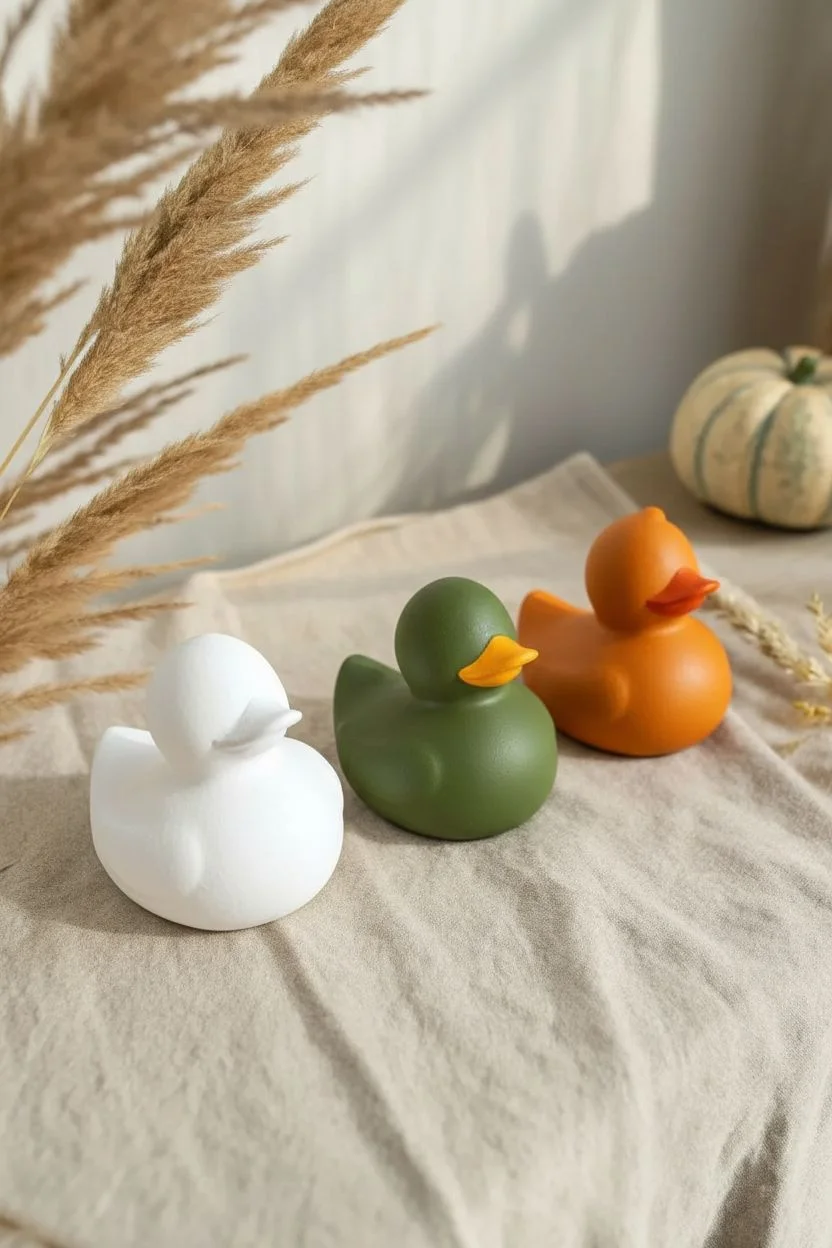
Transform ordinary yellow bath toys into a festive Halloween display featuring a dapper white ghost, an olive-green pumpkin creature, and a bewitching orange duck. These hand-painted figurines make adorable shelf decor or spooky party favors.
Detailed Instructions
Materials
- 3 standard rubber ducks
- Acrylic craft paint (white, black, olive green, bright orange, yellow)
- Small flat paintbrush
- Fine detail paintbrush (liner brush)
- Miniature black witch hat (plastic or felt)
- Hot glue gun or strong craft glue
- Matte spray sealer or Mod Podge
- Pencil
- Water cup and paper towels
Step 1: Base Coating
-
Prep the surface:
Begin by washing the rubber ducks with warm soapy water to remove any factory oils. Dry them thoroughly with a lint-free cloth. -
Mix the green shade:
For the middle duck, mix a standard green with a tiny drop of black or brown to achieve that earthy, olive-green mossy tone rather than a bright lime. -
Apply base colors:
Paint the first duck completely white, the second one your mixed olive green, and the third a vibrant pumpkin orange. -
Build opacity:
Acrylics on rubber can be streaky, so I usually let the first coat dry for about 20 minutes before applying a second coat to ensure solid, opaque coverage.
Step 2: The Olive Pumpkin Duck
-
Paint the tummy patch:
On the green duck, use your bright orange paint to create a large circle in the center of the chest. This will become the pumpkin face. -
Define the collar:
Using the fine liner brush and black paint, carefully draw a thin line around the neck to simulate a collar. -
Create the pumpkin face:
Once the orange chest patch is dry, switch to black paint and outline a classic jack-o’-lantern face with triangle eyes, a triangle nose, and a toothy grin. -
Detail the face:
Paint the beak bright orange. For the eyes, paint white circles first, let them dry, and add black pupils in the center with tiny white highlight dots.
Sticky Situation
Paint peeling off? Rubber ducks are flexible and often slick. If acrylics won’t stick, spray the ducks with a plastic primer first, or scuff the surface gently with fine sandpaper.
Step 3: The Witchy Orange Duck
-
Add chest details:
Directly on the orange body, paint a black jack-o’-lantern face on the chest using the fine liner brush. -
Paint the beak:
Paint the beak a slightly darker shade of orange or red-orange to help it stand out from the body color. -
Attach the hat:
Take your miniature witch hat and secure it to the top of the duck’s head using a dab of hot glue. -
Hat embellishments:
If your hat is plain black, use a small brush to paint a yellow square buckle on the band for that classic witch aesthetic.
Level Up
Make them glow! Use glow-in-the-dark acrylic paint for the white duck’s body and the pumpkin face on the green duck. They will look regular by day but terrifyingly cool when the lights go out.
Step 4: The Dapper White Duck
-
Sketch the bow:
Lightly sketch the outline of a ribbon bow tie on the chest using a pencil to guide your painting. -
Paint the accessories:
Fill in the bow tie with black paint, adding two tails hanging down. Add a thin black line around the neck for the collar. -
Face details:
Paint the beak bright orange. Use your finest brush to paint two simple black arches for eyebrows and small black dots for eyes.
Step 5: Finishing Touches
-
Clean up lines:
Check all three ducks for any sloppy edges, touching up with the base colors where needed. -
Seal the work:
To protect the paint from chipping, apply a coat of matte spray sealer or brush on a thin layer of Mod Podge and allow everything to cure overnight.
Now you have a trio of custom characters ready to haunt your bathroom counter or Halloween display
Winter Wonderland Dioramas
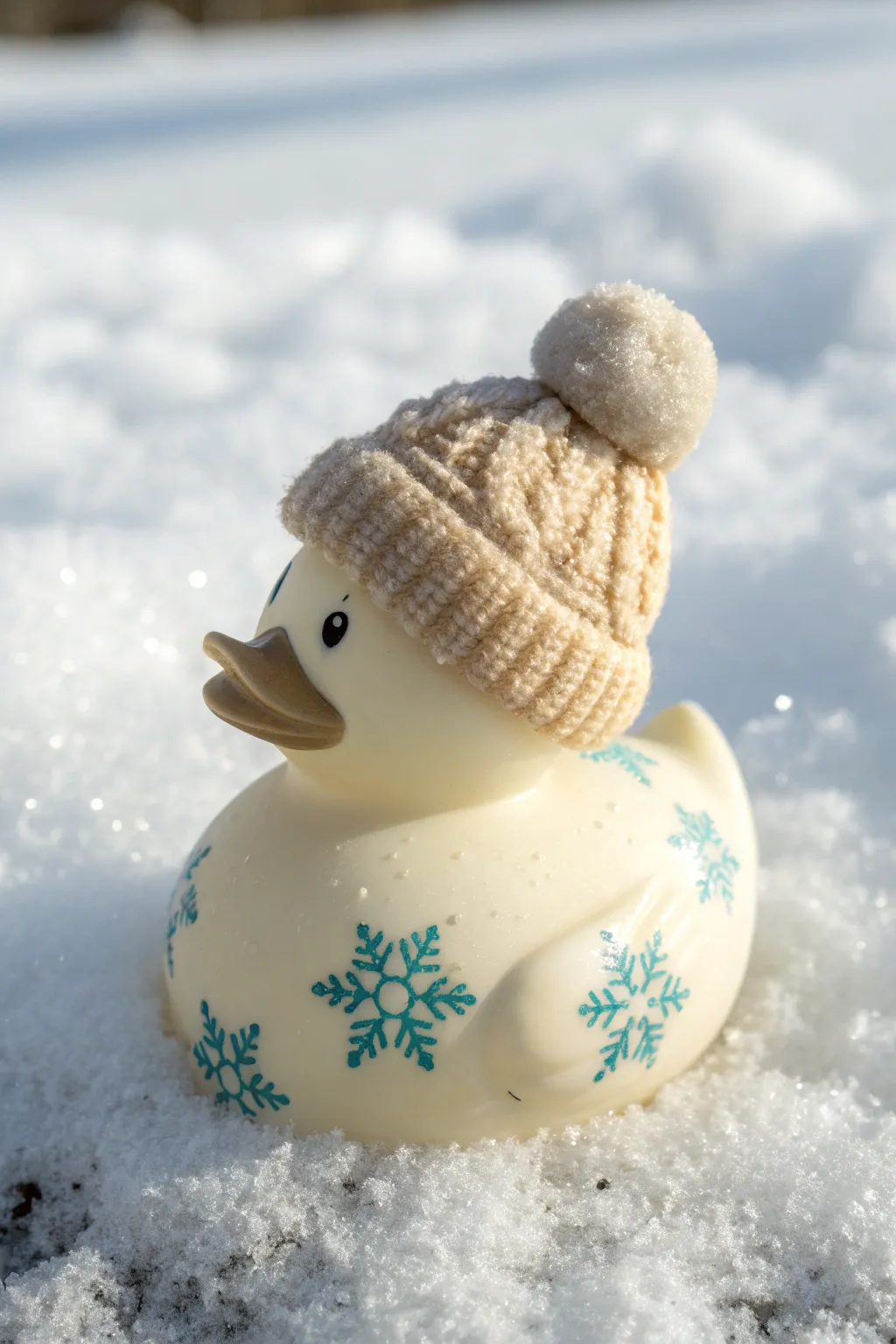
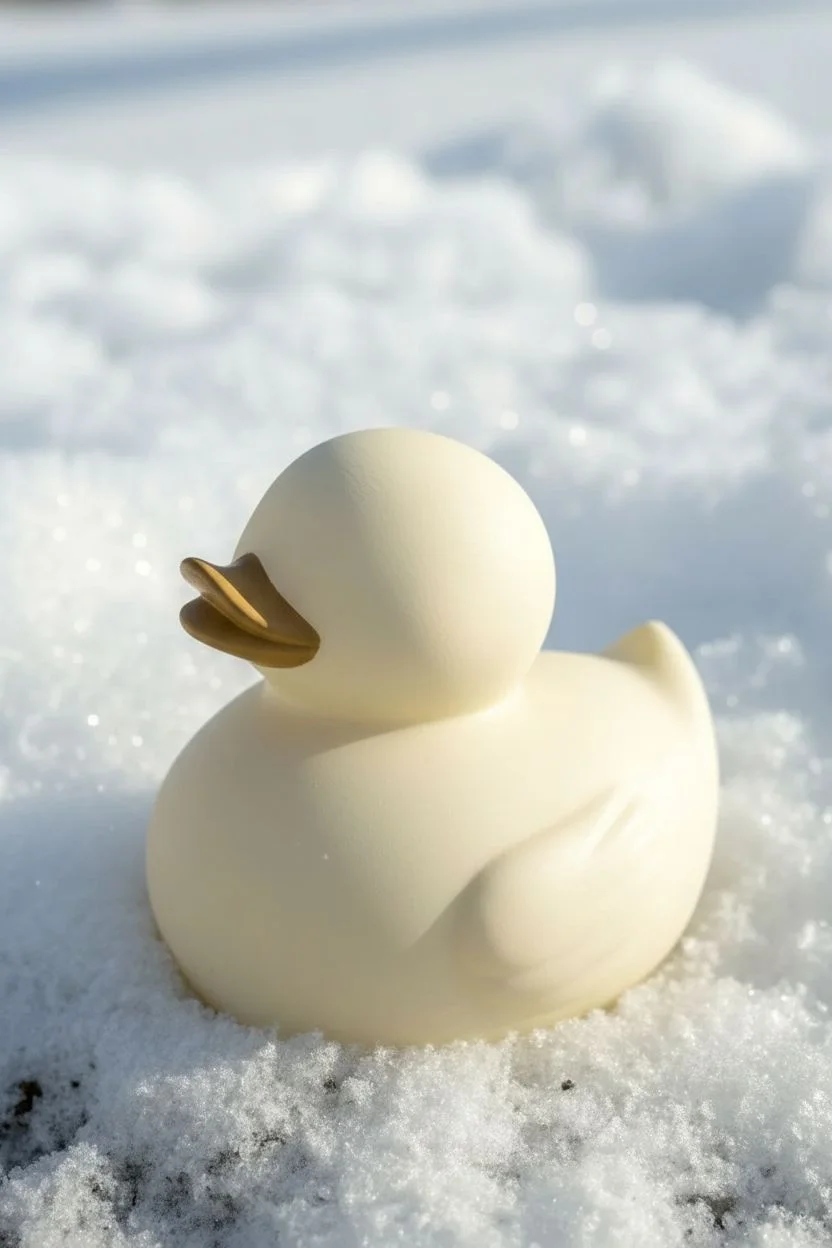
Transform a plain rubber duck into a frost-kissed friend ready for the snow. This project combines delicate detail painting with soft textile crafting to create a cozy keepsake perfect for winter dioramas.
Step-by-Step Guide
Materials
- Standard rubber duck
- Matte acrylic paint (Cream, Teal/Cyan, Muted Mustard)
- Spray primer (white or grey)
- Matte spray sealant
- Detail brushes (Size 00 or 000)
- Old beige knit glove or sock
- Small white pom-pom (approx. 1 inch)
- Fabric glue or hot glue gun
- Scissors
Step 1: Base Preparation
-
Clean the surface:
Wash your rubber duck thoroughly with warm soapy water to remove any factory oils or dust, then dry it completely with a lint-free cloth. -
Scuff sanding:
Lightly sand the surface of the duck using fine-grit sandpaper. This helps the primer adhere better to the slippery rubber material. -
Prime the duck:
Apply a thin, even coat of spray primer. I prefer holding the can about 10 inches away and doing short bursts to avoid drips. -
Base coat application:
Using a soft flat brush, paint the entire body of the duck with the cream or off-white matte acrylic paint. -
Build opacity:
Let the first coat dry fully (about 20 minutes), then apply a second coat of cream paint to ensure a solid, streak-free finish. -
Paint the beak:
Carefully paint the beak using the muted mustard or light brown acrylic to give it a natural, winter-toned look distinct from the pale body.
Precision Points
If a paint brush feels too shaky for the tiny snowflake lines, try using a fine-point acrylic paint marker or a dip-pen with turquoise ink for steadier control.
Step 2: Snowflake Detailing
-
Mix your blue:
Prepare your teal or cyan acrylic paint on a palette. Ensure it is thinned slightly with a drop of water for smoother flow. -
Start the main structure:
Using your size 000 liner brush, paint a simple vertical line crossed by a horizontal line to form a ‘plus’ sign where you want the center of a snowflake. -
Add the diagonal lines:
Paint a diagonal ‘X’ through the center of the plus sign. You should now have an eight-pointed star shape. -
Add the details:
Carefully paint tiny ‘V’ shapes at the end of each line, pointing outward, to create the crystalline snowflake effect shown in the photo. -
Repeat the pattern:
Continue painting snowflakes randomly around the lower half of the duck’s body, varying the size slightly for a natural look. -
Seal the paint:
Once the snowflake designs are completely dry, spray the entire duck with a clear matte sealant to protect your detailed work.
Step 3: The Knit Cap
-
Source the fabric:
Find a finger from an old beige knit glove or the toe section of a coarse-knit sock. The natural ribbing mimics a beanie perfectly. -
Cut the shape:
Cut off the finger portion of the glove, leaving about 2 to 2.5 inches of length to work with. -
Create the brim:
Roll the open cut edge of the fabric upward twice to create a thick, rolled brim for the hat. -
Secure the brim:
Use a tiny dab of fabric glue or hot glue on four sides of the roll to keep the brim from unrolling. -
Add the pom-pom:
Apply a drop of hot glue to the very top tip of the knit piece and press the white pom-pom firmly in place. -
Dress the duck:
Place the hat onto the duck’s head, tilting it slightly back. I like to secure it with a small dot of glue under the brim so it doesn’t slide off.
Frosty Finish
While the blue snowflake paint is still wet, lightly sprinkle a pinch of ultra-fine clear glitter over the designs to mimic the glisten of real ice crystals.
Now you have a frosty little companion ready to sit on your desk or join a larger winter scene
Hydro Dipping Marble Effects
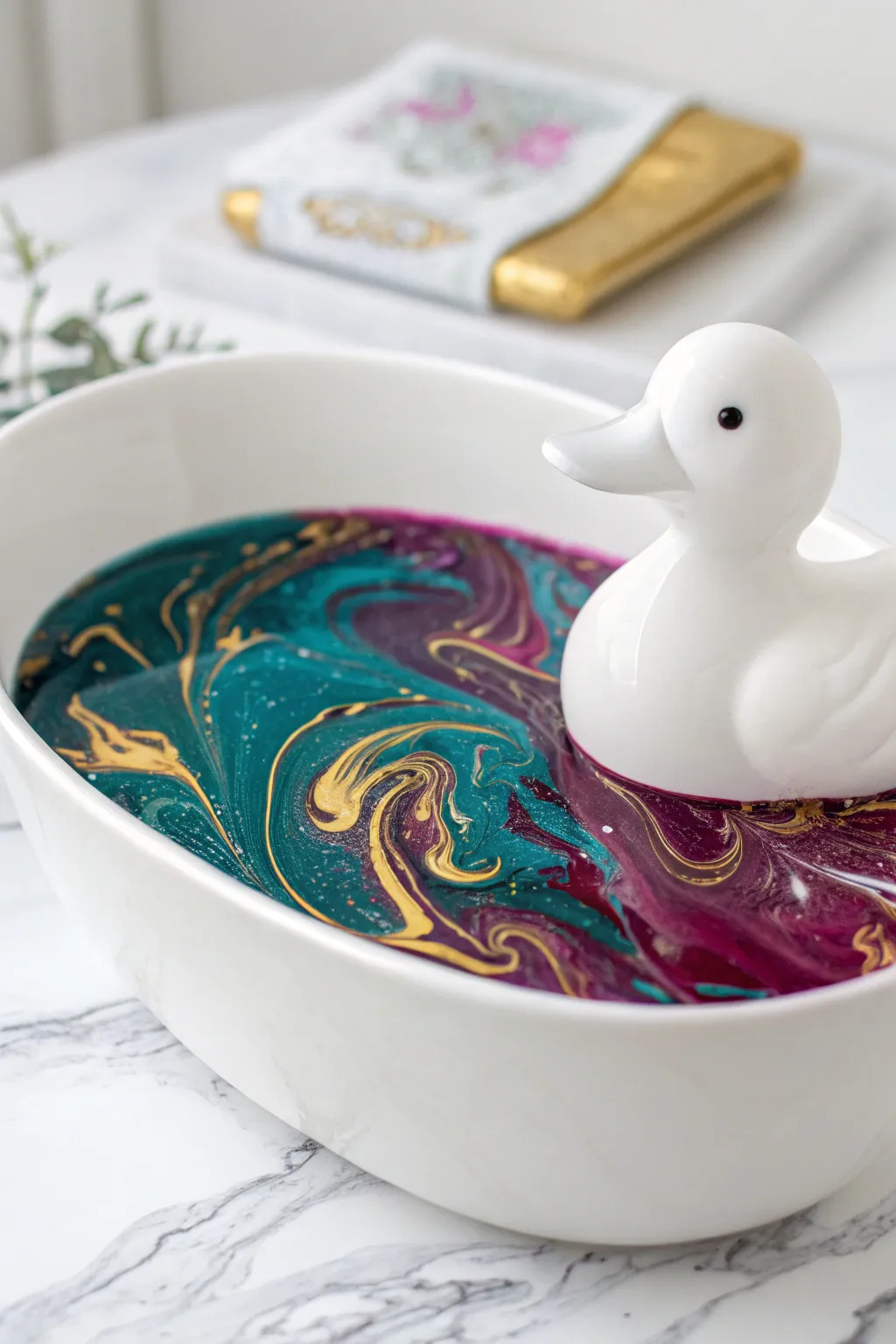
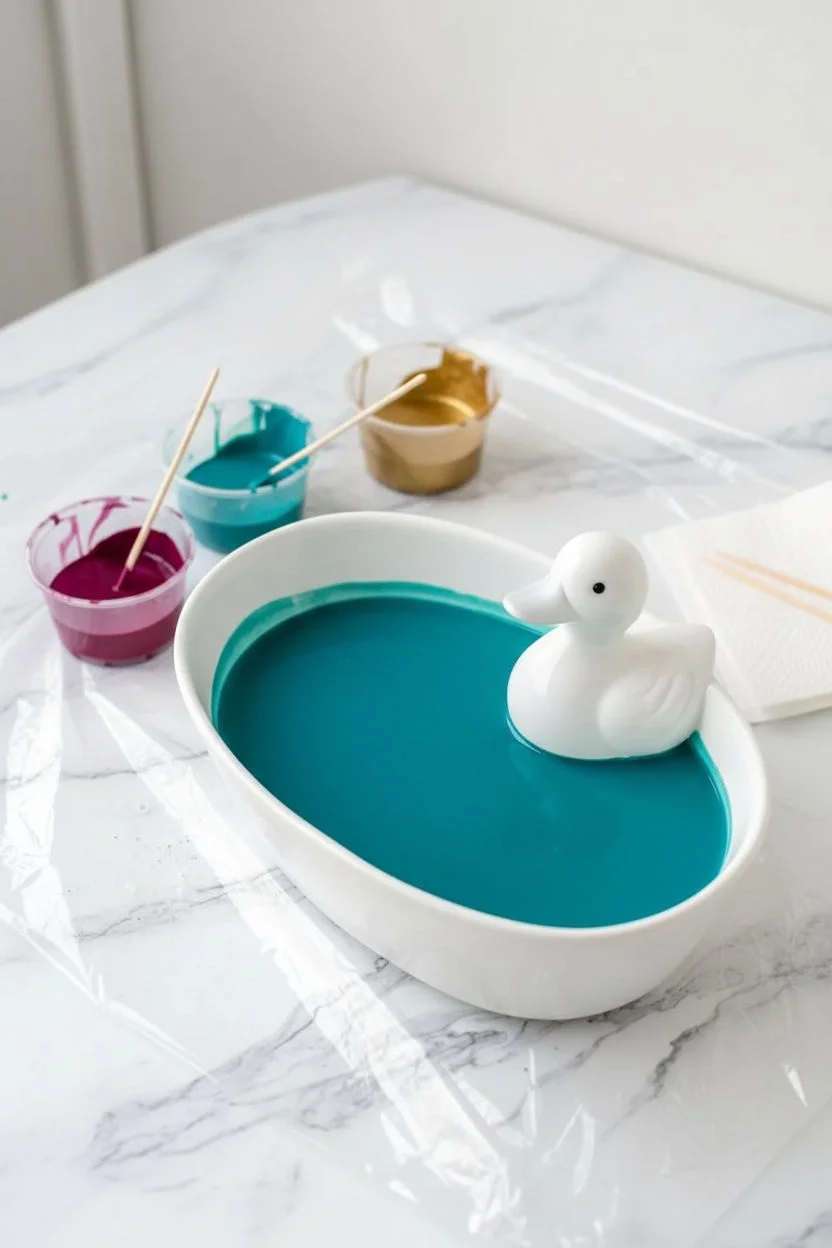
Transform a simple ceramic duck dish into a luxurious piece of art using fluid acrylic techniques that mimic the mesmerizing look of marbled water. This project combines deep jewel tones with metallic gold for a swirling, high-gloss finish that looks elegant on any vanity or shelf.
How-To Guide
Materials
- White ceramic duck dish or planter
- Acrylic paints (Teal, Deep Plum/Magenta, Metallic Gold)
- Pouring medium (Liquitex or Floetrol)
- Small disposable mixing cups
- Wooden stir sticks
- Toothpicks or bamboo skewers
- High-gloss varnish or clear resin
- Plastic drop cloth
- Paper towels
Step 1: Preparation & Mixing
-
Prepare your workspace:
Fluid art can get messy, so line your table with a plastic drop cloth or old newspapers to catch any drips. -
Clean the ceramic:
Wipe down the inside of your ceramic duck dish with alcohol to ensure it is perfectly clean and free of dust or oils. -
Mix the teal base:
In a small cup, combine one part teal acrylic paint with two parts pouring medium. Stir slowly to avoid creating too many air bubbles. -
Mix the accent colors:
Repeat the process in separate cups for the deep plum and metallic gold paints, maintaining the 1:2 paint-to-medium ratio. -
Check consistency:
Lift your stir stick; the paint should flow off it like warm honey in a continuous stream. If it breaks, add a tiny drop of water.
Step 2: Pouring the Pattern
-
Create the base layer:
Pour the teal mixture directly into the bottom of the duck dish until it covers the floor of the ceramic basin completely. -
Level the paint:
Gently tilt the dish side-to-side to ensure the teal paint hits all the edges and sits evenly. -
Add the contrast:
Slowly drizzle the plum paint into the wet teal base in random, sweeping curves or distinct puddles. -
Add the gold veins:
Pour thin ribbons of the metallic gold paint, letting them cut across both the teal and plum sections for that distinct marble vein look.
Gold Preservation Tip
Mix your metallic gold paint slightly thicker than the other colors. This helps it sit on top of the surface rather than sinking, ensuring that shimmer remains visible.
Step 3: Marbling & Finishing
-
Begin the swirl:
Take your toothpick or skewer and gently drag the tip through the surface of the paints. -
Create intricate patterns:
I prefer to use figure-eight motions or S-curves to pull the colors into one another without muddying them completely. -
Preserve negative space:
Be careful not to over-mix; stop while you still see distinct separation between the gold, teal, and plum. -
Release trapped air:
Lift the dish slightly and give it a firm tap on the table to force any air bubbles to rise to the surface and pop. -
Initial drying phase:
Place the dish on a level surface in a dust-free area and let it cure undisturbed for at least 24 to 48 hours. -
Seal the artwork:
Once fully dry, apply two coats of high-gloss varnish to protect the paint and give it that permanent ‘wet’ water appearance.
Level Up: Resin Finish
For the ultimate ‘water’ look, swap the gloss varnish for a clear epoxy resin pour. This creates a glass-like, durable surface that adds incredible depth.
Display your glistening marbled duck proudly as a unique catchall or a standalone piece of modern art.
The Floral Silhouette
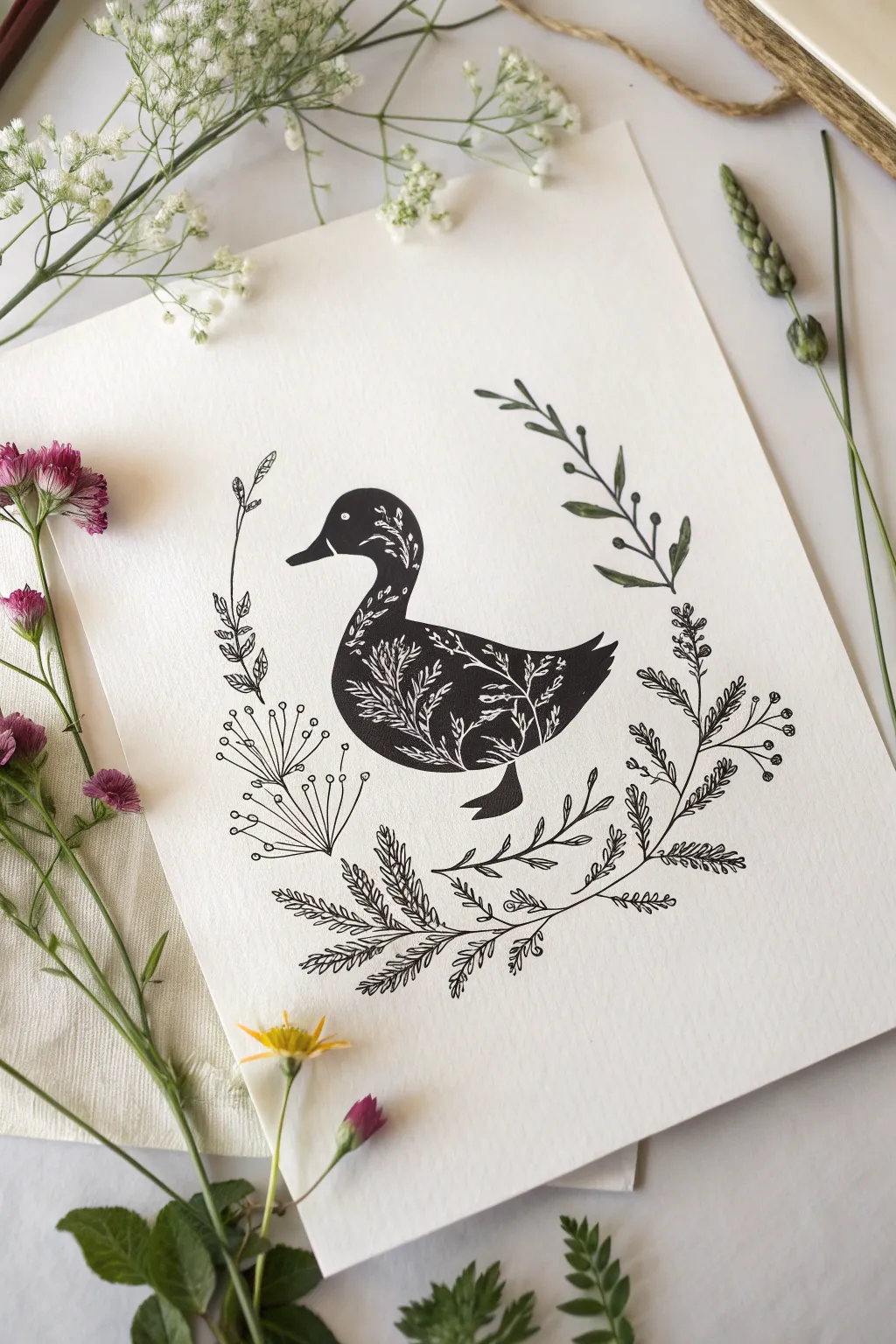
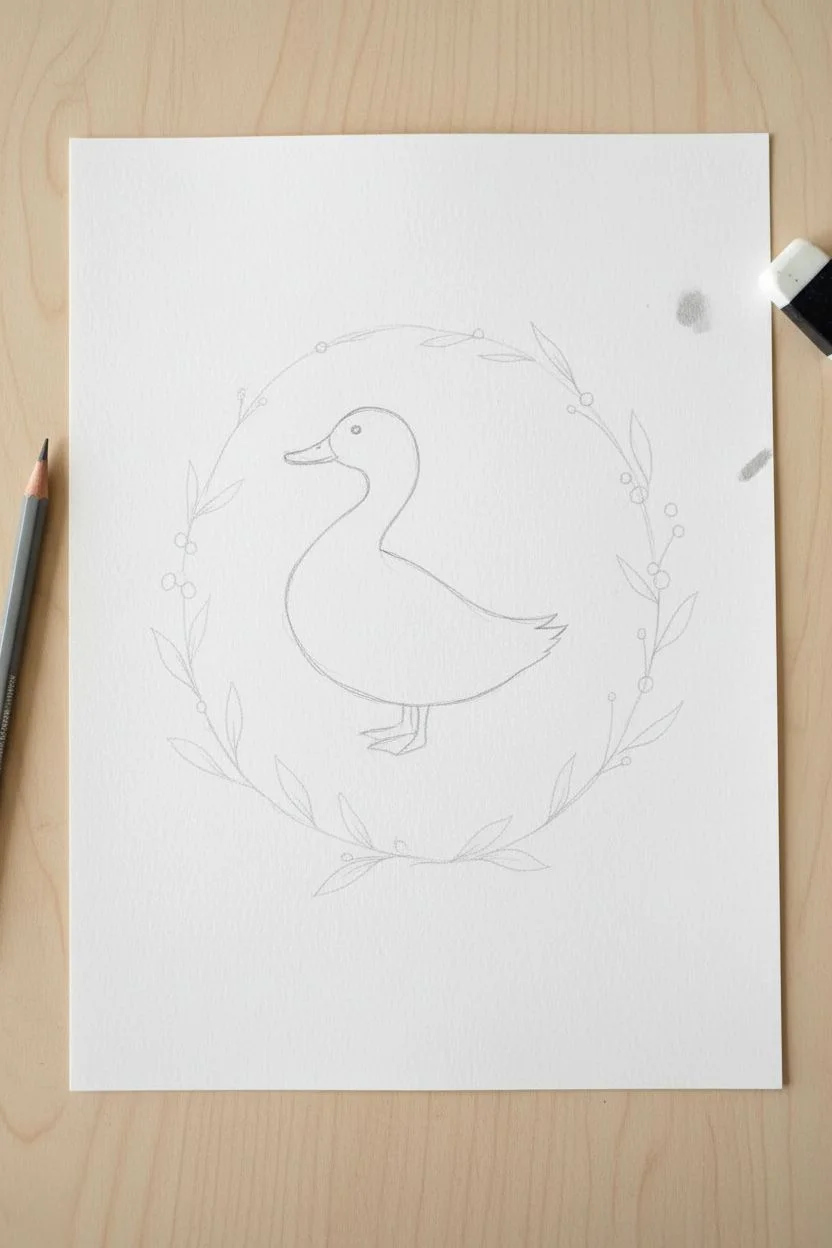
This project combines bold silhouette work with delicate botanical line art to create a striking piece. You will paint a solid black duck form and fill it with a negative-space garden, framing it all within a whimsical, hand-drawn wreath.
Step-by-Step
Materials
- Hot press watercolor paper or smooth Bristol board
- HB Graphite pencil
- Kneadable eraser
- Black India ink or black gouache paint
- Small round brush (size 2 or 4)
- Opaque white gel pen (0.8mm or 1.0mm)
- Fine liner pen (Black, size 01 or 0.3mm)
Step 1: Sketching the Composition
-
Outline the subject:
Lightly sketch the profile of a standing duck in the center of your paper using your graphite pencil. -
Define the shape:
Refine the outline to be smooth and continuous, paying attention to the curve of the neck and the pointed tail. -
Map the wreath:
Lightly sketch a loose, open circle around the duck to guide where your floral elements will go later. -
Sketch branches:
Draw the main stems for the wreath, ensuring they frame the central figure without touching it.
Smooth Foundations
Use “Hot Press” watercolor paper for this project. Its extremely smooth texture prevents the ink from bleeding and ensures your fine lines remain crisp.
Step 2: Creating the Silhouette
-
Outline in black:
Using a steady hand and your small brush loaded with black ink (or gouache), carefully trace the pencil outline of the duck. -
Fill the form:
Fill in the entire body of the duck with solid black. Ensure the coverage is opaque and even. -
Refine edges:
Clean up the edges of the beak and the webbed feet to keep them sharp and distinct. -
Dry completely:
Allow the black layer to dry thoroughly. I recommend waiting at least 20 minutes, as any dampness will ruin the white details in the next phase.
Level Up
Swap the white gel pen for a metallic gold or silver pen. The metallic ink will catch the light and add a luxurious, shimmering effect.
Step 3: Adding the Internal Garden
-
Start the white details:
Once the black ink is bone-dry, use your opaque white gel pen to draw small fern patterns inside the duck’s body. -
Follow the form:
Curve the stems of your internal botanicals to match the roundness of the duck’s belly and wing. -
Add variety:
Draw tiny leaves, distinct petals, and small sprigs to fill the negative space without overwhelming the black background. -
Detail the head:
Place a solid white dot for the eye and a thin curved line on the beak to define the bill. -
Balance the contrast:
Step back to ensure you have a good balance of black space and white line work.
Step 4: Drawing the Wreath
-
Switch tools:
Change to your fine black liner pen (size 01 or 03) for the delicate surrounding foliage. -
Draw bottom ferns:
Create lush fern fronds at the bottom that curve upward, cradling the duck’s feet. -
Add seed heads:
On the left side, draw thin stems topped with dandelion-style radiating lines and small circles. -
Create leafy branches:
On the upper right, draw a simple branch with oval leaves to balance the composition. -
Finishing touches:
Add small berries or texture lines inside the leaves, then gently erase your pencil guides once all ink is set.
Now you have a sophisticated, nature-inspired artwork that mimics the look of a classic lino-cut print.
Glow-in-the-Dark Accents
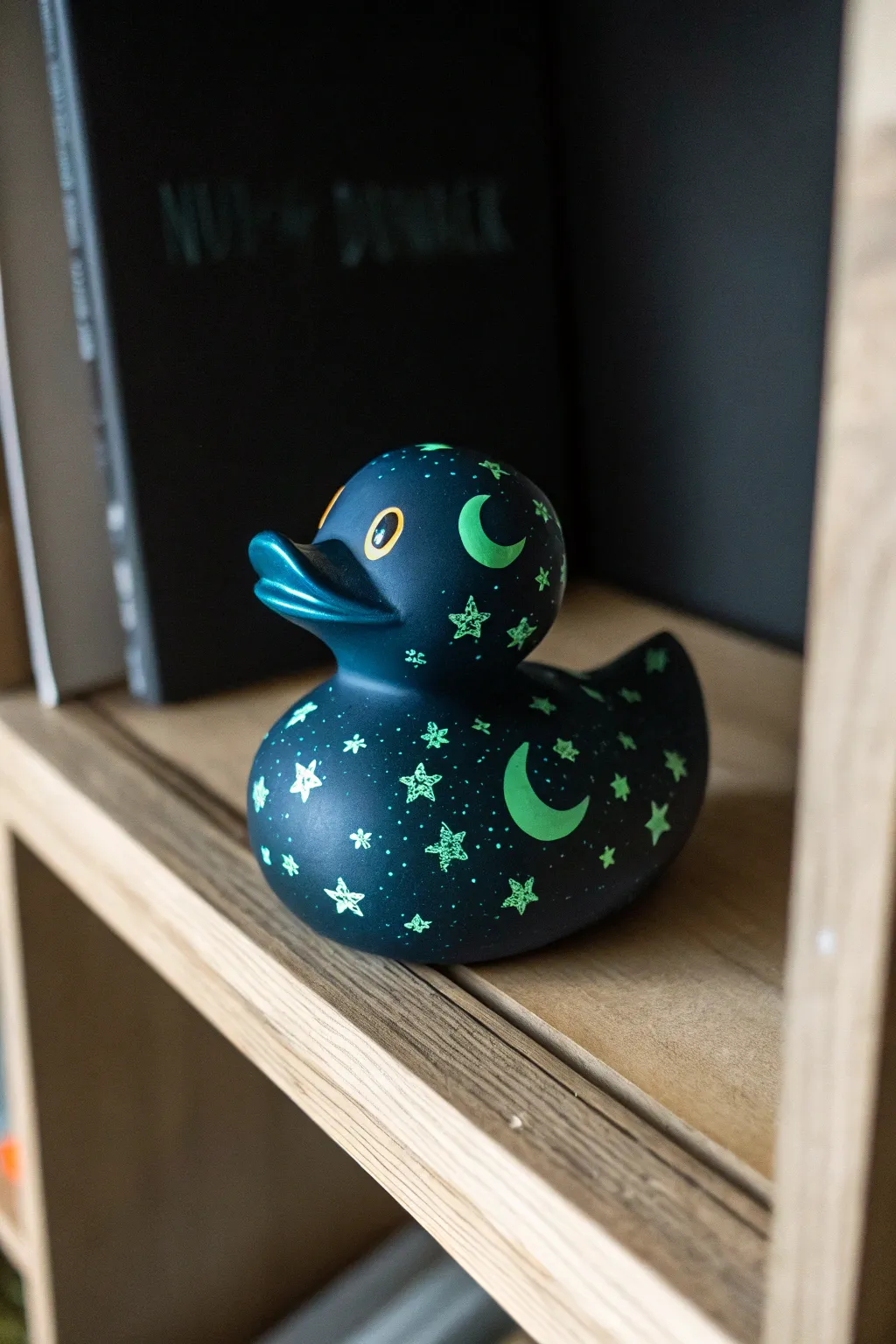
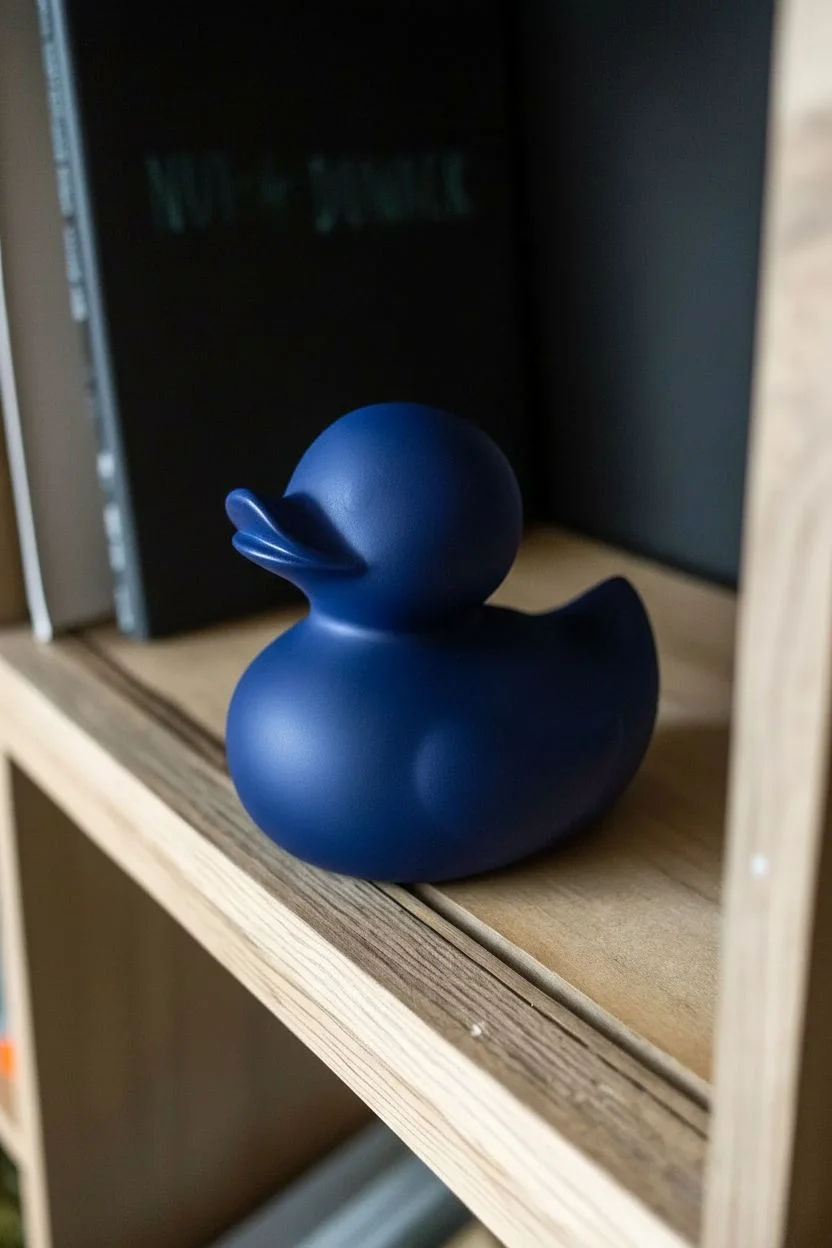
Transform a standard yellow bath toy into a mesmerizing piece of night-sky art. This project uses a deep matte base to make the glow-in-the-dark celestial patterns truly pop against the dark background.
Step-by-Step Tutorial
Materials
- Rubber duck (clean and dry)
- Acrylic primer (spray or brush-on)
- Matte acrylic paint (Midnight Blue or Carbon Black)
- Titanium White acrylic paint
- Glow-in-the-dark medium or paint (Phosphorescent Green)
- Yellow or Amber acrylic paint
- Paintbrushes: clear shading brush, fine detail liner (size 0 or 00)
- White chaulk pencil or watercolor pencil
- Matte spray varnish
Step 1: Base Preparation
-
Clean and Dry:
Wash the rubber duck thoroughly with soapy water to remove any factory oils or dust. Dry it completely to ensure the paint adheres properly. -
Prime the Surface:
Apply a coat of acrylic primer over the entire duck. Rubber is a flexible, non-porous surface, so skipping this step often leads to peeling paint later on. -
Base Color Application:
Paint the entire body and head with Midnight Blue acrylics. Use a flat shading brush for smooth, even strokes. -
Second Coat:
Let the first layer dry to the touch, then apply a second coat of blue to achieve a solid, opaque finish. I prefer to paint the bill the same color as the body for this monochromatic look. -
Matte Finish:
Ensure the base coat is fully matte when dry. If your paint has a sheen, the final glow effect won’t contrast as sharply.
Step 2: Mapping the Sky
-
Planning the Pattern:
Using a white chalk pencil or watercolor pencil, lightly sketch the placement of the crescent moons. Place one prominently on the head and a few on the wings. -
Underpainting Moons:
Paint the crescent moon shapes with solid Titanium White first. Glow paint is translucent, so it needs a white base to shine brightly. -
Adding Star Bases:
With your fine liner brush and white paint, add five-pointed stars scattered between the moons. Vary their sizes for interest. -
Tiny Details:
Fill the empty negative spaces with tiny white dots or small ‘x’ shapes to represent distant stars. -
Bill Highlight:
Mix a tiny amount of blue with white to create a lighter teal. Carefully paint the top ridge of the bill to give it dimension.
Sticky Situation?
If the paint feels tacky on the rubber even after drying, your environment might be too humid. Dust slightly with talcum powder to set it before sealing.
Step 3: Adding the Glow
-
Applying Glow Medium:
Load your brush generously with the glow-in-the-dark paint. Carefully trace over the white crescent moons you painted earlier. -
Tracing Stars:
Apply the glow paint over the white stars and dots. It will look milky when wet but dry fairly clear with a green tint. -
Layering:
Allow the first layer of glow paint to dry completely, then add a second or third layer. Thicker application equals a stronger, longer-lasting glow. -
Eye Base:
Paint a small oval for the eye using the base Midnight Blue if it was covered, or simply refine the shape. -
Iris Color:
Paint a thin ring of Yellow or Amber inside the eye area, leaving a dark center for the pupil. -
Pupil Definition:
Add a solid black dot in the center of the yellow iris for the pupil. -
Life Spark:
Place a microscopic dot of white paint on the upper right edge of the pupil to create a reflection. -
Seal the Work:
Once the duck is fully dry (give it overnight to be safe), mist it lightly with a matte spray varnish to protect the artwork without adding unwanted shine.
Make it Cosmic
Before adding stars, lightly sponge on some deep purple or nebula pink patches over the blue base to create a subtle galaxy background depth.
Charge your finished duck under a bright lamp for a minute and turn off the lights to see your handheld galaxy come to life
Decoupage Texture Techniques
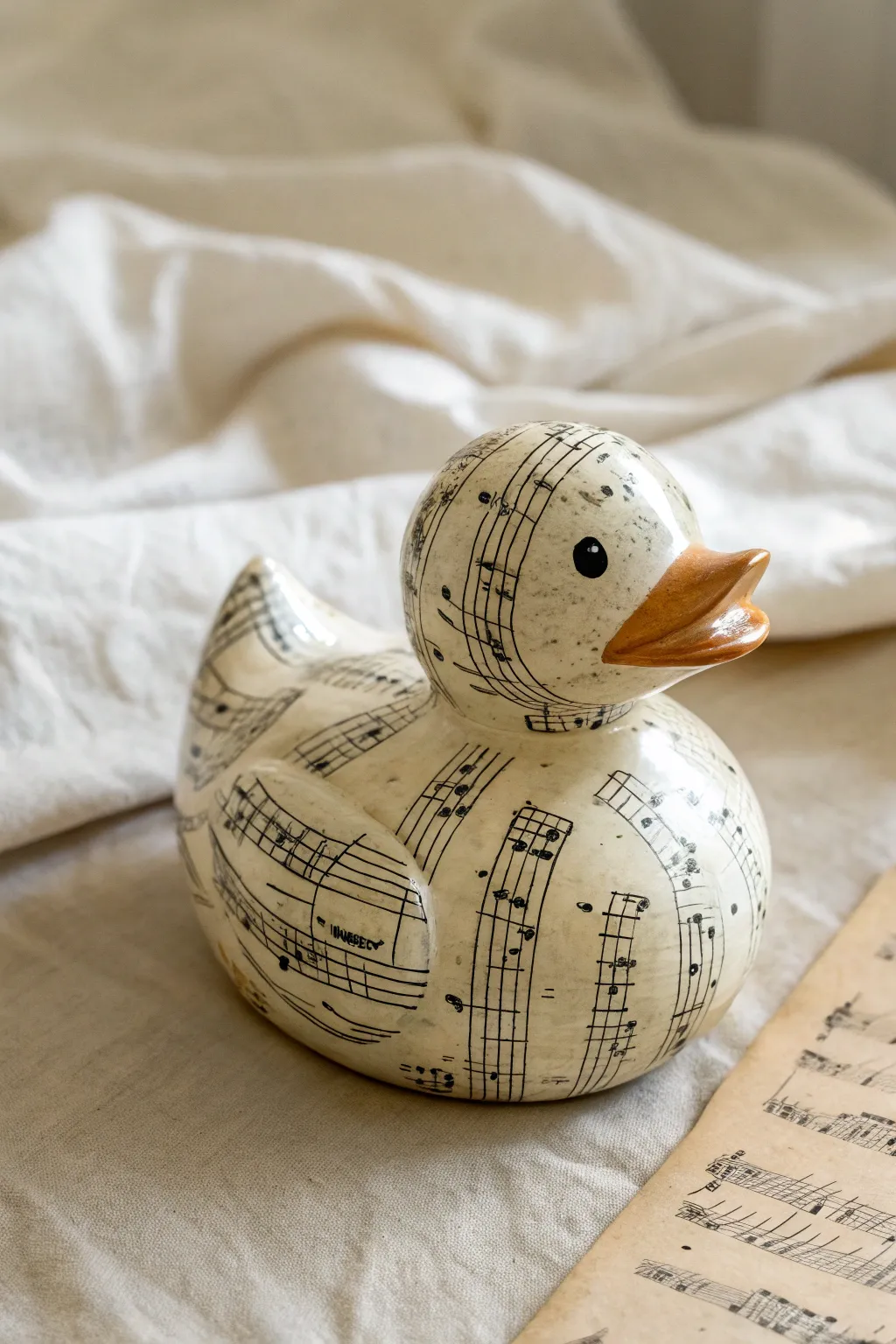
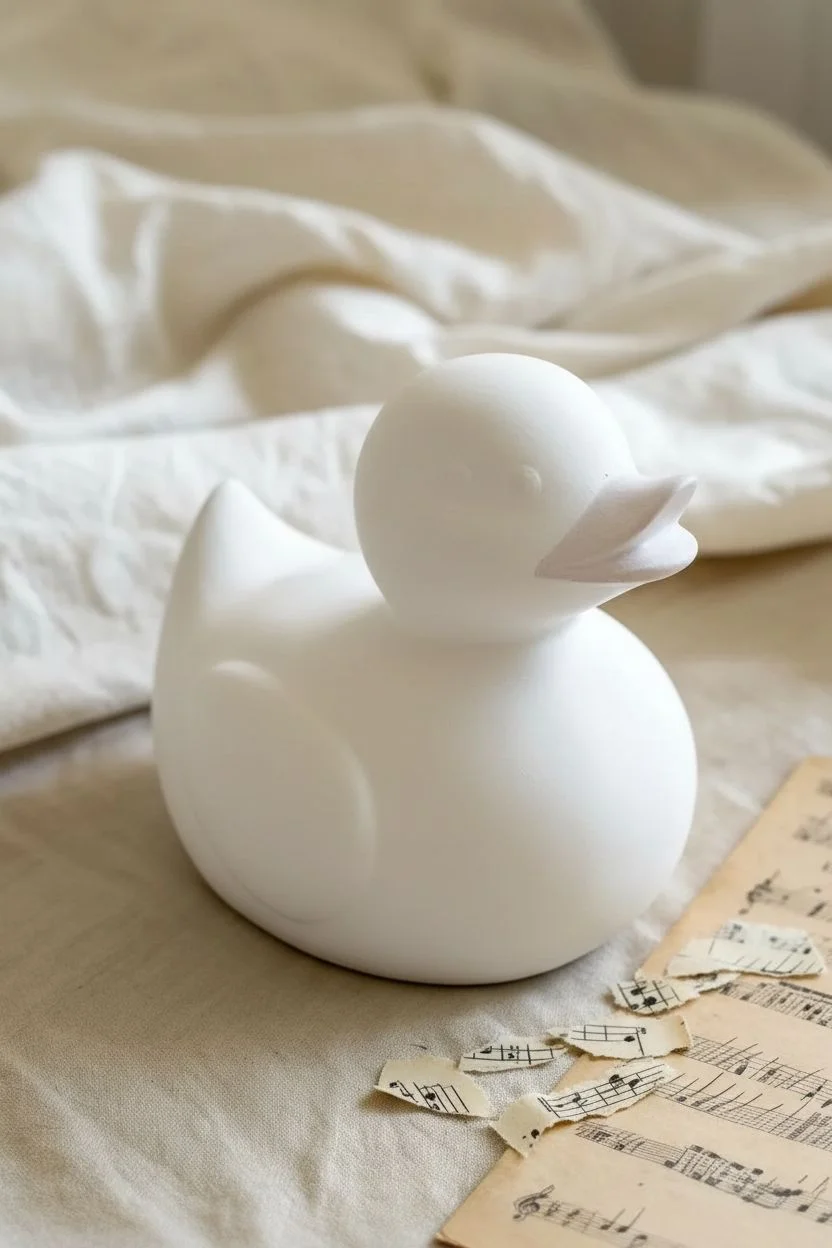
Transform a simple duck figurine into a faux-ceramic masterpiece using the timeless art of decoupage. This project layers torn sheet music to create a textured, antiqued surface that looks sophisticated and full of character.
Detailed Instructions
Materials
- Duck figurine (ceramic, heavy plastic, or rubber)
- Vintage sheet music (or laser-printed copies)
- Decoupage medium (like Mod Podge Matte)
- Acrylic paints: Warm White, Burnt Orange, Black, Burnt Umber
- Soft flat synthetic brushes
- Small round detail brush
- Old toothbrush
- High-gloss varnish or polyurethane
- Fine grit sandpaper
- Paper towels
Step 1: Preparation & Base
-
Surface Prep:
Clean your duck thoroughly to remove any oils or dust. If using a slick plastic or rubber duck, scuff the surface lightly with fine-grit sandpaper to help the adhesive grip. -
Base Coat:
Apply a coat of Warm White acrylic paint over the entire duck. This ensures a bright, consistent background so the sheet music pops, even if you miss a tiny spot later. -
Paper Prep:
Tear your sheet music into small, irregular strips and shapes. Aim for pieces about 1 inch wide; torn edges blend much more seamlessly than cut straight lines.
Step 2: Decoupage Application
-
First Layer:
Brush a thin layer of decoupage medium onto a small section of the duck’s body, starting with the flatter areas like the back or wings. -
Placing Paper:
Place a strip of sheet music onto the wet medium and smooth it down with your finger or brush to push out any trapped air bubbles. -
Sealing Strips:
Immediately brush another thin layer of decoupage medium over the top of the paper to seal it in place. -
Navigating Curves:
As you move to the neck and head, use much smaller pieces of paper. I prefer using tiny triangular shapes here, as they conform to round curves without wrinkling. -
Overlapping:
Continue applying strips until the body and head are fully covered, slightly overlapping the edges of each piece to create a continuous pattern. -
Drying Time:
Let the duck dry completely for at least 1-2 hours. The surface should feel hard and not tacky before moving to the next step.
Pro Tip: Smoother Curves
Dampen the back of thicker paper strips with a wet sponge before applying glue. This relaxes fibers, making the paper pliable enough to mold around the tight curves of the head.
Step 3: Painting Details
-
Beak Base:
Using a small flat brush, paint the beak with Burnt Orange acrylic. You may need two coats to fully cover any paper edges that overlapped onto the beak area. -
Eye Placement:
Dip the handle end of a paintbrush into Black acrylic paint and dot it onto the head to create perfectly round eyes. -
Eye Highlight:
Once the black paint is dry, use a toothpick or a fine point brush to add a tiny dot of White paint to the upper right corner of the pupil for life-like reflection.
Level Up: Crackle Finish
Apply a layer of crackle medium before your final clear gloss coat. As it dries, it will create web-like fractures over the music notes for a true antique porcelain vibe.
Step 4: Antiquing & Finishing
-
Aging Wash:
Mix a drop of Burnt Umber paint with water to create a very thin, translucent glaze. -
Applying Patina:
Lightly brush this glaze over the dried paper, then immediately wipe most of it back with a slightly damp paper towel. This leaves color in the texture of the paper overlaps, creating an aged look. -
Speckling:
Dip an old toothbrush into diluted Burnt Umber paint. Run your thumb across the bristles to flick tiny specks of paint onto the duck, mimicking unique ceramic imperfections. -
Gloss Sealer:
Apply a coat of high-gloss varnish over the entire piece. This is crucial for achieving that shiny, porcelain-like appearance shown in the photo. -
Final Coat:
After the first coat dries, apply a second layer of gloss varnish for extra depth and durability.
Place your musical duck on a shelf or desk and enjoy the vintage charm it brings to your space
Metallic and Gold Leaf Support
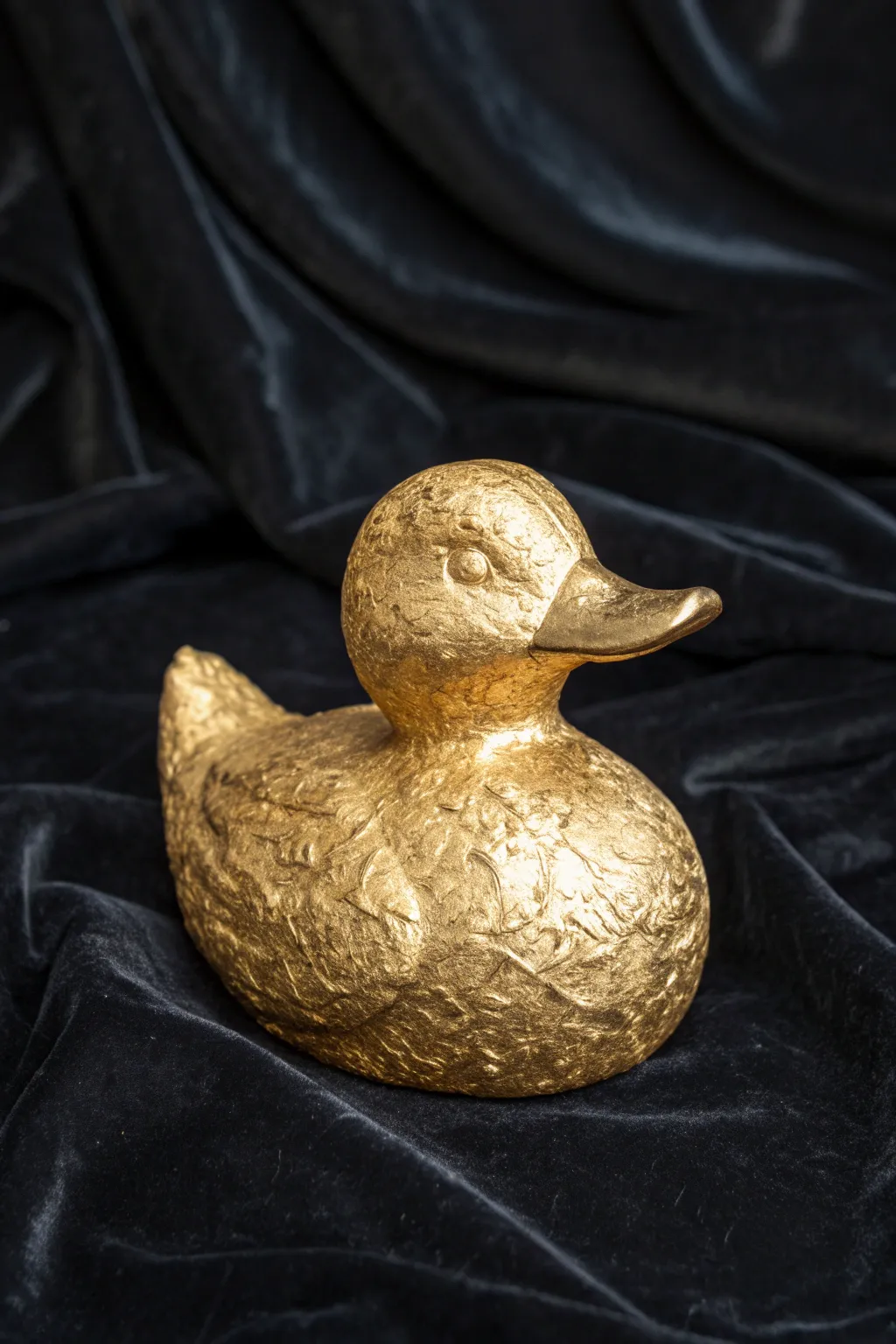
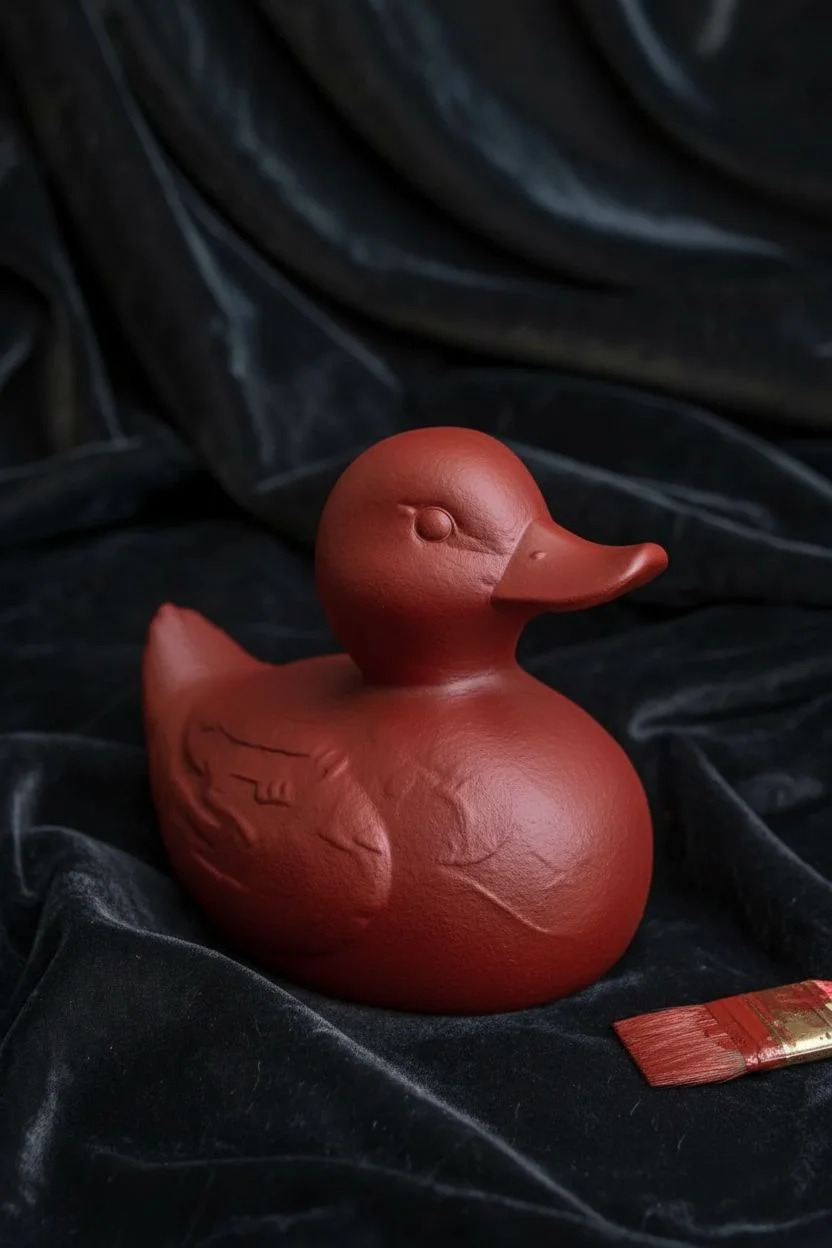
Transform a standard bath toy into a luxurious, sculptural art piece using the timeless technique of gold leafing. This project creates a stunning, highly textured metallic finish that catches the light beautifully, turning a humble rubber duck into a statue worthy of a gallery.
How-To Guide
Materials
- Standard rubber duck
- Rubbing alcohol
- Red oxide or ochre acrylic paint
- Soft paintbrush (for base coat)
- Water-based gilding size (adhesive)
- Imitation gold leaf sheets
- Very soft creative brush (e.g., mop brush)
- Stiff bristle brush (for cleanup)
- Cotton swabs
- Metal leaf sealer (spray or brush-on)
Step 1: Surface Preparation
-
Clean the surface:
Wash the rubber duck thoroughly with warm soapy water to remove any factory grease or dust. -
Degrease:
Wipe the entire surface down with a cotton ball soaked in rubbing alcohol to ensure perfect adhesion. -
Apply base color:
Paint the entire duck with a layer of red oxide or deep ochre acrylic paint. -
Let it dry:
Allow the base coat to dry completely; the underlying color adds warmth to the final gold finish.
Red Base Secret
Using a terracotta or deep red paint as a base coat gives the gold a rich, antique warmth. If the leaf cracks slightly, the red showing through looks intentional.
Step 2: Adhesive Application
-
Apply sizing:
Brush a thin, even layer of gilding size over the main body of the duck, avoiding the beak for now to handle it easier. -
Wait for tack:
Allow the size to sit until it turns from milky to clear. It should feel sticky but dry to the touch, not wet. -
Test the tack:
Lightly touch a knuckle to the surface; if firmly tacky but no residue comes off on your skin, it is ready.
Antique Texture
To enhance the crinkled look, apply a dark wax over the dried sealer, work it into the crevices, and wipe the high points clean with a soft cloth.
Step 3: Gilding the Body
-
Apply first sheet:
Gently lift a sheet of gold leaf and lay it over the duck’s back. -
Create texture:
Use a soft, dry brush to pat the leaf down. Instead of stroking it smooth, I like to dab vertically to encourage the crinkled texture seen in the photo. -
Continue coverage:
Apply subsequent sheets to the head and wings, overlapping the edges of previous sheets slightly. -
Fill gaps:
Tear small scraps of leaf to press into creases or areas where the base coat is showing through too much. -
Firm adhesion:
Once covered, firmly stipple the entire body with your soft brush to ensure the leaf binds tight to the adhesive curves.
Step 4: Detailing & Finishing
-
Size the beak:
Apply the gilding size carefully to the beak area and wait for it to reach the tacky stage. -
Gild the beak:
Apply a small piece of gold leaf to the beak. -
Smooth the beak:
Unlike the textured body, use a cotton swab to gently burnish the beak smooth for a slight visual contrast. -
Remove skewings:
After letting the project sit for an hour, take a stiff bristle brush and vigorously brush off the excess loose flakes. -
Seal the work:
Coat the entire duck with a metal leaf sealer to prevent the gold from tarnishing or reacting with air over time. -
Final cure:
Let the sealer cure overnight in a dust-free area before displaying.
Place your shimmering creation on a dark shelf or velvet cloth to watch it truly glow
The Bride and Groom Duo
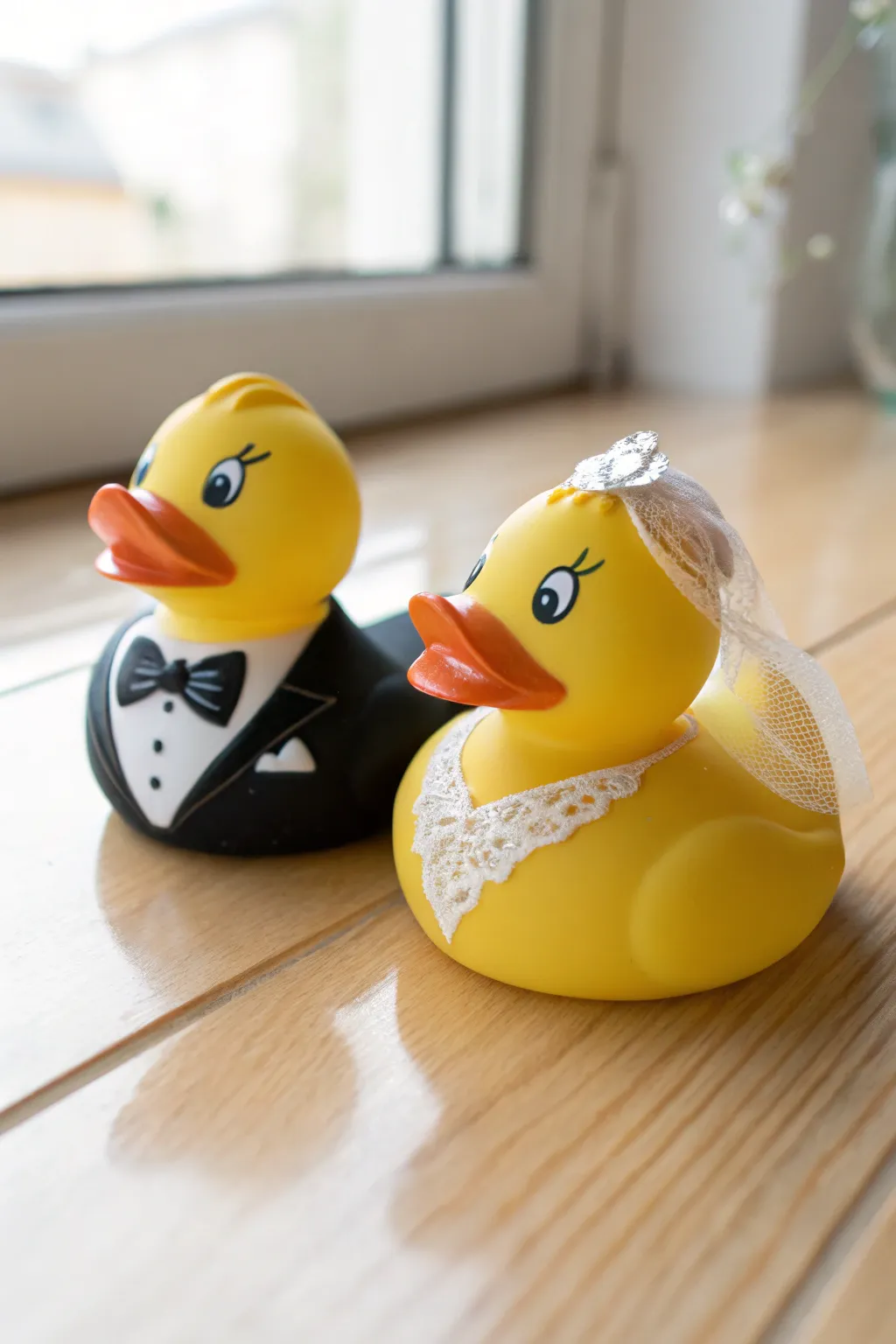
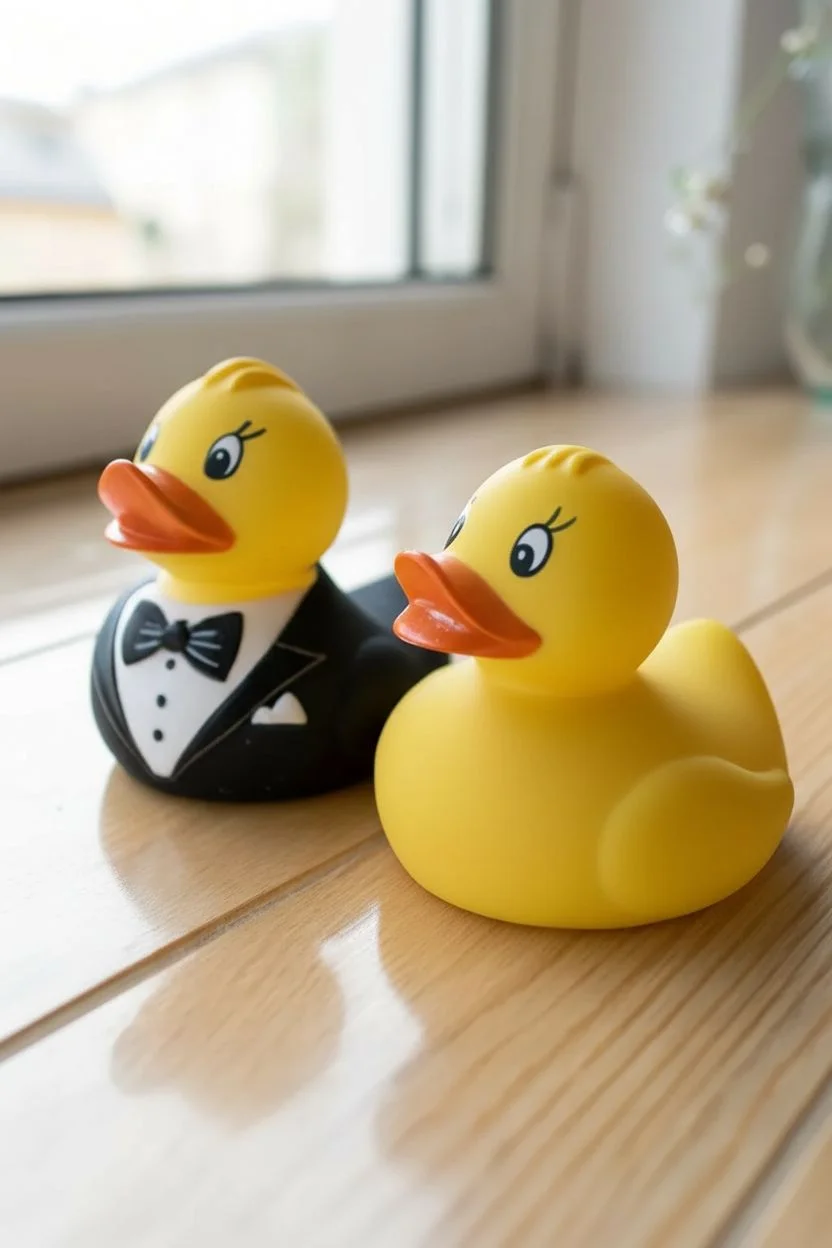
Celebrate a special union with this adorable pair of bride and groom rubber ducks. This project combines precise acrylic painting for the tuxedo with delicate lace crafting for a charming bridal finish.
Detailed Instructions
Materials
- Two yellow rubber ducks
- Acrylic paint (Black, White)
- Fine detail paintbrush (size 0 or 00)
- Small flat paintbrush
- Clear acrylic sealer (matte or gloss)
- White lace trim (about 1 inch wide)
- White tulle or netting fabric
- Silver sequin cluster or rhinestone gem
- Strong craft glue (e.g., E6000) or hot glue gun
- Scissors
- Rubbing alcohol
- Cotton pads
Step 1: Preparation & Groom’s Tuxedo
-
Clean the surface:
Wipe down both ducks with rubbing alcohol and a cotton pad to remove any manufacturing oils. This ensures the paint and glue will stick properly. -
Outline the shirt:
On the first duck, use your fine detail brush and white paint to outline a triangular bib shape on the chest. This will be the groom’s dress shirt. -
Fill the shirt:
Fill in the triangle with white paint. You will likely need two or three thin layers to cover the yellow rubber completely; let each layer dry before adding the next. -
Outline the jacket:
Once the white shirt is fully dry, switch to black paint. Carefully outline the ‘V’ shape of the tuxedo jacket bordering the white shirt. -
Paint the suit body:
Using the flat paintbrush, paint the rest of the duck’s body black, covering the sides, back, and tail. Leave the head yellow. -
Refine the edges:
Go back with your detail brush to clean up the neckline where the black suit meets the yellow neck. I like to keep a steady hand here to get a crisp line. -
Paint the bow tie:
Using the fine brush and black paint, create two small triangles meeting in the center just below the beak to form a bow tie. -
Add shirt buttons:
Dip the tip of a toothpick or the handle end of a small brush into black paint and dot three vertical buttons down the center of the white shirt. -
Add the pocket square:
Paint a tiny white horizontal sliver or triangle on the left side of the black jacket chest to represent a pocket square. -
Seal the groom:
Once all paint is completely dry, apply a coat of clear sealer over the painted areas to prevent chipping.
Adhesion Pro Tip
If your paint streaks or beads up on the smooth rubber, lightly buff the surface with fine-grit sandpaper gently before painting to give the surface some ‘tooth’ for the paint to grab.
Step 2: Styling the Bride
-
Cut the lace bodice:
Cut a small strip of white lace trim, measuring just enough to drape around the second duck’s neck and chest area. -
Shape the neckline:
Trim the bottom edge of the lace into a curve or V-shape to mimic a bridal gown neckline that sits flat against the duck’s chest. -
Attach the lace:
Apply a thin line of craft glue along the back of the lace and press it gently onto the duck’s chest and shoulders. -
Prepare the veil material:
Cut a rectangle of tulle or netting, roughly 3 inches by 4 inches, depending on how long you want the train to be. -
Gather the veil:
Pinch and gather one of the short ends of the tulle rectangle to create a bunched point. -
Secure the gather:
Add a drop of glue to the gathered point to hold the folds together before placing it on the duck. -
Mount the veil:
Glue the gathered end of the veil to the top-back center of the bride’s head. -
Add the tiara:
Apply a dab of glue directly on top of the messy gathered tulle on the head. -
Place the gem:
Press your silver sequin cluster or rhinestone gem firmly onto the glue to hide the tulle ends and serve as a sparkling headpiece. -
Final fluff:
Gently fluff the tulle veil so it cascades behind the duck, and ensure the lace on the chest is securely attached at the corners.
Level Up: Accessories
For extra personality, paint tiny eyelashes on the bride using a liner brush, or create a miniature top hat for the groom using black cardstock or polymer clay.
Display your charming couple on a shelf or use them as a unique cake topper for a bridal shower
Typography and Quote Art
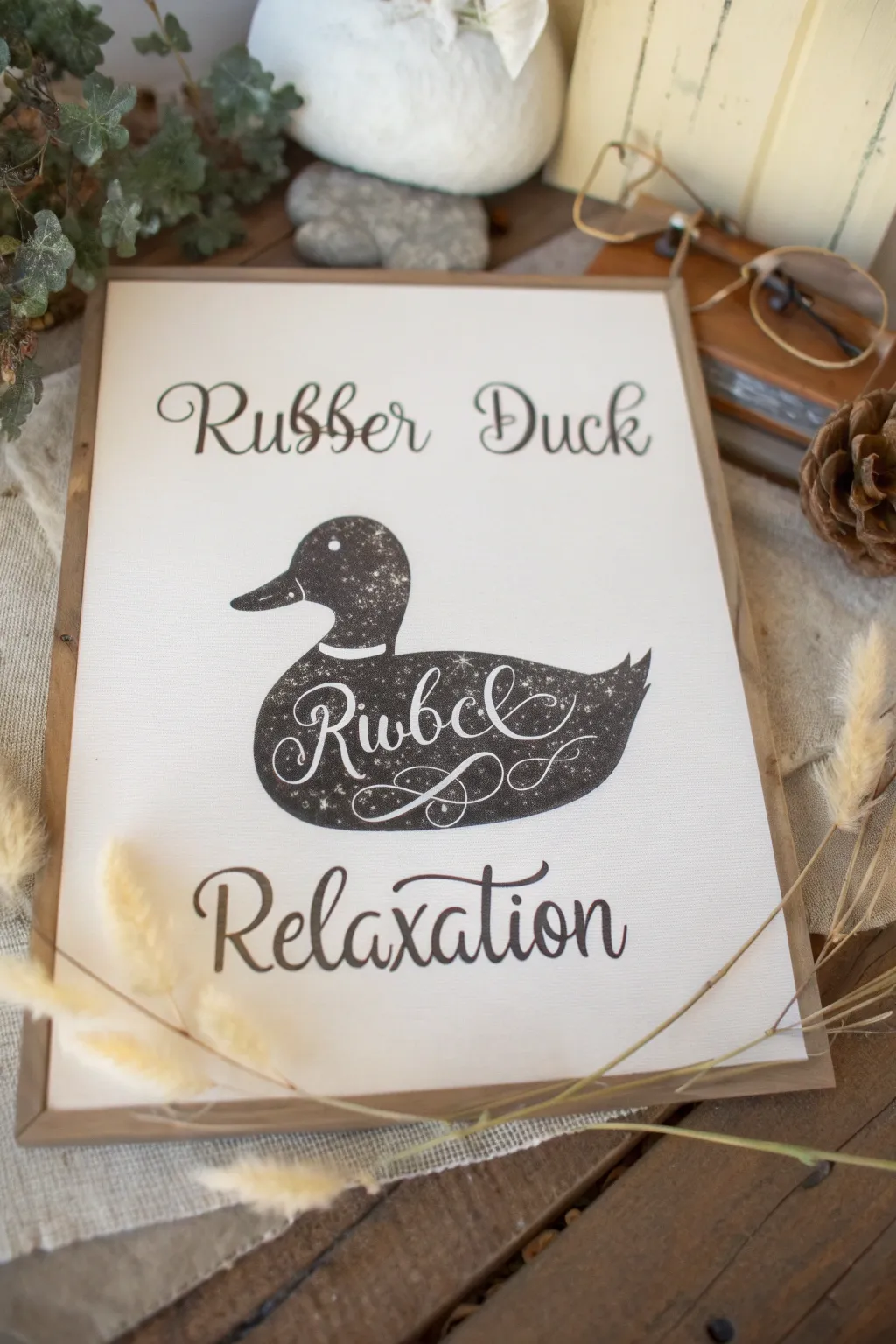
Combine minimalist typography with a whimsical silhouette to create this charming piece of farmhouse-style art. The black-and-cream color palette offers a sophisticated take on bathroom decor, featuring a galaxy-patterned duck that invites pure relaxation.
Step-by-Step Guide
Materials
- Rectangular canvas (approx. 11×14 inches)
- Acrylic paint (Titanium White, Mars Black, Unbleached Titanium/Cream)
- Flat shader brush (size 6 or 8)
- Fine liner brush (size 00 or 0)
- White acrylic paint pen (fine tip)
- Black acrylic paint pen (medium tip)
- Graphite transfer paper
- Printed template of design
- Pencil and masking tape
- Old toothbrush
- Balsa wood strips or lattice molding (frame)
- Wood stain (walnut or oak)
- Craft glue or hot glue gun
Step 1: Preparing the Base
-
Mix the background color:
Squeeze out a generous amount of Titanium White and mix in a pea-sized drop of Unbleached Titanium or a tiny touch of brown to create a warm, creamy off-white shade. -
Apply the base coat:
Use the flat shader brush to cover the entire front and sides of the canvas with your cream mixture. -
Smooth the texture:
Once the first coat is dry to the touch, apply a second coat using long, horizontal strokes to minimize brush marks and ensure opaque coverage. -
Dry completely:
Allow the canvas to cure fully for at least one hour so the surface is hard enough for tracing.
Clean Lines Pro Tip
If you struggle with unsteady hands during blocking, precise acrylic paint markers are much easier to control than bristle brushes for the lettering.
Step 2: Transferring and Painting
-
Position the design:
Print out your typographic layout on standard printer paper and center it on the canvas, securing the corners with masking tape. -
Trace the outlines:
Slide a sheet of graphite transfer paper (dark side down) between the print and the canvas. Trace the main text (‘Rubber Duck’, ‘Relaxation’) and the outer outline of the duck. -
Paint the text:
Using a black acrylic paint pen or a liner brush with Mars Black paint, carefully fill in the ‘Rubber Duck’ and ‘Relaxation’ lettering. -
Fill the silhouette:
Switch to a small flat brush and Mars Black paint to fill in the entire body of the duck silhouette, keeping the edges crisp. -
Let the black cure:
Wait for the black silhouette to dry completely before attempting the overlay effects to prevent colors from muddying.
Step 3: Details and Effects
-
Mask the artwork:
Place pieces of scrap paper over the background lettering and the cream canvas, leaving only the black duck exposed. -
Create the splatter:
Dilute a small drop of Titanium White paint with water. Load an old toothbrush, aim it at the duck, and run your thumb over the bristles to create a fine mist of starry speckles. -
Revealing the shape:
Carefully remove the masking papers immediately to ensure no wet splatter seeps through. -
Draft the inner script:
Once the splatter is dry, lightly sketch or transfer the decorative script design inside the duck’s body using a white chalk pencil. -
Paint the overlay:
I prefer using a white fine-tip paint pen here for maximum control; trace over your chalk lines to create the white script within the black silhouette. -
Add definition:
Use the white pen to add a small line for the duck’s neck collar and a dot for the eye.
Level Up: Texture
Mix a small amount of textile medium or glazing liquid into the black paint to make the silhouette look smoother and less plastic-like on the canvas.
Step 4: Framing
-
Measure the trim:
Measure the height and width of your canvas against your balsa wood strips and cut two vertical and two horizontal pieces to size. -
Stain the wood:
Apply a coat of wood stain to the strips using a rag or foam brush, wiping away excess for a rustic finish. Let them dry. -
Attach the top and bottom:
Apply a line of strong craft glue to the top and bottom edges of the canvas and press the horizontal wood strips firmly in place. -
Attach the sides:
Glue the vertical strips to the sides, completing the frame border.
Hang your finished artwork near the bath to add a serene and stylish touch to your self-care routine
Surrealist Melting Ducks
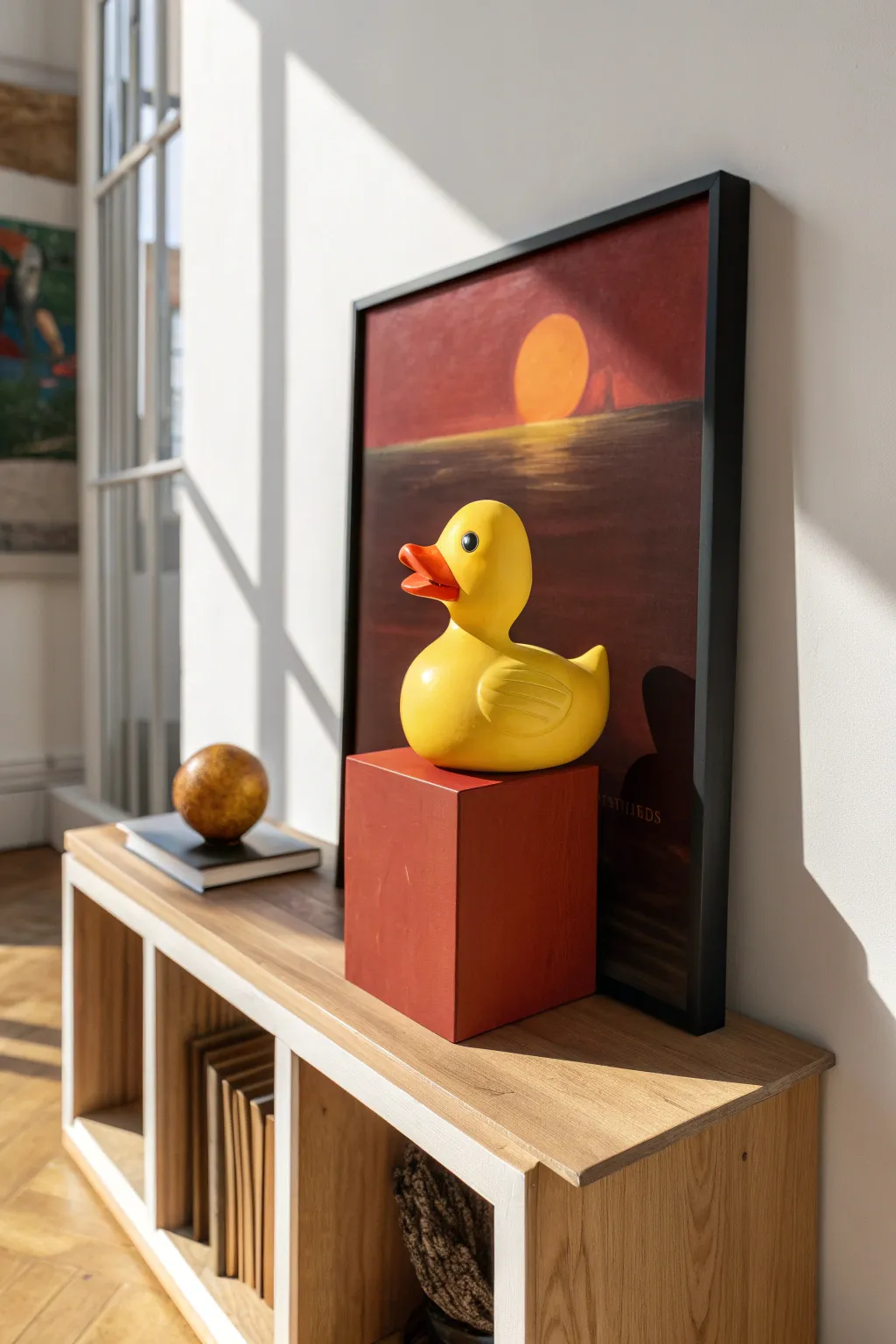
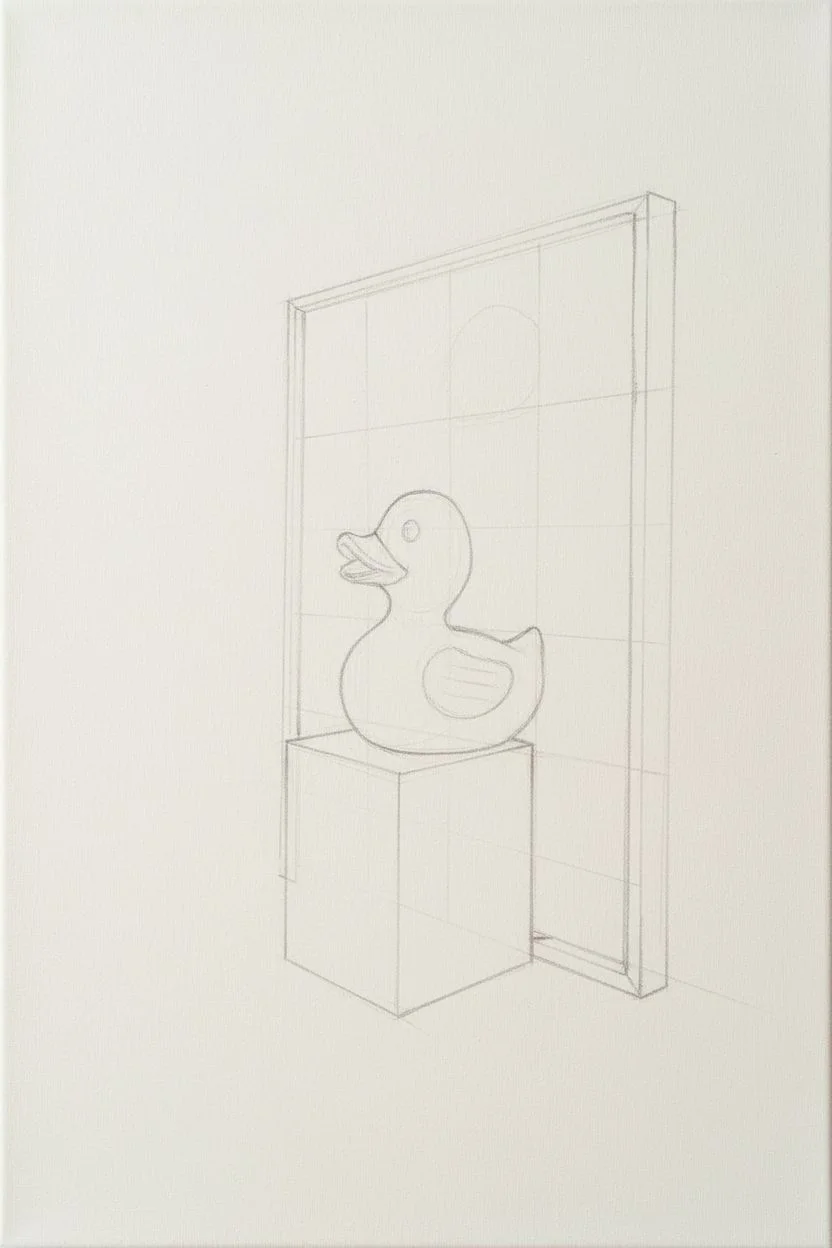
Capture a whimsical meta-moment by painting a rubber duck ‘viewing’ a sunset. This tutorial guides you through creating a realistic acrylic still life that contrasts the bright, smooth plastic of the toy with deep, moody landscape tones.
Step-by-Step
Materials
- Stretched canvas or canvas board (12×16 inches recommended)
- Acrylic paints (Cadmium Yellow, Cadmium Red, Alizarin Crimson, Burnt Sienna, Titanium White, Mars Black, Phthalo Blue)
- Flat synthetic brushes (various sizes)
- Small round detail brush (size 0 or 1)
- Ruler and pencil
- Painter’s tape
- Palette and water cup
Step 1: Sketching the Composition
-
Map out the grid:
Use your ruler to lightly draw a large rectangle for the framed painting in the background, leaving negative space on the left for the wall. -
Position the pedestal:
Draw the geometric cube shape in the lower center, overlapping the bottom edge of the framed painting area. -
Outline the subject:
Sketch the rubber duck sitting on top of the cube. Focus on the playful curves of the beak, head, and tail to contrast with the straight lines of the box.
Pro Tip: Crisp Lines
For the perfectly straight edges of the red cube and the black picture frame, use low-tack painter’s tape. Ensure the base layer is 100% dry before applying tape to avoid peeling up paint.
Step 2: The Background Elements
-
Base the wall:
Paint the wall area on the left with a mix of White and a tiny drop of Black/Brown to create a warm off-white. Don’t worry about shadows yet. -
Create the sunset gradient:
Inside the sketched frame, paint a smooth gradient from dark Alizarin Crimson at the top, fading into bright Cadmium Red, and finally Cadmium Orange near the horizon line. -
Paint the sun:
Mix Cadmium Yellow with White and paint a crisp circle just above the horizon line in the sunset area. -
Add the sea:
Below the horizon line, paint the water using dark browns and deep reds. Add horizontal dashes of orange directly below the sun to create reflection. -
Paint the frame:
I prefer to use painter’s tape here to get sharp lines. Paint the outer border of the sunset artwork with Mars Black to simulate a modern frame.
Level Up: Into Surrealism
To fit the ‘melting’ theme more literally, extend the yellow paint at the base of the duck, dripping it down the side of the red cube to make it look like the rubber is turning into liquid wax.
Step 3: The Red Plinth
-
Block in the red:
Paint the front face of the cube with pure Cadmium Red mixed with a touch of Burnt Sienna for a matte, solid look. -
Shade the side:
If your composition shows the side of the cube, paint it a darker shade by mixing the red with a little more brown or blue to indicate shadow. -
Define edges:
Use a liner brush with a slightly lighter red (mixed with a touch of yellow) to highlight the top sharp edge of the box where the light hits.
Step 4: Simulating the Duck
-
Yellow base coat:
Fill in the duck’s body with pure Cadmium Yellow. You may need two coats for full opacity. -
Model the form:
While the yellow is still slightly wet, blend in a mix of Yellow and slightly Ochre/Orange along the bottom curve and under the neck to create 3D volume. -
Beak details:
Paint the beak with bright Orange. Add a thin dark line between the upper and lower beak to separate them. -
The eye:
Using your smallest brush, paint a black circle for the eye. Once dry, add a tiny white dot at the 10 o’clock position to give it life and shine. -
Plastic highlights:
Mix White with a little Yellow. Paint a soft, curved highlight on the top of the head and the chest to mimic the reflective texture of rubber.
Step 5: Light and Shadow
-
Grounding the duck:
Mix a dark red/brown glaze and paint a soft shadow on the top of the red cube, right exactly where the duck sits. -
Background shadows:
Paint a dark shadow cast by the cube and duck onto the painting behind them. This connects the foreground object to the background. -
Window light effects:
To recreate the photo’s atmosphere, mix a transparent grey glaze. Paint the diagonal shadow lines on the white wall to suggest light streaming through a window.
Step back and admire how your realistic shading makes the duck pop right off the canvas against that moody sunset.
Family Portrait: Mama and Ducklings
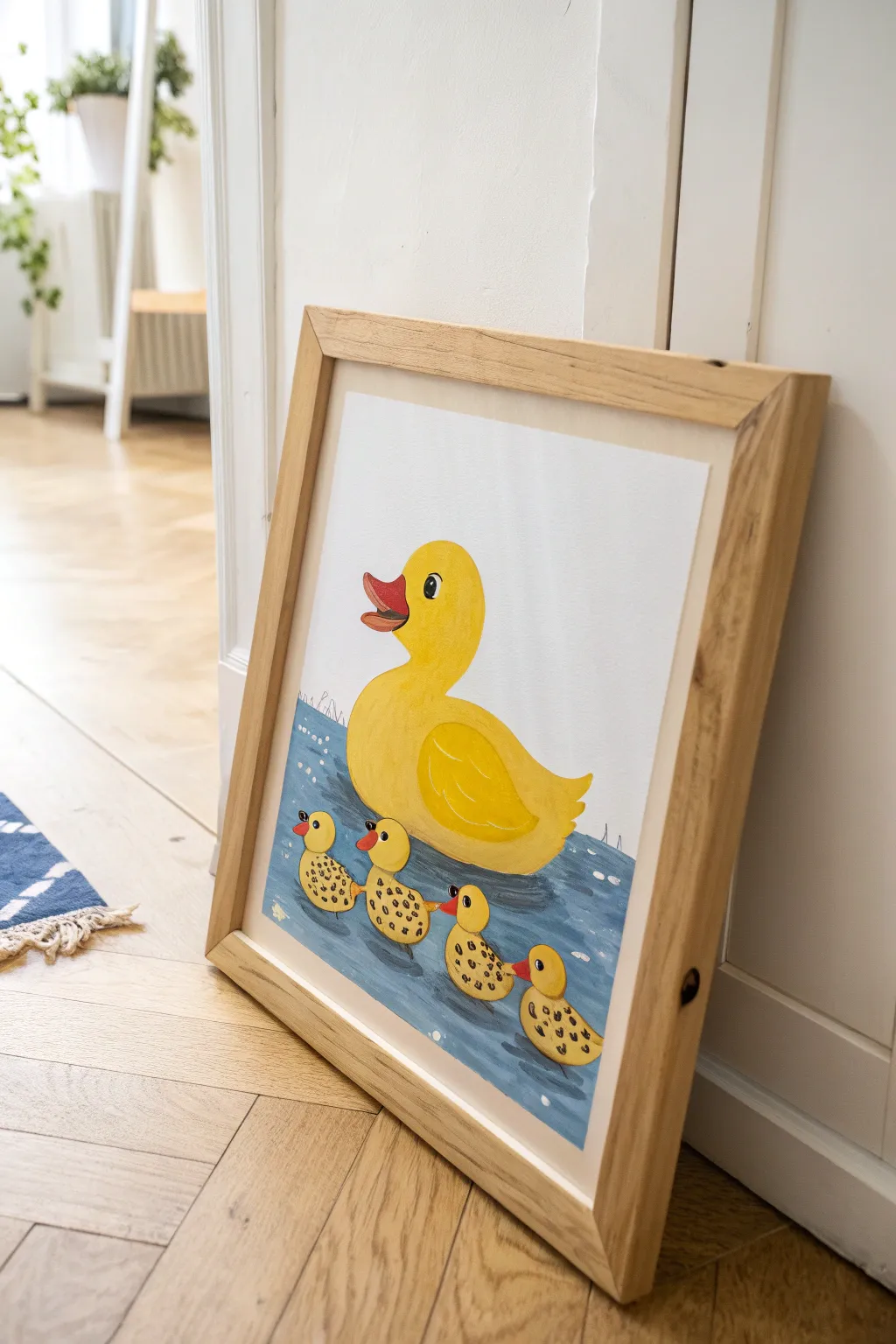
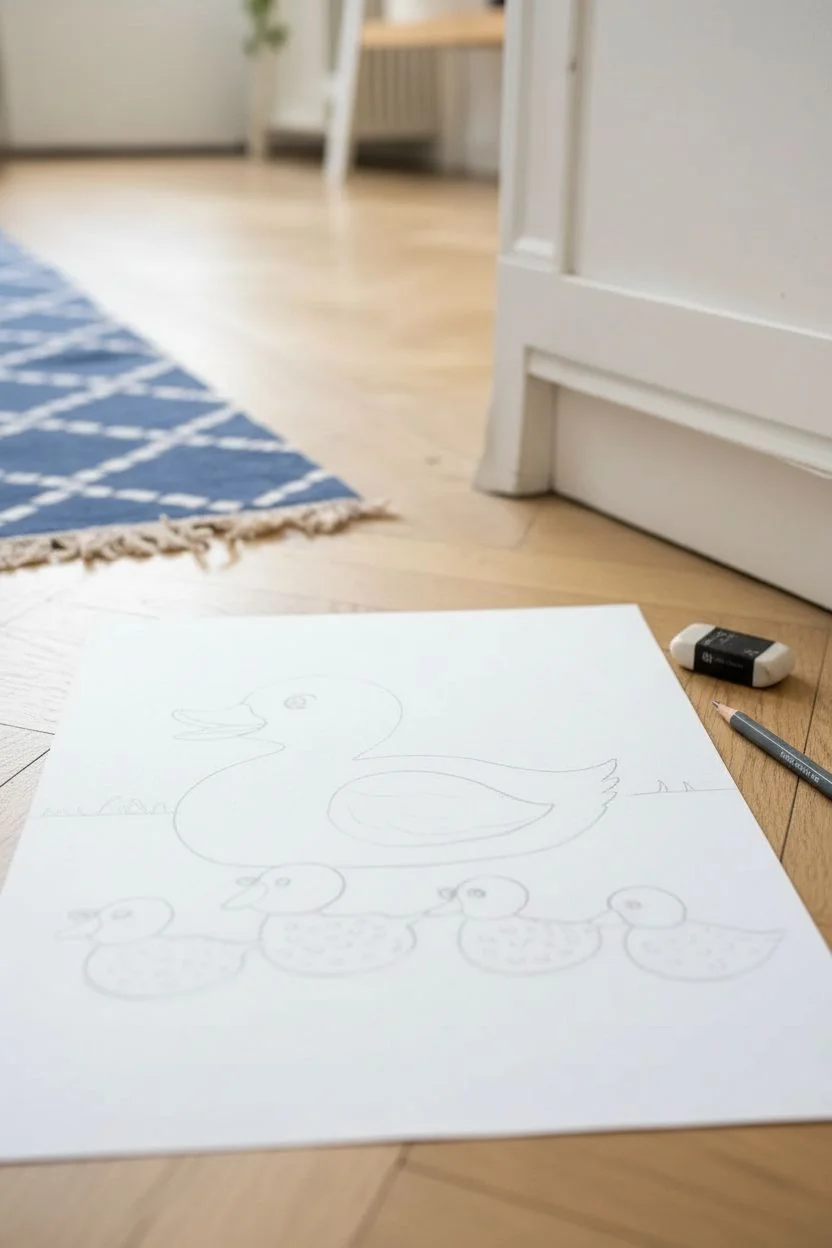
Bring a splash of joy to your walls with this charming acrylic painting of a mother duck leading her brood across the water. The bright yellow tones pop beautifully against the textured blue waves, making it a perfect addition to a nursery or family room.
Step-by-Step Guide
Materials
- Heavyweight mixed-media paper or canvas panel (11×14 inches recommended)
- Acrylic paints (Cadmium Yellow, Yellow Ochre, Ultramarine Blue, Titanium White, Cadmium Red, Mars Black)
- Flat synthetic brush (3/4 inch)
- Round synthetic brushes (sizes 4 and 0 for details)
- Graphite pencil and eraser
- Palette and water cup
- Paper towels
Step 1: Sketching the Composition
-
Establish the water line:
Using your pencil, lightly draw a horizontal line across the paper, about one-third of the way up from the bottom. This doesn’t need to be ruler-straight; a slight wave adds character. -
Outline the Mama Duck:
Draw the large mother duck in the center-left. Start with a circle for the head, an oval for the body, and connect them with a curved neck. Add a triangle for the tail and define the beak shape. -
Position the ducklings:
Sketch four smaller ovals trailing behind the mother. I like to vary their spacing slightly so they don’t look like toy soldiers. Give them small round heads and tiny triangular beaks. -
Refine the sketches:
Go over your outlines to connect the shapes smoothly. Erase any internal construction lines so the canvas is clean before painting.
Step 2: Painting the Water
-
Mix the base blue:
On your palette, mix Ultramarine Blue with a generous amount of Titanium White to create a soft, medium sky blue. -
Fill the water area:
Using your flat brush, paint the water area below your horizon line. Use horizontal strokes to mimic ripples. Be careful to cut in around the pencil outlines of the ducks—yellow is transparent and hard to paint over blue. -
Add depth and shadows:
While the blue is still slightly wet, mix a little more pure Ultramarine into your mix. Paint horizontal streaks directly under the ducks to ground them in the water. -
Create water texture:
Dip your brush into pure White. Add short, dashed horizontal lines throughout the blue area to create the look of glistening waves and movement.
Clean Edges Pro-Tip
Since yellow pigment is naturally translucent, if you accidentally paint blue inside the duck lines, paint that spot white first. Let it dry, then paint yellow over it for true brightness.
Step 3: Mama Duck Details
-
Base coat the body:
Load a size 4 round brush with Cadmium Yellow. Paint the entire body of the mother duck. If the paint looks streaky, let it dry and apply a second coat for solid coverage. -
Define the wing:
Mix a tiny dot of Yellow Ochre into your Cadmium Yellow. Paint a teardrop shape on the side of the body to suggest a folded wing. -
Paint the beak:
Mix Cadmium Red with a touch of Yellow to make an orange-red. Carefully fill in the beak area. Add a tiny black line to separate the upper and lower beak. -
Add the eye:
Using your smallest detail brush (size 0) and black paint, add a large oval eye. Leave a tiny speck of white paper or add a white dot later for the highlight.
Level Up: Personalize It
Make this a true family portrait! Adjust the number of ducklings to match the number of children in your (or the recipient’s) family for a sentimental touch.
Step 4: The Ducklings & Final Touches
-
Base coat the ducklings:
Paint the bodies of all four ducklings with your Cadmium Yellow. Just like with the mother, ensure the coverage is opaque. -
Add beaks and eyes:
Use your orange mix for their tiny beaks and black for their small round eyes. Remember to add the white ‘catchlight’ to their eyes to bring them to life. -
Create the patterned spots:
This is the unique part of this style: use a small brush and diluted black or dark brown paint to dab irregular ‘C’ shapes and dots onto the ducklings’ bodies, giving them a textured, downy look. -
Paint background grass:
Mix a very watery grey-blue. Paint thin, vertical lines sprouting from the horizon line on the far left and right to suggest distant reeds or grass. -
Final highlights:
Use pure white to add a final glint on the top curve of the mother duck’s beak and a few extra sharp white dashes in the water right next to the ducks.
Once the paint is fully dry, pop your masterpiece into a light wood frame to echo the warm tones of the ducks!


Have a question or want to share your own experience? I'd love to hear from you in the comments below!