
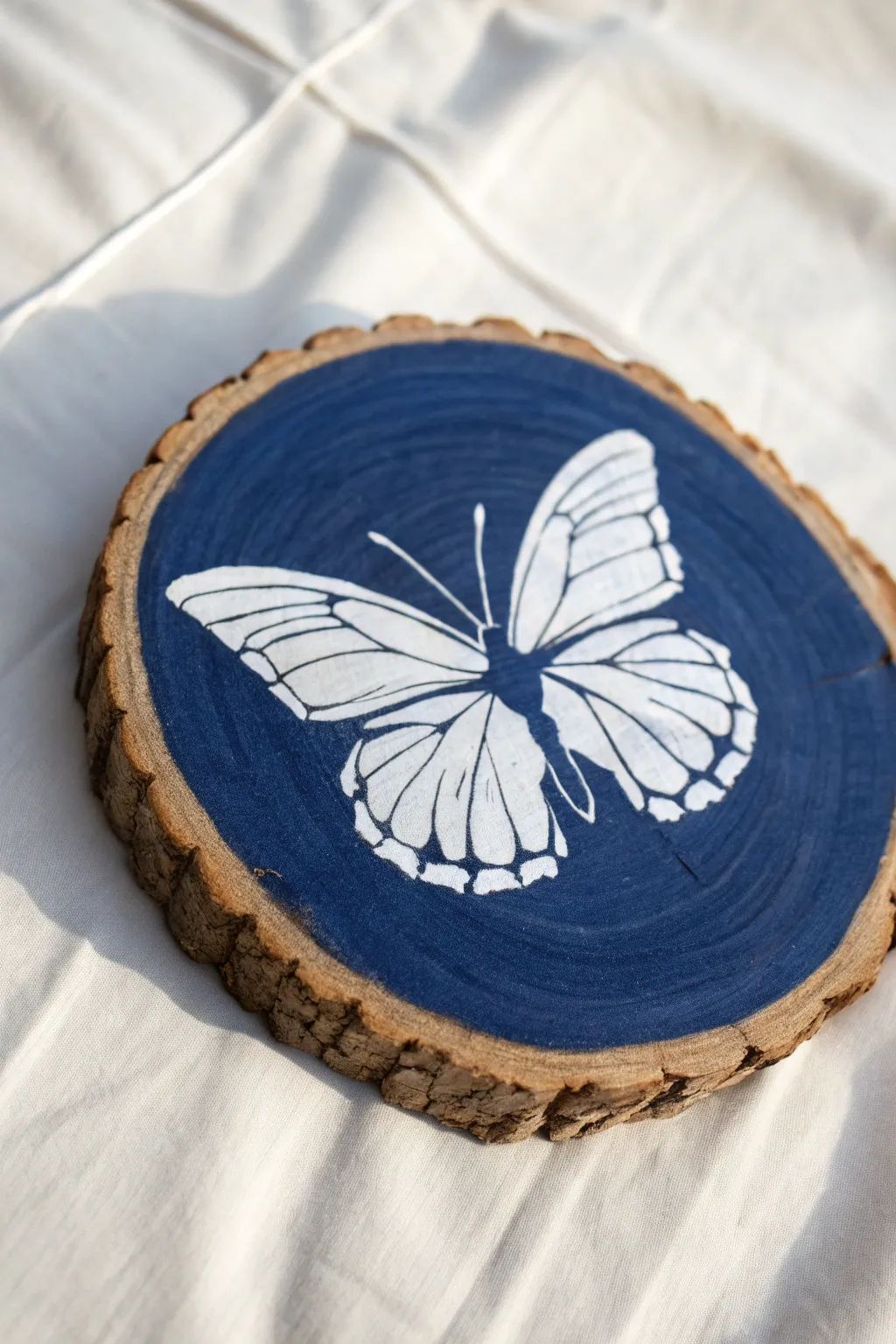
Wooden butterflies are one of those projects that feel instantly cheerful—small, satisfying, and perfect for playing with color. Here are my favorite wooden butterfly painting ideas to help you turn simple wood blanks and slices into tiny pieces of art you’ll want to hang, gift, and keep.
Purple Background on a Wood Slice
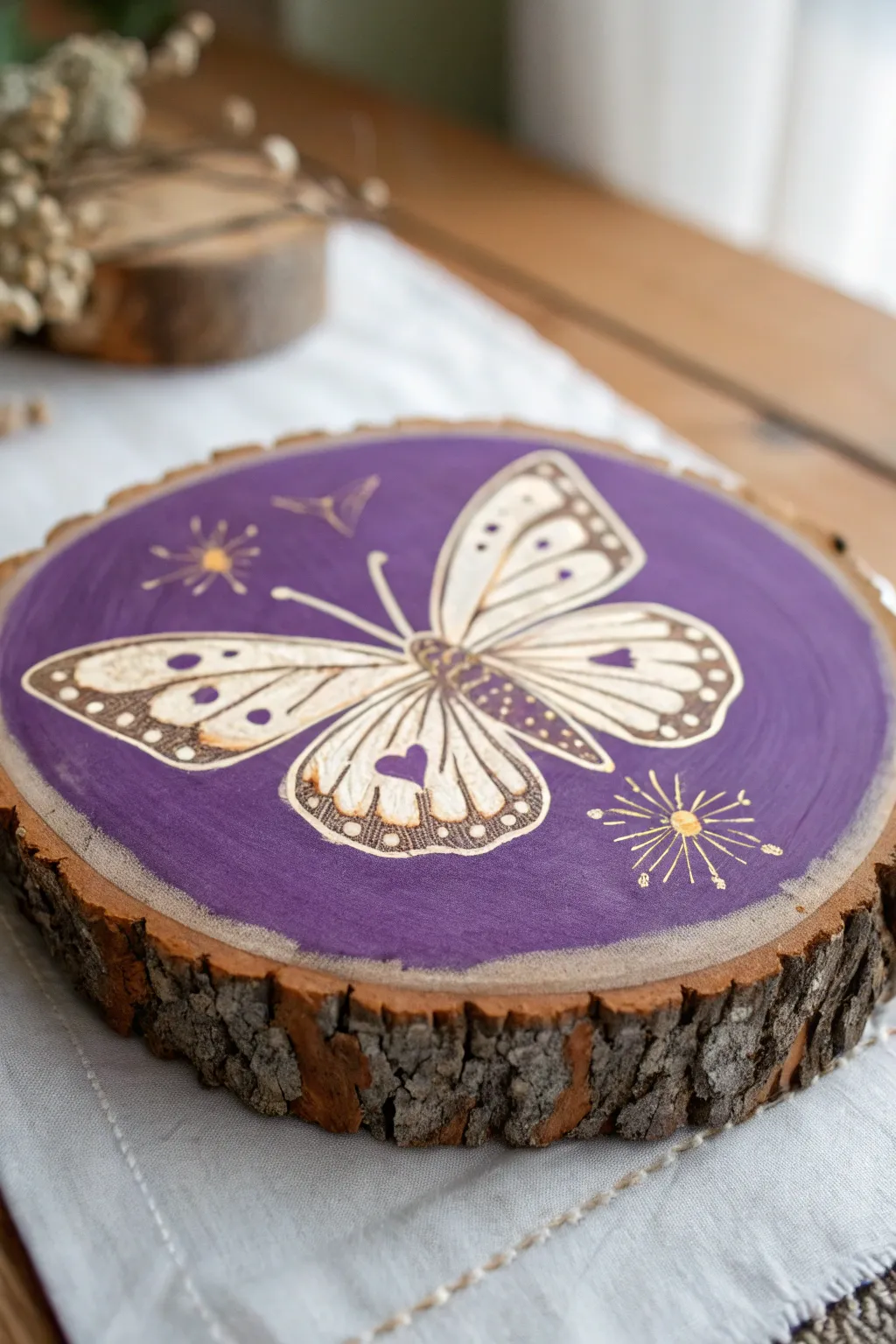
Transform a rustic wood slice into a mystical piece of art with this detailed butterfly design. By combining negative space techniques with rich purple acrylics and fine line work, you’ll create a captivating focal point perfect for nature-inspired decor.
Step-by-Step Tutorial
Materials
- Wood slice with bark (approx. 6-8 inch diameter)
- Deep violet or plum craft acrylic paint
- Pencil and eraser
- Fine grit sandpaper
- Flat shader brush (size 6 or 8)
- Fine liner brush (size 0 or 00) or extra-fine tip paint pen (black)
- White or gold gel pen (optional for accents)
- Wood sealant or varnish (matte or satin finish)
- Carbon transfer paper (optional)
Step 1: Preparation and Sketching
-
Surface Prep:
Begin by sanding the top face of your wood slice until it is silky smooth. This is crucial for crisp paint lines and smooth drawing later. Wipe away all sawdust with a damp shop cloth or tack cloth. -
Drafting the Design:
Lightly sketch your butterfly silhouette directly onto the wood. Focus on symmetrical wings and a segmented body. Also, sketch a circle about 1/2 inch from the bark edge to mark where your paint will stop. -
Adding Wing Details:
Within your butterfly outline, draw the interior patterns—the teardrop shapes, dots, and veins. Remember, we want the butterfly itself to remain mostly raw wood, so these lines guide where we *don’t* paint.
Clean Lines Secret
For the sharpest edge between paint and bare wood, gently score your pencil outline with a craft knife before painting to create a physical barrier.
Step 2: Painting the Background
-
Outlining the Negative Space:
Load your fine liner brush with violet paint. Carefully trace around the *outside* of your butterfly sketch. You are painting the background, preserving the wood color for the butterfly wings. -
Filling the Color:
Switch to your flat shader brush. Fill in the rest of the background area with the violet paint, working outward from your butterfly outline toward the circle border you marked earlier. -
Defining the Edge:
At the outer edge of the purple circle, use a steady hand to create a clean, crisp curve. I find rotating the wood slice while holding the brush still helps create a smoother arc. -
Layering Up:
Allow the first coat of purple to dry completely (about 15-20 minutes). Apply a second coat to ensure the color is opaque and vibrant, hiding the wood grain underneath.
Wood-Burning Effect
Instead of black paint for the wing outlines and veins, use a wood burning tool (pyrography pen) to sear the details for texture and permanence.
Step 3: Detail Work
-
Adding Dark Accents:
Once the background is fully dry, use a fine tip black paint pen or a very small brush with black paint to add the dark details on the wings. Fill in the tips of the wings and the body. -
Creating Definition:
Draw thin black lines to define the veins of the wings. Add small black dots along the outer edges of the wings for texture. -
Highlighted Details:
Add the small purple heart detail on the lower wing and the purple spots on the upper wing using your liner brush. -
Celestial Touches:
Using a gold gel pen or gold paint, draw two starburst shapes floating in the purple background—one near the top left and one near the bottom right. Add a small gold dot to the center of each. -
Fine Tuning:
Add tiny white or cream dots inside the black wing tips to mimic the pattern of a real butterfly. This contrast really makes the design pop.
Step 4: Finishing Touches
-
Clean Up:
Once all paint and ink are bone dry, gently erase any visible pencil marks from the unpainted wood areas. -
Antennae Check:
Don’t forget to paint the delicate antennae extending from the butterfly’s head into the purple background using a very light cream or white color for visibility. -
Sealing:
Protect your masterpiece with a clear spray sealer or brush-on varnish. A matte finish looks best to keep the natural wood vibe.
Hang your new wood slice art on a gallery wall or use it as a stunning rustic coaster.

Sky Blue “In Flight” Butterfly
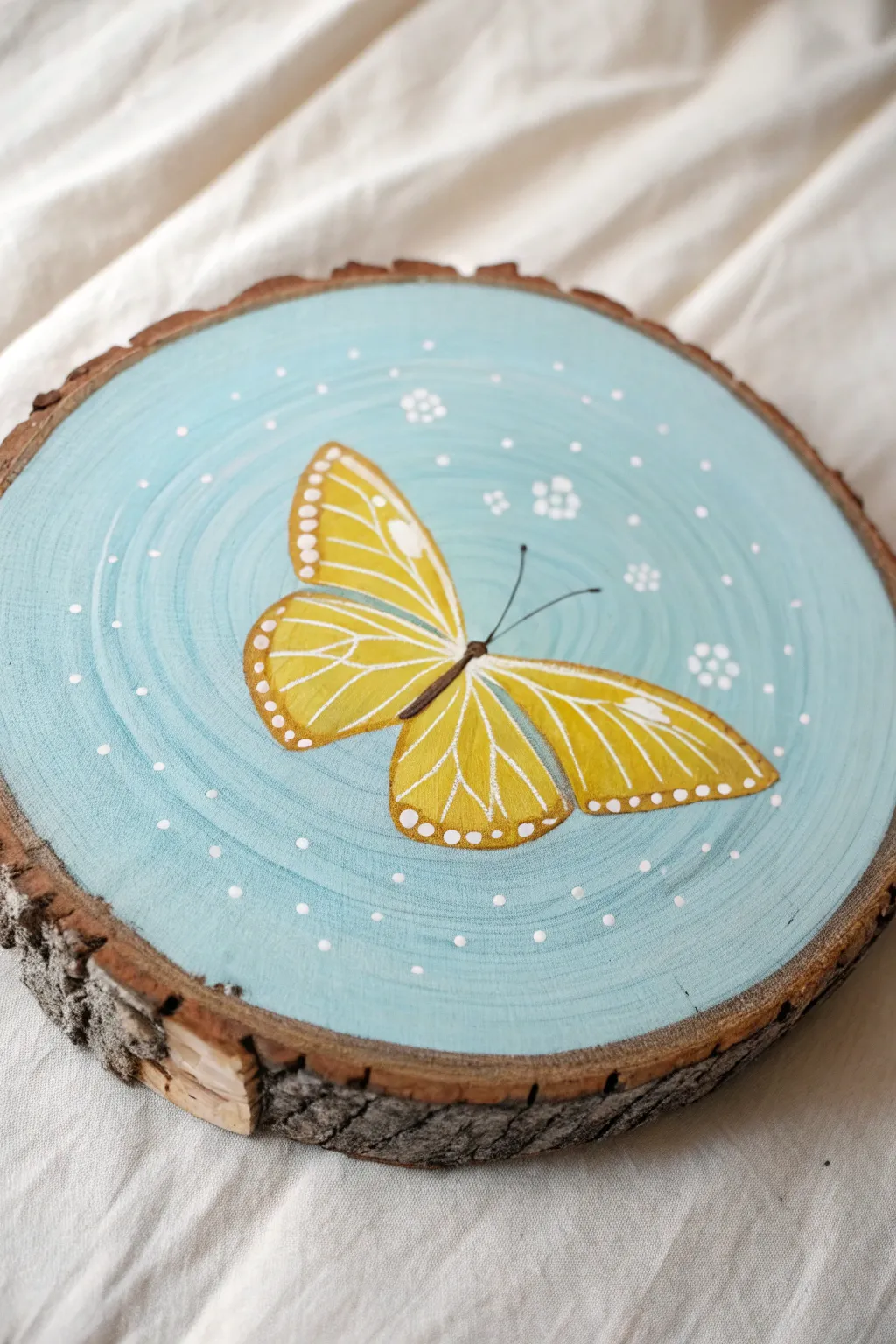
Capture the delicate beauty of a butterfly in flight with this charming wood slice project. The soft sky-blue background and sunny yellow wings create a cheerful, rustic piece of art perfect for a nursery or garden room.
How-To Guide
Materials
- Round wood slice (approx. 6-8 inches diameter, with bark intact)
- Acrylic paints: Sky blue, white, bright yellow, mustard/golden yellow, dark brown
- Flat paintbrush (medium size)
- Round paintbrush (small/detail size)
- Fine liner brush (size 0 or 00)
- Pencil
- Palette for mixing artwork
- Cup of water and paper towels
- Matte or glossy varnish (optional)
Step 1: Setting the Scene
-
Prepare the wood:
Ensure your wood slice is clean and free of loose dust. If the surface is very rough, give it a quick sanding with fine-grit sandpaper, but careful not to damage the bark edge. -
Paint the background:
Using your flat brush, coat the entire face of the wood slice with sky blue acrylic paint. Paint in a circular motion following the rings of the wood to keep the texture looking natural. -
Apply a second coat:
Let the first layer dry completely. If the wood grain is showing through too much, apply a second coat of blue for a more solid, opaque look. Allow this to dry fully before proceeding.
Uneven Paint Coverage?
If the wood soaks up too much paint, apply a layer of white gesso or primer first. This seals the pores and makes your blue background much smoother and brighter.
Step 2: Sketching and Base Coat
-
Sketch the butterfly:
Lightly sketch the outline of the butterfly directly onto the dry blue paint with a pencil. Draw a slender body in the center tilted slightly diagonally, with two large upper wings and two smaller lower wings. -
Base coat the wings:
Fill in the wing shapes using the bright yellow paint and a small round brush. Don’t worry about shading yet; just get a solid, even layer of yellow down. -
Paint the body:
Using the dark brown paint and a fine brush, carefully fill in the long, thin body of the butterfly. Add a small rounded head at the top of the body segment.
Make It Sparkle
Mix a tiny pinch of iridescent glitter into your final varnish coat or add touches of metallic gold paint to the wing veins for a magical, shimmering finish.
Step 3: Adding Detail and Dimension
-
Define the edges:
Mix a tiny bit of brown into your yellow or use a mustard shade to create a darker golden outline. Use your fine liner brush to outline the wings, giving them definition against the blue background. -
Add wing veins:
With the same fine liner brush and white paint, carefully draw the delicate veins inside the wings. Start from the body and fan outward toward the wing edges with thin, sweeping lines. -
Highlight the wings:
I like to add depth by painting a few soft white highlights near the top of the upper wings. Blending a little white into the wet yellow paint creates a gentle gradient effect. -
Dot the edges:
Dip the tip of your smallest brush or a toothpick into white paint. Add a row of tiny white dots along the outer edges of the wings, particularly on the rounded tips, to mimic real butterfly patterns. -
Add antennae:
Using the dark brown paint and your finest liner brush, paint two very thin, curved antennae coming from the head. Keep your hand light to ensure the lines stay crisp.
Step 4: Finishing Touches
-
Create the aura:
To make the butterfly feel magical, dampen a clean brush slightly and use very watered-down white paint to add faint, circular brushstrokes in the blue background around the wings. -
Add background dots:
Dip the end of a paintbrush handle into white paint to create perfectly round dots. Scatter these randomly around the blue background, varying the spacing. -
Paint tiny flowers:
Group five small white dots together in a circle to create simple flower clusters. Place these sporadically among the single dots to fill empty spaces. -
Final dry:
Allow the entire painting to dry for at least 24 hours. Ensure the thicker dots of paint are hard to the touch. -
Seal the art:
Protect your work by applying a layer of clear varnish over the painted surface. This will seal the wood and keep the colors vibrant for years to come.
Now you have a lovely piece of nature-inspired decor that brings a breath of fresh air into your home

Watercolor-Style Wash on Wood
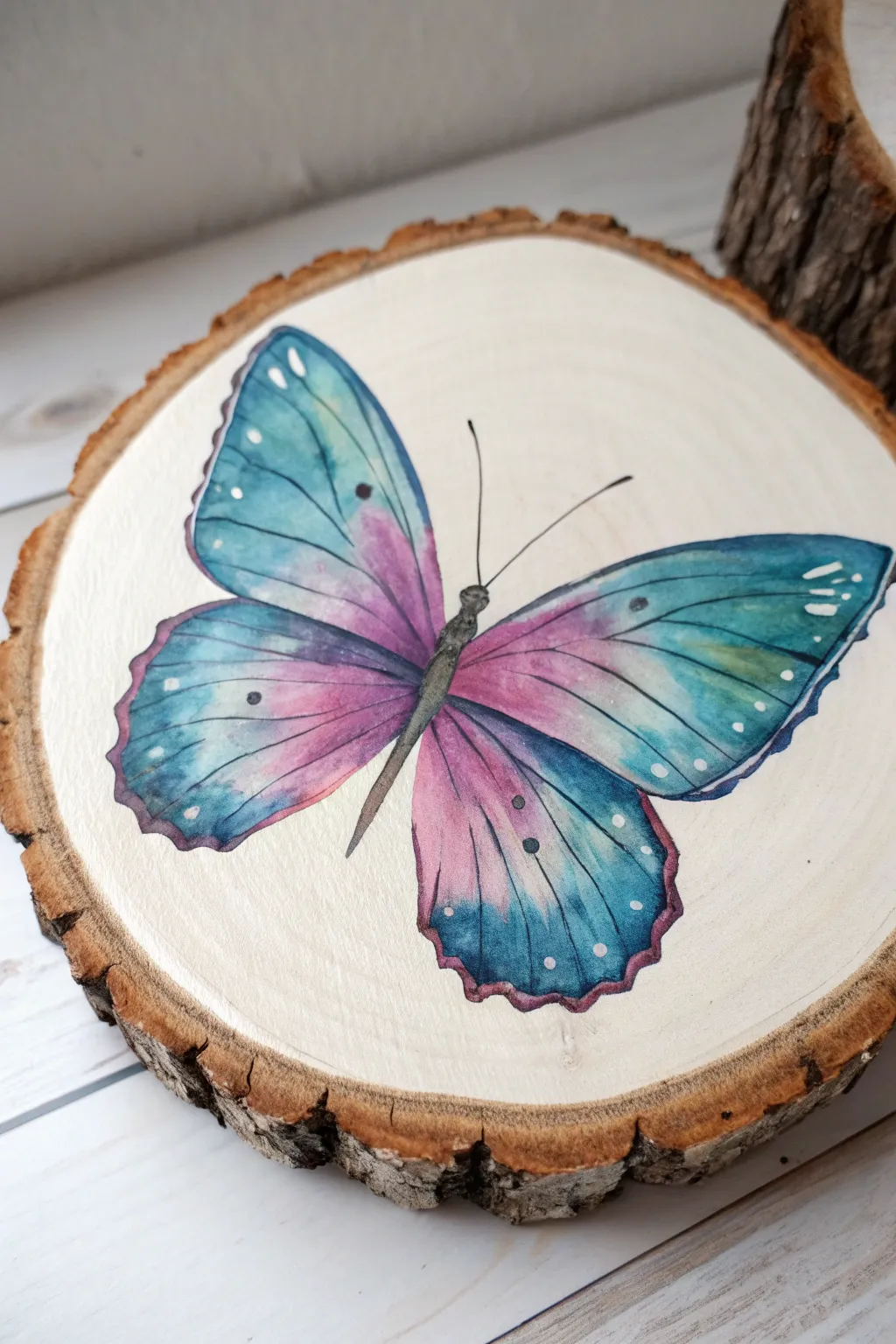
Enhance the natural beauty of a rustic wood slice with a delicate, watercolor-style butterfly. This project blends soft gradient washes of blue, teal, and magenta to create a translucent, wing-like effect that lets the wood grain peek through.
Step-by-Step Tutorial
Materials
- Round wood slice (approx. 6-8 inches, with bark)
- Fine-grit sandpaper (220 grit)
- White acrylic gesso or white acrylic paint
- Watercolor paints or fluid acrylics (Turquoise, Magenta, Deep Blue, Black)
- Soft round brushes (sizes 4 and 6)
- Fine liner brush (size 0 or 00)
- Pencil for sketching
- Water container and paper towels
- Clear matte varnish or spray sealant
Step 1: Preparation & Base
-
Prep the surface:
Begin by sanding the face of your wood slice gently with 220-grit sandpaper. You want it smooth enough for a brush to glide, but retain the organic feel. Wipe away any sawdust with a dry cloth. -
Prime the painting area:
Since raw wood absorbs watercolor endlessly, you need a faux-paper surface. Paint a large, solid white circle in the center of the slice using white gesso or acrylic. Leave a generous border of raw wood around the edges. -
Smooth the background:
If the gesso looks streaky after the first coat, apply a second thin layer. Sand this white area very lightly once dry to create a perfectly smooth, velvety base for your detailed work. -
Sketch the outline:
Using a light pencil touch, draw the butterfly shape. Start with the central thin body at a slight angle. Draw the large upper wings reaching toward the top left and right, and the smaller, rounded lower wings below.
Bleeding Lines?
If paint spreads uncontrollably into the wood grain, your gesso base layer might be too thin. Let it dry, apply clear matte medium over the trouble spot, and repaint the detail.
Step 2: Applying the Washes
-
Mix your watery hues:
Prepare your paints by diluting them significantly with water. You want translucent washes, not opaque blocks of color. Create puddles of turquoise, deep blue, and a soft magenta. -
Wet-on-dry technique:
Start with the upper right wing. Dip your size 6 brush in water, then pick up a small amount of turquoise. Apply this to the outer edges of the wing, pulling the color inward. -
Introduce the magenta:
While the blue is still slightly damp, rinse your brush and pick up the watery magenta. Apply this near the body of the butterfly where the wings attach. -
Create the gradient:
Gently blend where the magenta and turquoise meet in the middle of the wing. Allow them to bleed into each other slightly to create soft purples, but avoid overworking it or the colors will turn muddy. -
Repeat for all wings:
Move clockwise to the other wings, repeating this gradient process: teals/blues on the outer distinct edges and pinks/magentas concentrating near the butterfly’s body. -
Deepen the edges:
Once the initial wash is dry to the touch, take a slightly less diluted blue or indigo. Carefully trace the very outer scalloped edges of the wings to define their shape against the white background.
Metallic Accent
For a magical touch, trace the main veins of the butterfly wings with a metallic gold or silver gel pen after the paint is fully dry. It catches the light beautifully.
Step 3: Details & Definition
-
Paint the veins:
Switch to your fine liner brush with a dark grey or watered-down black. With a steady hand, paint the thin, delicate veins radiating from the body outward to the wing edges. -
Add texture spots:
Using the same dark mixture, dab tiny, deliberate dots along the outer margins of the bottom wings and a few near the top edges to mimic natural patterns. -
Highlight with white:
Dip your fine brush into undiluted white acrylic or gouache. Add tiny white dots or dashes near the tips of the upper wings and a few scattered on the lower blue sections for sparkle. -
Define the body:
Fill in the central body with dark grey or black. Make the thorax (middle section) slightly fuzzy by stippling the paint, and keep the abdomen (tail) slender and segmented. -
Draw the antennae:
With the finest point of your liner brush and black paint, sweep two long, thin lines curving outward from the head. I like to keep the pressure varied so the lines look organic. -
Refine the border:
If the butterfly feels too floating, add a very faint, watery shadow underneath just one side of the wings using diluted grey to ground it. -
Seal the artwork:
I recommend letting the piece dry overnight to ensure all moisture has evaporated. Finally, apply a clear matte spray varnish to protect the watercolor from humidity without adding unintended shine.
Hang your new rustic masterpiece on a wall or prop it on a shelf to bring a gentle touch of nature indoors
Splatter Background Behind a Butterfly
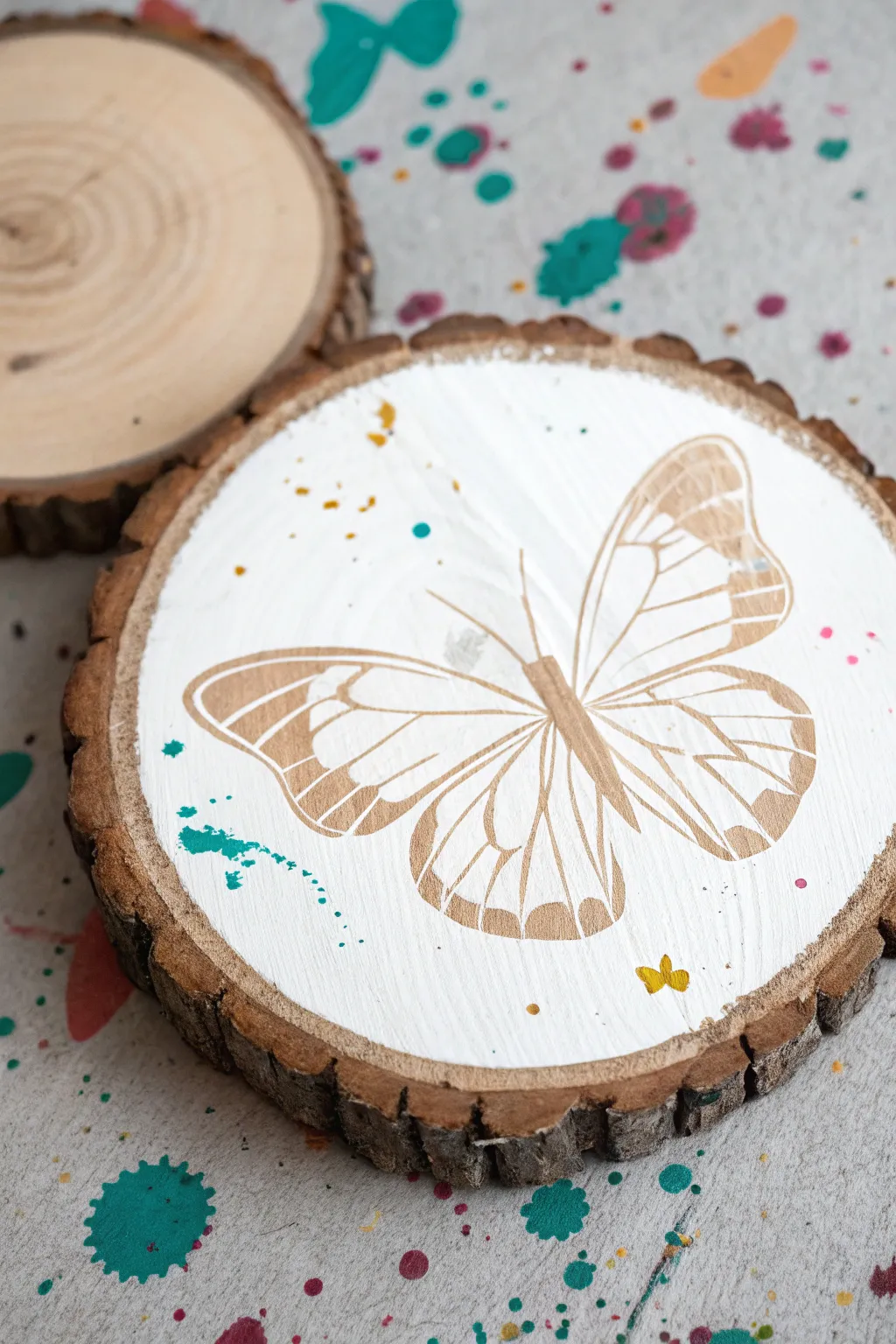
Embrace the natural beauty of wood by using negative space to create a stunning butterfly design. This project uses a reverse-stenciling technique where the wood grain becomes the star, framed by crisp white paint and playful color splatters.
Step-by-Step Guide
Materials
- Round wood slices (coasters or ornaments)
- Adhesive vinyl or contact paper
- Cutting machine (Cricut/Silhouette) or craft knife
- White acrylic craft paint
- Sponge dabber or high-density foam brush
- Small detail paintbrush
- Teal, magenta, and gold acrylic paints
- Weeding tool
- Transfer tape
- Gloss or matte varnish (optional)
Step 1: Preparing the Stencil
-
Choose your design:
Find a butterfly silhouette or line art design you love. For this specific look, you need a design that has defined outline thickness rather than just a solid shape, as the internal lines will remain natural wood color. -
Cut the vinyl:
Use your cutting machine to cut the design out of adhesive vinyl. Alternatively, print the design on paper, tape it over contact paper, and carefully cut it out by hand using a sharp craft knife. -
Weed the design:
This step is crucial and slightly counter-intuitive: remove the parts of the vinyl where you want the *white paint* to go later. Leave the butterfly shape (the positive space) on the backing paper. We are creating a mask, not a traditional stencil. -
Apply transfer tape:
Place transfer tape over your weeded vinyl butterfly and burnish it down firmly to ensure it lifts off the backing paper easily.
Step 2: Application and Painting
-
Prep the surface:
Sand your wood slice lightly if needed to ensure a smooth surface for the vinyl to stick to. Wipe away any dust. -
Place the mask:
Position the butterfly vinyl onto the center of the wood slice. Press down firmly, paying special attention to the thin inner lines and edges to prevent paint bleed. -
Seal the edges (Optional):
I sometimes like to brush a very thin layer of clear matte medium or Mod Podge over the vinyl edges first. This creates a barrier so if anything bleeds under, it’s clear, creating a perfect seal. -
Apply white base:
Using a sponge dabber, apply white acrylic paint over the entire surface of the wood slice, covering both the exposed wood and the vinyl mask. -
Build coverage:
Apply the white paint in light, tapping motions rather than dragging a brush. Let the first coat dry, then apply a second or third coat until the wood grain is mostly obscured by the white. -
Remove the vinyl:
While the final coat of paint is still slightly tacky (not fully cured), carefully use a weeding tool or pin to lift the edge of the vinyl. Peel it away slowly to reveal the natural wood butterfly beneath.
Bleeding Lines?
If paint seeped under the vinyl, use a craft knife to gently scrape away the excess paint while dry, or use a toothpick dampened with water to tidy up wet mistakes.
Step 3: Adding the Splatter
-
Prepare splatter paints:
Dilute small amounts of teal, magenta, and gold paint with a drop or two of water. The consistency should be ink-like but not too runny. -
Splatter teal:
Load a small brush with the diluted teal paint. Hold it over the wood slice and tap the handle against another brush or your finger to fling small droplets onto the white background. -
Add accent colors:
Repeat the splatter process with the magenta and gold paints. Aim for random placement, allowing some dots to land near the butterfly wings and others near the bark edge. -
Dry and seal:
Allow the paint to dry completely. If these will be used as coasters, apply a water-resistant varnish to protect the wood and paint from moisture.
Add Some Sparkle
For the gold splatters, try using metallic watercolor paint instead of acrylics. It tends to shimmer more brilliantly against the matte white background.
Now you have a beatiful nature-inspired piece that highlights the organic texture of the wood
BRUSH GUIDE
The Right Brush for Every Stroke
From clean lines to bold texture — master brush choice, stroke control, and essential techniques.
Explore the Full Guide
Negative-Space Butterfly on a Painted Slice
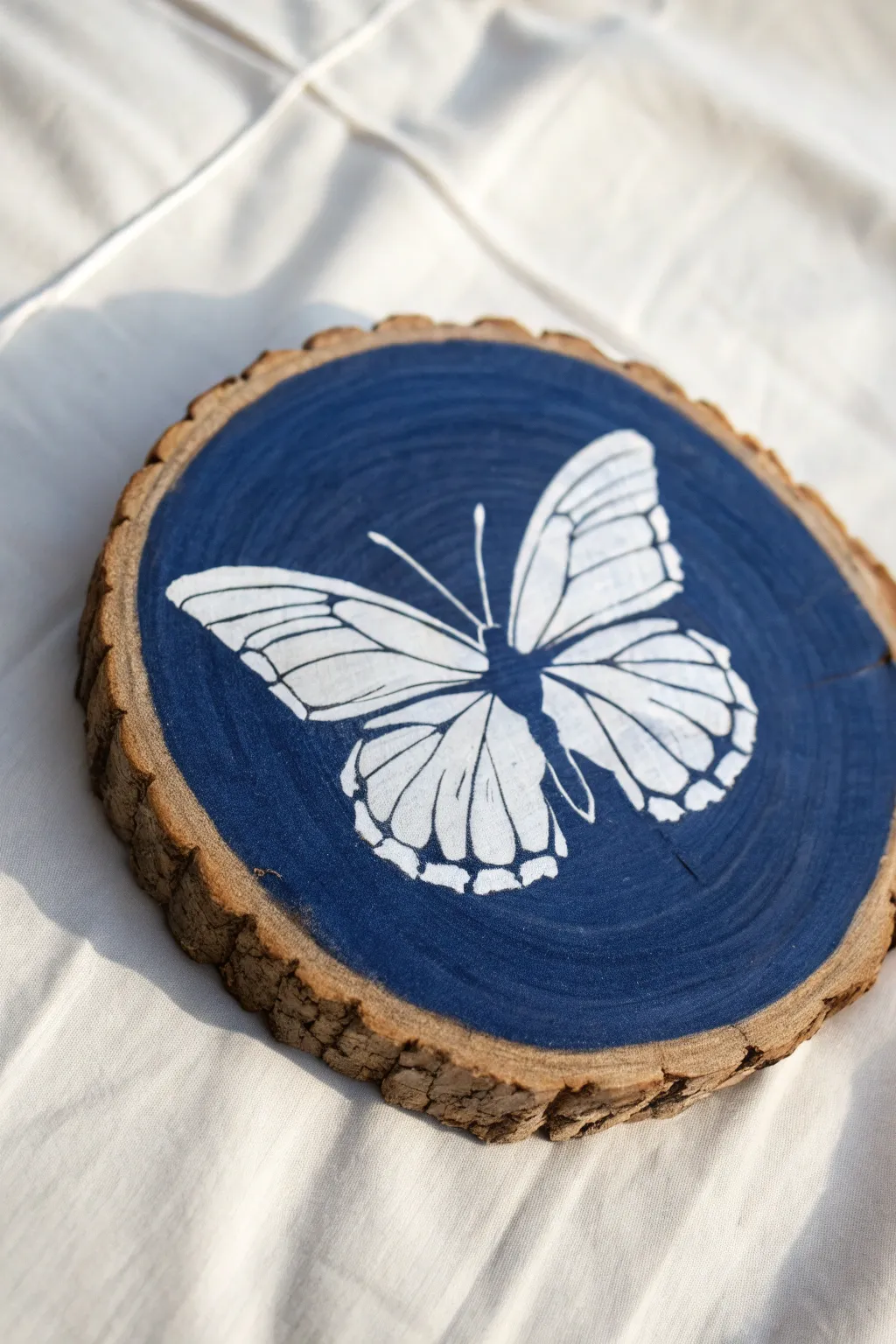
This rustic yet elegant project transforms a simple wood slice into a striking piece of wall art or a unique coaster. By contrasting deep navy blue with crisp white lines, you’ll create a butterfly that seems to glow against a midnight sky.
Detailed Instructions
Materials
- Wood slice with bark intact (approx. 4-6 inches wide)
- Sandpaper (medium grit, 120-150)
- Dark navy blue acrylic paint
- White acrylic paint
- Wide flat paintbrush
- Fine liner brush (size 0 or 00)
- Pencil
- Butterfly stencil or printed template (optional)
- Clear matte or satin varnish (spray or brush-on)
- Carbon transfer paper (optional)
Step 1: Preparing the Canvas
-
Sand the surface:
Begin by sanding the top face of your wood slice to create a smooth painting surface. Ensure you remove any splinters or rough saw marks, but be careful not to damage the natural bark edge. -
Clean the dust:
Wipe the surface thoroughly with a dry cloth or a tack cloth to remove all sanding dust. -
Paint the background:
Using a wide flat brush, apply a generous coat of dark navy blue acrylic paint to the flat surface of the wood. Make sure to get right up to the edge where the bark begins without painting the bark itself. -
Apply a second coat:
Allow the first layer to dry completely (about 20 minutes). If the wood grain is still showing through, apply a second coat of navy blue for a solid, opaque finish. -
Dry completely:
Let the background paint cure fully. It needs to be completely dry so that your white lines don’t pick up any blue pigment later.
Paint Consistency Pro-Tip
For smooth fine lines, add a drop of water or flow medium to your white paint. It should drift off the brush like ink, preventing clumpy or jagged wing veins.
Step 2: Outlining the Butterfly
-
Sketch the shape:
Lightly sketch a butterfly outline onto the dry blue paint using a pencil. A simple monarch or swallowtail shape works beautifully here. If you aren’t confident in your freehand drawing, tape a printed template over a sheet of carbon paper and trace the design onto the wood. -
Establish the center:
Identify the central body of the butterfly. This will be the darkest part of the design and acts as an anchor for the wings. -
Fill the body:
Mix a tiny drop of navy into your white paint to create a very dark grey-blue, or leave a negative space gap for the body. In the reference image, the body is largely defined by the blue background showing through the white wings.
Step 3: Painting the Wings
-
Paint the upper wing outlines:
Using your fine liner brush and pure white paint, carefully trace the outer edge of the upper wings. Keep your hand steady and your paint consistency creamy but fluid. -
Define the lower wings:
Continue the outline to the lower wings, creating the scalloped edges typical of butterfly wings. -
Block in white sections:
Fill in the larger white sections of the wings. Do not paint the whole wing solid white; you need to leave thin lines of the blue background visible to act as the ‘veins’ of the wings. -
Refine the veins:
Go back and sharpen the vein lines. Ideally, you are painting white shapes *next* to each other, leaving a consistent gap between them. -
Add wing details:
Add small white dots or stripes along the outer edges of the wings for extra texture and realism. -
Paint the antennae:
Using the very tip of your finest brush, paint two delicate, curved antennae extending from the head. -
Touch up edges:
If your white paint looks translucent in areas, wait for it to dry and dab a second layer on just the brightest spots to make them pop.
Uneven Wood Texture?
If the wood slice is too pitted for fine painting even after sanding, apply a layer of clear gesso or wood filler first to create a perfectly level canvas.
Step 4: Finishing Touches
-
Check for errors:
Look closely at your lines. If you accidentally painted over a blue vein line, you can touch it up with a tiny bit of the navy blue paint to restore the separation. -
Let it cure:
Allow the white paint to dry completely, preferably overnight, to ensure no moisture is trapped. -
Seal the wood:
Apply a coat of clear matte or satin varnish over the entire painted surface to protect the artwork from dust and moisture. I find a spray sealer works best here to avoid smearing the fine lines.
Hang your new rustic masterpiece on a gallery wall or prop it on a bookshelf for a touch of nature-inspired beauty
Have a question or want to share your own experience? I'd love to hear from you in the comments below!