

If you’re craving Christmas doodles that feel easy, cute, and super repeatable, you’re in the right place. I love building a little holiday “visual vocabulary” you can grab anytime for cards, notes, and sketchbook pages.
Christmas Tree Doodle Variations
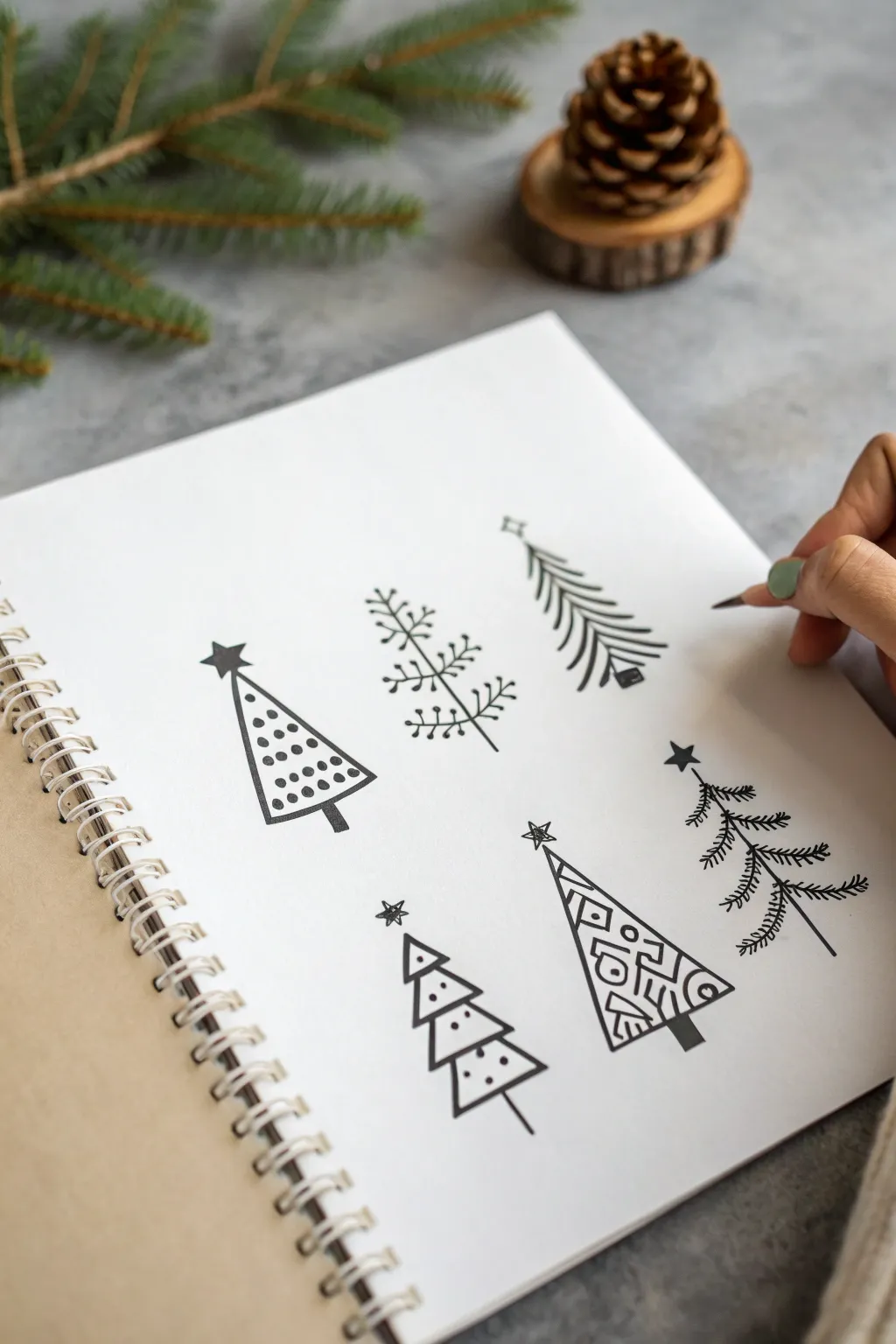
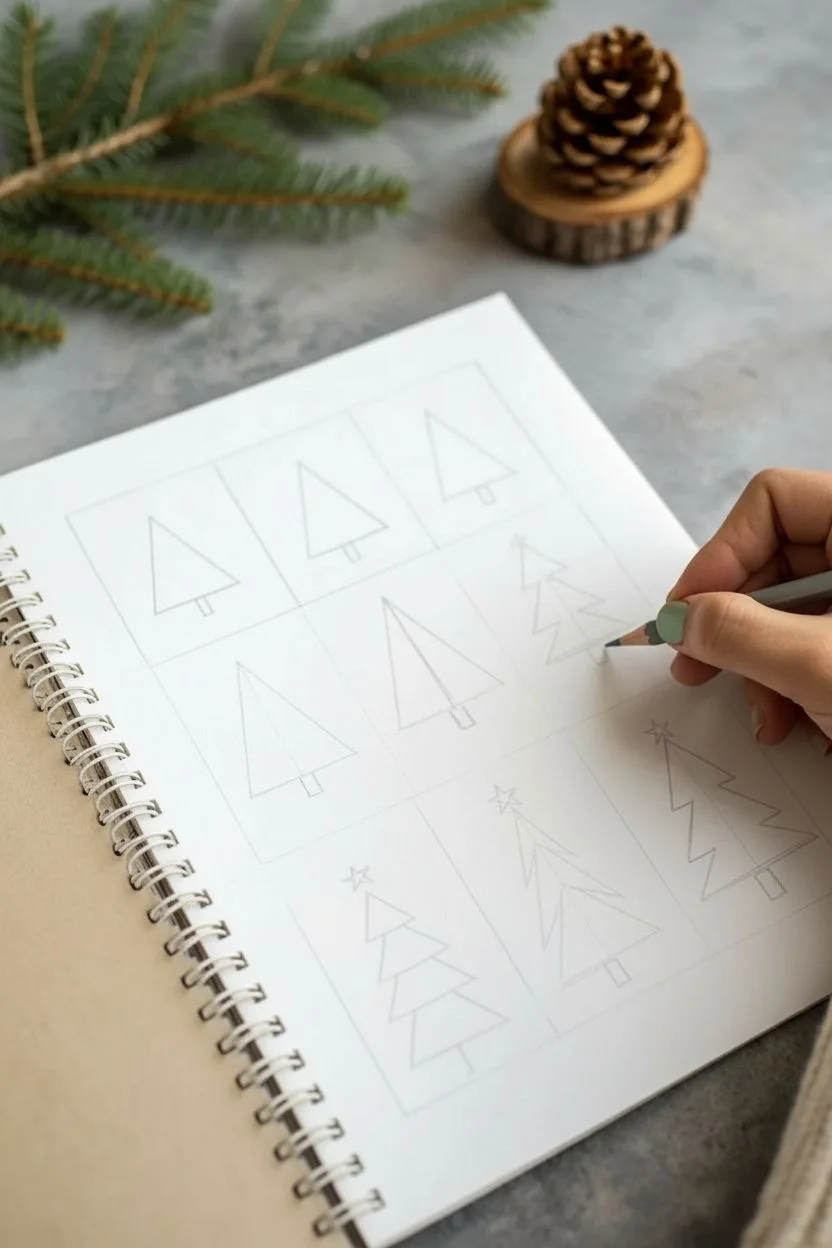
This project features six unique, stylized Christmas tree designs drawn in crisp black ink on clean white paper. It’s a perfect exercise for practicing line work and exploring different decorative patterns within a simple triangular form.
How-To Guide
Materials
- Spiral-bound sketchbook (white paper)
- Black fine-liner pens (0.3mm and 0.5mm)
- Pencil (HB or 2B)
- Eraser
- Ruler (optional)
Step 1: Planning the Layout
-
Lightly sketch the grid:
Visualize a 2×3 grid on your sketchbook page to evenly space out the six trees. You can mark these positions very faintly with a pencil to ensure they don’t crowd each other. -
Draft the basic shapes:
For each of the six spots, lightly sketch a basic triangle or a central vertical line with a pencil. This acts as the skeleton for your designs. Don’t press hard; you want these guide lines to disappear completely later.
Ink Stability
Use waterproof pigment liners (like Micron or Faber-Castell) if you plan to add watercolor later. Standard gel pens will bleed instantly.
Step 2: Drawing the Top Row
-
Design 1: The Polka Dot Triangle:
Start with the top left tree. Draw a star at the peak, then outline a long, slightly narrow triangle. Draw a short rectangular trunk at the base. -
Fill with dots:
Inside the triangle, draw rows of small, filled-in circles. Arrange them in neat horizontal lines, starting from the bottom and working your way up to the tip. -
Design 2: The Branching Twig:
Moving to the top center, draw a straight vertical line for the trunk. Instead of a solid outline, draw paired branches curving upward from the trunk. -
Add details to branches:
On each curved branch, add smaller tick marks or tiny leaves. Top this tree with a simple, three-pronged twig shape instead of a star. -
Design 3: The Curved Ribbons:
For the top right tree, draw a central spine. Starting from the top, draw swooping, curved lines outward and downward, resembling draped ribbons or heavy branches. -
Double the lines:
Add a second line parallel to each curve to give the branches visual weight. Top this one with a small, four-pointed sparkle or diamond shape.
Golden Accent
Use a metallic gold gel pen to fill in the stars or specific ornaments on the patterned trees for a festive pop of color.
Step 3: Drawing the Bottom Row
-
Design 4: The Stacked Triangles:
On the bottom left, draw three triangles stacked vertically, getting slightly larger as they go down. Leave a small gap between the tip of one and the base of the one above it. -
Decorate the tiers:
Draw three small dots inside the bottom of each triangle tier. Add a small star at the very top and a stick trunk at the bottom. -
Design 5: The Geo-Pattern:
For the bottom center tree, outline a tall triangle and a solid rectangular trunk. Top it with a five-pointed star. -
Fill with abstract shapes:
Divide the interior of the triangle into random sections using straight lines. Fill these sections with patterns like circles, stripes, triangles, and dots. I find it easiest to work from big shapes to small details here. -
Design 6: The Pine Needles:
For the final tree on the bottom right, sketch a slightly curved central trunk. Add main branches that droop slightly downward. -
Add needle texture:
Working along each branch, draw short, quick hatching lines to mimic pine needles. Make them dense for a fuller look. Top with a solid black star.
Step 4: Finishing Touches
-
Let the ink set:
Wait a few minutes to ensure the ink is completely dry. Fine-liner ink can smear easily if erased too soon. -
Erase guidelines:
Gently erase all your original pencil sketches and grid marks, leaving only the crisp black ink designs.
Now you have a charming page of varied tree designs ready to be used on holiday cards or gift tags



Ornaments With Simple Shine Lines

Capture the charm of classic holiday decor with this elegant sketchbook page featuring four distinct baubles dangling from invisible threads. By combining simple geometric shapes with purposeful line work and soft color accents, you’ll create a polished illustration perfect for bullet journals or holiday cards.
Detailed Instructions
Materials
- Spiral-bound sketchbook with smooth white paper
- Fine liner pens (Black, sizes 01 and 03)
- Colored pencils or fine-tip markers (Sage Green, Rust Orange, Warm Brown)
- White gel pen (for highlights)
- Pencil and eraser
- Ruler
Step 1: Sketching the Layout
-
Establish the Strings:
Begin by using a ruler and a light pencil touch to draw four vertical lines of varying lengths coming down from the top of the page. These will be the strings holding your ornaments, so space them out comfortably across the paper. -
Map Basic Shapes:
At the end of each string, lightly sketch the base shape for each ornament. Draw a teardrop shape on the left, an elongated spindle shape in the upper middle, a perfect circle on the right, and a slightly flattened sphere for the bottom center. -
Add Ornament Caps:
Top each shape with a small rectangular cap where the string meets the ornament. Add a tiny loop or ring connecting the string to this cap. -
Outline Pine Sprigs:
Sketch floating pine branches around the ornaments to fill the negative space. Use simple curved lines to indicate the main stems—place them near the top corners and filling the gaps between the lower ornaments.
Uneven Circles?
If freehand circles are tricky, trace a coin or bottle cap for the round ornament base. Just keep your pencil pressure very light so the guide erases easily.
Step 2: Drawing the Details
-
Detail the Teardrop Ornament:
On the left teardrop shape, draw vertical curved lines following the form of the ball to create segments. Inside alternating segments, add small circles or dots. -
Detail the Spindle Ornament:
For the upper-middle spindle shape, draw vertical contour lines that hug the curve of the shape, similar to a peeled orange. -
Detail the Round Ornament:
The right-side circle is transparent glass. Draw two simple snowflakes floating inside the circle. Add a horizontal ‘liquid level’ line near the cap if you want it to look like a filled bauble, or keep it clear as shown. -
Detail the Bottom Ornament:
Divide the bottom layered ornament into horizontal bands. Fill the top band with small triangles, the middle with a zigzag or scallop pattern, and the bottom band with large oval shapes.
Make It Sparkle
Use metallic gold or silver gel pens for the ornament caps, stars, and string lines to give the page a festive real-life shimmer.
Step 3: Inking and Coloring
-
Ink the Outlines:
Switch to your 03 fine liner. Carefully trace over your pencil lines for the ornaments and strings. Use a steady hand for the long strings, or use your ruler again with the pen. -
Ink the Pine Needles:
For the pine branches, draw short, quick strokes angling outward from the stem lines you sketched earlier. Keep the needles loose and slightly varied in length for a natural look. -
Add Decorative Stars:
Sprinkle small four-pointed stars, asterisk-style snowflakes, and tiny dots in the empty spaces around the composition to add a magical, dusty feel. -
Erase Pencil Guidelines:
Wait a moment for the ink to set completely, then gently erase all visible pencil marks. -
Color the Teardrop:
Use a sage green colored pencil to fill the teardrop ornament. Leave narrow white stripes between the colored segments to act as highlights. -
Color the Spindle:
Shade the spindle shape with rust orange. Apply more pressure near the edges and less in the center to create a sense of roundness. -
Color the Bottom Bauble:
Alternate warm brown and rust orange for the horizontal bands on the bottom ornament. Leave the background of the ovals white. -
Color the Greenery:
Go over the pine needles with a green pencil or fine marker. Drawing the green directly over the black ink lines adds depth without obscuring the drawing.
Step 4: Final Touches
-
Add White Highlights:
Use a white gel pen to add shine lines. Place curved white strokes on the upper left side of the colored ornaments to suggest a light source. -
Brighten the Dots:
I find that adding a tiny dot of white gel pen to the center of the decorative circles on the green ornament makes them pop.
Now you have a beautifully composed holiday page ready to inspire your winter journaling.

Wrapped Gifts and Bow Toppers

Capture the festive spirit with this charming collection of four hand-drawn gift doodles. Using clean lines and simple shading techniques, you’ll create a variety of box shapes and bow styles that look perfect on holiday cards or nestled in your bullet journal.
Step-by-Step
Materials
- Sketchbook or drawing paper (heavyweight preferred)
- Pencil (HB or H)
- Eraser
- Fine liner pen (0.3mm or 0.5mm)
- Ruler (optional)
Step 1: Planning and Pencil Sketches
-
Outline the Tall Box:
Start with the top-right gift. Lightly sketch a tall, vertical rectangle. Don’t worry about perfect straight lines yet; a little wobble adds character. -
Draft the Wide Box:
Move to the middle-left area. Draw a rectangular box shape that is wider than it is tall. Tilt the vertical sides slightly inward at the bottom for a subtle 3D perspective effect. -
Sketch the Big Bow Gift:
For the bottom-center gift, draw a large square. Leave distinct open space at the top center where the knot of the bow will eventually sit. -
Place the Small Square:
Finally, sketch a smaller, slightly tilted square on the right side to balance out your composition.
Wobbly Lines?
Don’t panic! If a line isn’t straight, simply go over it again lightly to thicken it intentionally. This creates a rustic ‘sketched’ style rather than a mistake.
Step 2: Inking the Outlines
-
Define the Tall Package:
Using your fine liner, trace over your tall rectangle sketch. Draw a vertical strip down the center and a horizontal strip across the middle to create the ribbon cross. -
Add the Loopy Bow:
Top the tall package with a loose, four-loop bow. Draw thin, ribbon-like loops sticking up and out, almost like palm leaves. -
Ink the Wide Box Structure:
Trace the wide rectangle. Draw the lid line horizontally near the top edge. I find it helps to extend the lid slightly past the box sides for realism. -
Design the Classic Bow:
On the wide box, draw a traditional two-loop bow. Make the knot small and round, and let the ribbon tails drape down over the front of the box. -
Outline the Big Gift:
Ink the large square shape at the bottom. Draw a very large, fluffy four-loop bow on top, making sure the loops are generous and rounded. -
Detail the Small Package:
Ink the tilted square box. Draw a thick dark cross for the ribbon, filling it in completely with black ink for contrast. -
Top the Small Box:
Add a simple, angular bow on top of the small package, keeping the shapes sharp and triangular.
Step 3: Texture and Shading
-
Pattern the Tall Box:
Add small dots randomly all over the tall package, avoiding the ribbon area. This creates a cute wrapping paper effect. -
Texture the Ribbon:
On the tall box’s ribbon, add tiny horizontal hatch marks to give it a woven texture. -
Shade the Wide Box:
Use vertical hatching lines on the sides of the wide box to suggest shadows. Keep the lines light and swift. -
Decorate the Big Gift:
For the large bottom gift, draw vertical curves on the box surface to mimic the tension of the wrapping paper. -
Shade the Big Bow:
Add curved hatching lines inside the loops of the large bow to show depth and the fold of the fabric. -
Pattern the Small Box:
Draw small, uneven polka dots on the small square package for a final playful texture. -
Clean Up:
Wait a moment for the ink to dry completely, then gently erase all your initial pencil guidelines to reveal the crisp doodle.
Make it Pop
Use a white gel pen to add tiny highlights on the black ribbons or in the center of the wrapping paper dots for extra dimension.
Now you have a festive set of gift illustrations ready to decorate your holiday stationery

Candy Canes, Peppermints, and Stripes

These festive peppermint and candy-themed doodles bring a burst of holiday cheer to your art journal with minimal effort. By combining simple geometric shapes with classic Christmas colors, you’ll create a spread that looks intricate but relies on clever repetitive patterns.
Step-by-Step Tutorial
Materials
- Spiral-bound sketchbook or journal
- Red ink pad (dye-based or pigment)
- Green ink pad (soft sage or mint tone)
- Clear acrylic stamping blocks
- Peppermint swirl stamps (various sizes)
- Snowflake stamps
- Geometric tree stamps
- Fine-point red felt tip pen (for hand-drawn details)
- Pencil (optional for layout)
- Scrap paper for testing
Step 1: Planning the Layout
-
Test your colors:
Before touching your journal, stamp your red and green inks onto a scrap piece of paper. You want to make sure the red is vibrant and candy-like, while the green should have that vintage, minty quality seen in the photo. -
Visualize the composition:
Visualize the right-hand page as your main canvas. The goal is a scattered ‘confetti’ look rather than neat rows. Imagine where your largest elements—the big peppermint swirls—will sit first to anchor the page.
Step 2: Stamping the Peppermints
-
Start with the large red swirl:
Ink up your largest peppermint swirl stamp with the red ink. Press it firmly near the top right corner of the page. Apply even pressure so the spiral lines come out crisp without bleeding. -
Add a contrasting mint swirl:
Clean your stamp or switch to a different swirl pattern. Ink it with your green pad and place it to the left of your first red one. This establishes the color palette immediately. -
Create a lower focal point:
Stamp another large red peppermint swirl near the bottom middle of the page. This creates a visual triangle when combined with the top elements, balancing the layout. -
Fill the gaps with medium swirls:
Using a slightly smaller swirl stamp, add a red peppermint to the middle right edge. Varying the orientation of the swirls makes them look like they were tossed onto a table.
Stamp Blotches?
If a stamped image comes out too blotchy, your ink pad might be too juicy. Blot the stamp on scratch paper once before hitting your final page to get clearer lines.
Step 3: Adding Festive Accents
-
Stamp the green circle:
Ink a simple solid circle stamp with your green ink. Place this near the center of the page. The solid block of color provides a nice visual rest from all the busy spiral lines. -
Plant the trees:
Take a small triangle or stylized tree stamp. Ink it green and place one near the top right (angled slightly) and another near the bottom center. These triangular shapes break up the roundness of the candies. -
Stamp red snowflakes:
Using a bold, thick-lined snowflake stamp and red ink, place a snowflake in the middle of the page. The stark geometric lines contrast beautifully with the organic swirls. -
Add delicate green flakes:
Select a finer, more spindly snowflake stamp. Ink it green and place it in the lower right corner and another near the middle. These lighter elements add depth to the background.
Visual Balance
Work in triangles. When placing a color or shape (like the green trees), try to place them in threes, forming a rough triangle across the page for natural flow.
Step 4: Refining and Detail Work
-
Add tiny fillers:
Use a very small circle or dot stamp to fill in empty white spaces. A small red dotted circle works well in the lower right area to mimic a cookie or small candy. -
Start the left page:
Instead of filling the left page entirely, replicate the design only in the bottom left corner. Stamp one large red swirl and a small red starburst shape. -
Keep the left page open:
Leave the vast majority of the left page blank. This negative space is crucial; it makes the notebook feel ready for use and draws the eye to your decorated corners. -
Check for distressing:
If your stamps didn’t print perfectly solid, that’s actually perfect. Looking at the reference, the slightly ‘distressed’ or textured look adds to the vintage charm, so don’t try to fix patchiness. -
Clean up edges:
If you accidentally got ink on the spiral binding or the table, wipe it up quickly. I prefer to use a baby wipe for this as it lifts dye ink easily. -
Let it dry:
Allow the ink to dry completely before closing the book, or place a piece of scrap paper between the pages to prevent the red ink from transferring to the facing page.
Now you have a delightfully sweet spread ready for your holiday notes or wish lists

PENCIL GUIDE
Understanding Pencil Grades from H to B
From first sketch to finished drawing — learn pencil grades, line control, and shading techniques.
Explore the Full Guide
Snowflakes From Basic Shapes
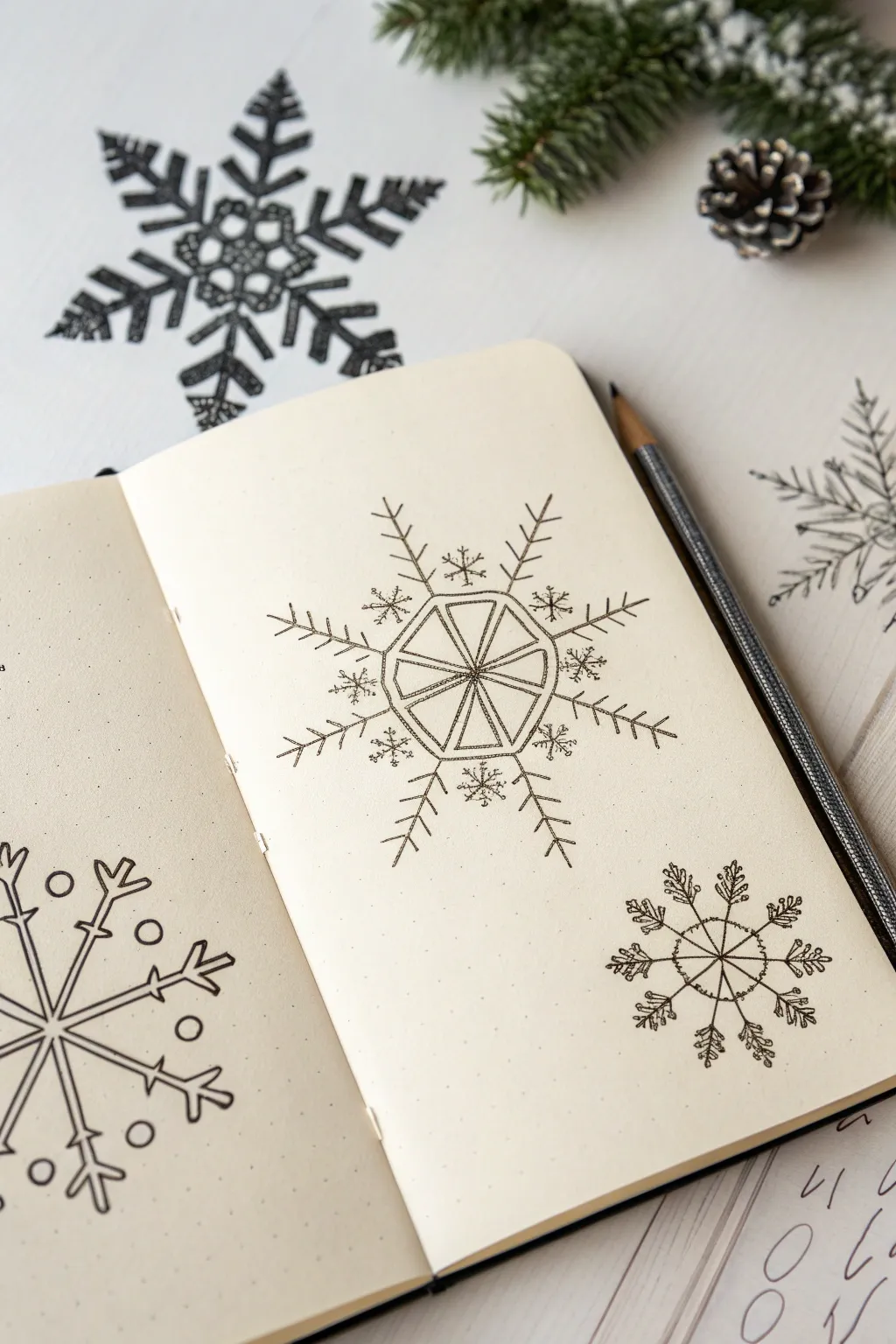
Break away from traditional lacy snowflakes by constructing this bold, geometric variation directly in your bullet journal. Using a simple hexagonal core, you can build outward to create a structured yet festive winter motif that looks crisp and modern.
Step-by-Step Guide
Materials
- Dot grid sketchbook or journal
- Fine liner pen (0.3mm or 0.5mm)
- Pencil
- Eraser
- Ruler (optional, but helpful for the core)
Step 1: Building the Hexagonal Core
-
Mark the center:
Start by identifying a central point on your dot grid paper. This will be the anchor for your entire snowflake design. -
Plot the hexagon points:
Count two or three dots out from the center in six directions to form a hexagon shape. Imagine a clock face and place dots roughly at 12, 2, 4, 6, 8, and 10 o’clock positions. -
Draw the hexagon outline:
Connect these six outer points with straight lines to create a perfect hexagon. Double-check your symmetry using the grid dots as a guide. -
Create the inner structure:
Draw straight lines from each corner of the hexagon directly to the center point. This creates six equal triangular sections like pie slices. -
Add the inner detail:
Sketch a smaller hexagon inside the first one, about halfway between the center point and the outer edge. This creates a framed window effect within each triangular ‘slice’.
Step 2: Extending the Arms
-
Draw the main spokes:
Extend a straight line outwards from each of the six corners of your main hexagon. Make these lines about twice the length of the distance from the center to the hexagon edge. -
Add the arrow fletching:
On each of these six long spokes, draw small V-shapes pointing outward. Place three V-shapes on each spoke, spacing them evenly as you move away from the center. -
Close the tips:
Just past the final V-shape on each spoke, draw a tiny line perpendicular to the spoke to cap it off neatly.
Wobbly Lines?
Don’t stress if your hexagon isn’t perfect. Embrace the ‘hand-drawn’ look by going over lines twice loosely. This sketchy style hides unevenness.
Step 3: Adding Delicate Accents
-
Position the floating stars:
Look at the spaces between the six main spokes. Locate the midpoint of the flat edge of your central hexagon between the spokes. -
Draw the star stems:
From those midpoints, draw a short line extending outward. These should be shorter than your main spokes, reaching only about halfway out. -
Add asterisk details:
At the tip of each short stem, draw a tiny asterisk or star shape. Keep these delicate to contrast with the bold geometric center. -
Emphasize the core:
Go back to your central hexagon and darken the inner ‘window’ frames slightly to give the center more visual weight and solidity.
Level Up
Use a light grey fineliner for the background snowflakes and a bold black pen for the main one to create instant depth and perspective.
Step 4: Refining and Finalizing
-
Check for balance:
Take a moment to look at the snowflake as a whole. If any lines look too faint, carefully retrace them to match the line weight of the rest of the drawing. -
Erase guide marks:
I always wait at least five minutes for the ink to fully set before erasing any pencil sketches underneath to prevent smearing. -
Add surrounding doodles (optional):
If you have empty space on the page, sketch smaller, simplier snowflakes nearby—like the starburst shape seen in the bottom corner—to create a falling snow effect.
Now you have a structured, icy centerpiece ready for your winter journal spread
Stockings on a Cozy Mantel Line

Capture the anticipation of Christmas morning with this charming illustration of four unique stockings strung up on a clothesline. This project uses simple fine-line drawing techniques paired with soft coloring to create a cozy, vintage-style holiday card or decoration.
Step-by-Step Tutorial
Materials
- Heavyweight textured cardstock (cream or off-white)
- Fine liner pen (black, 0.3mm or 0.5mm)
- Colored pencils or alcohol markers (muted red, beige, tan, pink)
- Pencil and eraser
- Ruler
Step 1: Setting the Scene
-
Draw the clothesline:
Start by drawing a gentle, swooping horizontal line across the upper third of your cardstock. It shouldn’t be perfectly straight; a slight dip in the middle makes it look like it’s holding weight. -
Position the stockings:
Lightly sketch four vertical rectangles hanging from the line to act as placeholders for your stockings. Space them evenly apart, but leave a little extra room on the far left for the holly decoration. -
Sketch the clothespins:
At the top of each rectangle, sketch a small, narrow rectangle that overlaps the string. These will become the wooden clothespins holding the stockings in place.
Ink Smudges?
If you accidentally smudge wet ink, turn it into a deliberate shadow or pattern. Wait longer than you think before erasing pencil lines.
Step 2: Defining shapes
-
Outline the first left stocking:
Working from left to right, flesh out the first stocking. Give it a wide, ribbed cuff at the top and a classic boot shape with a rounded toe and heel. -
Outline the second stocking:
Draw the second stocking slightly longer and slenderer than the first. Add a cuff, but make the foot part angle slightly differently to give the line variety. -
Outline the striped stockings:
For the third and fourth stockings, create simple sock shapes. I like to make the fourth one appear a bit more stretched, as if it’s heavy with treats. -
Add the holly sprig:
On the far left end of the string, sketch three small circles for berries. Draw spiky, classic holly leaves radiating out from the berries.
Step 3: Inking the Details
-
Ink the main lines:
Using your fine liner pen, carefully trace over your pencil lines. Don’t worry about being too perfect; a slightly shaky line adds to the hand-drawn doodle aesthetic. -
Detail the first stocking:
Draw vertical lines inside the cuff of the first stocking for a ribbed texture. Fill the main body with small, scattered polka dots. -
Pattern the second stocking:
On the second stocking, draw vertical stripes on the cuff. For the body, add rows of tiny dots. Draw a defined heel and toe cap area. -
stripe the third stocking:
Create horizontal stripes all the way down the third stocking. Make the heel and toe distinct separate sections. -
Pattern the fourth stocking:
Draw long, vertical pinstripes down the length of the final stocking. This elongates the shape nicely. -
Erase pencil guides:
Once the ink is completely dry to the touch, gently erase all underlying pencil sketches to clean up the artwork.
Make It Sparkle
Use a clear glitter gel pen on the stocking cuffs or the holly berries. It adds a festive shimmer that catches the light nicely.
Step 4: Adding Color
-
Color the heels and toes:
Use a muted red or rust-colored pencil to fill in the heel and toe patches on the third and fourth stockings. Keep the pressure light to maintain a vintage look. -
Add spot color to patterns:
Use a soft pink or beige pencil to color in the polka dots on the first two stockings. You can also shade alternating stripes on the third stocking with a very light tan. -
Color the clothespins:
Lightly shade the clothespins with a tan or yellow-ochre pencil to mimic wood. -
Finish the holly:
Color the berries a deep red and use a sage green for the holly leaves. Shading just the edges of the leaves keeps the look delicate. -
Final shading touch:
Add a tiny bit of grey shading along one side of each stocking to give them just a hint of dimension against the paper background.
Now you have a delightful piece of holiday art ready to display or send to a friend
BRUSH GUIDE
The Right Brush for Every Stroke
From clean lines to bold texture — master brush choice, stroke control, and essential techniques.
Explore the Full Guide
Wreaths Built From One Circle
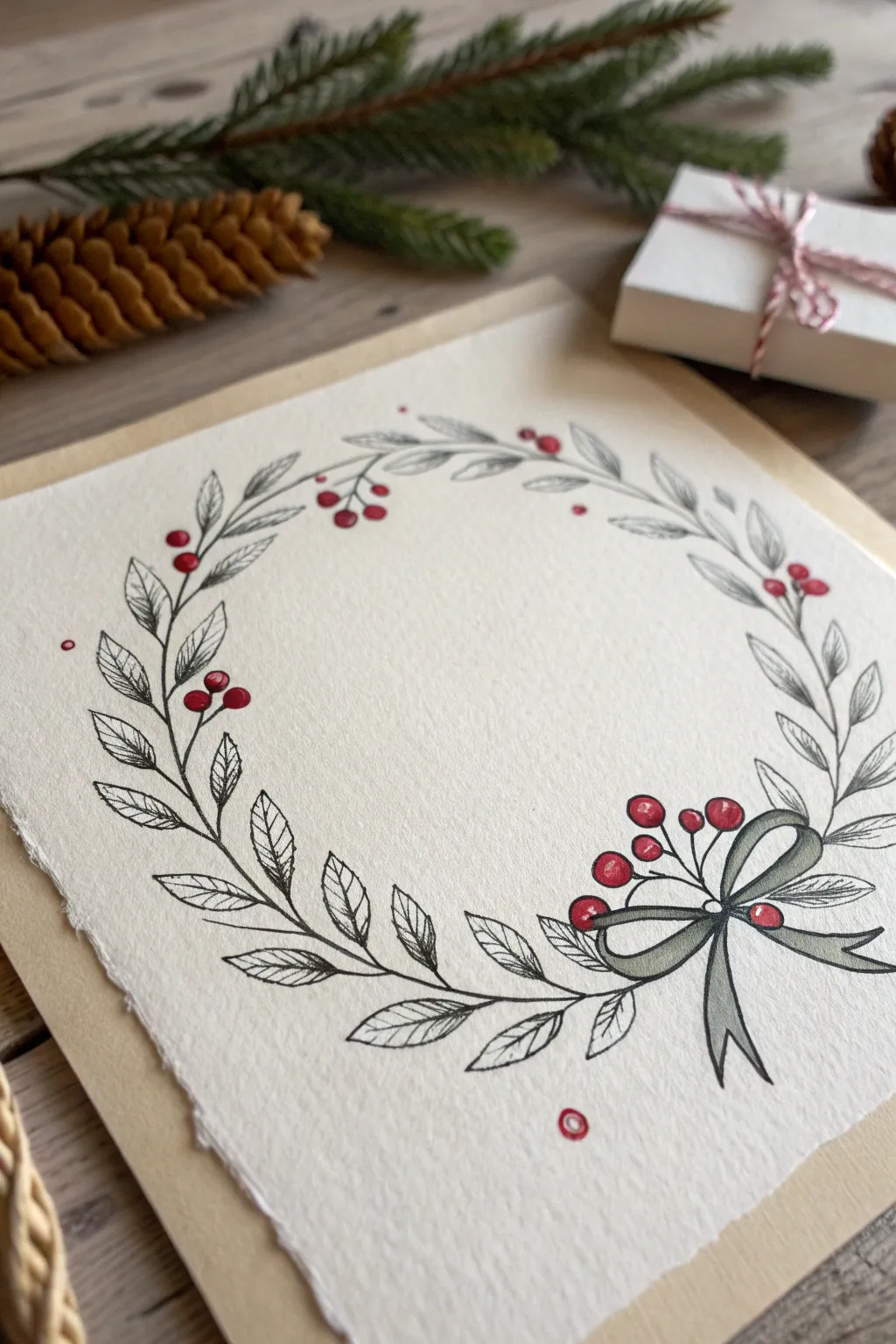
This delicate wreath combines the precision of fine ink linework with soft touches of watercolor for a sophisticated holiday card design. The open, airy structure allows the beautifully textured paper to shine through, focusing attention on the festive red berries and dark green bow.
Detailed Instructions
Materials
- Cold-pressed watercolor paper (heavyweight, textured)
- Fine liner pen (waterproof, 0.1mm or 0.3mm, black)
- Pencil (HB or 2H)
- Art eraser (kneaded ideal)
- Watercolor paints (bright red, deep green)
- Round watercolor brush (size 2 or 4)
- Circular object or compass for tracing
- Cardstock or kraft paper for mounting (optional)
Step 1: Planning the Structure
-
Trace the foundation:
Begin by lightly tracing a circle onto your watercolor paper using a circular object or compass. This faint guideline will ensure your wreath stays perfectly round but won’t be part of the final drawing. -
Mark the bow placement:
Decide where the bow will sit—in this design, it’s placed in the lower right quadrant. Sketch a rough X shape there to reserve space so you don’t accidentally draw leaves through it later. -
Sketch the primary vine:
Using your pencil, sketch a single, continuous vine following your circle guide. Let it weave slightly in and out of the perfect circle line to make it look organic rather than mechanical.
Ink Confidence
Don’t stress if your ink lines aren’t perfectly straight. A slightly shaky hand actually mimics natural textures better than rigid lines when drawing organic leaves and branches.
Step 2: Inking the Botanical Elements
-
Start the main stem:
Switch to your waterproof fine liner. Carefully go over your vine sketch, using a slightly broken or uneven line weight to mimic the texture of a real branch. -
Draw the leaf outlines:
Begin adding leaves along both sides of the stem. Group them in pairs or alternating patterns. Shape them like elongated ovals with pointed tips, keeping them relatively uniform in size. -
Add detail to the leads:
Draw a central vein down the middle of each leaf. Then, add tiny, quick hatching lines branching from the center vein to create shading and texture. -
Define the bow:
Draw the outline of the bow where you reserved space. Create two loops and two trailing tails. Keep the lines clean, but give the ribbon ends a little curve to show movement. -
Ink the berry clusters:
Draw small circles in clusters of two or three along the vine. I find it looks best to place these near the base of leaf groupings. Don’t shade them with ink; leave them open for the paint.
Step 3: Adding Color & Finishing
-
Erase pencil guides:
Wait until the ink is completely dry to avoid smudging. Gently run your kneaded eraser over the entire design to lift the pencil circle and sketch lines. -
Paint the berries:
Load your small brush with a bright, festive red watercolor. Carefully fill in the berry circles. Leave a tiny speck of white paper unpainted on one side of each berry to simulate a highlight. -
Paint the loose dots:
Add a few stray red dots floating near the wreath, as seen on the left side and bottom. This adds a whimsical, confetti-like effect. -
Color the bow:
Mix a deep, muted green watercolor. Paint the bow loops and tails. Try to make the color darker near the center knot and lighter on the loops to show dimension. -
Add bow highlights:
While the green paint is still wet, lift a little pigment from the top of the loops with a dry brush, or leave a sliver of white paper exposed for a shine. -
Create the torn edge effect:
If you want the rustic look shown in the example, place a ruler against the edge of your paper. Wet the paper along the ruler’s edge with clear water, wait a moment, and gently tear the strip off to create a soft, decked edge. -
Mount the artwork:
Adhere your finished watercolor piece onto a larger sheet of kraft or tan cardstock to frame it beautifully.
Go Metallic
Swap the standard watercolors for metallic gold paint on the bow or the berries for an extra luxurious, shimmering holiday card.
Now you have a timeless, hand-drawn wreath ready to grace a gift tag or holiday card
Santa Hat Minis for Corner Decor
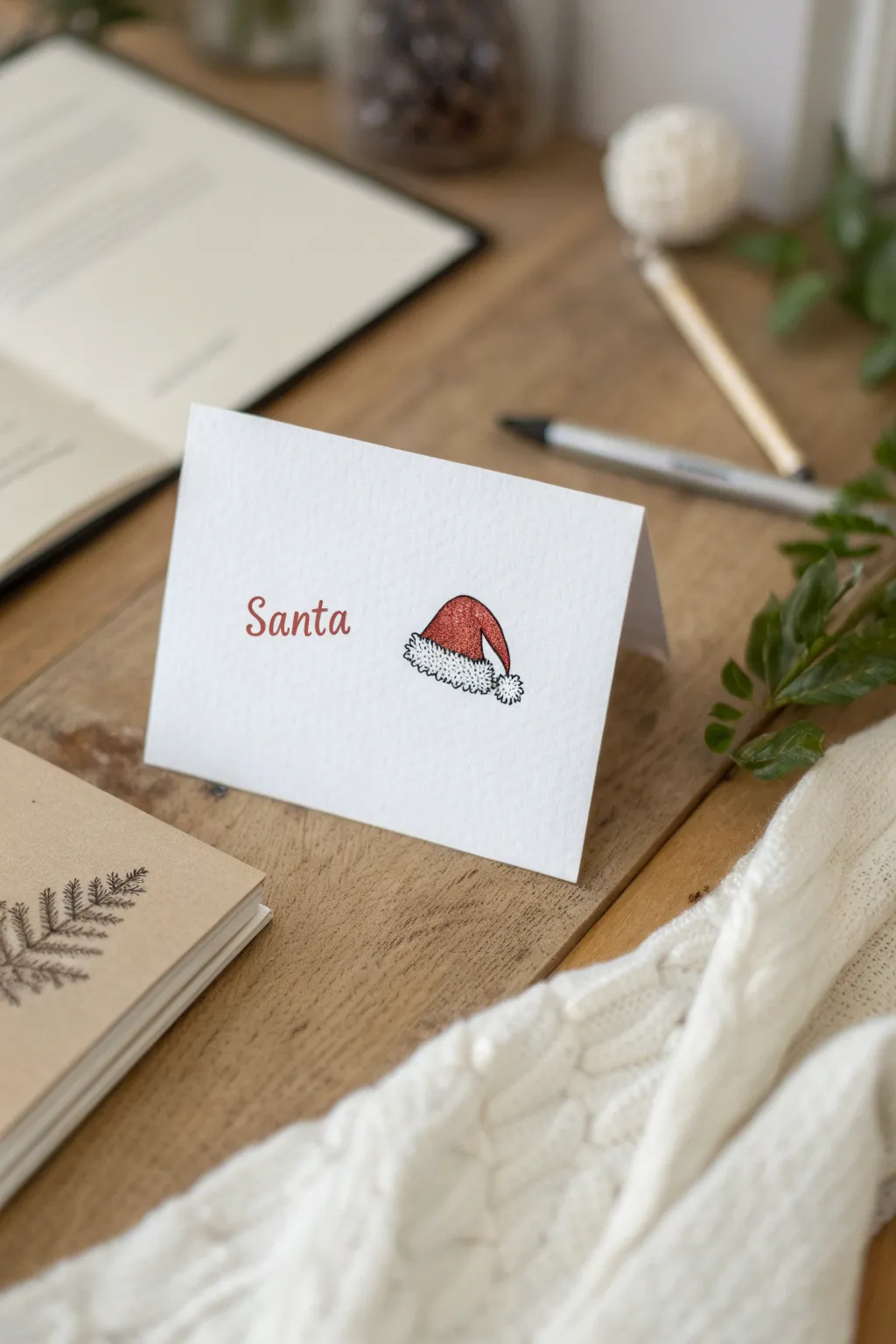
Add a festive touch to your holiday table with these charming, minimalist place cards featuring a hand-lettered name and a tiny, textured Santa hat. The combination of clean lines, red ink, and a touch of sparkle makes these cards feel both modern and cozy.
Step-by-Step
Materials
- Heavyweight white watercolor paper or cardstock (cold press recommended for texture)
- Fine-point black drawing pen (0.1mm or 0.3mm)
- Red gel pen or fine-tipped red marker
- Red watercolor paint or gouache
- Small round paintbrush (size 0 or 2)
- White gel pen or white gouache (optional highlights)
- Clear glitter glue or stickles
- Ruler
- Pencil and eraser
- Bone folder (optional)
Step 1: Preparation & Layout
-
Cut the base:
Begin by cutting your heavyweight paper into rectangular strips that measure approximately 4 inches by 3 inches. -
Score and fold:
Measure the midpoint of the long side and lightly score a line across the center. Fold the card in half to create a tent shape that stands on its own. Use a bone folder to crisp up the crease. -
Positioning elements:
Lightly sketch the word ‘Santa’ (or your guest’s name) on the left side of the card front using a pencil. Leave enough space on the right for the hat illustration. -
Sketch the hat:
To the right of the name, pencil in a small Santa hat shape. Start with a fluffy cloud shape for the trim, a curved triangle for the hat body, and a pom-pom circle at the very tip.
Step 2: Lettering & Outlining
-
Ink the name:
Using your red gel pen or marker, carefully trace over your penciled lettering. A simple, rounded sans-serif style works beautifully here. -
Thicken the strokes:
Go back over the downstrokes of your letters to add just a tiny bit of weight, making the text stand out clearly against the white background. -
Outline the hat trim:
Switch to your fine-point black drawing pen. Draw the fluffy white trim at the base of the hat using short, erratic scribbles or loops to simulate fur texture. -
Outline the hat body:
Draw the main body of the hat with a smooth black line, slightly curving the tip downwards to the right. -
Outline the pom-pom:
Use the same scribbly, looped motion from the trim to outline the round pom-pom at the hat’s tip. -
Erase guidelines:
Once the ink is completely dry—give it a few minutes to be safe—gently erase all visible pencil marks.
Ink Smearing?
If your red writing smears when erasing pencil marks, switch to a waterproof archival ink pen or wait at least 15 minutes before erasing.
Step 3: Painting & Coloring
-
Prepare red paint:
Mix a vibrant, true-red watercolor or gouache on your palette. You want a consistency that isn’t too watery so the color stays opaque. -
Fill the hat:
Carefully paint the interior of the hat body red, staying neatly within your black outlines. Leave the trim and pom-pom white. -
Add shading (optional):
While the red paint is still damp, I like to drop a tiny bit of darker red or purple near the fold of the hat to create dimension. -
Texture the white:
If your paper is very smooth, use a stippling motion with a clean, barely damp brush on the white areas to rough up the paper fibers slightly for texture.
Level Up: Flocking
Instead of glitter, apply liquid glue to the white trim and sprinkle on white embossing powder or flocking powder for a fuzzy, 3D texture.
Step 4: Finishing Touches
-
Apply glitter:
Once the red paint is dry, apply a layer of clear glitter glue or stickles over the red part of the hat for a subtle shimmer. -
Dot the trim:
Add tiny dots of the glitter glue to the white trim and pom-pom as well to make the ‘fur’ sparkle. -
Final drying:
Set the cards aside in a dust-free area to dry completely flat before standing them up.
Set these cheerful little cards at each plate to welcome your guests with festive warmth


Gingerbread Characters With Icing Details
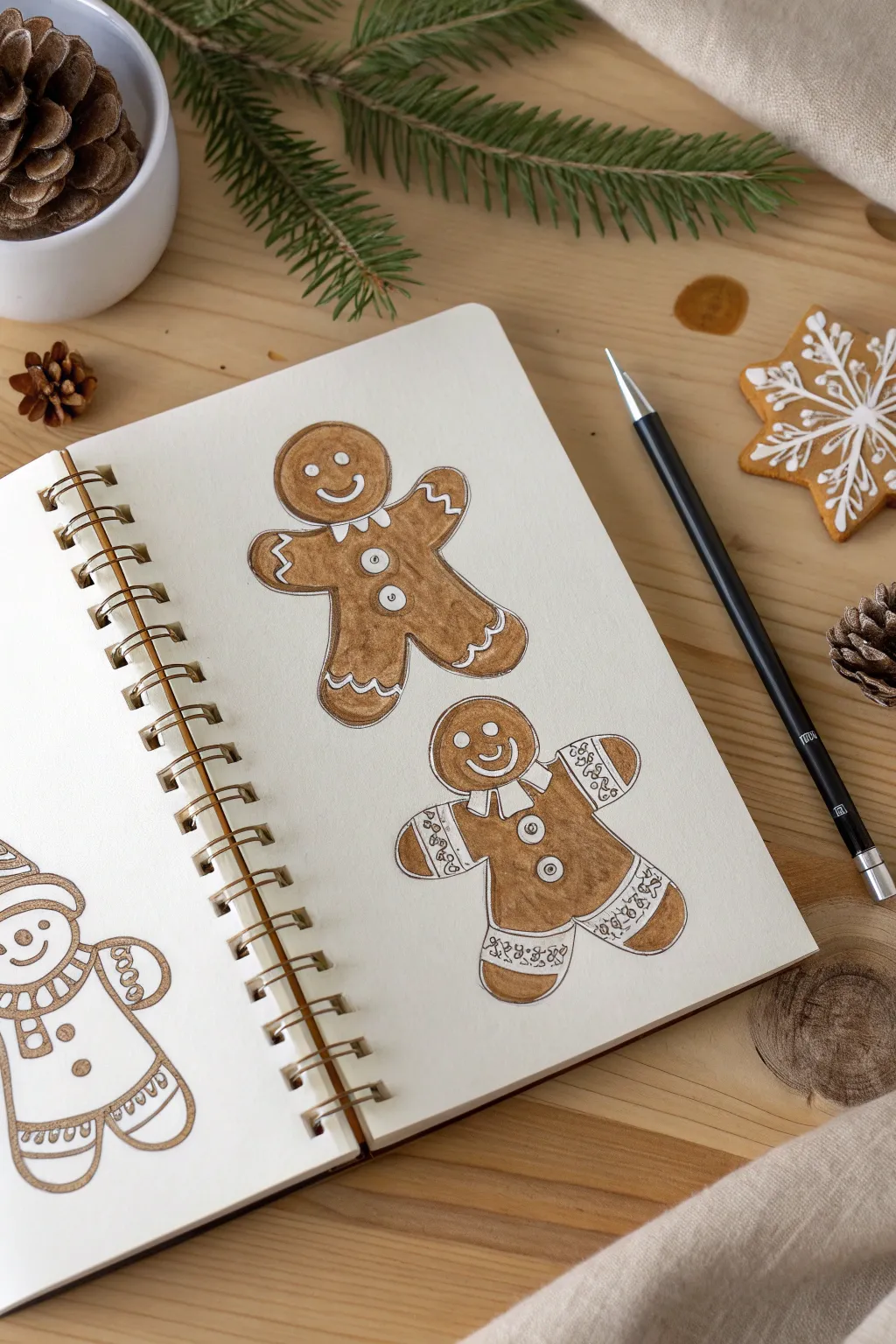
Capture the cozy charm of holiday baking without even turning on the oven with these adorable gingerbread character sketches. Using simple shapes and clever white pen details, you’ll create illustrations that look good enough to eat right on the page.
Detailed Instructions
Materials
- Sketchbook or drawing paper (heavyweight preferred)
- Pencil for sketching
- Eraser
- Brown alcohol-based markers (medium gingerbread tone)
- White or ivory gel pen (opaque)
- Fine liner pen (brown or black, optional)
Step 1: Sketching the Base Shapes
-
Draw the head:
Start by drawing a simple circle for the gingerbread man’s head. It doesn’t need to be perfectly round; a slight oval shape adds character. -
Add the body:
Below the head, sketch a rounded body shape. Imagine a soft, slightly squashed oval that is wider at the bottom than the top. -
Attach the limbs:
Extend two arm stumps outward from the upper body and two leg stumps from the bottom. Keep the ends rounded and knobby, just like a real cookie that has expanded in the oven. -
Refine the outline:
Go over your sketch to connect the limbs to the body smoothly, creating one continuous cookie outline. Erase any intersecting lines between the head and body so it looks like a single piece of dough.
Ink Not Showing?
If the white gel pen absorbs into the marker and disappears, wait for the brown ink to dry completely. A second layer of white usually fixes opacity issues.
Step 2: Coloring the Dough
-
Fill the base color:
Using your brown alcohol marker, color in the entire shape of the gingerbread man. Use long, even strokes to minimize streakiness. -
Layer for texture:
Once the initial layer is dry, I like to go back over the edges with the same brown marker. This darkens the perimeter, mimicking the way real cookies brown slightly more at the edges. -
Add baked spots:
For extra realism, add a few tiny dots or dabs of the brown marker on the face and tummy to suggest texture in the baked surface.
Step 3: Adding the Icing Details
-
Test your white pen:
Before drawing on your work, scribble your white gel pen on a scrap piece of paper to ensure the ink is flowing smoothly. -
Draw the face:
Draw two small circles for eyes and a wide, U-shaped curve for the smile. You can add little cheek marks at the corners of the mouth for a cheery expression. -
Decorate the cuffs:
Using the white pen, draw squiggly lines or scallops across the wrists and ankles. These ‘icing’ lines separate the hands and feet from the rest of the body. -
Add buttons:
Draw two or three vertically aligned circles down the center of the chest for gumdrop buttons. You can add a tiny dot in the center of each for dimension. -
Create variation:
For the second gingerbread man, try a different pattern. Draw a collar made of two triangles, or decorate the arms with tiny hearts or zig-zags instead of simple lines.
Cookie Texture Tip
Use a colored pencil in a slightly darker brown shade to lightly shade the edges over the marker base. It creates a soft, crumbly ‘baked’ look.
Step 4: Final Touches
-
Highlight the edges:
Use a white pencil or a very faint touch with the white gel pen to add a subtle highlight on the upper left curve of the head and limbs. -
Add shadows:
If you want the drawing to pop off the page, use a light grey marker or pencil to draw a thin shadow line along the right and bottom edge of the cookie. -
Clean up:
Once the white ink is completely dry, gently erase any visible pencil marks from your initial sketch that might be showing through.
Now your sketchbook is filled with the sweetest holiday treats that will never go stale
Reindeer Faces With Antler Styles
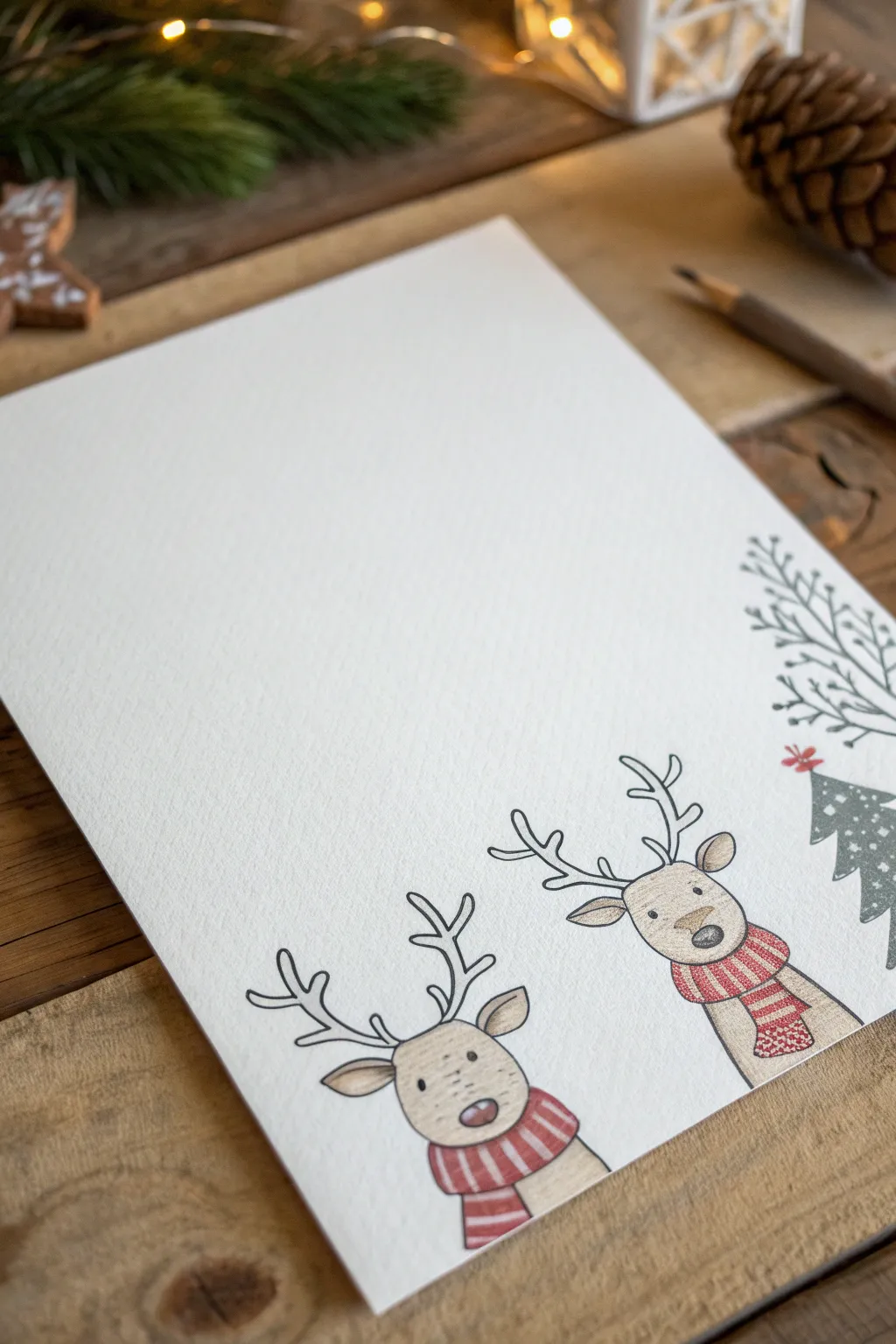
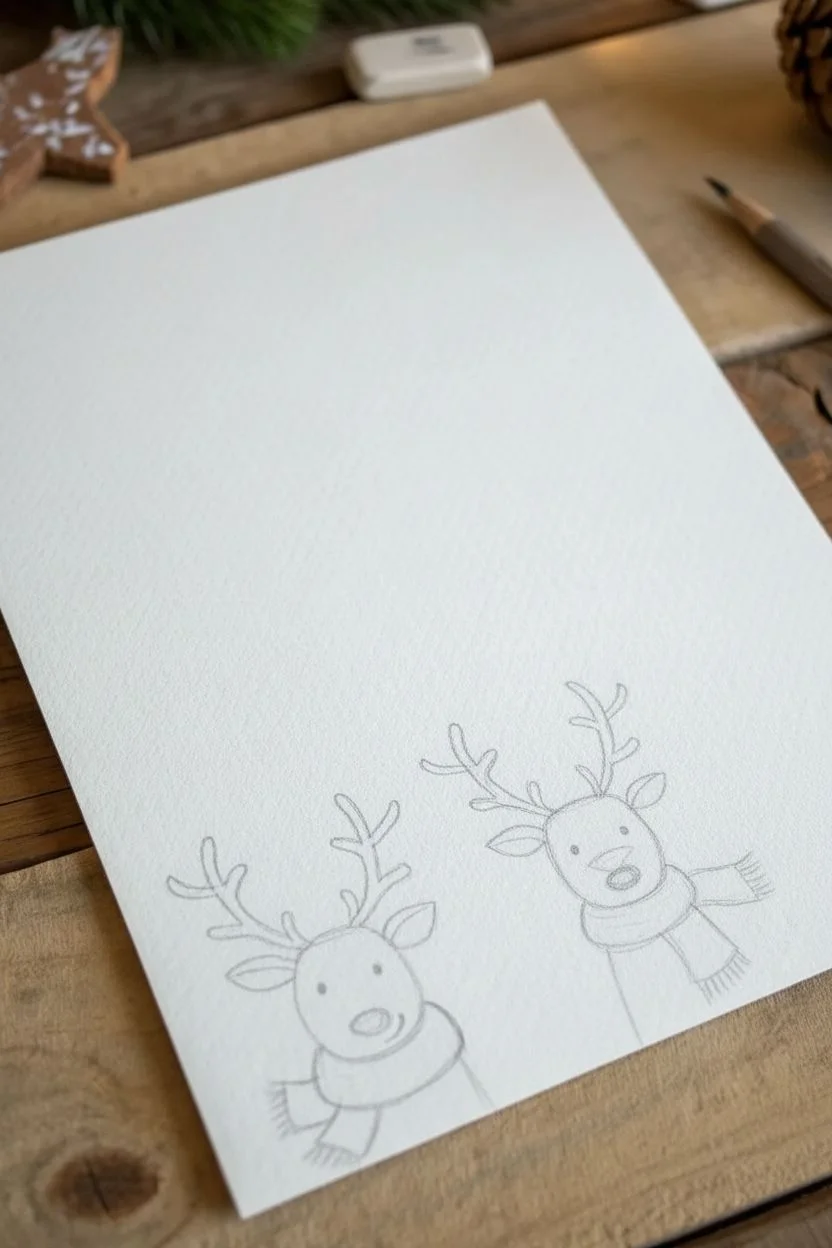
Create your own adorable holiday stationery with this sweet doodle project featuring two friendly reindeer bundled up in striped scarves. The design combines simple line art with soft coloring for a heartwarming, handmade look perfect for letters to Santa or holiday greetings.
Step-by-Step Guide
Materials
- Heavyweight drawing paper or cardstock (white)
- Fine-liner pen (black, size 0.3mm or 0.5mm)
- Colored pencils (light brown, red, dark green)
- Graphite pencil (HB for sketching)
- Eraser
- Ruler (optional)
Step 1: Sketching the Reindeer
-
Establish placement:
Begin by deciding where your reindeer will sit. Aim for the bottom right corner of your paper, leaving plenty of white space above for writing. Lightly sketch two oval shapes side-by-side for the heads using your pencil. -
Draw the ears:
Add leaf-shaped ears to the sides of each oval head. Position them slightly high on the head so they perk up cheerfully. -
Add the antlers:
Sketch the antlers emerging from the top of the head using branch-like lines. For the left reindeer, curve the main beam outward and add 3-4 smaller tines. Repeat this for the right reindeer, but perhaps make the antlers slightly taller. -
Define the faces:
Draw widely spaced dots for eyes to create a cute, innocent expression. Add an oval nose in the center of the lower face area, and a small curved line for a mouth on the left reindeer. -
Wrap them in scarves:
Draw a thick band just under each chin for the scarf. Add trailing ends hanging down—one short end on the left deer, and slightly longer ends on the right deer to create variety.
Ink Confidence
If your hand shakes while inking, try ‘ghosting’ the line (moving your hand over the paper without touching it) a few times before committing to the stroke.
Step 2: Inking the Outlines
-
Trace with ink:
Take your black fine-liner pen and carefully trace over your pencil lines. Keep your hand steady but allow for slight imperfections, which add to the doodle charm. -
Add scarf details:
Draw vertical or horizontal stripes inside the scarf shapes using your pen. Vary the stripe width slightly to make them look like cozy knitwear. -
Refine the antlers:
Go over the antler lines. I like to thicken the base of the antlers just a tiny bit where they connect to the head for a more organic look. -
Erase guidelines:
Wait at least five minutes for the ink to be completely dry to the touch, then gently erase all visible pencil marks.
Make It Pop
Use a white gel pen to add tiny highlights to the reindeer’s eyes and noses after coloring. It instantly brings the characters to life.
Step 3: Adding Color and Background
-
Color the fur:
Using a light brown colored pencil, gently shade the reindeer heads and bodies. Use a very light touch in the center of the face and press slightly harder near the edges to create subtle dimension. -
Fill in the scarves:
Color every other stripe on the scarves with a red pencil. Leave the alternating stripes white or shade them very lightly with grey for a classic candy-cane look. -
Rosy cheeks and noses:
Add a small circle of pink or light red to the cheeks. For the noses, color the left one reddish-brown and the right one a dark grey or black. -
Sketch the side foliage:
Along the right edge of the paper, above the reindeer, draw a simple fir tree shape using triangles and a taller, bare branch shape reaching upward. -
Color the greenery:
Fill the fir tree with a muted dark green pencil. Add small white dots using a gel pen or by leaving negative space to suggest snow. -
Final touches:
Using your fine-liner, add small texture lines (little dots or dashes) on the reindeer faces to suggest freckles or fur texture.
Now you have a charming piece of custom stationery ready for your holiday correspondence
Snowmen With Mix-and-Match Accessories

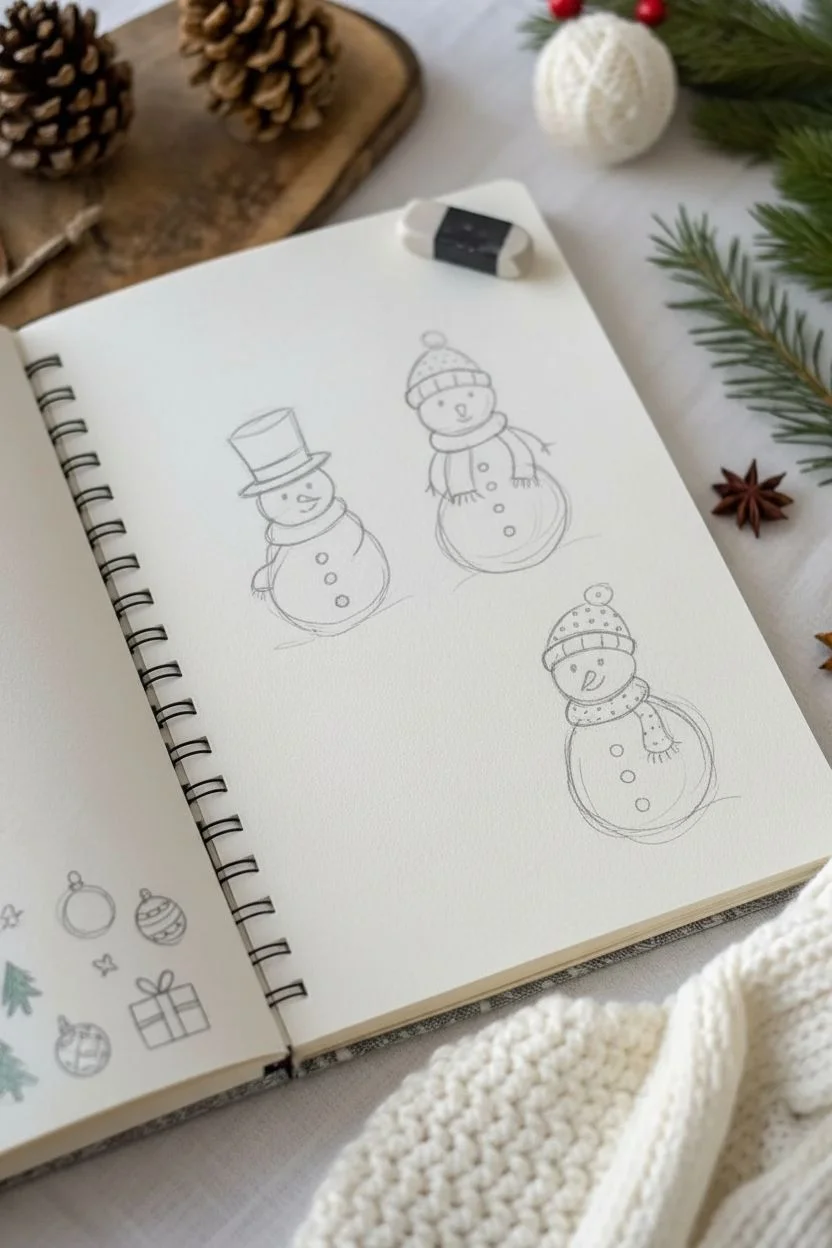
Create a charming page of holiday character studies with these customizable snowman doodles. This simple pen-and-ink project features three distinct personalities created by swapping hats and scarves, accompanied by tiny festive fillers.
Detailed Instructions
Materials
- Sketchbook with smooth paper
- Pencil (HB or 2H)
- Eraser
- Black fine liner pen (0.3mm or 0.5mm)
- Red fine liner or gel pen
- Green fine liner or gel pen
- Light blue/grey fine liner (optional for details)
Step 1: Planning Sketches
-
Lay out the shapes:
Begin by lightly sketching the basic body shapes for three snowmen in pencil. Draw two circles for each figure—a smaller one for the head and a larger one for the body—leaving plenty of space between them for accessories. -
Sketch the hats:
For the top left snowman, draft a tall top hat. For the top right figure, sketch a rounded beanie with a pom-pom. For the bottom right snowman, create a patterned knit cap that sits snugly on the head. -
Add accessories and fillers:
Complete the pencil draft by adding scarves to each snowman. In the empty space at the bottom left, sketch small icons like ornaments, pine trees, and a gift box to fill the composition.
Smudge Prevention
Red ink takes longer to dry than black. Work from left to right (if right-handed) to avoid smearing your fresh colors.
Step 2: Inking the Top Left Snowman
-
Outline the head and hat:
Using your black fine liner, trace the top hat. Fill in the band area with red ink later, but for now, keep the main shapes clean. Draw the head outline beneath the brim. -
Draw the scarf:
Ink the scarf wrapped snugly under the chin. Extend the tail of the scarf down the left side of the body. -
Add facial features:
Dot two eyes and a series of smaller dots for a coal smile. Add a small carrot nose pointing to the left. -
Texture the scarf:
Use your red pen to add texture to the scarf. I like to use small, dense scribbles or hatching lines to simulate a woolly texture rather than solid coloring. -
Final body details:
Ink the round body shape and add three distinct buttons down the center. Draw two simple stick arms near the bottom for a playful look.
Pattern Variety
Make each snowman unique by varying the scarf patterns—try polka dots, plaid, or zig-zags instead of just stripes.
Step 3: Inking the Top Right Snowman
-
Outline the beanie:
Ink the beanie cap, including the fluffy pom-pom on top. Create stripes on the hat by alternating between blank spaces and hatched red lines. -
Draw the face and scarf:
Ink the face with wide-set eyes and a nose. Draw a long scarf that drapes over the right shoulder, adding red fill to make it pop. -
Complete the body:
Trace the body circle. Instead of buttons, add stick arms that reach outward. Finish with a few stray lines at the base to suggest snow.
Step 4: Inking the Bottom Right Snowman
-
Detail the knit cap:
Outline the patterned cap on the third snowman. Use intricate patterns like zig-zags or small circles inside the bands of the hat for variety. -
Create the striped scarf:
Draw a thick scarf with vertical stripes. Use your red pen to color in alternating stripes, leaving the others white for contrast. -
Add character details:
Ink the face, body, and buttons. Draw one arm waving upwards and the other resting by the side.
Step 5: Filling the Gaps
-
Ink the mini ornaments:
Trace your pencil sketches for the ornaments. Use red horizontal hatching to color the round baubles, leaving thin white stripes for highlights. -
Draw the pine trees:
Use a green pen to draw simple, zig-zag pine trees. Keep the strokes loose to mimic needles. -
Finish the gift box:
Outline the small gift box. Add vertical hatching in red for the box pattern and use a contrasting color (like green or blue) for the ribbon if desired. -
Clean up:
Wait at least 5-10 minutes for all ink to dry completely. Gently erase all underlying pencil lines to reveal your crisp, festive doodles.
Now you have a playful page of winter friends ready to decorate cards or journals
Holly and Mistletoe Sprig Fillers


Bring a touch of wintry elegance to your bullet journal or sketchbook with these delicate botanical corner illustrations. Featuring classic holly leaves, bright red berries, and wispy pine needles, this layout frames your page without overcrowding it, leaving plenty of space for your holiday lists or memories.
Step-by-Step Guide
Materials
- Journal or sketchbook with thick, bleed-proof paper
- Pencil (H or HB)
- Kneaded eraser
- Fine liner pens (Black or Dark Green, size 0.1 or 0.3)
- Watercolor paints or varied green and red markers
- Small round paintbrush (size 2-4)
- White gel pen (optional for highlights)
Step 1: Planning the Layout
-
Visualize the corners:
Visualize the page as your canvas. You will be working primarily in the top-left and bottom-right corners to create a balanced frame effect. -
Lightly sketch the top cluster:
Start with a pencil. In the top-left corner, draw a faint curved line extending downward for the main stem. Add a second line branching off for the pine needles. -
Rough in the bottom cluster:
Move to the bottom-right. Sketch two intersecting curved lines: one main branch reaching up towards the left, and a smaller, thinner stem crossing it near the bottom.
Step 2: Drawing the Details
-
Shape the holly leaves:
On the bottom-right cluster, sketch the jagged outlines of 3-4 holly leaves along the main thicker branch. Keep the points sharp but the curves between them soft. Add a single vein line down the center of each. -
Add berries to the holly:
Draw small circles clustered near the base of the holly leaves where they join the stem. Group them in twos or threes for a natural look. -
Draft the thin berry sprig:
On the thinner intersecting stem in the bottom-right, draw tiny circles at the end of small, forked branches. These should look more delicate than the holly berries. -
Detail the top pine branch:
Back at the top-left, turn that secondary branch line into pine needles. Draw short, straight lines extending outward from the stem in V-shapes. -
Finish the top sketch:
Add one or two small holly leaves and a trailing vine with tiny berries to complete the top corner arrangement.
Bleeding Paper?
If your journal paper is thin, switch from watercolors to colored pencils. You can layer colors to get that deep green without warping the page.
Step 3: Adding Color & Dimension
-
Base coat for leaves:
Using watercolor or markers, fill in the holly leaves with a deep, forest green. If using paint, keep the pigment fairly saturated but not opaque. -
Paint the pine needles:
Switch to a slightly lighter, yellower green for the pine needles. Use quick, flicking stokes to keep them looking sharp and thin. -
Color the berries:
Fill in all your berry circles with a bright crimson red. For the tiny sprig berries, a single dot of color often suffices. -
Create stems:
With a very fine brush or thin colored pen, trace over your stem lines in a brownish-green hue. Connect all the elements securely. -
Add leaf texture:
Once the green holly leaves are dry, take a darker green pencil or fine pen and lightly trace the center vein and the edges to define the shape. -
Enhance shading:
To make the berries pop, add a tiny crescent of darker red or brown on the bottom edge of the larger berries to simulate shadow. -
Add highlights:
This is my favorite part: use a white gel pen to add a tiny dot or curved line on the top-right side of each large red berry. This makes them look glossy and round. -
Final Erasure:
Ensure all ink and paint is completely dry to the touch. Gently run your kneaded eraser over the design to lift any remaining graphite guidelines.
Pro Tip: Organic Flow
Don’t make your lines too straight. Give the stems a slight ‘S’ curve. Nature is rarely perfectly straight, and curves add elegance.
Now your page is framed with holiday cheer, ready for your seasonal notes and lists
String Lights as Divider Lines
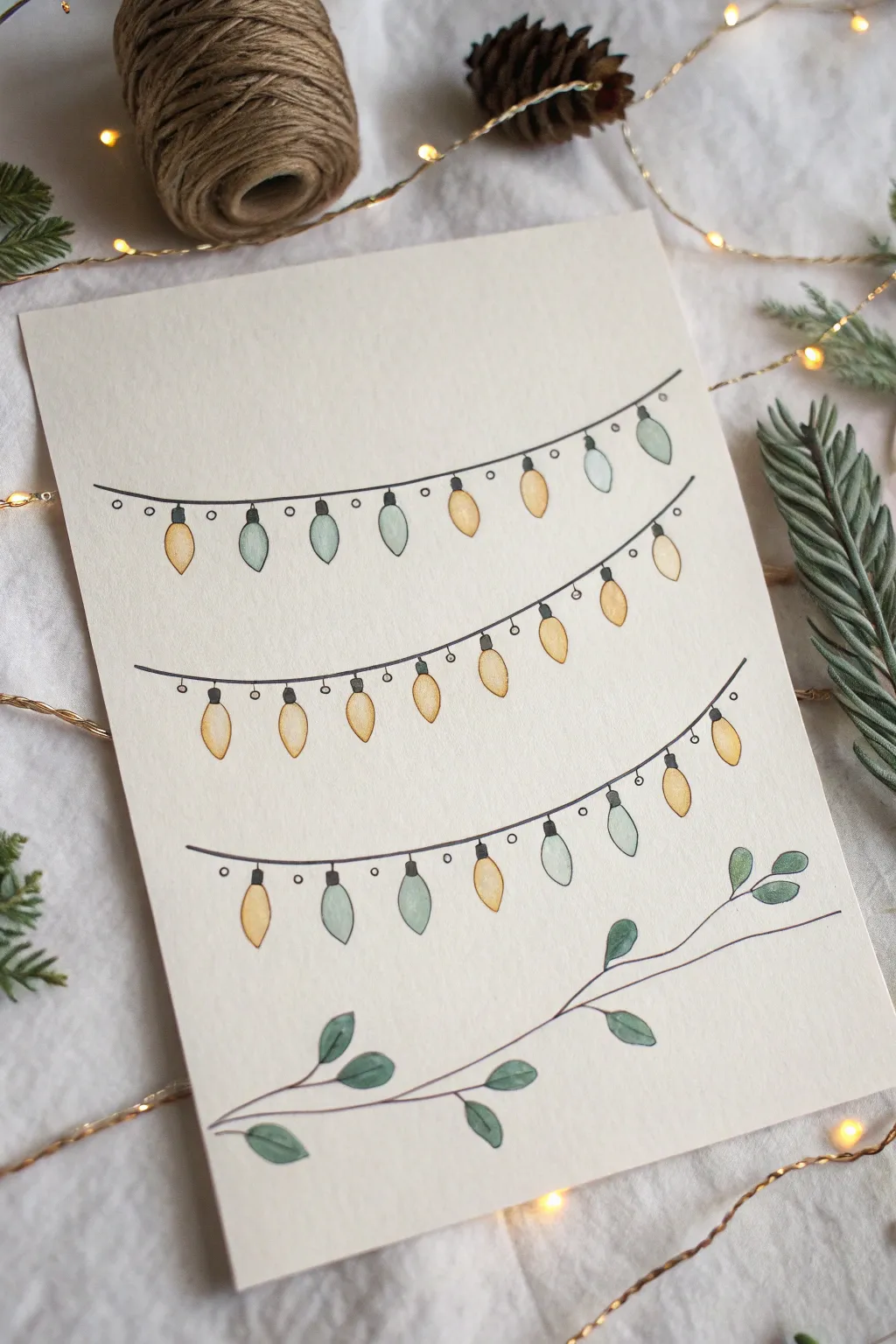
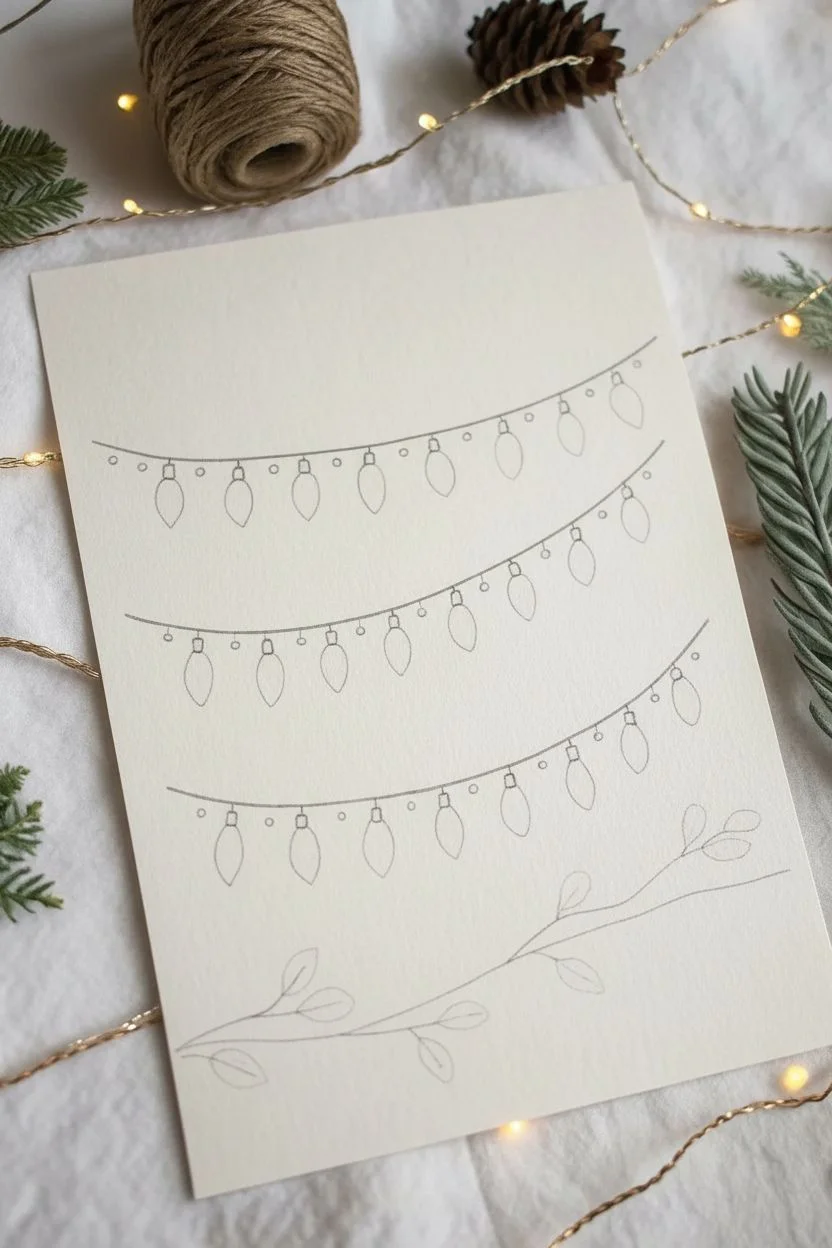
Capture the cozy glow of the holidays with this minimalist string light illustration. Using simple looping lines and a muted, Scandinavian-inspired color palette, this project creates a lovely divider or border perfect for holiday cards and bullet journals.
Detailed Instructions
Materials
- Cream or off-white cardstock (smooth bristol or mixed media paper)
- Black fine liner pen (01 or 03 size)
- Colored pencils or alcohol markers (Mustard Yellow, Sage Green, Pale Blue)
- Pencil and eraser
- Ruler (optional)
Step 1: Drawing the Structure
-
Map the curves:
Start with a pencil to lightly sketch three sweeping, curved lines across your paper. Let them drape naturally, with the middle curve sagging slightly lower than the top one for variety. -
Ink the wires:
Trace over your pencil lines with a black fine liner. Don’t worry about making the line perfectly straight; a little wobble adds hand-drawn charm. Add tiny loops at the ends if you want them to look attached to something. -
Add the sockets:
Along each wire, draw small rectangles or squares spacing them out evenly. These will be the sockets for your bulbs. I like to let the angle of the socket follow the curve of the wire. -
Connect with loops:
In the spaces between the sockets, draw tiny circles or loops directly on the wire line. This suggests the twisted nature of light strands.
Uneven Bulbs?
Don’t stress if your teardrops vary in size. Real vintage lights are often quirky. Just keep the general length consistent for a cohesive look.
Step 2: Sketching the Bulbs
-
Draw the bulb shapes:
Attached to each socket, draw a teardrop shape. Aim for a classic C9 Christmas bulb silhouette—rounded at the bottom and tapering slightly toward the socket. -
Vary the direction:
Keep most bulbs hanging straight down, but occasionally angle one slightly left or right to simulate the natural twisting of the cord. -
Add nature elements:
Below the bottom string of lights, pencil in two long, crossing branches. Draw small, oval-shaped leaves sprouting from the stems. -
Finalize outlines:
Go over all your pencil sketches—bulbs, stems, and leaves—with your fine liner. Once the ink is completely dry, gently erase all underlying pencil marks.
Step 3: Adding Color
-
Choose your palette:
Select a limited color palette to maintain that Scandinavian feel. A warm mustard yellow, a soft sage green, and a dusty blue work beautifully together. -
Color the first string:
On the top string, color the bulbs in an alternating pattern. Start with yellow, then blue, then yellow again. Use a light touch to keep the colors soft. -
Color the second string:
For the middle string, switch to a warm, glowing look by coloring all the bulbs in the mustard yellow shade. This creates a nice focal point. -
Color the third string:
On the bottom string, mix it up again. Alternate between the sage green and the mustard yellow. -
Shade the sockets:
Use a dark grey marker or pencil to color in the small rectangular sockets. This provides contrast against the wire and the bright bulbs. -
Fill the leaves:
Color the leaves on the bottom branches with your sage green and dusty blue. I prefer to alternate the tints on the leaves to tie the whole composition together. -
Add highlights:
If you are using markers, leaving a tiny sliver of white paper on one side of each bulb creates a shiny, glass-like reflection. With pencils, you can erase a small spot later.
Add a Glow
After coloring, outline the yellow bulbs very lightly with a pale yellow pencil or pastel to make them look like they are actually illuminated.
Now you have a festive, hand-drawn decoration ready to brighten up any page
Jingle Bells With Ribbon Loops

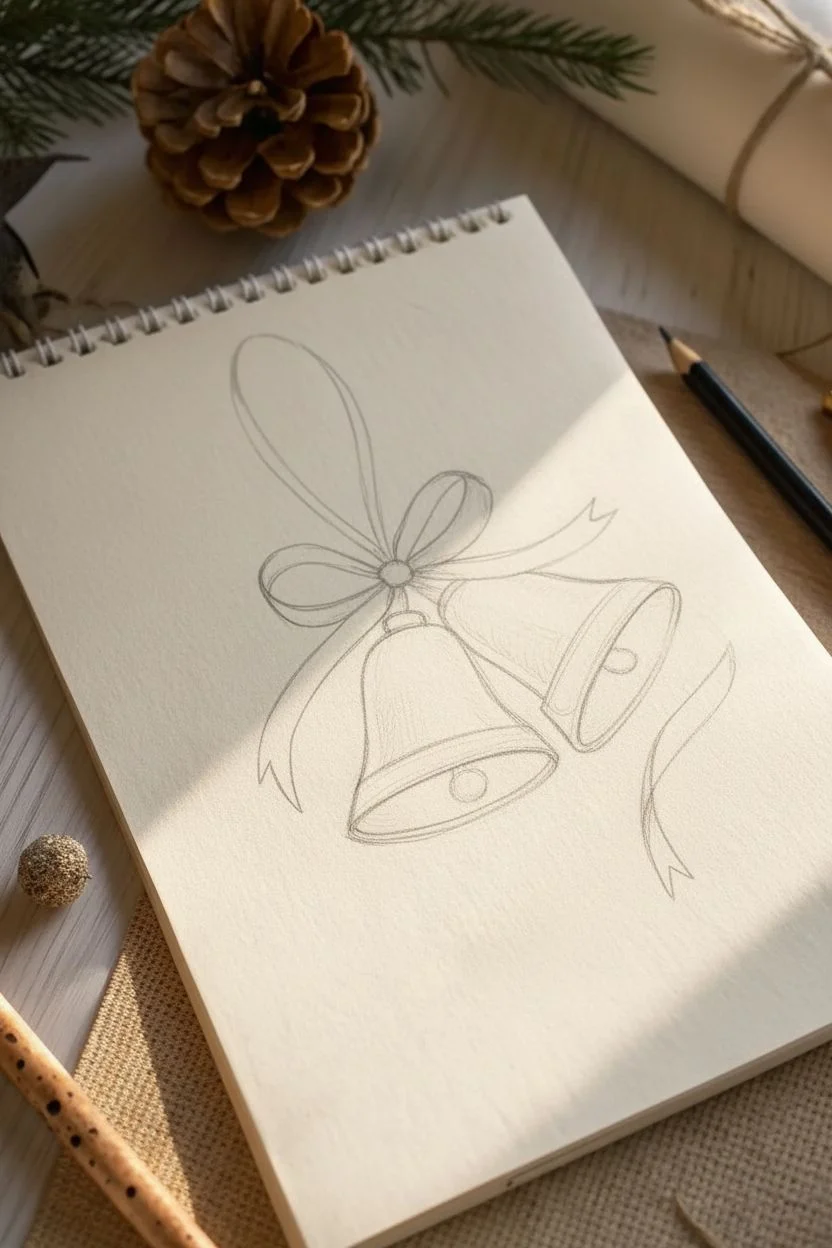
Capture the nostalgic charm of the holidays with this elegant pen-and-ink illustration of classic jingle bells. This project focuses on confident line work and simple shading techniques to create a cozy, vintage-style drawing.
How-To Guide
Materials
- High-quality sketchbook paper (mixed media or heavy drawing paper)
- Pencil (HB or 2B for sketching)
- Kneaded eraser
- Fine liner pens (sizes 0.1, 0.3, and 0.5)
- Gold metallic marker or gel pen (optional)
Step 1: Drafting the Shapes
-
Outline the bells:
Begin by lightly penciling two cup shapes tilted away from each other. Think of them as inverted tulips or rounded cones. -
Add the rims:
At the bottom of each bell shape, draw a thin, curved parallel band to create the rim of the bell. -
Sketch the clappers:
Inside the opening of each bell, draw a small sphere peeking out near the bottom curve to represent the clapper. -
Draw the bow structure:
Above where the two bells meet, sketch a central knot. From this knot, draw two large loops extending outward to the left and right. -
Add the ribbon tails:
Let two ribbon tails flow downwards from underneath the bow, curving slightly around the bells. -
Position the branch:
Lightly sketch a curved spine for the pine branch in the bottom right corner, ensuring it balances the composition.
Shadow Secrets
Make your shading lines follow the curve of the object. Curved hatch lines make the bells look round, while straight lines might flatten them.
Step 2: Inking the Outlines
-
Define the bells:
Using a 0.3 fine liner, trace over your pencil lines for the bells. Make the lines slightly thicker on the underside of the curves to suggest weight. -
Detail the ribbon:
Ink the bow loops, making sure to overlap the lines where the ribbon twists. I find it helpful to ink the knot last to ensure the loops connect naturally. -
Create the texture:
On the rim of the bells, draw tiny repeating shapes or zig-zags to mimic an engraved pattern. -
Draw the pine needles:
Switch to a 0.1 fine liner. Along the branch spine you sketched earlier, draw short, quick strokes flicking outward to create delicate pine needles.
Step 3: Shading and Finishing
-
Hatch the shadows:
With the 0.1 pen, add vertical hatching lines to the sides of the bells. Keep the center of each bell largely white to act as a brilliant highlight. -
Deepen the contrast:
Add cross-hatching (lines going the opposite direction) to the darkest areas, specifically under the rim and where the ribbons cast shadows on the metal. -
Shape the ribbon:
Use curved hatching lines that follow the flow of the fabric to give the ribbon dimension, darkening the areas inside the loops. -
Add the gold loop:
From the center knot, draw a large hanging loop extending upward. Use a gold metallic pen or marker here to add a touch of warmth and contrast. -
Sprinkle decorations:
With your finest pen using very light pressure, draw small asterisks and dots around the bells to simulate twinkling stars or falling snow. -
Clean up:
Wait until the ink is completely dry—give it a full minute—then gently erase all underlying pencil sketch marks.
Vintage Patina
Lightly wash over the finished drawing with dilute tea or coffee to stain the paper for an authentic, aged parchment look.
Your finished bell illustration is ready to bring a classic festive touch to cards or journals
Festive Lettering With Doodle Accents

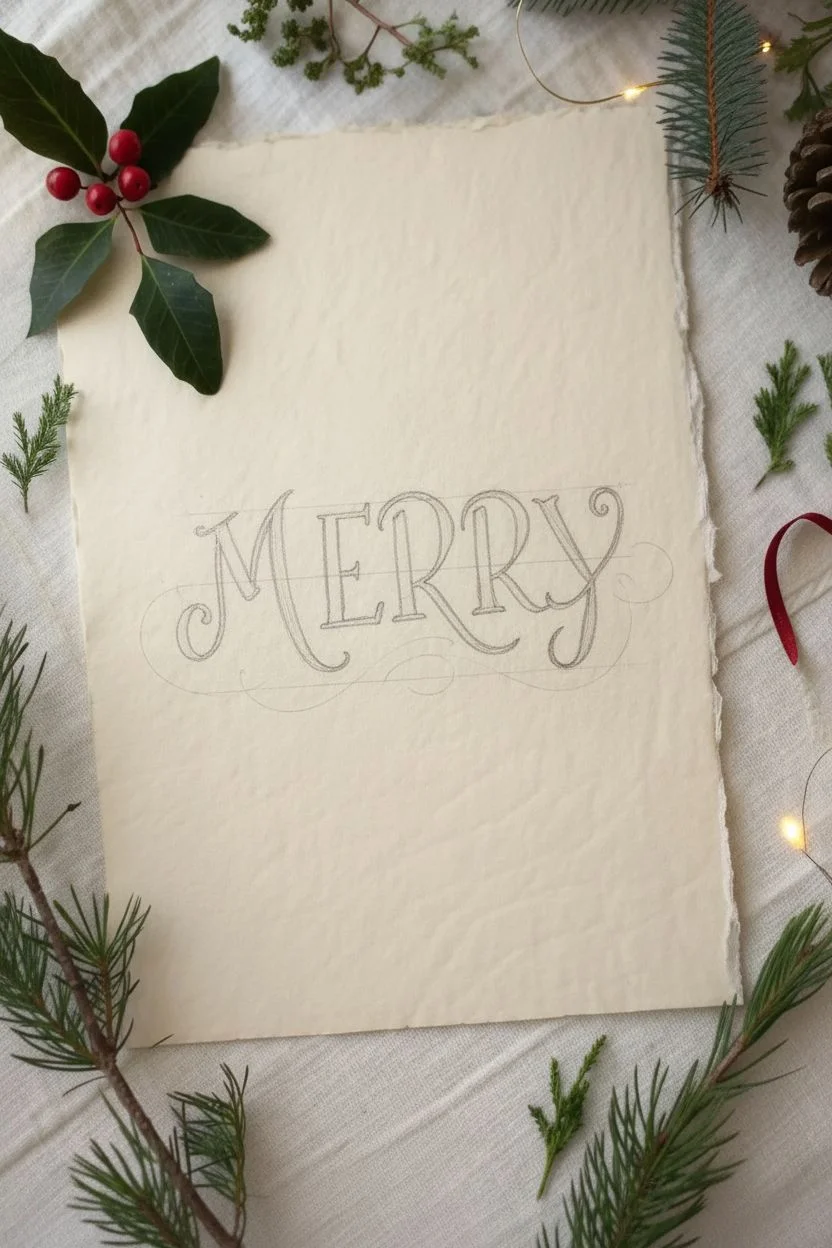
Embrace the elegance of the season with this hand-lettered piece that combines classic typography with sparkling doodle accents. Using textured paper and metallic ink creates a vintage, warm aesthetic perfect for holiday cards or framed decor.
Detailed Instructions
Materials
- Textured handmade paper (deckled edge)
- Pencil and eraser
- Ruler
- Dark grey or black fine-liner pen (0.5mm or larger)
- Gold gel pen or metallic marker
- Green fine-tip marker or gel pen
- Calligraphy drawing nib (optional, for variation)
Step 1: Drafting the Lettering
-
Paper Preparation:
Begin by selecting a piece of heavy, textured paper with deckled edges. Lay it flat on a clean surface. Using a ruler, lightly draw a single horizontal guideline across the center of the paper to keep your letters aligned. -
Spacing the Letters:
With a soft pencil, lightly sketch out the word ‘MERRY’. Start by marking the center point of the paper and placing the middle ‘R’ there to ensure the word is centered. Work outwards to the left (‘E’, ‘M’) and right (‘R’, ‘Y’). -
Sketching the Style:
Flesh out the skeleton of your letters. Aim for a serif style with slightly condensed proportions. Give the ‘M’ and ‘Y’ curving, flourished tails—let the left leg of the ‘M’ curl underneath and the tail of the ‘Y’ curl upward. -
Adding Weight:
Thicken the downstrokes of each letter to create a faux-calligraphy look. The vertical lines should be significantly thicker than the horizontal crossbars. Keep these pencil lines light so they are easy to refine.
Tip: Texture Control
On rough handmade paper, pens can bleed or snag. Test your pen on a scrap piece first. Using a felt-tip pen often works better than a rollerball on this surface.
Step 2: Inking the Text
-
Outlining:
Take your black fine-liner or dark grey pen. Carefully trace the outline of your thickened letters. I find it helpful to rotate the paper slightly as I work to maintain a natural hand position on the curves. -
Filling In:
Once the outlines are mostly dry, gently fill in the thick downstrokes with the same pen. Use consistent, short strokes to ensure solid coverage, especially on the textured paper surface where ink might skip. -
Refining Edges:
Go back over the thin upstrokes and serifs to ensure they are crisp. Extend the curled flourish on the ‘M’ and the ‘Y’ slightly if needed to balance the composition. -
Erasing:
Wait until the black ink is completely dry—textured paper absorbs ink slowly. Gently erase your pencil guidelines and sketch marks, being careful not to scuff the paper surface.
Troubleshooting: Uneven Ink
If the black filling looks patchy due to paper texture, don’t press harder. instead, apply a second layer of ink after the first one dries to darken it safely.
Step 3: Adding Festive Doodles
-
Snowflake Placement:
Switch to your gold metallic pen. visualize a loose oval shape surrounding the word ‘MERRY’. Draw 4-5 main snowflakes along this imaginary border—two above and three below. -
Drawing Snowflakes:
To draw the snowflakes, start with a simple cross (+), then add an X over it. Add small v-shapes at the tips of the lines to create the crystalline effect. -
Adding Stars:
In the gaps between snowflakes, draw a few five-pointed stars using the gold pen. Keep them open (outlined) rather than filled in to maintain a delicate look. -
Tiny Accents:
Scatter smaller gold asterisk shapes (*) and simple dots around the larger doodles to fill empty space and create a shimmering dust effect. -
Green Highlights:
Using a fine-tip green marker, add very small, solid stars (just 4 or 5 pointed dashes) specifically near the ends of the word ‘MERRY’ to bring a subtle pop of holiday color. -
Final Dusting:
Add a few final distinct dots of green ink interspersed among the gold dust. -
Review and Finish:
Step back and look at the overall balance. If one side feels empty, add a tiny gold dot or asterisk to even out the visual weight.
Display your beautiful hand-lettered piece among festive greenery to complete the holiday mood
Minimal Line Icons With Color Pops
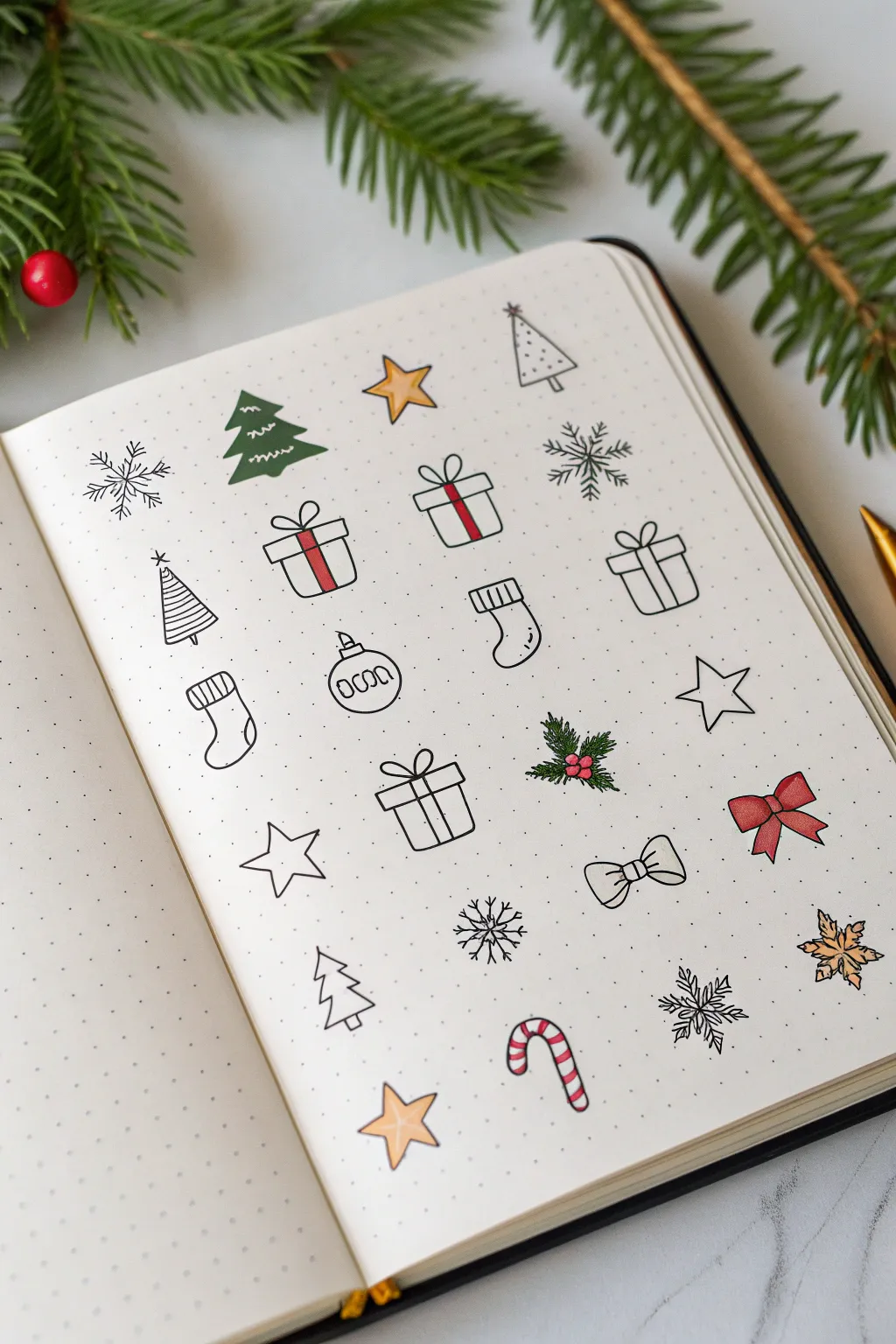
This festive spread features a collection of minimal holiday icons drawn with clean black lines and selective pops of color. The grid layout of a bullet journal makes it easy to space these charming illustrations evenly, creating a tidy yet playful compendium of winter motifs.
Step-by-Step Tutorial
Materials
- Dotted bullet journal or grid paper
- Fine-liner pen (black, 0.3mm or 0.5mm)
- Colored pencils or markers (red, green, gold)
- Pencil and eraser (optional for sketching)
Step 1: Setting the Layout
-
Visualize the grid:
Before drawing ink lines, look at your dotted paper and mentally divide the page into a 4×5 or 5×5 grid. You want roughly equal spacing between each icon so the page feels balanced but not overcrowded. -
Pencil placement:
If you’re nervous about spacing, lightly mark the center point for each doodle with a pencil. This acts as an anchor for centered drawings.
Step 2: Drawing the Linear Doodles
-
Create the first snowflake:
Start in the top left with a snowflake. Draw a simple cross, then an ‘X’ through the center. Add small ‘V’ shapes at the end of each line to create the frosty tips. -
Draw the striped tree:
Moving down, draw a simple triangle for a tree. Instead of filling it in, draw horizontal lines across the triangle, starting narrow and getting wider at the base. Add a tiny star on top. -
Sketch the stockings:
For the stockings, draw a ‘J’ shape that loops back up. Top it with a rectangular cuff. Add small vertical lines inside the cuff for texture, or leave it plain. -
Outline the gift boxes:
Draw several cubes or 3D rectangles scattered throughout the page. Draw a straight vertical line and a horizontal line crossing the face of the box to represent ribbon. Top them with simple loops for bows. -
Add the ornament:
Draw a perfect circle. Sketch a small rectangle on top with a loop for the hook. Inside the circle, write a word like ‘COCOA’ or draw simple patterns. -
Draw the sprig of holly:
Draw three small circles in a cluster for berries. Extend prickly, pointed leaves outward from the berries. Keep the lines jagged to mimic holly texture. -
Create star varieties:
Draw a few five-pointed stars. Keep some simple and open, and for others, double the lines or draw lines from the center to the inner corners to create a 3D faceted effect. -
Form the candy cane:
Draw two parallel curved lines forming a hook shape. Close the ends with curved lines. Draw diagonal stripes all the way down the cane. -
Finish with detailed snowflakes:
For more complex snowflakes, start with a six-pointed star. Add intricate branches or diamond shapes along the spokes. Varying the snowflake designs adds visual interest.
Clean Lines Tip
When drawing straight lines for gift boxes, pause briefly at the end of each stroke. This prevents messy, tapered ends and keeps corners sharp.
Step 3: Adding the Color Pops
-
Select your palette:
Choose a limited color palette to keep the ‘minimal’ aesthetic. A classic Christmas red, a deep forest green, and a warm yellow or gold work perfectly. -
Focus on the red:
Use your red marker or pencil to fill in specific details: the ribbons on the gift boxes, the berries on the holly, the stripes on the candy cane, and a simple bow icon. -
Add evergreen touches:
Take the green color and fill in just one of the tree designs—like the zig-zag tree at the top. Also, color the holly leaves carefully, blending slightly for depth if using pencils. -
Highlight with gold:
Use yellow or gold to fill in the stars. I usually like to color fully for the simple stars and color only one facet of the 3D stars for a shiny effect. -
Final clean up:
Once the ink and marker are completely dry, gently erase any visible pencil guidelines to leave a crisp, clean finish.
Ink Smudging?
If your black fineliner smears when you add color, switch to waterproof archival ink pens or color the design first and outline last.
Now you have a cheerful page of holiday icons ready to decorate your seasonal spread
One-Page Christmas Doodle Sticker Sheet
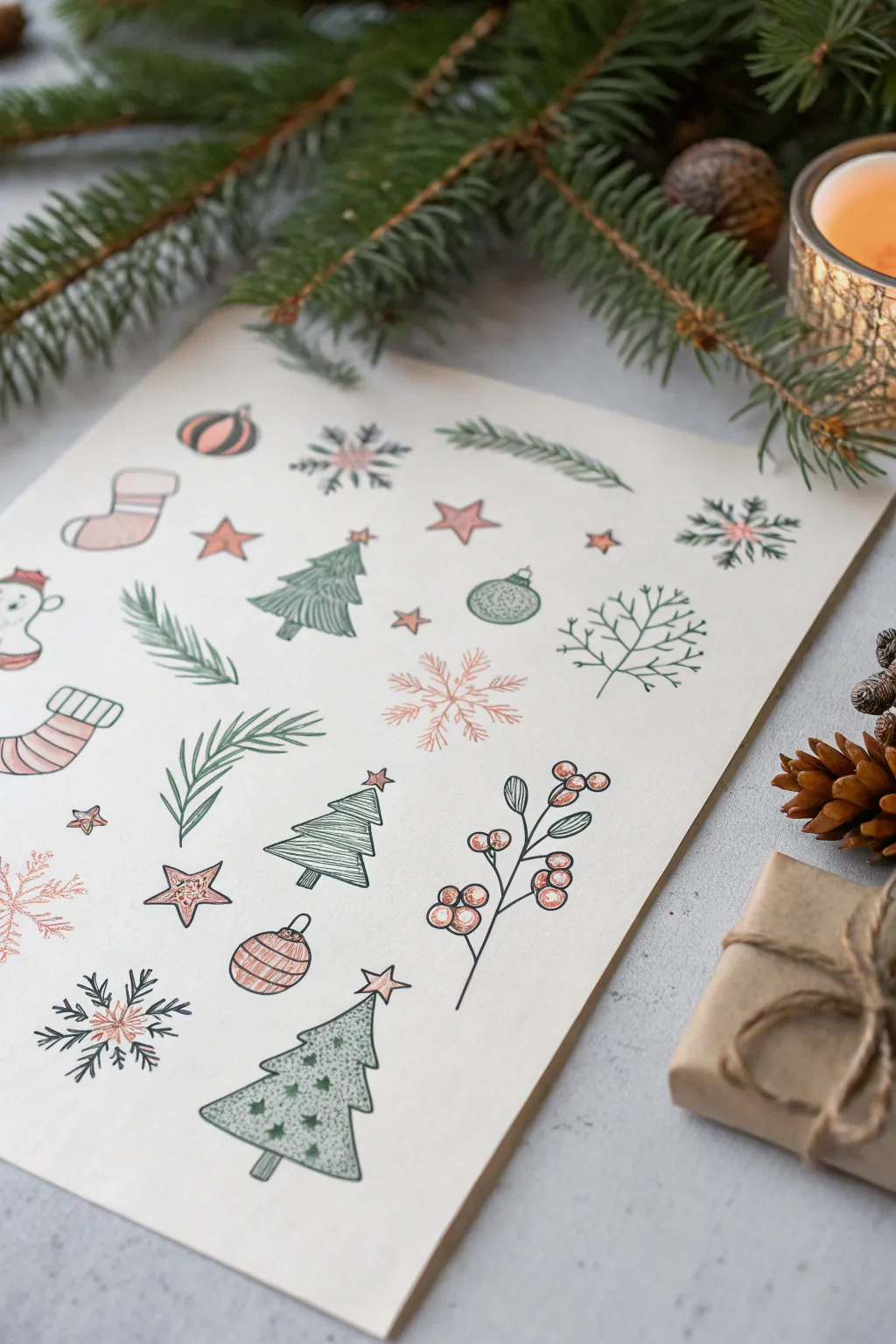
Capture the charm of the holiday season with this delightful collection of hand-drawn Christmas icons on warm-toned paper. This project combines simple line work with soft coloring to create a vintage-inspired aesthetic perfect for stickers, gift tags, or sketchbook practice.
How-To Guide
Materials
- Light cream or off-white sketchbook paper (heavyweight works best)
- Fine liner pens (0.3mm and 0.5mm, black or dark grey)
- Colored pencils or fine-tip markers (sage green, forest green, muted red/pink)
- Pencil (HB for sketching)
- Soft eraser
- Ruler (optional for spacing)
Step 1: Planning the Layout
-
Prepare your surface:
Start by selecting a smooth, cream-colored sheet of paper. Secure it to your workspace if loose, or open your sketchbook flat to ensure a comfortable drawing angle. -
Lightly sketch placements:
Using an HB pencil, very lightly map out where each icon will go. Instead of drawing details, just draw faint circles, triangles, or rectangles to represent the approximate size of each doodle to ensure balanced spacing across the page. -
Draft the tall elements:
Sketch the triangular shapes for the three Christmas trees. Vary their styles: one with tiered layers, one with simple horizontal stripes, and one with a more illustrative, textured look.
Smudge Prevention
Place a scrap piece of paper under your drawing hand. This acts as a shield, preventing oils from your skin from smearing the fresh ink or pencil shadings.
Step 2: Drawing the Greenery
-
Outline the fir branches:
Switch to your fine liner pen. Start confident ink lines for the evergreen sprigs. Draw a central curved stem first, then add quick, short flicks outward on both sides to simulate pine needles. -
Detail the leafy branch:
For the more structured branch on the right side, draw a straight central line and add smaller symmetrical offshoots. Keep the lines crisp to contrast with the softer pine needles. -
Ink the berry sprig:
Near the bottom right, draw a long, slightly curved stem. Attach small circles for berries in clusters of two or three, and add simple oval leaves at the joints. -
Create the snowflakes:
Draw the snowflakes starting with a simple cross or ‘X’ shape. Add smaller ‘V’ shapes or lines radiating from the center points to build complexity without overcrowding the design.
Turn Them Into Stickers
Draw these directly onto full-sheet white label paper. Once done, cut around each doodle with scissors leaving a small white border to create a custom sticker set.
Step 3: Inking the Ornaments & Decor
-
Draw the baubles:
Ink the round ornaments scattered throughout the page. Include a small square attachment at the top for the hook. Vary the patterns inside—try horizontal stripes on one and vertical segments on another. -
Add the stockings:
Draw the iconic sock shapes. Give them a folded cuff at the top and add stripes to the body of the stocking. I like to make the heel and toe distinct shapes for easier coloring later. -
Sketch the stars:
Fill in the empty spaces with five-pointed stars. Draw a few larger ‘feature’ stars and several tiny, simple stars to act as filler confetti around the main drawings. -
Ink the Christmas trees:
Go over your pencil sketches for the trees. For the textured tree at the bottom, use small stippling dots or tiny ‘x’ marks inside the triangle shape instead of solid lines to create a flocked look.
Step 4: Adding Color & Texture
-
Erase pencil lines:
Wait until the ink is completely dry to avoid smudging. Gently run your soft eraser over the entire page to remove the initial planning marks. -
Color the greens:
Take a sage green or muted forest green pencil. Fill in the pine branches using quick, directional strokes that follow the needles. Color the striped tree sections, alternating green and white. -
Apply the reds:
Use a soft, muted red or salmon pink for the berries, stocking stripes, and baubles. Keep the shading light—a ‘sketchy’ fill looks better here than perfectly solid coloring. -
Add metallic accents:
If you have a darker beige or gold-toned pencil, color the stars and the little caps on the ornaments. This adds warmth to the palette without needing actual glitter. -
Deepen the shading:
Go back over your green and red areas. Press slightly harder on one side of each object (like the bottom of the baubles or the left side of the trees) to create a subtle shadow effect. -
Final ink touches:
Look over the fully colored sheet. If any ink lines were faded by the colored pencil wax, carefully re-trace them to bring back the definition.
Enjoy using your festive doodle sheet to decorate your holiday correspondence this year
Have a question or want to share your own experience? I'd love to hear from you in the comments below!