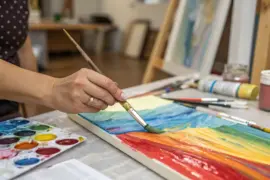
Few painting techniques feel as fluid and expressive as the wet-on-wet method. It’s a way to let colors and forms unfold naturally, capturing softness and spontaneity in every brushstroke.
What the Wet-on-Wet Method Really Means

“Wet-on-wet,” or alla prima in traditional oil painting, refers to applying fresh paint over a still-wet layer rather than waiting for each pass to dry. This technique allows pigments to mingle directly on the surface, producing delicate gradients, atmospheric textures, and dynamic tonal transitions.
Although most associated with oils, the same principle applies beautifully to acrylics and watercolors. The difference lies in drying time and pigment behavior: oil retains its workable surface for hours, acrylic for minutes, watercolor for seconds. Understanding that timing is essential to success.
Why Artists Love the Technique
Working wet-on-wet encourages a sense of immediacy and precision balanced by surrender. The result often feels more natural and organic than overworked compositions.
Here’s what makes it so appealing:
- Speed and cohesion. You complete paintings in fewer layers, achieving harmony while colors are still responsive.
- Soft transitions. It’s ideal for skies, mist, skin tones, and reflective surfaces.
- Expressive control. You can manipulate texture and blending with a single stroke.
- Efficient layering. When handled correctly, the surface retains freshness rather than looking muddy.
Tools and Materials to Prepare

Even without mentioning brands, a good setup defines outcome. Gather the essentials before beginning.
| Tool/Material | Purpose | Notes |
|---|---|---|
| Canvas, panel, or heavy paper | Painting surface | Choose one compatible with your medium. |
| Medium (oil, water, or acrylic retarder) | Extends open time | Adjusts consistency and drying rate. |
| Brushes | Varying texture | Soft rounds for blending, flats for coverage. |
| Palette knife | Mixing and texture | Useful for quick color blending on palette. |
| Spray bottle or misting device (for acrylics) | Keeps surface damp | Prevents paint from drying too fast. |
| Absorbent cloths | Lifts excess paint | Maintains controlled diffusion of color. |
Keep your working environment consistent—no fans or direct heat—since airflow accelerates drying unintentionally.
Getting Started: Step by Step

A wet-on-wet painting session flows best when you pace the process intentionally. Here’s how to begin.
- Prime your surface. Apply a thin, even layer of medium—oil medium for oils, water or retarder mix for acrylics. It should feel slick but not saturated.
- Lay down large color fields. Start broad and light. Think of the first strokes as atmospheric foundation.
- Blend selectively. Work with a clean, lightly damp brush to merge edges. Avoid overblending; it dulls chroma.
- Add details into wet layers. Introduce secondary colors, shapes, or highlights directly—gently feathering transitions.
- Step back frequently. Because blending occurs fast, distance helps you see whether to push intensity or leave softness.
Many artists describe the balance as “painting with timing.” You’re learning not just color harmony but when to stop, when to let wetness speak for itself.
The Science of Smooth Blending

The tactile magic behind this technique is rooted in pigment dispersion and surface tension. When two wet films contact each other, their suspended particles intermix before the liquid medium evaporates or polymerizes.
- Oils: Pigments diffuse slowly through viscous linseed or walnut oil, allowing long blending windows.
- Acrylics: Water-based polymers form a film through evaporation. A retarder or misting slows this process by reducing surface tension.
- Watercolors: Capillary action draws wet pigment across the paper fibers, creating flowing gradients. Manipulation depends on absorbency, humidity, and brush moisture.
Understanding this behavior helps predict results and reduce frustration—particularly with acrylics, where controlled moisture is vital.
Techniques to Experiment With

Once comfortable with basic blending, explore variations that add richness and movement.
- Wet lifting. Use a clean brush or rag to remove pigment while the surface is still moist, revealing soft highlights or reflections.
- Color glazing. Introduce transparent layers onto semi-wet bases to extend depth.
- Directional flow. Tilt the surface slightly to guide pigment runs for abstract or atmospheric effects.
- Edge control. Alternate between dry and wet brushes to balance crisp definition and blurred transitions.
Each variation refines your understanding of how physical water, oil, and pigment interact.
Avoiding the Most Common Pitfalls
A few mindful adjustments prevent frustration and muddy results.
- Keep brushes clean between colors to prevent unwanted gray tones.
- Work from light to dark when using thin media like watercolor; from dark to light with opaque ones like oil.
- Limit the number of pigments per layer to preserve clarity.
- Allow partial drying if edges begin to lose crispness excessively.
Even when a section feels overworked, resist the urge to fix everything immediately. Once dry, subtle glazing can restore brightness without heavy reworking.
A Personal Reflection
When using the wet-on-wet method, patience and pace become intertwined. I often find that once I stop chasing perfection, the surface begins to paint itself. Those blurred edges, gentle gradients, and faint hue shifts carry a quiet energy no brush could force. What begins as technique evolves into dialogue—between paint, moisture, and intention.
Inspiration for Experimentation
This approach suits many subjects and styles:
- Landscapes with diffused morning light.
- Abstract forms emphasizing luminous transitions.
- Still lifes with reflective metallic surfaces.
- Portraits capturing soft facial modeling.
Start small—a 9×12 study is plenty—then translate the process onto larger canvases as confidence grows. Over time, your brushwork becomes more economical and intuitive, echoing the meditative flow that defines wet-on-wet painting.