
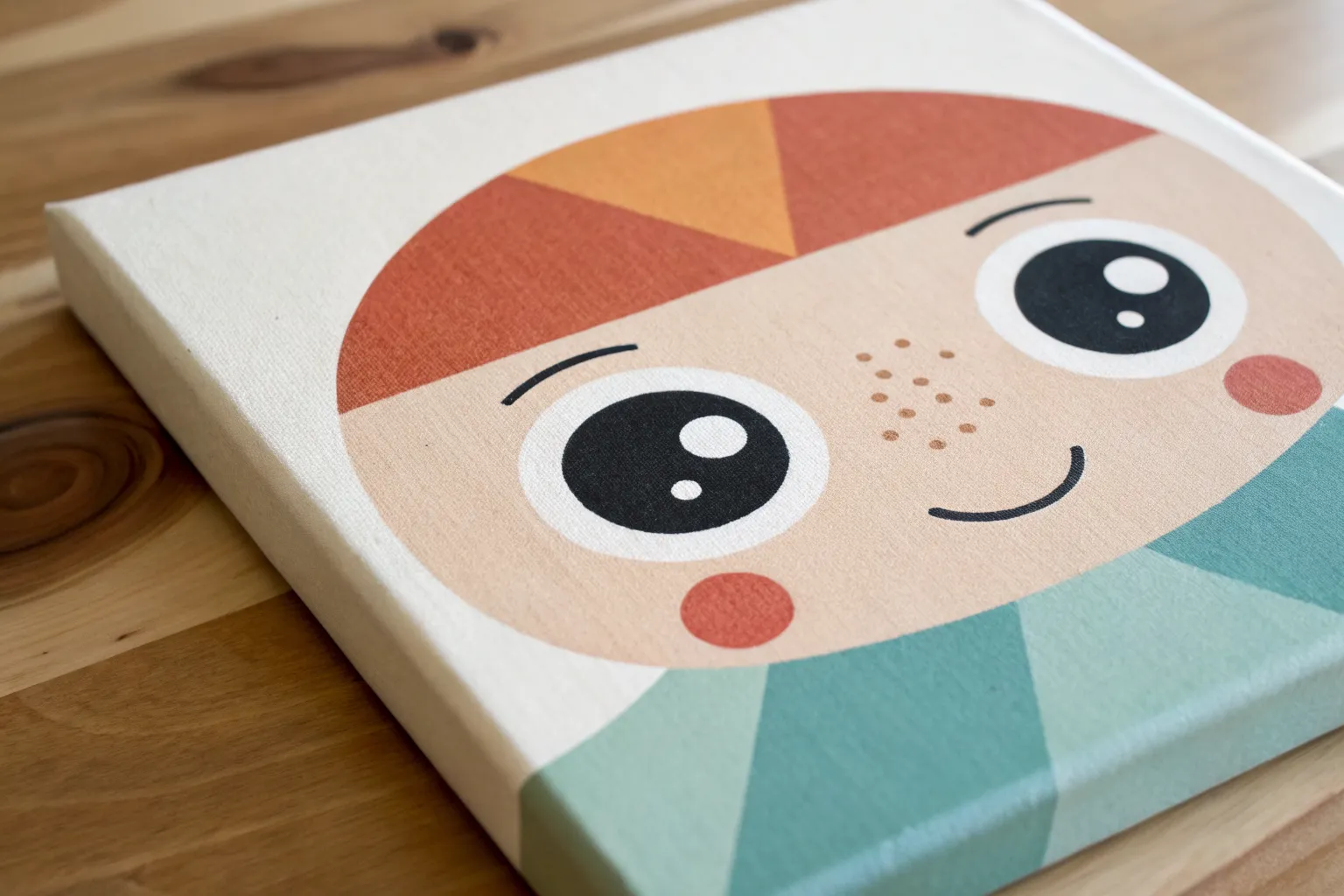
Whenever you want a painting win without the stress, easy characters are my go-to because they’re basically just simple shapes with personality. I’m sharing my favorite beginner-friendly character ideas that look super cute with bold outlines and flat colors, even if you’re still getting comfy with your brush.
Big-Eyed Cartoon Cat
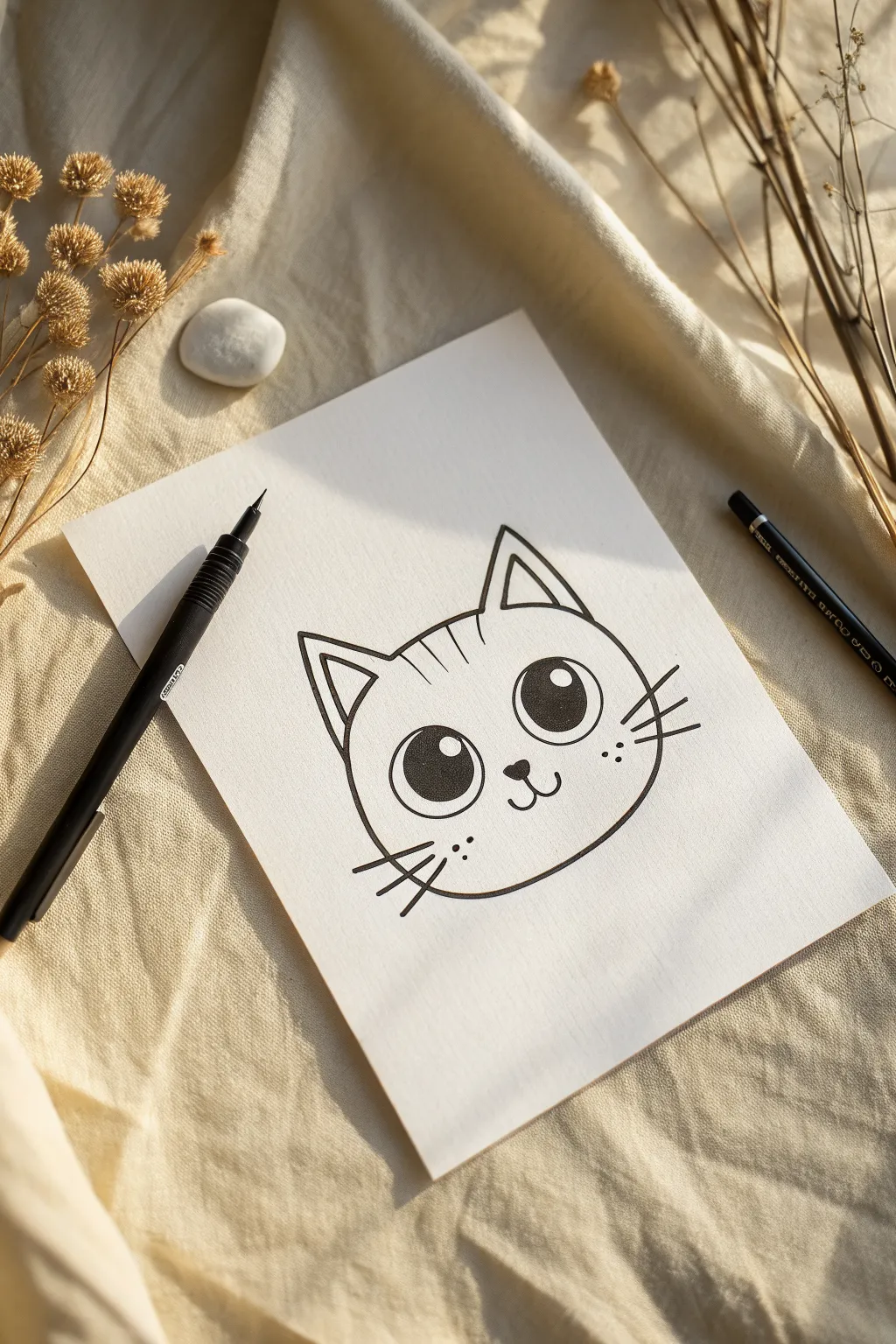
This charmingly simple project features a wide-eyed cartoon cat drawn with crisp, clean lines on high-quality paper. Its minimalist style relies on bold shapes and contrast, making it a perfect exercise for practicing confident ink strokes.
How-To Guide
Materials
- Smooth bristol board or heavy drawing paper (white)
- HB pencil for sketching
- Soft eraser
- Black fine liner pen (approx. 0.5mm)
- Black brush pen or thicker marker for filling in eyes
Step 1: The Pencil Sketch
-
Define the head shape:
Start by lightly sketching a wide oval shape for the cat’s head. Keep your pencil pressure very light so these lines can be erased later. -
Add the ears:
Draw two large triangles on top of the oval. The triangles should curve slightly outward to look soft rather than sharp. -
Sketch the inner ears:
Inside each ear triangle, draw a smaller, similar triangle shape to represent the inner ear structure. -
Placement of the eyes:
In the center of the face, lightly mark two large circles. They should be quite far apart but centrally aligned horizontally. -
Refine the eye details:
Within those large circles, draw smaller circles near the top left of each eye to mark the highlights. This reflection is crucial for that cute look. -
Nose and mouth:
Below the eyes, centrally place a small, rounded triangle for the nose. Extend two small curved lines outward from the bottom of the nose to form the mouth smile.
Step 2: Inking the Outline
-
Trace the head contour:
Using your black fine liner, carefully trace over your pencil lines for the main head shape. Use a steady hand and try to make one continuous line where possible. -
Ink the ears:
Go over the ear triangles. I find it helpful to turn the paper slightly to get a better angle for these angled strokes. -
Add forehead stripes:
Draw three small, vertical curved lines between the ears at the top of the forehead. These add a bit of texture and character. -
Define the eyes:
Trace the large outer circles of the eyes with your fine liner. Be very deliberate here, as circles are unforgiving. -
Fill the eyes:
Now, careful work is needed. While keeping the small highlight circle completely white, fill in the rest of the eye with solid black ink. A thicker pen or brush pen saves time here. -
Nose and mouth details:
Ink the small heart-like nose completely black, then trace the smile lines carefully. -
Draw the whiskers:
Place three horizontal lines on each cheek. Make them brisk and quick strokes so they taper naturally at the ends. -
Add freckles:
Dot three small points on each cheek, just above the whiskers, to give the face some extra sweetness.
Clean Lines Secret
Draw mostly from your shoulder, not your wrist. This locks your hand in place and helps creating smoother, less shaky long lines.
Step 3: Finishing Touches
-
Erase pencil lines:
Wait until the ink is completely dry—give it a few minutes to be safe. Then, gently erase all the underlying pencil sketches. -
Review contrast:
Check your black fills. If the eyes look streaky, go over them one more time to ensure a deep, solid black.
Fixing Wobbly Circles
If your eye circle isn’t perfect, thicken the outline slightly on the wobbly side to reshape it without starting over.
Now you have a crisp, adorable cat drawing ready to frame or gift


Floppy-Eared Puppy Pal
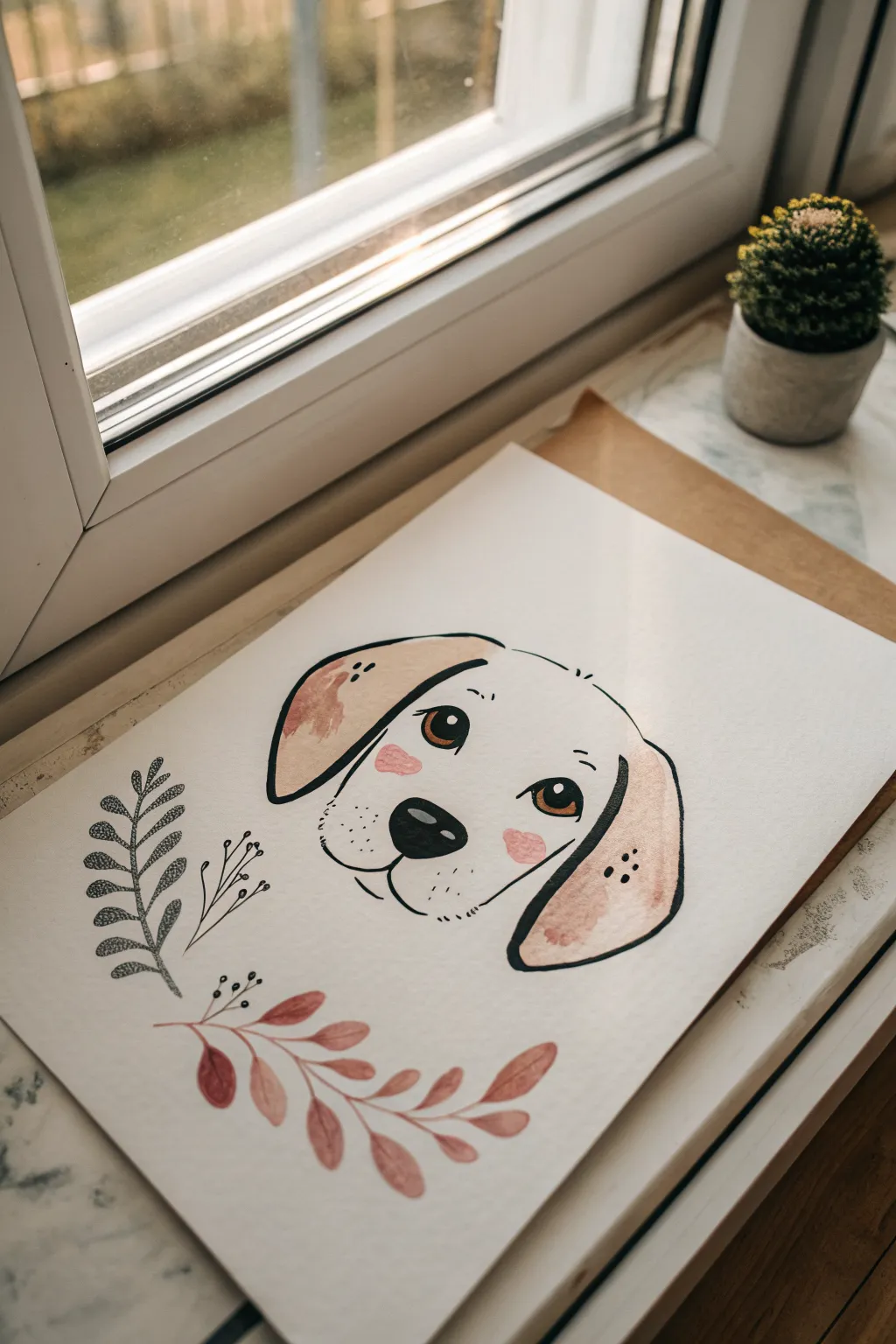
Capture the sweetness of a charming pup with this simple yet expressive illustration that mixes watercolor washes with crisp ink lines. The soft tan tones and gentle floral accents make it a perfect project for a beginner artist looking to create something heartwarming.
Step-by-Step
Materials
- Cold press watercolor paper (A4 or similar size)
- Watercolor paint (Ochre, Burnt Sienna, Pink/Rose, Green)
- Black fine liner pen (0.5mm and 0.8mm)
- Round watercolor brush (Size 4 or 6)
- Pencil (HB) and eraser
- Jar of water
- Paper towel
Step 1: Sketching the Outline
-
Block in the shape:
Start by drawing a soft, rounded square shape for the head in the center of your paper. Keep your pencil pressure very light so the lines can be erased later. -
Add the ears:
Draw two drooping, tear-drop shapes on either side of the head for those signature floppy ears. The tops should start just slightly below the crown of the head. -
Map the features:
Sketch a large, curved triangle for the nose in the lower center. Just above that, place two wide, oval shapes for the eyes, tilting them slightly inward for a kind expression. -
Refine the muzzle:
Add the muzzle curves connecting to the bottom of the nose, creating the ‘jowls’ or lips of the dog. Draw a U-shape around the nose area to mark where the white fur will eventually be.
Uneven Wash?
If your ear color dries with hard “cauliflower” edges, you used too much water. Dab excess water with a dry brush next time, or embrace the texture—it looks like fur.
Step 2: Watercolor Washes
-
Mix the ear color:
Create a watery mix of Yellow Ochre with a tiny touch of Burnt Sienna. You want a warm, toasted tan color but keep it very transparent. -
Paint the first ear:
Fill in the left ear with your tan wash. While it’s still wet, I like to drop in a slightly more concentrated dot of the same color at the tip or top edge to create a natural gradient as it dries. -
Paint the second ear:
Repeat the process for the right ear. Be sure not to let the paint bleed into the main head shape; keep the edges clean. -
Add rosy cheeks:
Clean your brush thoroughly. Mix a very diluted Pink or Rose color. Paint two soft, circular patches on the cheeks, right below the eyes. Soften the edges with a damp brush so they aren’t perfect circles. -
Paint the bottom leaves:
While the face dries, move to the bottom floral element. Mix a reddish-brown or rust watercolor. Paint a stem curving upward, then add small, almond-shaped leaves branching off it. -
Paint the side leaves:
For the leaves on the left, use a blue-green or grey-green mix. Paint a stem with small, fern-like leaves extending outward. Let all paint dry completely before moving to ink.
Step 3: Inking the Details
-
Outline the head:
Using your 0.5mm pen, carefully trace the top of the head. Don’t make a solid, continuous line; use broken or slightly overlapping strokes to suggest fur texture. -
Ink the ears:
Outline the painted ear shapes. You can make the line slightly thicker on the outer curves to give the drawing weight. -
Fill the eyes:
Outline the eyes carefully. Draw a small circle inside each eye for the highlight (leave this white!). Fill the rest of the pupil black, perhaps leaving a small sliver of brown if you want to paint irises, or keep them solid black for a simpler cartoon look. -
Define the nose:
Use the thicker 0.8mm pen for the nose to make it stand out. Color it solid black, leaving a tiny white oval at the top for a shine. -
Add muzzle details:
Draw the mouth lines and add small dots on the muzzle for whisker spots. Add a few small, brisk dashes on the chin to suggest a furry texture. -
Final foliage details:
Draw a thin ink stem next to your green leaves. At the end of these thin lines, draw tiny open circles or berries to add contrast to the foliage.
Make it Personal
Customize the puppy to match a real pet! Add ink spots for a Dalmatian, use grey paint for a Weimaraner, or make the ears pointy for a Shepherd.
Once the ink is fully dry, gently erase any remaining pencil marks to reveal your adorable puppy portrait
Chunky Teddy Bear Buddy
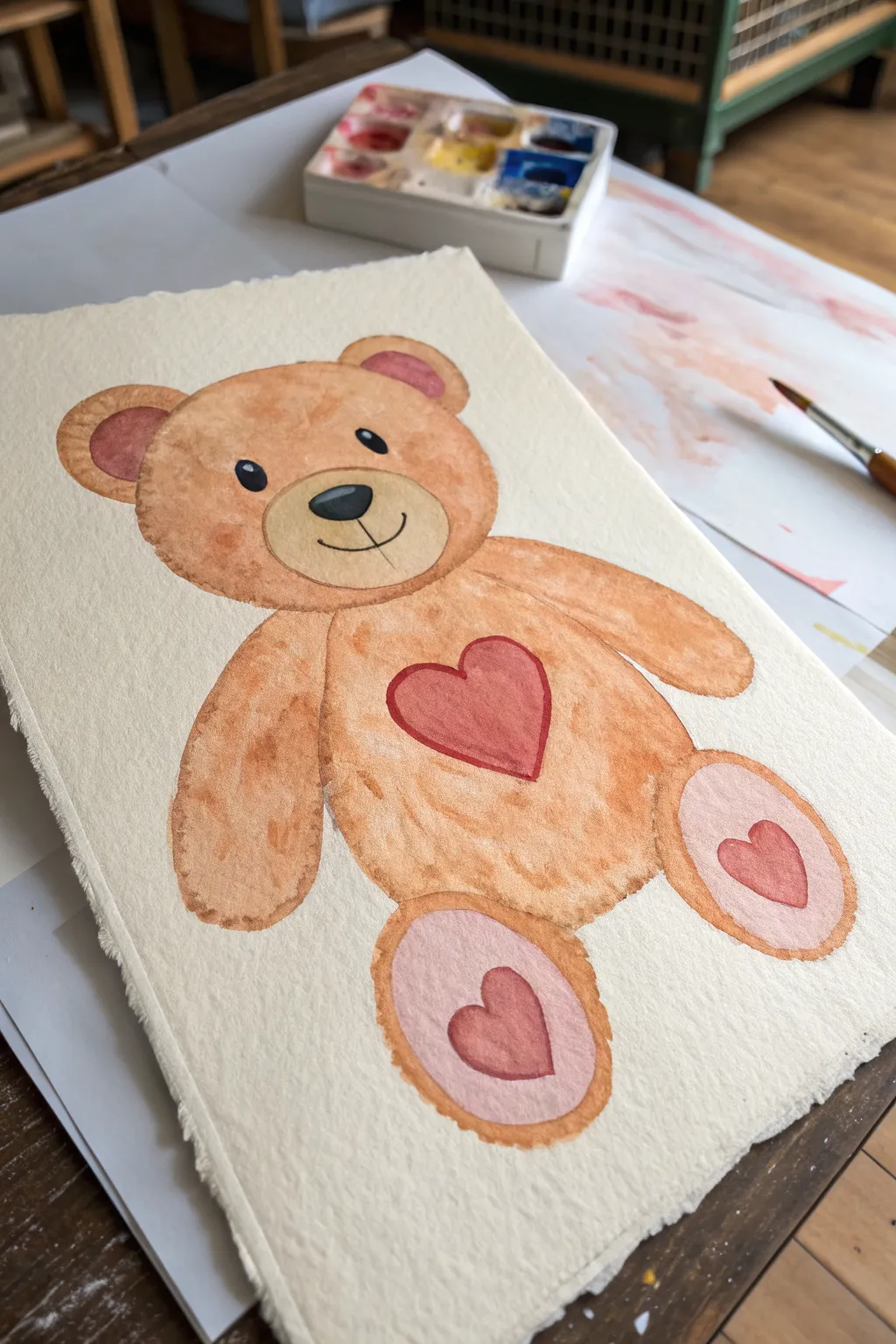
This lovable teddy bear carries a heart right on its chest and cute heart-shaped pads on its paws. Painted with warm watercolor washes, this project is perfect for creating a sweet card or nursery decoration.
Detailed Instructions
Materials
- Cold press watercolor paper (deckled edge optional)
- Watercolor paints (Light Brown, Dark Brown, Pink, Red, Black)
- Pencil and eraser for sketching
- Medium round brush (size 6 or 8)
- Fine detail brush (size 0 or 2)
- Jar of clean water
- Paper towel
Step 1: Sketching the Shape
-
Outline the head:
Start by lightly sketching a large, rounded oval for the bear’s head near the top center of your paper. -
Add the ears:
Draw two semi-circles on the top left and right of the head for the ears. Keep them soft and rounded rather than pointy. -
Outline the body:
Below the head, sketch a pear-shaped body that is slightly larger than the head. The top should connect seamlessly to the chin area. -
Create the limbs:
Sketch two arm shapes extending from the shoulders, angled slightly downward. Then, draw two oval feet pointing outward at the bottom of the body. -
Detail the face and pads:
Draw a smaller oval inside the face for the snout. Inside the feet, sketch oval pads, and add a heart shape within each foot pad. Draw a larger heart right in the center of the chest.
Furry Texture Tip
For a softer look, paint the fur edges while the base layer is still slightly damp. The colors will bleed gently, creating a fuzzy effect.
Step 2: Applying the First Wash
-
Mix your base color:
Dilute a light brown or ochre watercolor paint with plenty of water to create a soft, honey-colored wash. -
Paint the head and body:
Using your medium round brush, fill in the main head shape and the body. Paint carefully around the snout, the heart on the chest, and the foot pads—we want those areas to stay white for now. -
Fill the arms and outer ears:
Continue using the honey-brown wash to fill in the arms and the outer rim of the ears. Leave the inner ear shapes unpainted. -
Paint the outer feet:
Fill in the feet area surrounding the inner pads with the same brown wash. Ensure your edges are fairly neat, but don’t worry about perfection; watercolor charm lies in its fluidity. -
Let it dry:
Allow this entire first layer to dry completely. If the paper feels cool to the touch, it’s still damp.
Step 3: Adding Details and Contrast
-
Paint the inner ears:
Mix a muted pink or reddish-brown tone. Carefully paint the inner semi-circles of the ears. -
Color the snout:
Create a very watery, pale beige wash—much lighter than the body color—and fill in the snout area. -
Fill the foot pads:
Using a very pale pink wash, paint the oval pads on the feet, carefully painting around the small hearts inside them. -
Paint the hearts:
Load your brush with a richer red or deep pink. Paint the heart on the chest and the two small hearts on the soles of the feet. -
Define the texture:
Once the base brown is dry, I like to take a slightly darker brown mixture with less water and dab small, irregular strokes along the edges of the bear to suggest a furry texture.
Smudged Paint?
If you accidentally smudge wet paint, dab it immediately with a clean, dry paper towel. Don’t rub, or you’ll damage the paper surface.
Step 4: Final Touches
-
Add the nose:
Switch to your fine detail brush and black paint (or a very dark grey). Paint a rounded triangle nose at the top of the snout. -
Draw the mouth:
From the bottom of the nose, paint a thin, straight line down, curving into a smile on either side. -
Paint the eyes:
Add two small black ovals for eyes just above the snout. Leave a tiny speck of white paper in each for a sparkle, or add it later with white gouache. -
Outline the hearts:
Using a slightly darker red or brown and the fine brush, gently outline the chest heart to make it pop. -
Soften harsh lines:
If any outline looks too stark, lightly run a clean, damp brush over it to soften it into the surrounding fur.
Now your adorable teddy bear is ready to bring a smile to anyone’s face
Penguin With a Cozy Scarf
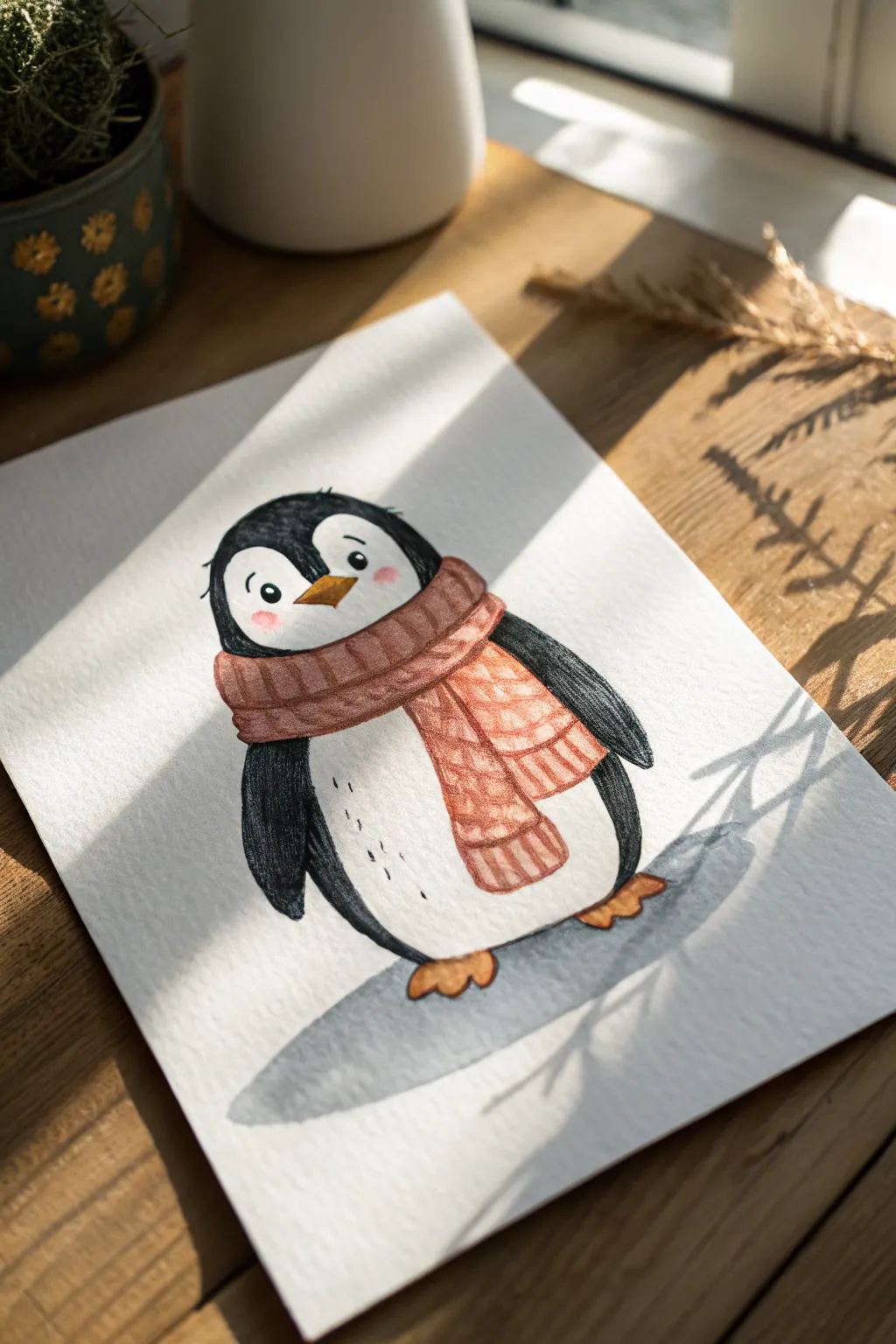
Bundle up for watercolor fun with this adorable penguin sporting a thick, warm scarf. This beginner-friendly project uses simple shapes and basic watercolor techniques to create a charming winter character full of personality and warmth.
How-To Guide
Materials
- Cold press watercolor paper (A5 size recommended)
- Pencil (HB) and eraser
- Watercolor paints (Black, Peach/Coral, Orange)
- Round watercolor brushes (size 4 and 8)
- Fine liner pen (Black, waterproof)
- White gouache or gel pen (optional for highlights)
- Jar of water and paper towel
Step 1: Sketching the Basics
-
Outline the head:
Start with a light pencil sketch. Draw a rounded dome shape for the top of the penguin’s head. -
Add the scarf foundation:
Directly below the head, draw a thick, sausage-like oval wrapping around where the neck would be. This will be the main collar of the scarf. -
Draw the body:
Extend two curved lines downward from the scarf to form the oval-shaped body, making sure the bottom is slightly flatter for stability. -
Define the wings:
Sketch two simple flippers on either side of the body. They should curve slightly outward and point down, resting naturally against the sides. -
Complete the scarf:
Draw the hanging part of the scarf draped down the front of the body. Add a fringe detail at the bottom of this section. -
Add facial features:
Draw the distinct heart-shaped hairline on the face. Add two oval eyes and a small, triangular beak right in the center.
Keep it clean
Wait for the black areas to be bone-dry before painting the scarf or beak. Any dampness will cause the black to bleed into your light colors.
Step 2: Applying Watercolor
-
Paint the black areas:
Using your black watercolor, carefully fill in the head (avoiding the white face area) and the outer edges of the wings. Keep the paint fairly saturated for a deep, rich tone. -
Soften the belly:
For the body, paint the sides black but dilute your paint significantly with water as you move toward the center, or leave the belly mostly white paper to suggest roundness. -
Paint the scarf base:
Mix a warm peach or coral color. Fill in the entire scarf area with a wash of this color. It’s okay if it looks a bit flat for now; we will add texture later. -
Add the feet and beak:
Use a bright orange specifically for the triangular beak and the two small feet peaking out at the bottom. Let this layer dry completely. -
Adding scarf shadows:
Once the first scarf layer is dry, mix a slightly darker, more concentrated version of your peach color. Paint stripes or small knit-like patterns to give the scarf texture. -
Rosy cheeks:
Take a very watery pale pink or red. Gently dab two small circles on the penguin’s cheeks, right under the eyes, for a blushing effect. -
Create the shadow:
Mix a very watery grey or cool blue. Paint an oval shadow on the ground beneath the penguin, stretching slightly to the left to match the light source.
Step 3: Refining Details
-
Inking the eyes:
Using a fine liner or very tip of a small brush with concentrated black, fill in the eyes, leaving a tiny speck of white paper for a sparkle. -
Enhancing textures:
I like to use a colored pencil or a dry brush technique here to add vertical ribbing lines to the scarf, making it look extra woolly. -
Belly details:
With a fine pen or very light pencil, add tiny dashes on the white belly feathers to suggest fluff and direction. -
Final observation:
Check your edges. If the black paint dried a bit too light, you can add a second layer to the darkest parts of the wings for contrast.
Snowy Scene
Splatter white gouache or acrylic paint lightly over the finished painting using a toothbrush to create a falling snow effect.
Now your little penguin is ready to waddle off the page and warm someone’s heart
BRUSH GUIDE
The Right Brush for Every Stroke
From clean lines to bold texture — master brush choice, stroke control, and essential techniques.
Explore the Full Guide
Frog With a Big Grin
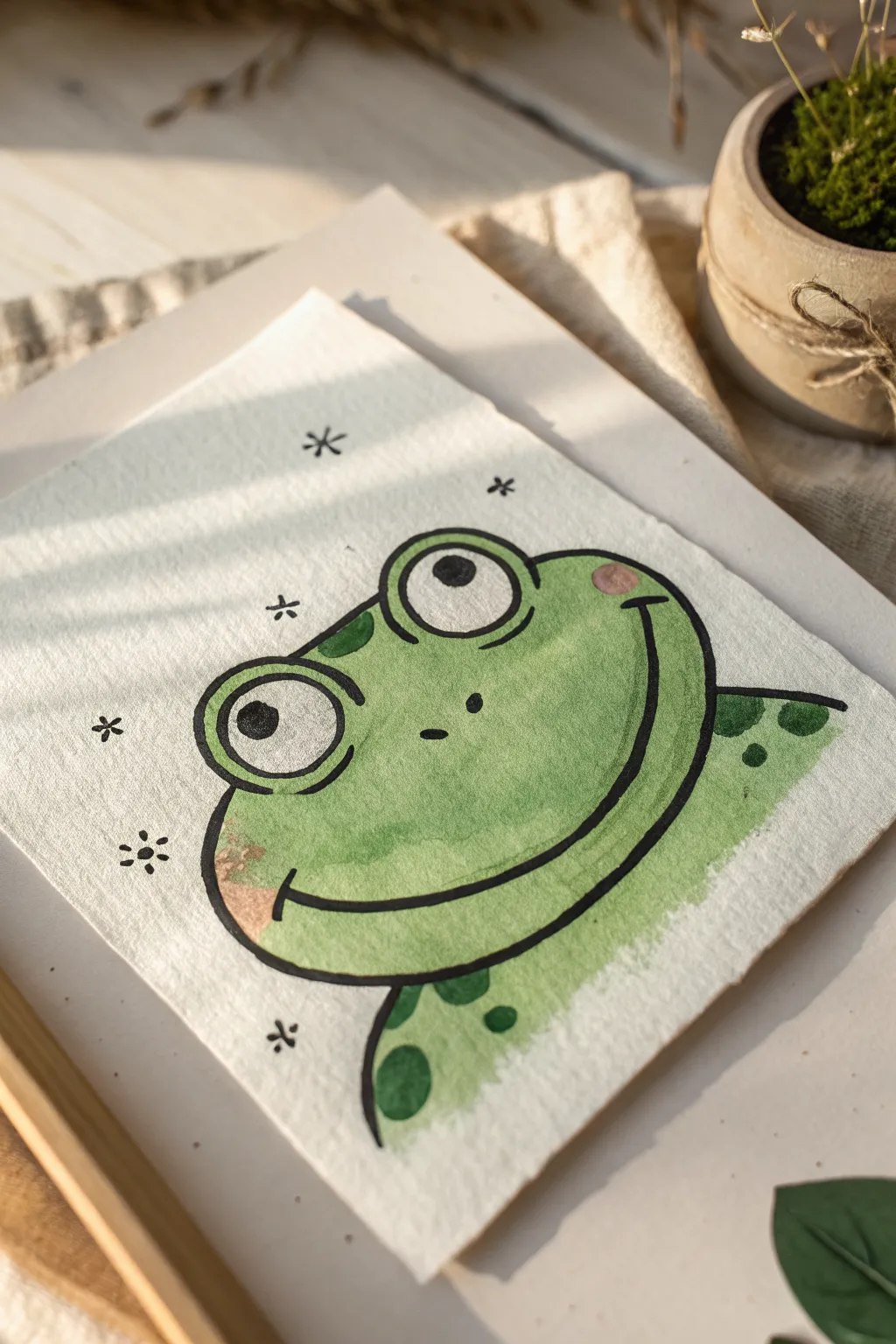
Capture pure joy with this delightful watercolor painting of a frog sporting an impossibly wide smile. The soft washes of green and distinct ink outlines give it a charming, storybook illustration quality that brightens any room.
Step-by-Step Guide
Materials
- Cold press watercolor paper (approx. 300 gsm)
- Watercolor paints (Sap Green, darker Forest Green, light Pink)
- Round watercolor brush (size 6 or 8)
- Small round detail brush (size 2)
- Waterproof black fine liner pen (0.5mm or 0.8mm)
- Pencil and eraser
- Clean water
Step 1: Sketching the Outline
-
Map the head shape:
Start by drawing a wide, flattened oval for the frog’s head. It should be wider than it is tall, almost bean-shaped, leaving plenty of room at the bottom for the neck. -
Add the eyes:
Place two large, slightly protruding circles on the top edge of the head. Make the left eye slightly larger and tilted outward for a quirky look. -
Sketch the smile:
Draw a sweeping curve that stretches from cheek to cheek. The smile should dip low and wide, occupying the bottom third of the face oval. -
Draw the body:
Extend a simple rounded shape downwards from the chin to create the chest and shoulders, hinting at the frog’s upper body. -
Detail the pupils and nose:
Inside the eye circles, draw smaller circles for pupils, glancing upwards or sideways. Add two tiny dots in the center of the face for nostrils.
Smudge Prevention
Is your ink bleeding? Ensure the watercolor is 100% dry. If the paper feels cool to the touch, it’s still damp inside. Wait 5 more minutes or use a hairdryer.
Step 2: Watercolor Washes
-
Mix your base green:
Dilute Sap Green with plenty of water on your palette to create a light, translucent wash. -
First color layer:
Gently fill the entire head shape with this light green wash. Work wet-on-dry, carefully painting around the whites of the eyes to keep them crisp. -
Paint the body:
Continue the green wash down into the body section. You can let the paint fade slightly at the bottom edge for an artistic, unfinished look. -
Add depth while wet:
While the green paint is still damp, dab a slightly more concentrated mix of green along the bottom curve of the chin to create a subtle shadow. -
Rosy cheeks:
Mix a very watery pale pink. While the green is drying but not soaking wet, touch a small drop onto the upper right cheek area for a soft blush effect. -
Let it dry completely:
Allow the paper to dry fully. If you touch it and it feels cool, it needs more time.
Make It Pop
Add a tiny dot of white gouache or a gel pen highlight to the pupils and the ‘wet’ part of the nose after inking to make the expression look lively and bright.
Step 3: Details & Inking
-
Add spots:
Using your smaller brush and the darker Forest Green, paint a few organic oval spots on the frog’s forehead and shoulders. I tend to keep these spots loose rather than perfect circles. -
Outline the eyes:
Once the paint is bone dry, take your black fine liner. Outline the large eye circles first, varying your pressure slightly to give the line character. -
Define the pupils:
Fill in the pupils solid black with the pen, leaving a tiny white speck in each if you want a highlight. -
Trace the main features:
Go over your pencil lines for the head shape and body. Keep the lines confident and continuous rather than sketchy. -
The big smile:
Draw the long, curved smile line. At the ends of the mouth, add tiny vertical ticks to emphasize the cheek muscles. -
Finishing embellishments:
Draw simple asterisks or star shapes floating in the background around the frog’s head to add a whimsical touch.
Now you have a cheerful amphibian friend ready to bring a smile to anyone who sees your sketchbook
One-Eyed Friendly Monster
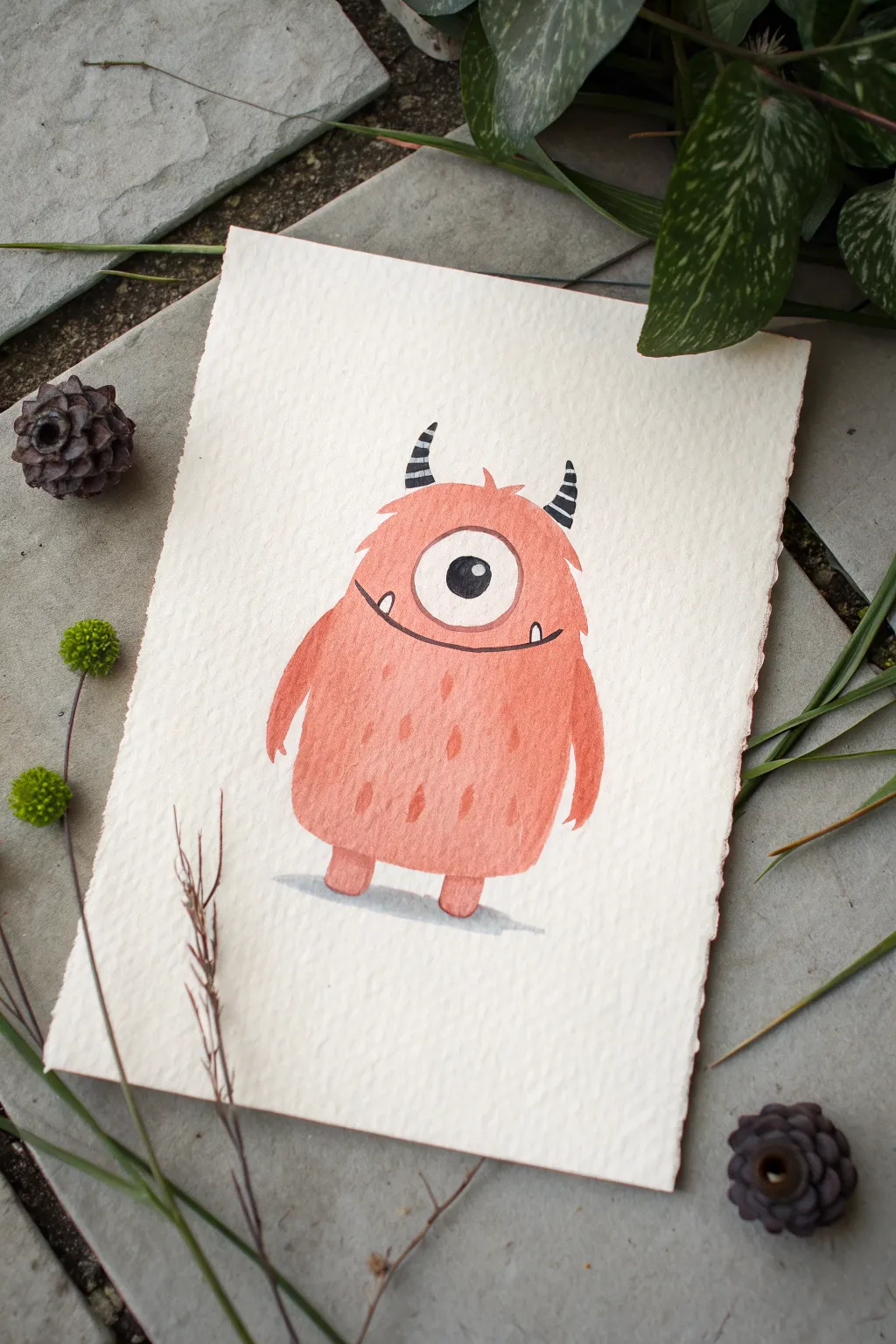
This charming, one-eyed monster combines soft watercolor washes with crisp ink details to create a character that pops off the page. The textured paper adds a lovely organic feel, making the little guy look even fuzzier.
Step-by-Step
Materials
- Cold press watercolor paper (with visible texture)
- Watercolor paints (burnt orange, black, grey)
- Round watercolor brush (size 6 or 8)
- Fine liner brush or black waterproof pen (0.5mm)
- Pencil and eraser
- Clean water and paper towel
- White opacity paint or white gel pen (optional)
Step 1: Sketching the Shape
-
Outline the body:
Start by lightly sketching a large, rounded egg shape for the monster’s body. Let the bottom be slightly flatter where the feet will go. -
Add sensory details:
Draw a large circle near the top center for the single eye. Inside that, draw a smaller circle for the pupil, leaving a tiny spot for the highlight. -
Horns and limbs:
Sketch two small, curved horns pointing inward at the top of the head. Add simple, dangling arms on either side and two small, stump-like feet at the bottom. -
Face refinement:
Draw a wide, U-shaped smile just under the eye. Add two small, triangular teeth peaking up from the bottom lip.
Fixing messy edges
If you accidentally paint into the white eye area, wait for it to dry completely. Then, use white gouache or a white gel pen to cover the mistake and restore the bright crisp shape.
Step 2: Painting the Base Layer
-
Mix your monster color:
Prepare a watery mix of burnt orange or a soft red-orange. You want this to be somewhat transparent to let the paper texture shine through. -
Paint around the eye:
With your round brush, fill in the body shape with the orange wash. Be very careful to paint around the large eye, keeping the paper white. -
Fill the limbs:
Continue the wash into the arms and feet. If the paint pools too much, lift the excess with a clean, damp brush. -
First dry:
Let this base layer dry completely. The paper should feel cool but dry to the touch before moving on.
Give him personality
Change the expression easily by moving the pupil. Looking up makes him contemplative; looking sideways makes him sneaky. Try adding eyebrows for even more emotion.
Step 3: Adding Texture and Details
-
Create fur texture:
Using a slightly more concentrated mix of the same orange, add small vertical dashes or diamond shapes across the body to suggest fur tufts. -
Horn base:
While the fur dries, carefully paint the horns. You can leave them white for now if you plan to use ink later, or paint them a very pale grey. -
The pupil:
Switch to black paint or a very dark grey. Fill in the pupil of the eye, being extremely careful to preserve the tiny white highlight you sketched earlier. -
Shadowing:
Mix a watery grey wash. Paint a simple oval shadow underneath the monster’s feet to ground him, softening the edges with clean water.
Step 4: Inking and Definition
-
Horn stripes:
Once everything is bone dry, use your black pen or fine brush to paint thick black stripes on the horns. -
Outline the eye:
Draw a clean, thin black line around the outer edge of the main eye circle to define it clearly against the orange fur. -
Mouth and teeth:
Trace the smiling mouth line with black ink. Outline the two little teeth, keeping the insides of the teeth white. -
Final touches:
Add small black tips to the horns if desired, or refine any rough edges on the pupil. I prefer to leave the body outline soft and painted rather than inked.
Now you have a friendly little creature ready to brighten up your sketchbook

PENCIL GUIDE
Understanding Pencil Grades from H to B
From first sketch to finished drawing — learn pencil grades, line control, and shading techniques.
Explore the Full Guide
Mini Robot With a Boxy Body
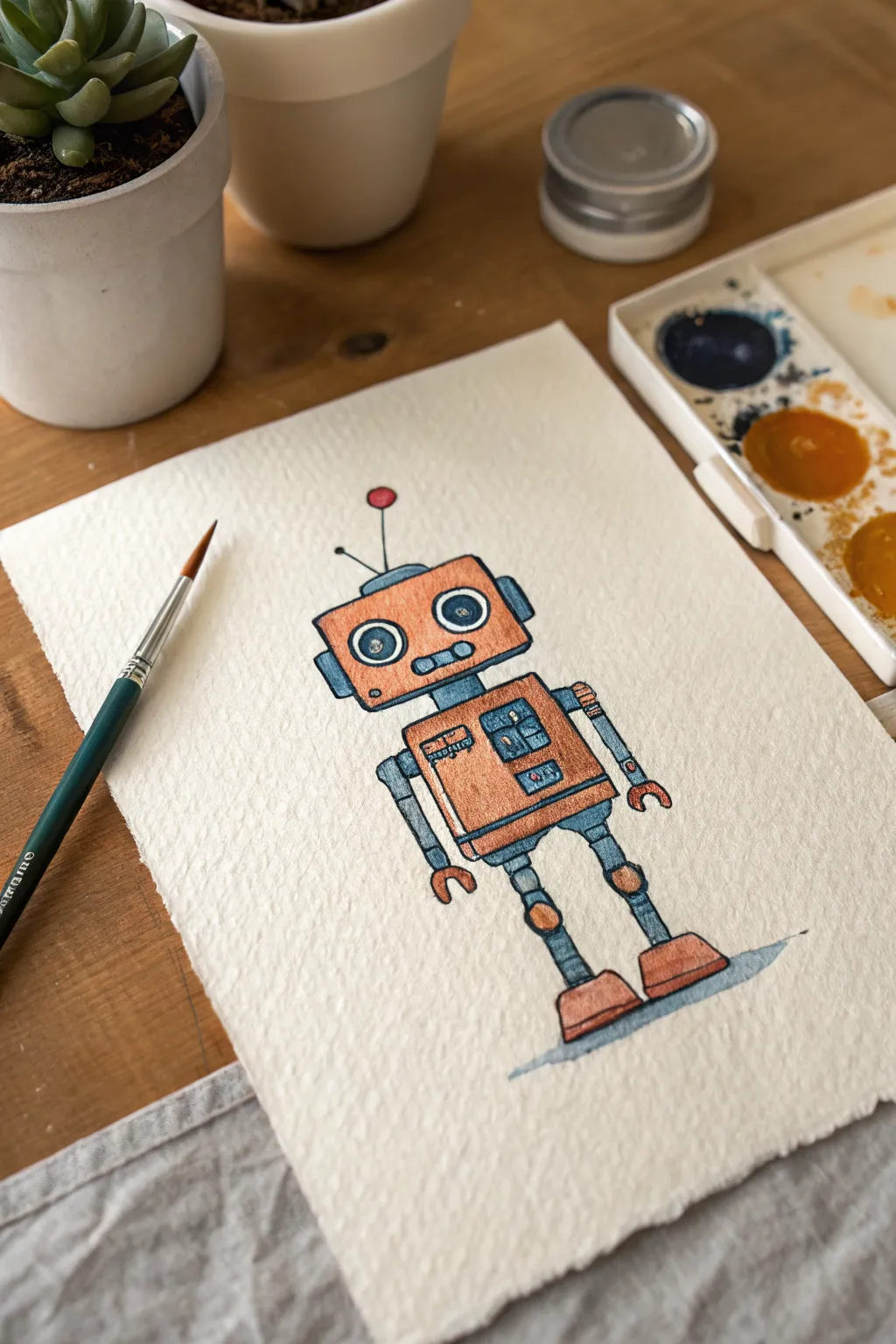
Bring a little mechanical friend to life with this charming watercolor illustration. Featuring a simple geometric design and a warm vintage color palette, this project is perfect for practicing clean lines and even washes.
Detailed Instructions
Materials
- Cold press watercolor paper (textured)
- Pencil (HB or H)
- Fine liner pen (waterproof, black, 0.3mm or 0.5mm)
- Watercolor paints (burnt sienna/orange, indigo/payne’s gray, red)
- Round watercolor brush (size 4 or 6)
- Jar of water
- Paper towel
Step 1: Sketching the Structure
-
Head start:
Begin by lightly sketching a wide rectangle for the robot’s head. Keep your pencil pressure light so the lines don’t show through the paint later. -
Body mechanics:
Draw a square shape slightly smaller than the head directly beneath it to form the torso. Connect the head and body with a small, narrow rectangle for the neck. -
Limbs and joints:
Sketch the arms and legs using segmented rectangles. Think of them as tubes connected by small circles for the elbows and knees. Add simple C-shapes for the claw hands. -
Feet foundations:
Draw trapezoids at the bottom of the legs for the feet, making the base wider than the ankle connection. -
Details and features:
Add two large circles for eyes inside the head and a rectangular mouth. Draw an antenna on top with a small circle at the tip. Sketch a control panel on the chest with a few buttons.
Bleeding Lines?
If your black ink bleeds when you paint over it, your pen might not be waterproof. Always test your pen on a scrap piece of paper with water before starting the main artwork.
Step 2: Inking the Outline
-
Tracing the lines:
Using your waterproof fine liner, carefully go over your pencil sketch. Focus on keeping the lines somewhat loose and organic rather than perfectly ruler-straight to maintain the illustration’s charm. -
Adding texture:
Add tiny hatching lines in the shadowed areas, particularly under the chin and on the sides of the limbs, to suggest depth before painting. -
Clean up:
Wait until the ink is completely dry—I usually give it a full five minutes to be safe—and then gently erase all visible pencil marks.
Make it Metallic
For a futuristic upgrade, mix a tiny bit of silver shimmer watercolor or metallic gouache into your blue-gray paint for the robot’s limbs to give them a real steel sheen.
Step 3: Applying Watercolor
-
Vintage orange wash:
Mix a watery Burnt Sienna or muted orange. Paint the main box of the head and the torso. Let the pigment pool slightly at the edges for a natural watercolor look. -
Extending the warmth:
Use the same orange mix to paint the feet and the small hands. If the color feels too flat, touch a slightly darker orange into the wet paint while it’s still damp. -
Cool contrast:
Mix a watery Indigo or Payne’s Gray (a blue-gray tone). Paint the arms, legs, neck, and the ‘ears’ on the side of the head. -
Small details:
Fill in the control panel on the chest with the blue-gray tone. Carefully paint the mouth area, leaving the ‘teeth’ white if you sketched them, or just filling the strip. -
The eyes:
Paint the outer rings of the eyes with the blue-gray mix. For the pupils, use a more concentrated, darker version of the same color, leaving tiny white spots for highlights. -
Pop of red:
Add a touch of saturated red to the ball of the antenna and one of the buttons on the chest panel to create a focal point.
Step 4: Final Touches
-
Grounding the bot:
Mix a very diluted wash of your blue-gray paint. Add a quick, horizontal puddle of shadow underneath the feet so the robot doesn’t look like it’s floating in space. -
Drying time:
Let the entire piece dry completely. If some areas look too pale, you can glaze a second layer of color over the dry paint to intensify the oranges or blues.
Now you have a quirky little character ready to brighten up your sketchbook
Masked Superhero Bust
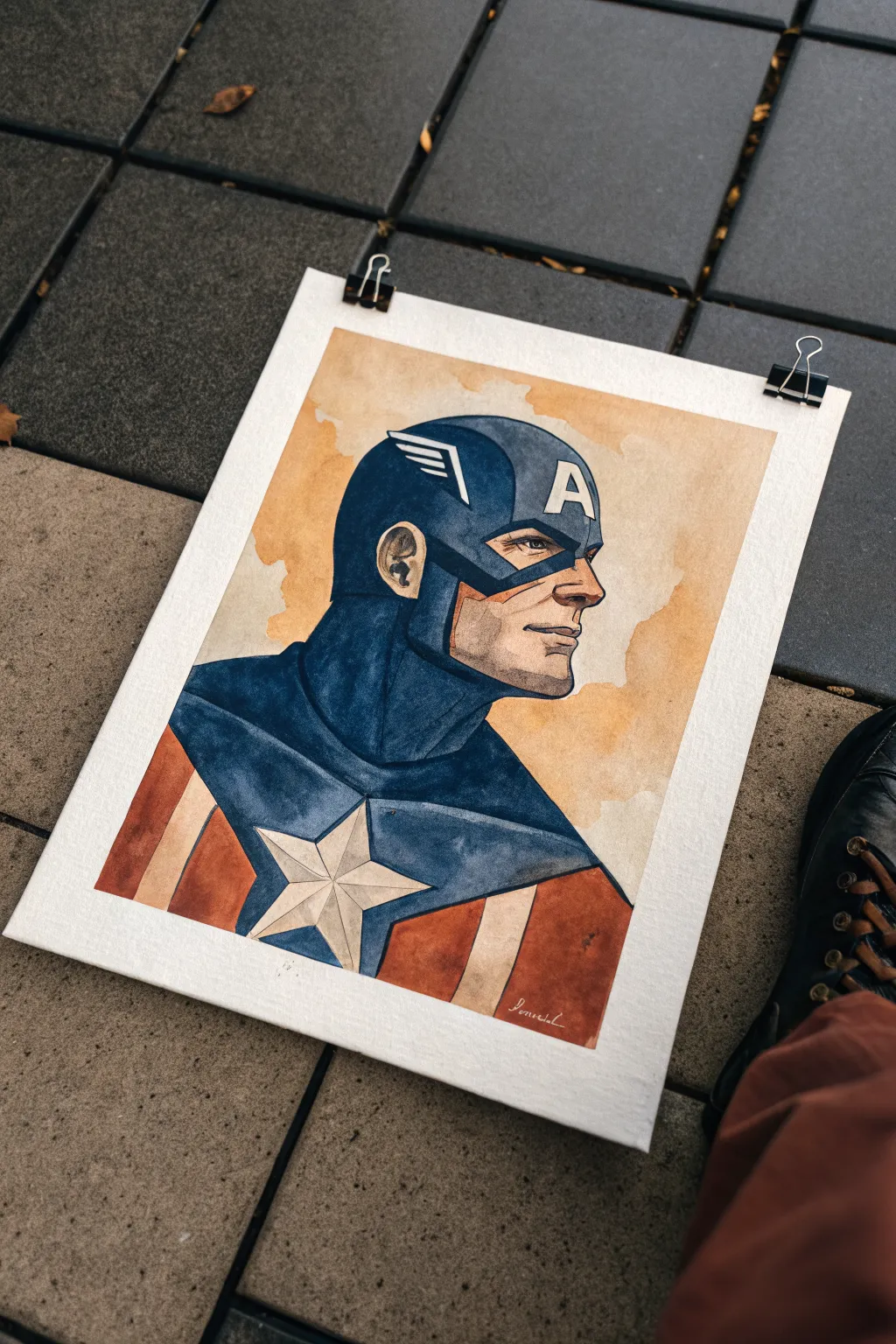
Capture the classic, stoic look of Captain America with this watercolor portrait project. Using a limited palette of blue, red, and warm earth tones, you’ll create a striking profile that balances comic book boldness with painterly textures.
How-To Guide
Materials
- Cold press watercolor paper (approx. 9×12 inches)
- HB pencil for sketching
- Kneaded eraser
- Watercolor paints (Ultramarine Blue, Prussian Blue, Alizarin Crimson, Yellow Ochre, Burnt Sienna)
- White gouache or white gel pen
- Round watercolor brushes (Size 4, 8, and a fine liner)
- Palette for mixing
- Jar of water and paper towels
- Black ink pen or fine liner (optional for outlines)
Step 1: Sketching the Profile
-
Establish the Head Shape:
Start lightly with your pencil. Sketch a basic oval for the head and a strong, squared jawline. Remember, he is facing to the right in profile. -
Define the Features:
Place the ear towards the back of the jaw. Draw the nose profile, lips, and chin. Keep the expression neutral and determined. -
Add the Cowl:
Draw the helmet (cowl) line across the cheek and around the eyes. Don’t forget the ‘A’ on the forehead and the small wing motive above the ear. -
Shoulders and Chest:
Extend the neck down into thick trapezius muscles and broaden out into the shoulders. Sketch the star emblem on the chest and vertical stripes on the midsection. -
Refine and Clean:
Go over your lines to make them definite but not too dark. Use your kneaded eraser to lift off any graphite smudge or heavy initial construction lines.
Bleeding Lines?
If your blue paint bleeds into the skin area, stop immediately. Use a clean, thirsty brush or paper towel to lift the mistake. Let the area bone-dry before re-attempting that edge.
Step 2: Base Layers and Skin Tones
-
Mixing the Skin Tone:
Mix a watery wash of Yellow Ochre and a tiny touch of Alizarin Crimson. Test it on a scrap piece of paper first to ensure it’s a natural flesh tone. -
Painting the Face:
Apply this wash to the exposed face area—the jaw, nose, and mouth. Leave the eyes white for now. Let this layer dry completely. -
Adding Facial Shadows:
Mix a slightly darker skin tone by adding a bit of Burnt Sienna. Paint shadows under the nose, lower lip, and jawline to give the face dimension. -
Background Wash:
I like to tackle the background early to set the mood. Create a very diluted wash of Yellow Ochre and Burnt Sienna. Paint loosely around the head, leaving uneven, cloud-like edges for a vintage vignette effect.
Step 3: The Uniform
-
The Blue Cowl Base:
Mix a rich blue using Prussian Blue and a touch of Ultramarine. Paint the helmet area and the neck/shoulder sections. Carefully paint around the ‘A’, the wings, and the star on the chest. -
Deepening the Blues:
While the blue is still slightly damp in places, drop in cleaner, darker blue pigment into the shadow areas—specifically where the neck meets the jaw and under the collarbone. -
Red Stripes:
Mix Alizarin Crimson with a little Burnt Sienna to get a vintage, less saturated red. Paint the vertical stripes on the lower torso area. -
The White Elements:
The ‘A’, wings, and chest star need to look slightly aged, not blindingly white. Use a very watery wash of Yellow Ochre or dirty water to give them an off-white, fabric look.
Battle Damage
For a grittier look, splatter tiny speckles of brown or grey watercolor over the finished piece using an old toothbrush. It simulates dirt and battle wear.
Step 4: Refining Details
-
Defining the Eyes:
Use a fine brush to paint the eye inside the cowl. Add a tiny pupil and outline the eye shape carefully. A small shadow under the brow ridge adds intensity. -
Shadows on the White:
Using a very diluted grey-blue mix, add subtle geometric shading to the star and the ‘A’ to make them look three-dimensional, like raised patches. -
Enhancing Contrast:
Go back with your darkest blue (almost black) and sharpen the edges of the cowl mask against the skin. This crisp line is crucial for the masked hero look. -
Final Outlines:
If you want a clearer comic book style, use a very fine brush with concentrated dark paint (or a waterproof ink pen) to lightly outline the jaw and key features. -
Highlights:
Finally, use white gouache or a gel pen to add small highlights to the eye and the tip of the nose, bringing the character to life.
Now you have a timeless superhero portrait ready to guard your wall.


Caped Sidekick With a Big Logo
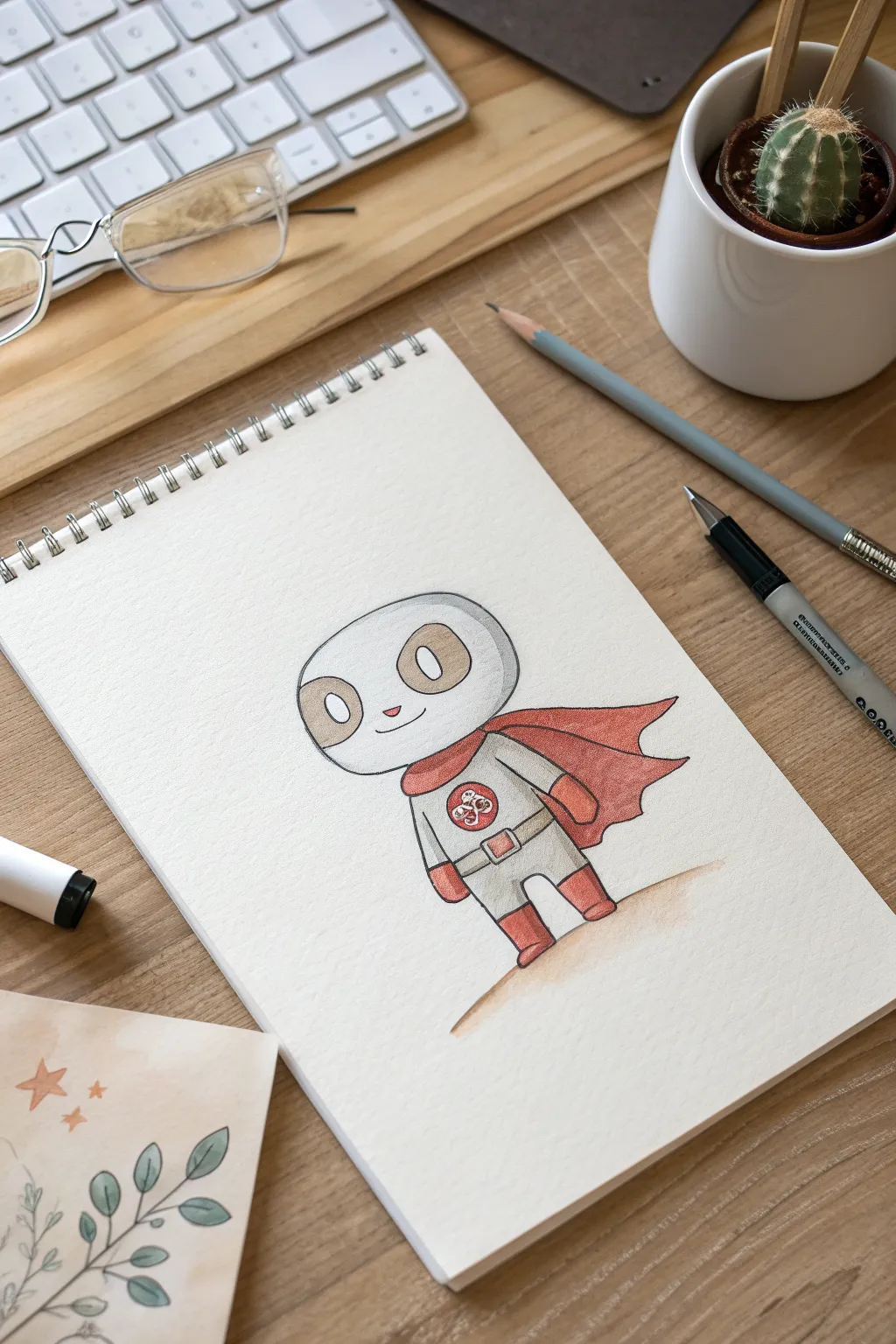
This adorable little superhero features clean lines, soft shading, and a distinctive emblem that pops against a neutral suit. It’s a perfect beginner project for practicing character proportions and simple cape physics.
Step-by-Step
Materials
- Sketchbook or watercolor paper (smooth bristol works well too)
- HB graphite pencil
- Eraser
- Fine-liner pen (black, 0.3mm or 0.5mm)
- Grey marker (light cool grey)
- Red marker or watercolor paint (muted red/terracotta)
- Beige or light tan marker
- White gel pen (optional for highlights)
Step 1: Sketching the Framework
-
Draw the head shape:
Start by drawing a large, rounded rectangular shape for the head. It should be wider than it is tall, almost like a stretched marshmallow, taking up the upper third of your drawing space. -
Add the body block:
Directly beneath the head, sketch a small, simple rectangular body. The body should be significantly smaller than the head to achieve that cute ‘chibi’ proportion. -
Sketch the limbs:
Draw two simple legs extending down, slightly wider at the paws/boots. Add arms hanging by the sides; keep them simple and tube-like, ending in rounded mitten shapes for hands. -
Define facial features:
Inside the head, draw two large oval patches for the eyes, slanted slightly inward. Place small oval eyes inside these patches. Add a tiny nose and a simple curved smile right between the patches. -
Map out the costume:
Draw a belt line across the waist with a rectangular buckle. Sketch the lines for the boots and gloves. Draw a circle in the center of the chest for the logo. -
Draft the cape:
Sketch the cape flowing out to the right. Use wavy lines to suggest fabric movement—one line curving up from the shoulder and another swooping down behind the legs.
Keep it Clean
Place a scrap piece of paper under your hand while drawing. This prevents oils from your skin transferring to the paper and greying your crisp pencil lines.
Step 2: Inking the Lines
-
Outline the main form:
Take your fine-liner pen and carefully trace over your pencil sketch. I prefer to use confident, continuous strokes for the head to keep it smooth. -
Detail the costume:
Ink the belt, gloves, and boots. Be careful not to ink through the cape where it overlaps the body. -
Draw the logo:
Carefully ink the circle on the chest. Inside, draw a squiggly, abstract symbol contrasting with the background circle. -
Refine the face:
Ink the eye patches, nose, and mouth. Do not ink the pupils black yet; we’ll color them later, but you can outline them. -
Erase pencil marks:
Wait a moment for the ink to dry completely, then gently erase all the underlying graphite lines to leave a clean black-and-white drawing.
Make it Yours
Personalize the chest emblem! Instead of the swirl, try drawing your own initial, a lightning bolt, or a tiny star to give your sidekick a unique power.
Step 3: Adding Color & Depth
-
Color the suit base:
Use your light grey marker to fill in the main body of the suit and the head. Leave the eye patches and the face mask area white (or very light grey) for contrast. -
Fill the eye patches:
Use a beige or light tan marker to color the large oval patches around the eyes. This gives the character its distinct animal-like appearance. -
Paint the red accents:
Take your muted red marker. Fill in the cape, the gloves, the boots, and the circular background of the chest logo. -
Add shading to the cape:
Go over the folds of the cape a second time with the same red marker. This layers the ink to create a darker tone, adding depth to the fabric ripples. -
Detail the logo:
If you have a fine white pen, you can clean up the symbol inside the red circle, or simply leave the paper white in that area carefully while coloring. -
Ground the character:
Use the beige or light brown marker to draw a simple horizon line under the feet, scribbling lightly to create a shadow and ground texture.
Now your little hero is ready to save the day, one sketchbook page at a time
Sweet Little Alien With Antennas
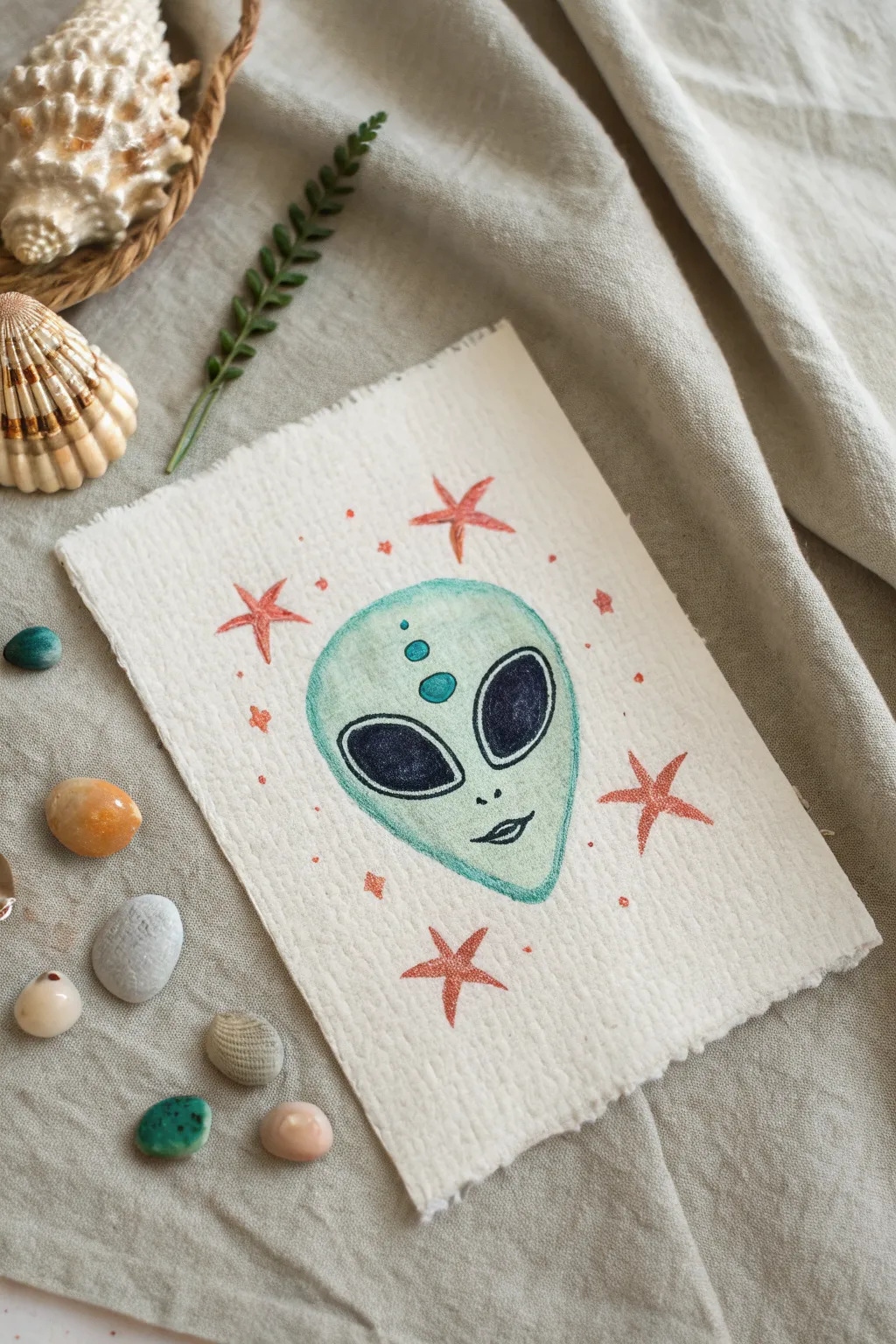
This charming project features a stylized alien portrait surrounded by sea stars on handmade paper. With soft teal shading and bold, starry outlines, it’s a perfect blend of spooky and sweet.
Step-by-Step
Materials
- Textured handmade paper (deckle edge)
- Pencil (HB or lighter)
- Watercolor paints (teal/mint green, reddish-orange, black)
- Fine liner or drawing pen (black)
- Small round paintbrushes (size 0 and 2)
- Water cup and paper towels
- Eraser
Step 1: Sketching the Outline
-
Form the head shape:
Start by lightly sketching an inverted teardrop shape near the center of your paper. Make the top dome wide and round, tapering down to a narrow, slightly pointed chin. -
Add facial features:
Draw two large, slanted oval shapes for the eyes, positioning them low on the face. Keep a wide space between them for the nose area. -
Detail the face:
Add two tiny dots for nostrils and a small, delicate mouth just below. Above the eyes, sketch three vertical circles ascending in size up the forehead. -
Sketch the surroundings:
Lightly draw four simple starfish shapes around the head—two above and two below. Add a few tiny circles or stars scattered in the background for extra detail.
Step 2: Painting the Base Layers
-
Wash the skin:
Mix a watery mint green or pale teal watercolor. Using your larger brush, fill in the entire face shape, working carefully around the eyes and forehead circles. -
Add first shadows:
While the green is still slightly damp, drop a tiny bit of darker teal along the left edge of the head and the right cheek to create soft dimension. -
Fill the forehead details:
Paint the three circles on the forehead with a slightly darker, more saturated teal than the skin tone to make them pop. -
Paint the eyes:
Switch to your smaller brush and carefully fill the large eye ovals with solid black watercolor or ink. Leave them fully opaque. -
Color the starfish:
Mix a soft reddish-orange or coral color. Paint the four starfish shapes, keeping the edges slightly loose and organic.
Uneven Wash?
If your green watercolor dries with hard edges or ‘blooms,’ wet the area slightly with a clean damp brush and gently smooth out the pigment.
Step 3: Adding Details and Texture
-
Outline the face:
Once the paint is completely dry, use a fine tip black pen or very dry brush to trace the outline of the head. Keep the line varied—sometimes thick, sometimes thin. -
Define the eyes:
Outline the black eye shapes with your pen. Add a second, thinner line inside the large ovals to create a rim effect. -
Add facial details:
Darken the nostrils and outline the lips with the fine liner, adding a tiny shadow beneath the lower lip. -
Detail the forehead:
Outline the three teal circles on the forehead. Add tiny stippling dots inside them for texture. -
Highlight the eyes:
If you have white gouache or a gel pen, add a very subtle reflection dot or speckled texture inside the black eyes to make them look glossy.
Cosmic Sparkle
Use metallic gold or silver watercolor for the forehead dots and background stars to give your alien an intergalactic shimmer.
Step 4: Bringing the Background to Life
-
Texture the skin:
Using a very dry brush or a colored pencil, add faint stippling or tiny dots across the green skin to mimic the texture of the drawing shown. -
Add background stars:
Use your orange/coral paint to add tiny dots and small star shapes scattered between the main starfish. -
Final touches:
Review your lines. If any starfish need more definition, lightly outline them with the orange paint or a colored pencil, but keep them softer than the face.
Now you have a cute cosmic friend ready to frame or gift
Mermaid With a Simple Tail Silhouette
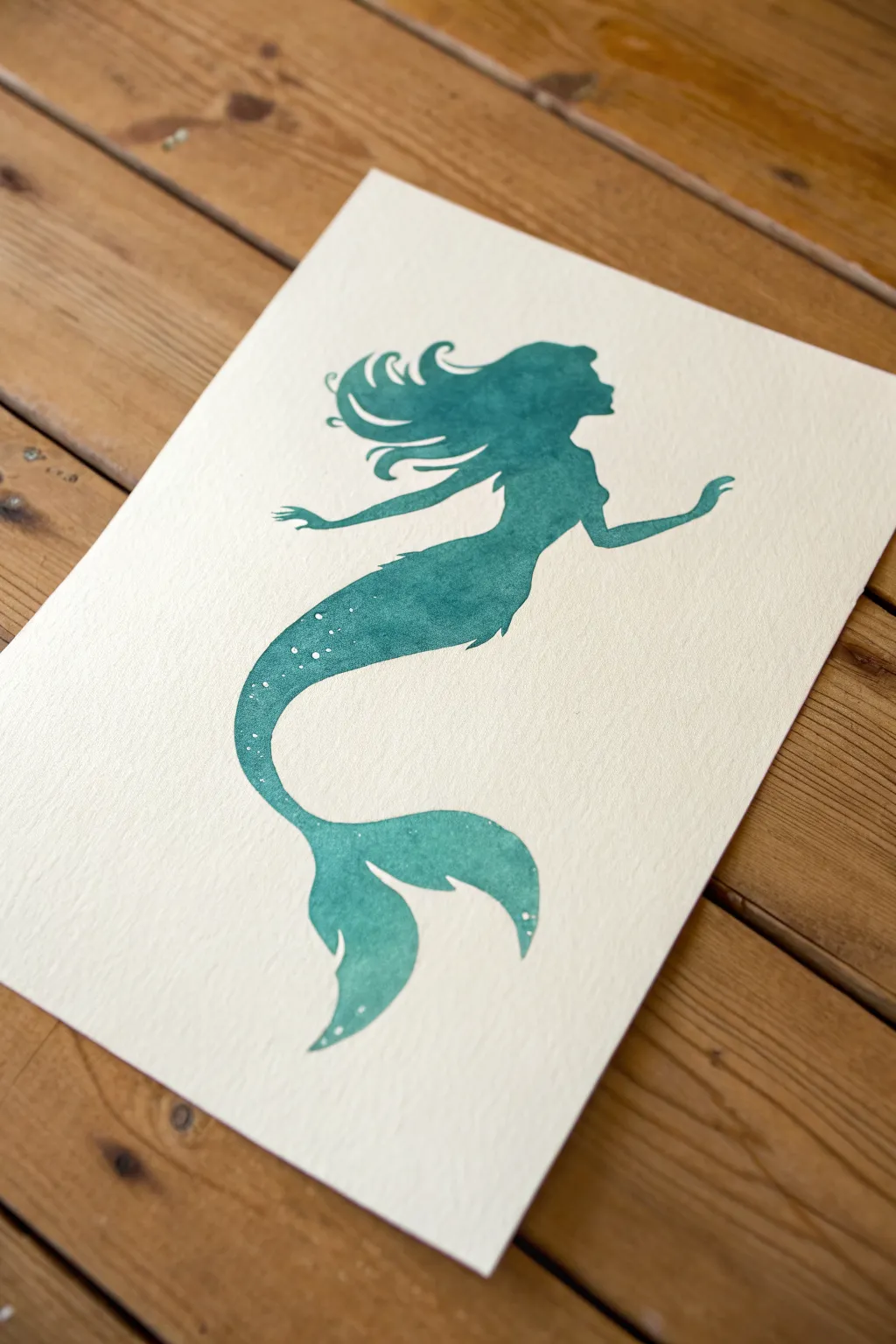
Capture the fluid grace of the ocean with this elegant watercolor silhouette featuring a swimming mermaid. The striking teal hue and delicate starry details create a dreamy, monochromatic look that pops beautifully against textured paper.
How-To Guide
Materials
- Cold press watercolor paper (300 gsm)
- Teal or turquoise watercolor paint
- Pencil (HB or H)
- Clean eraser
- Round watercolor brush (size 4 or 6)
- Fine detail brush (size 0 or 1)
- White gouache or white ink
- Old toothbrush (optional)
- Paper towels
- Two jars of water
Step 1: Preparation & Sketching
-
Paper selection:
Choose a high-quality cold press watercolor paper. The textured surface adds character to the silhouette and helps hold the pigment evenly. -
Outline the head and torso:
Lightly sketch the profile of the mermaid’s face, neck, and torso using an HB pencil. Keep your lines very faint so they won’t show through the translucent watercolor later. -
sketch the hair:
Draw the flowing hair sweeping backward as if she is swimming forward. Focus on the main shapes of the locks rather than individual strands. -
Form the arms:
Sketch the arms extended gracefully. One arm should reach forward and slighty down, while the other extends backward consistent with a swimming motion. -
Draw the tail curve:
Create a long, sweeping ‘S’ curve for the tail. Start wide at the hips and taper it down gradually before extending into the fluke (fin). -
Refine the silhouette:
Go over your sketch one last time to ensure the proportions look natural. Gently erase any stray sketch marks, leaving only the faintest guide for your paint.
Step 2: Painting the Silhouette
-
Prepare the paint:
Mix a generous amount of teal watercolor. Aim for a milky consistency—not too watery, but fluid enough to glide smoothly. -
Start with the head:
Using your smaller round brush, carefully fill in the face profile. Take your time here, as the profile shape determines the character. -
Fill the hair:
Switch to a slightly larger brush if comfortable, and fill in the hair shape. Use the tip of the brush to keep the ends of the hair sharp and tapered. -
Paint the torso:
Work your way down the neck and into the torso. Try to maintain a ‘wet edge’ where you are painting so you don’t get unwanted drying lines in the middle of the body. -
Extend to the arms:
Carefully paint the slender arms. I suggest switching back to the detail brush for the fingers to ensure they look elegant and not blotchy. -
Flood the tail:
Load your larger brush with plenty of teal pigment and fill the large curve of the tail. Allow the color to pool slightly in some areas to create natural variations in density. -
Finish the fin:
Paint the flukes of the tail, ensuring the points remain crisp. While the tail is still damp, you can drop in a tiny bit more concentrated pigment near the bottom for a subtle gradient.
Uneven Drying?
If you get hard edges inside the body (cauliflowers), you likely let an edge dry too fast. Keep the leading edge of your paint wet as you work from head to tail.
Step 3: Finishing Details
-
Add texture effects:
While the tail paint is still just barely damp (not soaking wet), lightly tap a clean, damp brush against the paper to lift tiny spots of color, creating a mottled texture. -
Let it dry completey:
Allow the entire silhouette to dry completely. If the paper feels cool to the touch, it is still wet deep down. -
Apply white speckles:
Dip a fine brush or an old toothbrush into white gouache. Gently flick or tap it over the tail area to create the ‘magical dust’ or bubble effect shown in the tail. -
Clean up edges:
If any paint went outside your lines, use a damp, clean brush to gently scrub the mistake and blot it with a paper towel.
Make It Sparkle
For a magical touch, mix a pinch of mica powder or iridescent medium into your teal paint before applying, giving the mermaid a subtle shimmer.
Now step back and admire the simple fluidity of your underwater creation
Food Character With a Cute Face
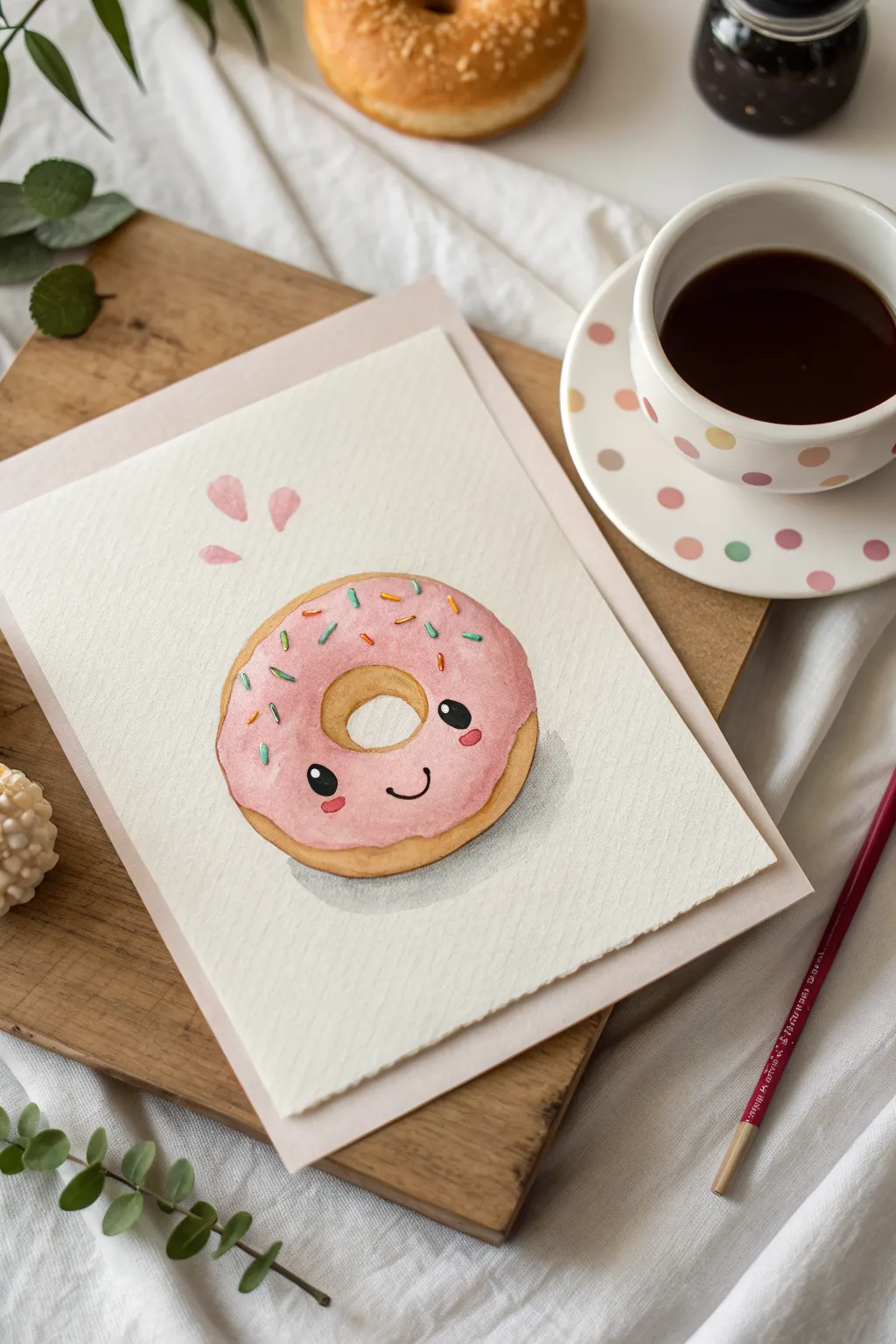
Capture the sweetness of breakfast with this adorable watercolor painting of a blushing, pink-frosted donut. The combination of simple shapes, soft washes, and a cute kawaii face makes this a perfect project for beginners looking to practice wet-on-dry techniques.
Step-by-Step Tutorial
Materials
- Watercolor paper (cold press recommended for texture)
- Pencil (HB or H for light lines)
- Kneaded eraser
- Watercolor paints (Pink, Yellow Ochre or Raw Sienna, Burnt Umber, Black)
- Round brushes (Size 4 or 6 for filling, Size 0 or 00 for details)
- White gel pen (optional for highlights)
- Cup of water and paper towels
Step 1: Sketching the Shape
-
Draw the outer circle:
Start by lightly sketching a large circle in the center of your paper. It doesn’t need to be perfectly round; a slightly organic shape looks more like real dough. -
Add the inner hole:
Draw a smaller circle in the middle for the donut hole. Make it slightly off-center if you want a fun, tilted perspective. -
Outline the frosting:
Sketch a wavy, irregular line inside the outer circle to define where the frosting sits. Let it dip and curve to mimic how glaze pours over a pastry. -
Position the face:
Mark two small ovals for eyes on the lower half of the frosting area. Add a tiny ‘u’ shape between them for the smile. -
Clean up sketch lines:
Gently roll your kneaded eraser over the sketch. You want the graphite lines to be barely visible so they don’t show through the translucent watercolor.
Muddy Colors?
If your pink frosting looks dirty near the dough color, you likely didn’t wait for the tan layer to dry fully. Always ensure one section is dry to the touch before painting an adjacent color.
Step 2: Painting the Dough
-
Mix the dough color:
Create a golden-brown hue by mixing Yellow Ochre with a tiny touch of Burnt Umber. Dilute it with water until it’s a light, warm tan. -
Paint the outer edge:
Using a size 4 or 6 brush, carefully paint the strip of dough visible below the wavy frosting line. -
Fill the inner hole:
Paint the small circle inside the donut hole with the same tan mixture. -
Add dough shading:
While the paint is still slightly damp, add a concentrated drop of Burnt Umber to the bottom-most edge of the donut and the inner shadow of the hole to create volume. -
Wait for drying:
Let these dough sections dry completely. If you paint the frosting now, the colors might bleed into the wet tan paint.
Glazed Look
Once the pink paint is fully dry, use a white gel pen or gouache to add a curved highlights line on the top curve of the frosting. It makes the donut look shiny and freshly glazed.
Step 3: Adding the Frosting
-
Prepare the pink wash:
Mix a vibrant pink or rose watercolor with plenty of water. You want a soft, even wash, not a thick opaque layer. -
Fill the frosting area:
Carefully paint the entire frosting section, working around the eye ovals if you plan to keep the paper white for highlights (or you can paint over them and use opaque black later). -
Create frosting texture:
While the pink layer is wet, you can drop in slightly darker pink pigment near the bottom edge and cheeks to give the frosting a rounded, 3D look. -
Paint the blushing cheeks:
I prefer to add two small ovals of slightly more concentrated pink right below the eyes while the main wash is still damp, creating a soft, diffused blush effect. -
Let it dry completely:
Ensure the pink area is bone dry before moving to the next steps to prevent the details from fuzzying.
Step 4: Details & Features
-
Paint the eyes:
Using a small size 0 detail brush and concentrated black paint (or ink), fill in the eye ovals. Leave tiny speck of white paper for the sparkle, or add it later with white gel pen. -
Inking the smile:
With the very tip of your detail brush, paint the thin, curved smile line in black or dark brown. -
Adding sprinkles:
Mix small amounts of contrasting colors like blue, yellow, and orange. Paint tiny dashes scattered randomly across the pink surface for sprinkles. -
Cast shadow:
Mix a very watery, cool grey. Paint a crescent shape underneath the donut to ground it on the page. -
Decorative splashes:
For a playful touch, add three small petal-like splashes of pink floating above the donut to suggest sweetness or scent.
Now you have a charming little pastry character that looks good enough to eat
Split-Face Transformation Character
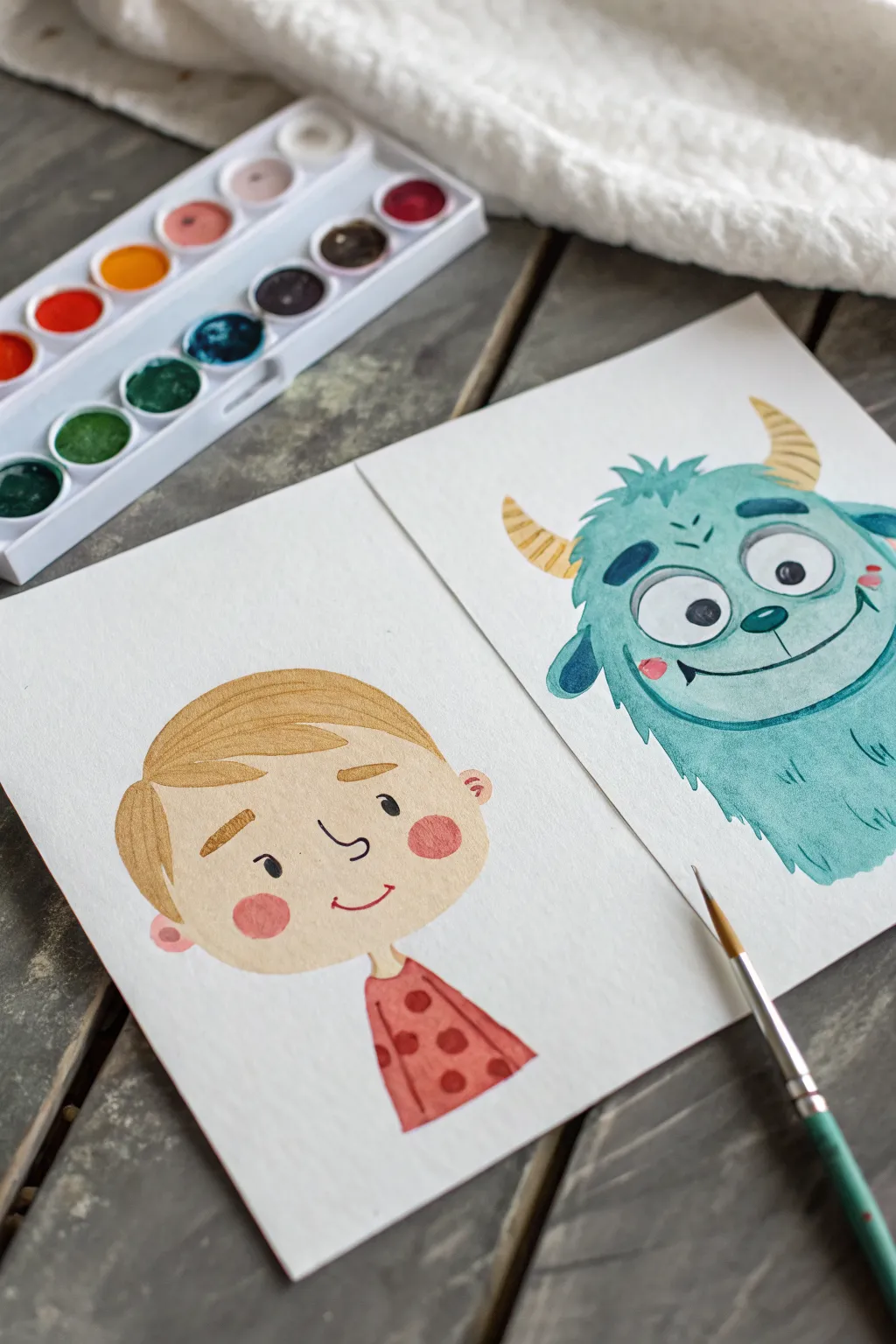
Create a charming pair of portraits featuring a gentle human character and their friendly monster counterpart. This watercolor project uses simple shapes and layering techniques to bring two distinct personalities to life on paper.
Step-by-Step Tutorial
Materials
- Watercolor paper (cold press, roughly 140lb)
- Watercolor paint set (pan set shown)
- Round watercolor brushes (size 2 and size 6)
- Pencil for sketching
- Eraser
- Jar of clean water
- Paper towel
Step 1: Sketching the Characters
-
Outline the boy’s head:
Start on the left side of your paper. Lightly sketch a rounded oval shape for the boy’s head, keeping the lines very faint. -
Add facial features:
Draw simple C-curves for ears on either side. Inside the face, mark positions for wide set eyes, a small triangular nose, and a simple curved smile. -
Sketch the hair and body:
Add a sweeping line across the forehead for bangs and outline the hair shape. Below the head, draw a narrow neck and a trapezoidal shape for the shirt. -
Outline the monster:
On the right side, sketch a larger, rougher oval for the monster. Make the top slightly pointed or tufted. -
Detail the monster’s face:
Draw large, expressive eyes and a wide, friendly grin. Add two curved horns at the top and small ears on the sides.
Fixing Bleeds
If paint bleeds outside your sketch lines, quickly blot it with a clean, dry tissue. Then, wet the area slightly with clean water and blot again to lift the pigment.
Step 2: Painting the Human Character
-
Base skin tone:
Mix a very watery pale peach or beige. Using your larger brush, fill in the face and neck area, carefully painting around the eyes. Let this layer dry completely. -
Hair base layer:
Mix a light brown or sandy yellow paint. Fill in the hair shape with a wash of this color. -
Adding hair texture:
Once the base hair layer is dry, mix a slightly darker brown. Use your smaller brush to paint thin, curved lines effectively creating individual strands and texture. -
Painting the shirt:
Choose a warm red or rust color for the shirt. Paint the main shape, then wait for it to dry before adding darker red dots for a pattern. -
Facial details:
Using a very fine brush and dark brown or black, carefully paint the eyes, eyebrows, nose, and mouth. Dilute some red paint to add soft, rosy circles for cheeks.
Dynamic Background
Paint two different background colors behind each character—maybe a soft yellow behind the boy and a light purple behind the monster—to emphasize their different worlds.
Step 3: Painting the Monster
-
Monster base coat:
Mix a teal or turquoise color with plenty of water. Paint the entire face shape of the monster, leaving the eyes and horns white. -
Creating fur texture:
While the paint is still wet, you can dab a little more pigment in certain areas for variation. Once dry, use a slightly darker teal to paint small ‘V’ shapes or tufts around the edges to suggest fur. -
Painting the horns:
Use a yellow ochre or gold color for the horns. Once dry, add thin brown lines across them for texture. -
Monster eyes and mouth:
Fill the eye shapes with white (or leave the paper white) and carefully outline them in dark grey or black. Add pupils and paint the wide smile line. -
Final touches:
Add pink spots to the monster’s cheeks for a friendly look. Check both characters for any needed touch-ups or strengthened outlines.
You now have a delightful pair of portraits ready to frame or give as a gift
Have a question or want to share your own experience? I'd love to hear from you in the comments below!